Lead Analysis
Infosys pushes AI to 10.5% of revenue in Q2 -- but guidance cut flags deep AI-led deflation
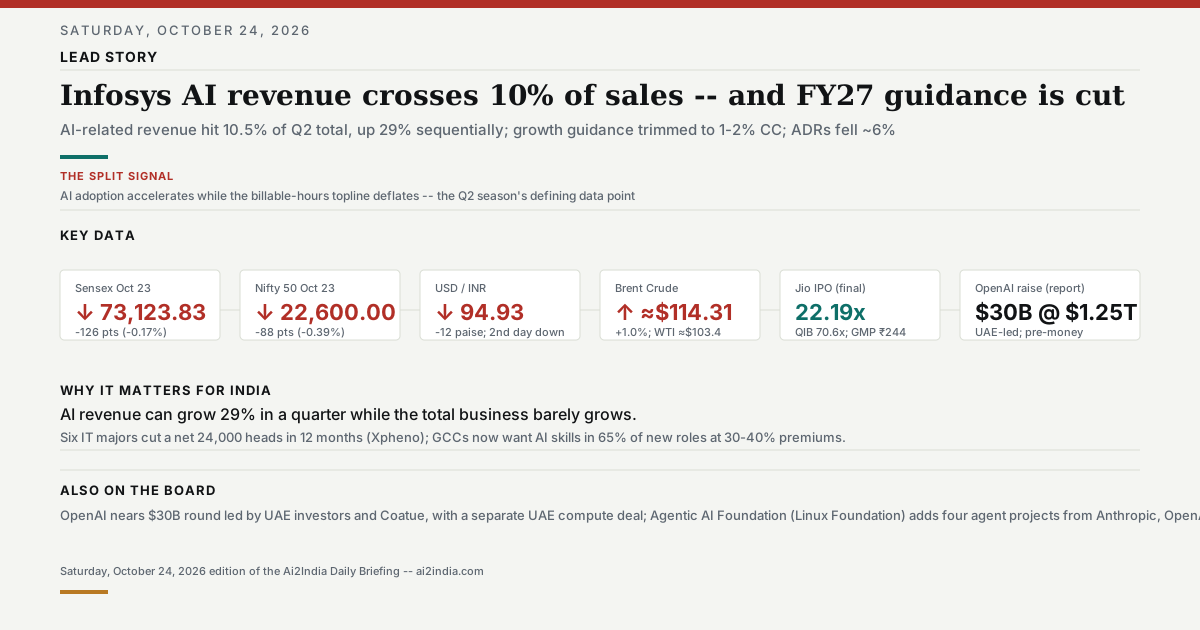
Saturday, October 24, 2026: Infosys reported Q2 FY27 results on October 23, delivering $5,145 million in revenue with AI-related income rising 29 per cent quarter-on-quarter to hit 10.5 per cent of the total. Yet the company cut FY27 constant-currency growth guidance to 1-2 per cent -- down from its prior 1.5-3 per cent range. Adrads fell more than 6 per cent after hours.
Quarterly revenue grew just 1.2 per cent sequentially; operating margin stable at 21.0 per cent. Large deal TCV reached $5.2 billion including a single mega-deal exceeding $2 billion with 62 per cent net new. Free cash flow declined 15.7 per cent to $928 million despite interim dividend rising 13 per cent to ₹26 per share. The split between AI growth and topline stagnation is the clearest signal yet that billable-hours economics are being repriced.
The numbers present a compound story that resolves what the Q2 season had left ambiguous. Across the top-5 Indian IT majors -- HCLTech, TechM, Wipro, TCS, and now Infosys -- AI revenue is growing at double-digit pace quarter on quarter while aggregate revenue barely moves. HCLTech delivered $219 million in advanced AI services in Q2 (annualised run-rate ≈$876 million). Tech Mahindra posted profit growth of +32.7 per cent -- the strongest among large-cap peers. Wipro reported profit decline of -1.4 per cent. TCS booked $3.1 billion in annualised AI revenue. Now Infosys: AI at 10.5 per cent of revenue, up from 8.2 per cent in Q1, growing 29 per cent sequentially -- the fastest acceleration seen so far. But total revenue grew only 1.5 per cent year-on-year (1.2 per cent constant-currency sequential) and FY27 guidance was trimmed. That gap is the signal: AI budgets grow fast because clients invest in capability-building, but unit economics compress because automation reduces the billable-hours that traditional delivery models price.
CFO Jayesh Sanghrajka confirmed margin stability at 21.0 per cent through cost discipline and operational efficiency measures while continuing required investments in AI capabilities. Free cash flow conversion was strong at 113.3 per cent of net profit, underscoring financial health even as absolute FCF declined. Salil Parekh, CEO and Managing Director, framed the result positively: "We had strong large deals of $5.2 billion, including a mega deal of over $2 billion, reinforcing our position as a trusted partner in the marketplace when clients embark on large and complex transformation programs. Our AI revenue was at 10.5 per cent and grew 29 per cent quarter-on-quarter. As enterprises move to AI adoption at scale, the strong growth in AI revenues is a recognition of our differentiated market positioning." Yet the guidance trim reveals the tension beneath: outcome-based pricing transitions combined with automation-driven labour arbitrage compression mean that even as AI-revenue grows, total-revenue trajectories soften.
This quarter resolves one of the central questions running through the Q2 season: can AI revenue meaningfully scale without lifting the overall P&L? The answer from Infosys is yes-and-no simultaneously. AI revenue at 10.5 per cent -- up nearly three percentage points from Q1's 8.2 per cent -- validates the AI-service growth narrative. Large deal TCV of $5.2 billion (62 per cent net new, including a single mega-deal >$2 billion) demonstrates that enterprise clients still commit large budgets to multi-year transformations. But the guidance cut from 1.5-3 per cent to 1-2 per cent constant-currency tells another part of the story: pricing pressure, weaker organic demand, and timing headwinds outweigh the AI tailwind at the aggregate level. For Indian enterprise AI planners -- the readership base of this publication -- the takeaway is clear: AI is becoming a genuine budget line, but its contribution to corporate revenue growth will lag behind AI revenue growth rates because of margin compression effects.
Broader market context reinforces the caution tone. Crude oil surged to $114 per barrel amid Middle East tensions, pushing the rupee down a second day to 94.93 against the dollar. Bloomberg reports that Bank of America views the rupee weakening to 98 by year-end; the "Rupee rally faces limits from India's oil and dollar problem." Four consecutive sessions of market losses reflect this macro pressure. The Jio Platforms IPO -- which closed its final subscription session on October 23 -- attracted 22.19x oversubscription overall with QIB demand reaching 70.6x, setting stage for allotment October 26 and listing October 28. Tomorrow's tape (well, Monday October 26) will be shaped by Infosys' full read, Jio's allotment outcome, and continued geopolitical oil dynamics.
The global AI capital environment adds another dimension. CNBC reported Thursday (October 22) that OpenAI is closing in on a $30 billion funding round at a $1.25 trillion pre-money valuation, led by UAE investors and Coatue -- coupled with a separate commercial deal securing additional computing capacity from the UAE. CFO Sarah Friar has stated that an IPO could come in 2027. The pattern is unmistakable: the frontier model layer is attracting unprecedented capital ($30 billion in a single round) while the services layer -- the IT majors that execute on behalf of enterprises -- is grappling with declining revenue growth and compressed margins. AI value migration from labour to capital is the structural theme, not just a talking point.