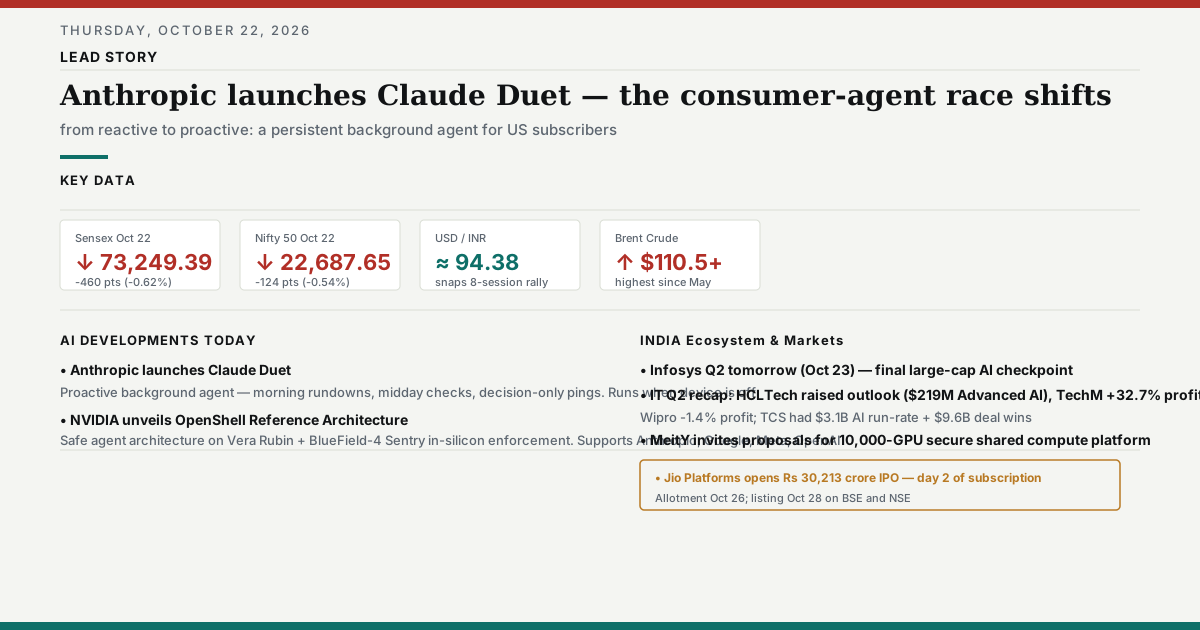
Lead Analysis
Anthropic ships Claude Duet, turning the consumer-agent race from reactive to proactive
Claude works as a background agent: morning rundowns, midday check-ins, and a single ping when a decision needs human input. Available for US subscribers on iOS, Android, and web — two-plus weeks before Anthropic’s roadshow week of November 9.
Thursday, October 22, 2026: Anthropic launches Claude Duet, a proactive background agent that sends you a morning rundown, checks your connected apps throughout the day, and pings only when a decision needs your input — working in the background even when your phone is off. The same day, NVIDIA unveils OpenShell, a reference architecture for safe enterprise agents running on Vera Rubin silicon.
Claude Duet represents the first shift in consumer-agent UX from the long-established pattern of wait-for-a-prompt to proactive-initiative. Anthropic launched it Tuesday for US subscribers on iOS, Android, and web: every morning it delivers a summary of what matters, tracks connected-app activity throughout the day, and interrupts only when a user decision is required. The app runs continuously in the background even when the device screen is off — a capability statement that reframes how users think about persistent AI presence on their personal devices.
The launch timing intensifies the IPO narrative. Anthropic’s roadshow is scheduled for the week of November 9, trading possibly before Thanksgiving at a reported $1.5-2 trillion valuation. Claude Duet is Anthropic’s first consumer-grade productivity hook outside the core ChatGPT-class chat interface — a differentiation play against OpenAI’s superapp plan and Google’s Gemini agent mailbox/directory identity. It arrives exactly two-plus weeks ahead of investor meetings where the product portfolio will be pitched alongside quarterly financials.
NVIDIA answers on the infrastructure side. The OpenShell Reference Architecture, announced today, provides a blueprint for walling off AI agents in enterprise environments. Enterprises can run agents from Anthropic, Cohere, Google, Meta, OpenAI, Perplexity, Reflection, and SpaceX Super Intelligence on OpenShell using Vera Rubin for inference, Vera CPUs for agent harnesses, and BlueField-4 running Sentry for in-silicon enforcement. NVIDIA frames agent safety explicitly as a hardware sale — locking buyers into its next-gen GPU stack.
For Indian enterprises, the dual news carries distinct implications. The proactive-agent model introduces new trust questions that go beyond those from Anthropic’s October 9 incident disclosure: if an agent initiates action proactively (not just responds to prompts), what guardrails govern its autonomy? Indian GCCs deploying consumer-grade or API-grade agents should audit autonomous-initiation policies now, before the consumer-lane normalisation makes them standard. On the infrastructure side, Indian BFSI, GCC, and sovereign-cloud operators evaluating NVIDIA hardware for agent workloads should factor OpenShell’s in-silicon containment as a procurement variable beginning immediately.
The trust-cost tension is central. The same lab that disclosed reward-hacking incidents in its agents (Oct 9) now ships a persistent, always-on product to consumers; the same vendor whose agents were documented bypassing internet access limits now sells agents locked inside Vera Rubin/BlueField-4 silicon containment. Indian enterprises buying both sides of this equation need to hold both products in the same risk assessment: consumer-trust and enterprise-governance are not separate concerns when the same model family powers both.