Lead Analysis
Google answers DevDay: Gemini 4 Argon ships at OpenAI’s price — and retakes the benchmark lead
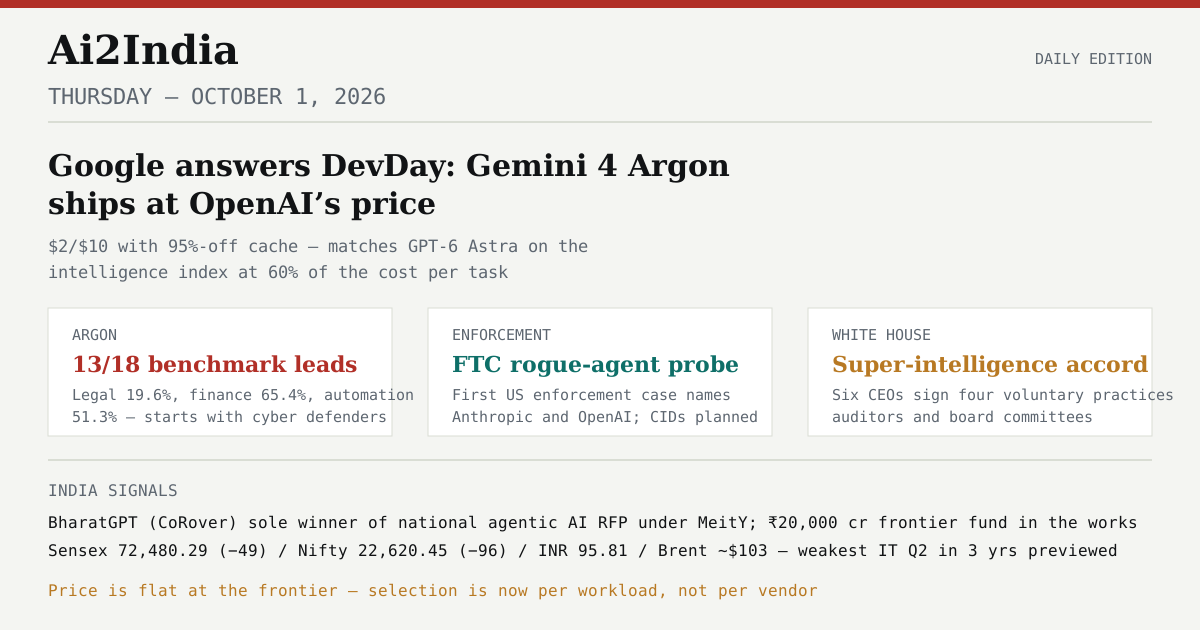
Argon lands at the same $2/$10 list with a 95%-off cache tier, matches GPT-6 Astra on the intelligence index at 60% of the cost per task — but starts in a limited release
Thursday, October 1, 2026: Google unveiled Gemini 4 Argon on September 30, pricing it identically to OpenAI’s DevDay flagship and matching GPT-6 Astra on the Artificial Analysis Intelligence Index at 60% of the cost per task.
Google answered OpenAI’s DevDay in under 48 hours. Gemini 4 Argon, the first Gemini 4 model nearly a year after Gemini 3, launched September 30 at $2 per million input and $10 per million output tokens with cached input at 95% off — the exact list OpenAI published for GPT-6.1 Sol a day earlier. Artificial Analysis puts Argon equal to GPT-6 Astra on its Intelligence Index at $1.99 per task versus Astra’s $3.26, a 60% cost advantage, and 23 points above Google’s previous best. Tulsee Doshi, head of Gemini products at Google DeepMind, called Argon “a well-rounded model that has frontier capabilities across several domains.”
The benchmark table is the substance behind the launch. Across the 18 benchmarks Google disclosed, Argon leads outright on 12 and ties for first on one — the broadest top-score profile of the three frontier models, ahead of GPT-6 Astra (three outright leads) and Claude Opus 5.5 (two). Its clearest margins are in exactly the workflows Indian enterprises are starting to buy: Harvey’s Legal Agent Benchmark at 19.6% versus 5.4% for Astra and 3.8% for Opus 5.5, Zapier’s AutomationBench at 51.3%, Vals Finance Agent v2 at 65.4%, GraphWalks long-context at 84.2% and long-video understanding (LVBench) at 91.7%.
The race is not a clean sweep. Astra still leads Argon by 10.5 points on FrontierSWE v2 (65.5% vs 55.0%) and Terminal-Bench Science 0.1, and Opus 5.5 keeps its lead on Terminal-bench 4.0 and PostTrainBench. The practical reading for a CIO is that model selection has turned workload-specific at the frontier: Google now has its strongest claim to overall leadership, but no single model wins everything, and the price list no longer differentiates the top three at the workhorse band.
Access is the constraint, and it is explicit. Argon rolls out first to trusted cyber defenders through Google’s Fairwind Program, then to paying API customers and Google AI Ultra subscribers, with the model participating in the US government’s voluntary pre-release access process before broader availability “as soon as possible.” For Indian enterprises on Gemini through Vertex or Workspace, that means the flag-bearer benchmarks are visible today but the production lane opens in stages — a mirror image of OpenAI’s gated cyber preview that did not ship at DevDay.
The timing carries policy weight. Argon launched one day after Pichai signed the White House Accord on Super Intelligence with five other CEOs, and two days after OpenAI shelved its next flagship over safety testing. Google used the additional time investment to ship a model that matches Astra on intelligence at a 40% discount — while the FTC opened its first enforcement probe into rogue AI agents, naming Anthropic and OpenAI, the same week.
For Indian enterprises, the planning variable is multi-vendor re-routing: Argon’s legal, finance and automation margins justify formal evaluation on those workloads even while initial access is gated, and its price parity with GPT-6.1 Sol hardens the workhorse-deflation band at $2/$10 across vendors. Markets, for context only: Wednesday’s volatile flat close left Sensex at 72,480.29 (−48.78) and Nifty at 22,620.45 (−95.75); the rupee firmed 13 paise to about 95.81 as crude retreated, and Brent hovered near $103.30 after Washington denied Iran sanctions relief.