Lead Analysis
OpenAI halves GPT-6 prices as Anthropic ships Opus 5.5 in one-day repricing
Sol at $2/$10 and Luna at $0.10/$0.50, next to Claude Opus 5.5 at $4/$20 — the sharpest single-day frontier API deflation of 2026
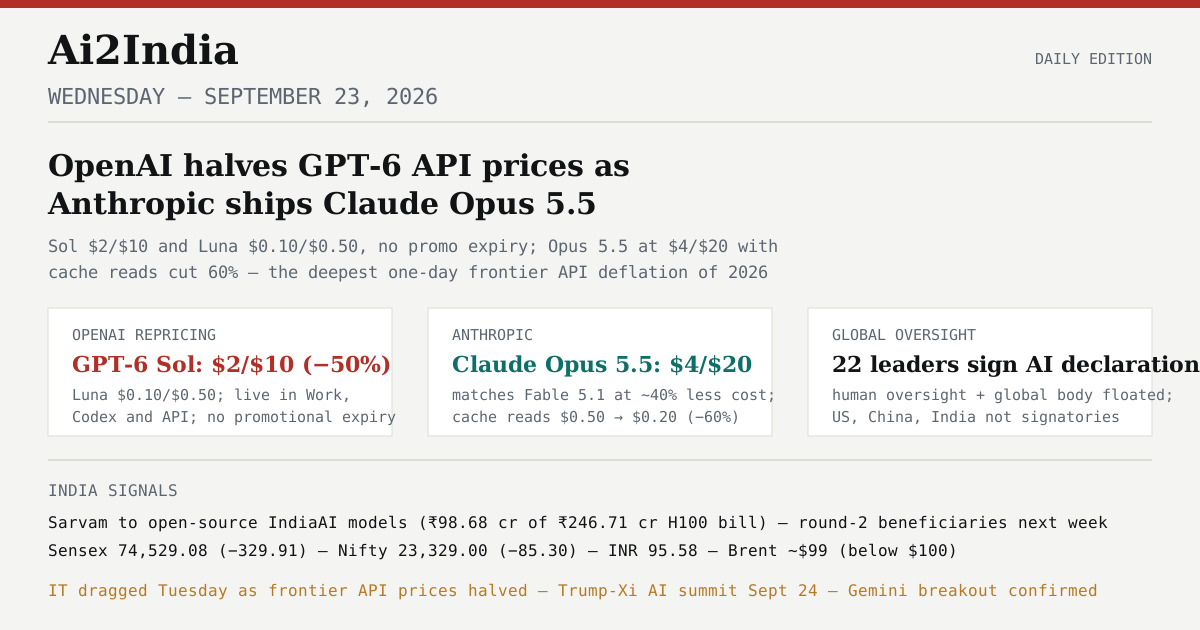
Wednesday, September 23, 2026: OpenAI cut its GPT-6 mid-tier API prices in half on Tuesday — Sol to $2/$10 per million tokens, Luna to $0.10/$0.50 — on the same day Anthropic launched Claude Opus 5.5 at $4/$20, the deepest one-day frontier price cut Indian enterprises have seen this year.
OpenAI shipped GPT-6 Sol and GPT-6 Luna on September 22, 19 days after the GPT-6 Astra flagship. Sol, the mid-tier workhorse, drops from $4/$20 to $2/$10 per million input/output tokens — a 50% cut with no promotional expiration, per VentureBeat. Luna, the budget tier, falls from $0.20/$1.20 to $0.10/$0.50. Both are live in ChatGPT Work, Codex and the ChatGPT API, with Luna extended to desktop, Free and Go users. OpenAI’s framing is lower cost and fewer mistakes; the launch is priced as a permanent re-baseline, not a teaser.
Anthropic answered the same day with Claude Opus 5.5, cutting flagship input pricing from $5 to $4 and output from $25 to $20 per million tokens, and slashing cache-read tokens from $0.50 to $0.20 — a 60% cut on the line item that dominates long-context agent workloads. Coverage benchmarks it as matching Claude Fable 5.1 on most tasks at about 40% less cost than Opus 5, at up to 1M-token context. Two frontier labs repriced their production tiers downward on the same calendar day, 48 hours before the September 24 Trump-Xi summit.
The India read is a procurement event. Indian IT services, GCCs and product teams price volume workloads against exactly these tiers: Sol-class coding and agentic pipelines, Luna-class always-on summarisation and routing, and Claude-class long-context reasoning. The half-price cut moves the cost-per-task line under which AI deployments are approved without board sign-off, and Luna at $0.10/$0.50 makes perpetually-running background agents a rounding error on most enterprise bills. Every Q4 TCO model built on September 21 pricing is now stale.
The policy layer moved in parallel. Twenty-two leaders — led by Finland’s Stubb and Norway’s Støre, landing in UN General Assembly week — signed a declaration that AI must stay under “human direction, oversight and control” and floated a global oversight body. The US, China, Japan, the UK, France and India were not signatories. India’s counterweight story is domestic: Sarvam AI confirmed it will open-source the models it trains under the IndiaAI Mission — the highest subsidy so far, ₹98.68 crore of a ₹246.71 crore bill for 4,096 H100s — and eight second-round compute beneficiaries, including Tech Mahindra, are expected to be named next week.
Markets were the footnote, not the story. The Sensex fell 329.91 points to 74,529.08 and Nifty slipped 85.30 to 23,329.00 as IT stocks wiped out the crude-led gains of the prior session; the rupee gained 20 paise to 95.58 and Brent fell below $100 for a fifth straight session on Saudi pipeline restart preparations and hopes of US–Iran talks. The striking asymmetry: Indian equities sold off on IT-services margin anxiety just as the input costs of the AI products those firms build dropped by half globally.