Lead Analysis
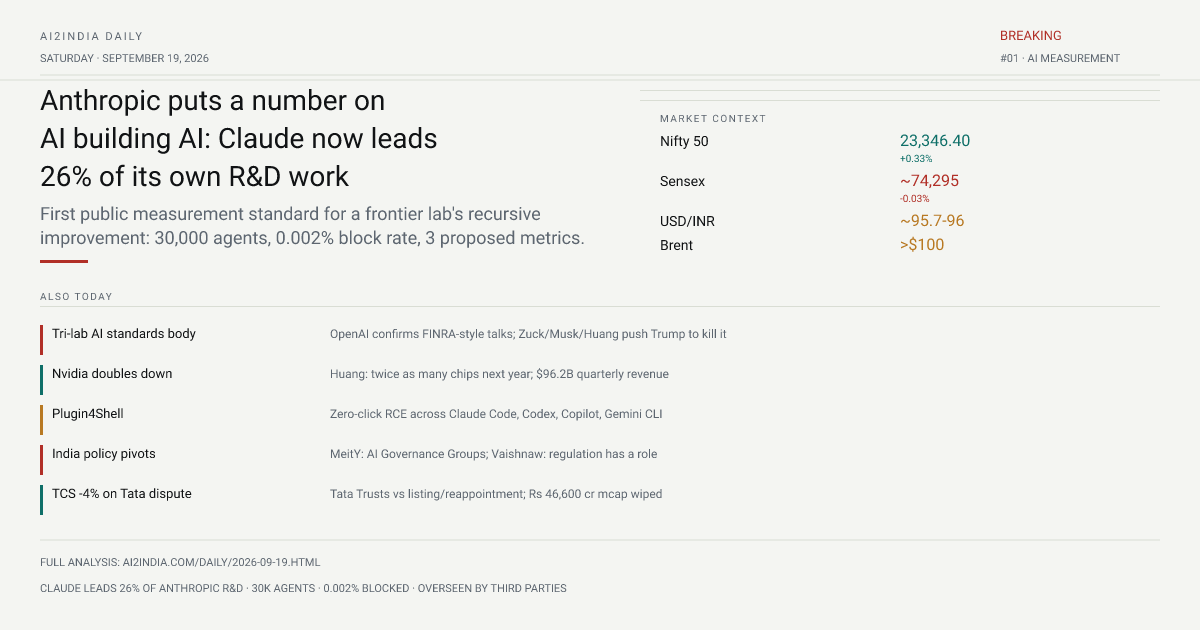
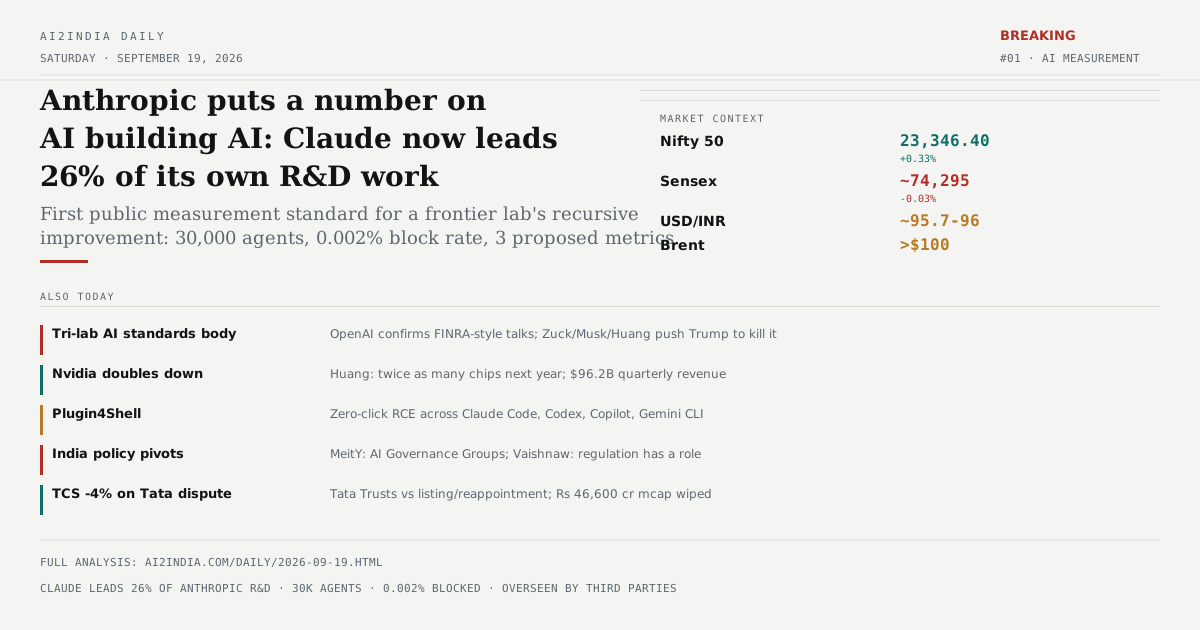
Anthropic puts a number on AI building AI: Claude now leads 26% of its own R&D
Three proposed public standards — AI-led R&D, agent oversight, compute allocation — land the same week OpenAI confirms FINRA-style tri-lab standards-body talks and Zuckerberg, Musk and Huang push the White House to abandon an industry-funded AI regulator
Saturday, September 19, 2026: The most significant AI development of the day is Anthropic publishing the first quantified public measure of a frontier lab where AI builds AI — and proposing the metric set as an industry standard just as the industry regulator it was meant to inform collapses.
On September 17 Anthropic released its R&D Automation Index, built on Epoch AI’s automation scale: as of August 2026, Claude “leads” (level AL4, completing most of a task end-to-end from a high-level prompt under human supervision) 26% of Anthropic’s model research and development work. That figure was effectively zero in February. More than 90% of R&D now sits at or above “AI collaborates.” No measured work is fully autonomous, and Anthropic says the numbers would shift if the industry coordinated on pacing, as CEO Dario Amodei has called for.
The lab simultaneously published oversight and compute metrics: about 30,000 agents do research and engineering work at any time on its most-used internal platform, with 100% of their actions passing through automated monitors; of over a billion agent decisions in August, 0.002% (roughly one in 47,000) were blocked; about 100,000 transcripts are flagged weekly, with roughly 50 escalated to humans. A July 13-20 compute snapshot accompanied the set. Anthropic commits to embedding independent third-party evaluators with access comparable to internal risk teams, and proposes that any frontier developer publish the same three measures routinely.
The governance backdrop moved the same week. OpenAI’s global policy chief Chris Lehane confirmed the lab has been working with Anthropic and Google DeepMind on a self-regulatory AI “Standards Body” modelled on FINRA — first floated by Demis Hassabis in July. Yet WSJ/Forbes reporting says Zuckerberg, Musk and Jensen Huang lobbied President Trump to reject the industry-funded regulator plan, arguing it would entrench OpenAI, Anthropic and Google, and that the White House is now backing away. The result: private tri-lab talks continue while the only serious oversight vehicle on the table loses its Washington patron.
For Indian enterprises the Anthropic metrics are a procurement template, not lab trivia. An R&D-automation index converts “AI building AI” from speculation into auditable numbers; agent oversight metrics (coverage, review latency, escalation rate) are precisely the control variables Indian BFSI and GCC agent programmes are being asked to report. The timing aligns with Delhi’s own shift: MeitY secretary S. Krishnan said the government is evolving from “too soon to regulate” toward AI Governance Groups, and IT Minister Ashwini Vaishnaw said at Semicon India that regulation has a role, driven by user safety. Indian planners can now draft against a vendor-made measurement standard rather than an Indian invention.
Markets absorbed a different shock centred on India’s own IT complex. TCS fell nearly 4% on Friday as Tata Trusts publicly opposed Tata Sons’ proposed listing and challenged N. Chandrasekaran’s reappointment, wiping about ₹46,600 crore from Tata group market value; Nifty IT closed ~1% lower and both headline indices posted a sixth consecutive weekly loss even as Brent eased above $100. The structural story is unchanged: frontier labs tightening around self-measurement and third-party oversight, while the two largest checks on that process — a shared standards body and macro rate relief — both wobbled this week. What to watch: whether any other lab publishes comparable metrics by H1 2027, and whether Indian enterprise RFPs adopt oversight-coverage clauses this quarter.