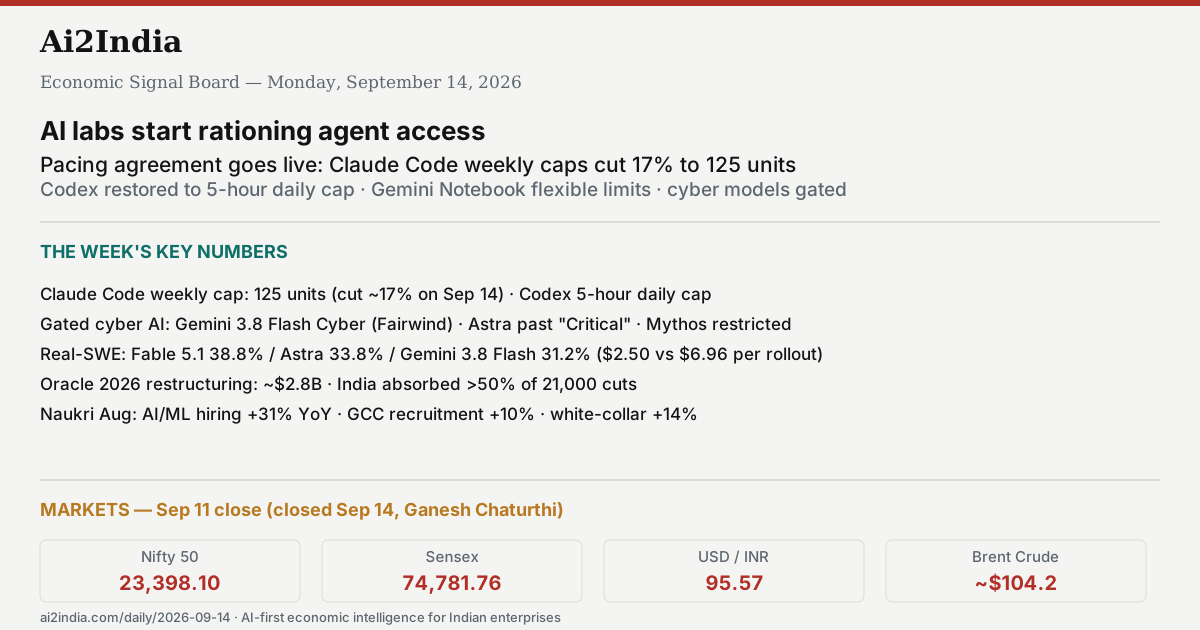
Lead Analysis — Frontier pacing moves from Amodei’s Sept-12 manifesto to product-level enforcement on Sept 14: Anthropic cuts Claude Code weekly limits 17% effective today (125 units vs 150 promo peak), OpenAI restores a strict five-hour Codex daily cap, and Google rolls out compute-specific flexible usage limits for Gemini Notebook — the first concrete, billed throttles Indian enterprises will feel when buying agent and coding capacity, after a week in which all three labs gated their most capable cyber models behind vetted-defender programs
AI labs start rationing agent access as the pace agreement goes live
Usage caps on Claude Code, Codex and Gemini Notebook are the first product-level enforcement of the frontier pacing consensus, and the same week Google, OpenAI and Anthropic each gated their most capable cyber models behind trusted-defender programs — making the access layer itself the thing Indian enterprises must now negotiate
Monday, September 14, 2026: The most significant AI development for Indian enterprises this week is not a model release — it is the frontier’s biggest labs starting to ration agent and coding capacity, turning last weekend’s pacing philosophy into metered, billed throttles.
On Sept 14 Anthropic’s ClaudeDevs notice went into effect: Claude Code’s temporary 50% weekly-limit boost ended and was replaced by a permanent 25% raise over baseline — a net ~17% cut from the promo peak, resetting most paid tiers to 125 weekly units. Developer forums show users now checking their meter and rationing a week that had briefly flirted with a summer boost (androidheadlines.com; bleepingcomputer.com; implicator.ai; Sept 14).
OpenAI moved in the same direction, restoring a strict five-hour daily cap on Codex after a looser spell, and Google began rolling out compute-specific flexible usage limits for Gemini Notebook. The three moves look coordinated in spirit if not in letter with Amodei’s “We Must Pace the Frontier,” which the prior edition analysed — Altman already committed OpenAI to the embedded-evaluator regime, and these usage caps are the first consumer- and developer-visible enforcement of the pacing consensus (aitoolsrecap.com; thehackernews.com; Sept 14).
The same week all three labs gated their most capable cyber models behind trusted-defender programs: Google shipped Gemini 3.8 Flash Cyber through the Fairwind program for vetted defenders (650+ partners), OpenAI confirmed GPT-6 Astra is the first model to cross its internal “Critical” cybersecurity threshold and will be tested inside a small, vetted program, and Anthropic released Mythos 5.1 through restricted access. This is the clearest signal yet that in cyber AI, the access programme is now the product — the model alone no longer ships (thehackernews.com; cnbc.com; spearhead.so; Sept 14).
The India implication is direct and near-term. Every Indian GCC, bank, IT-services delivery team and independent software vendor now buying Claude Code, Codex or Gemini Notebook seats faces metered rationing on a per-week or per-day basis — a new capacity-planning variable on top of API pricing. For Indian enterprises the practical steps are: budget agent-seat consumption against the new caps rather than assume unlimited usage, build escaping-cost models for cyber-AI that now require vetted-defender onboarding, and treat “access tier” as a scored procurement criterion for both coding agents and the new gated cyber models.
Markets provide context only, and were closed today (Mon Sep 14) for Ganesh Chaturthi — the Sep 11 Friday close carried forward: Sensex 74,781.76, Nifty 23,398.10 at three-month lows, the rupee at 95.57 and Brent near $104.2 after intraday spikes above $108. The hiring headline is AI-led: Naukri’s Aug data (Sept 8) showed AI/ML hiring +31% YoY and GCC recruitment +10%, while Oracle’s restructuring total rose to ~$2.8B with India absorbing over half of the 21,000 cuts (People Matters).