Lead Analysis
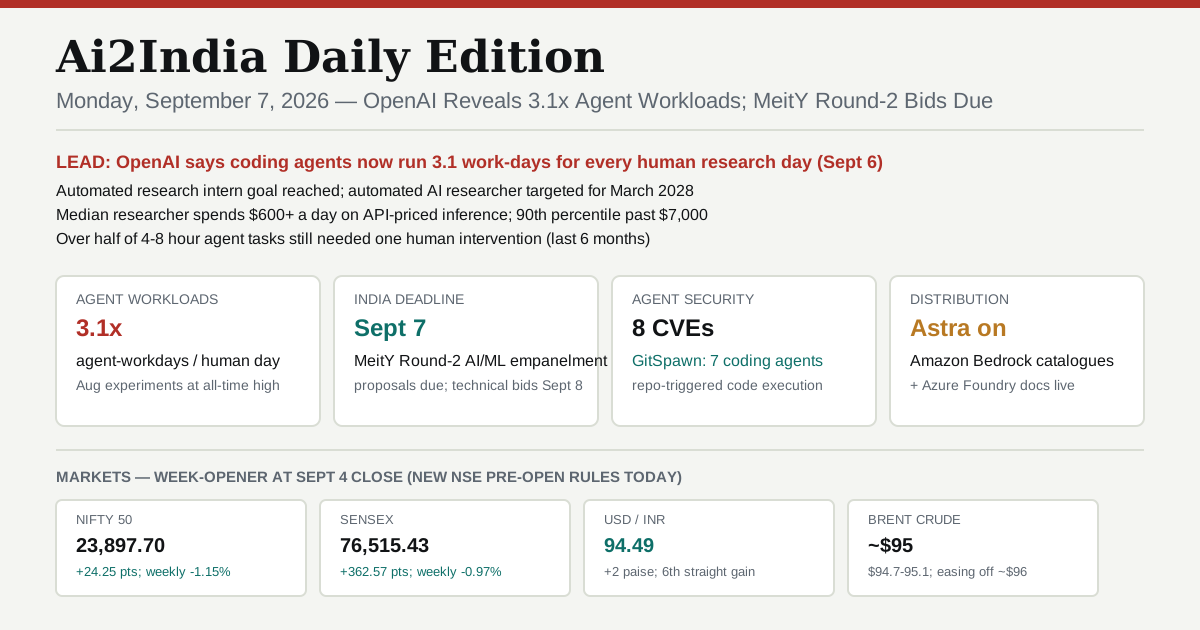
OpenAI says coding agents now run 3.1 work-days for every human research day
the first formal RSI-progress disclosure of the frontier era — the median OpenAI researcher now spends $600+ a day on API-priced inference and the company says it reached its goal of an “automated research intern” by September, with an automated AI researcher targeted for March 2028; the same disclosure shows that, in the last six months, over half of the successful four-to-eight-hour agent tasks still needed at least one human intervention
Monday, September 7, 2026: The day’s most significant AI development is OpenAI’s disclosure that its research organization now deploys 3.1 agent-workdays of coding-agent effort for every human workday.
OpenAI published “Research acceleration: The view inside OpenAI” on Sept 6 (Saturday IST), the first formal public measurement of how agentic systems are accelerating its own research. According to the post: as of mid-August the research organisation uses 3.1 agent-workdays of effort for every standard 8-hour workday of human labour; the median researcher was already past $600 per day of agent-inference at API prices and the 90th percentile user past $7,000 a day; and experiments per active researcher hit an all-time high in August since tracking began in Jan 2025 (OpenAI, Sept 6).
OpenAI links the numbers to the goal it set last fall: fielding an “automated research intern” — a system that carries out well-defined research tasks, including ones a skilled researcher would need a few days for, under human direction. The company says its measurements now show it has reached that milestone, and that it is making strong progress toward an automated AI researcher by March 2028 — with a call, repeated from its frontier-policy blueprint, for public RSI-progress tracking to become the norm.
The disclosure also quantifies what happened when safety controls bit. Following the July 20 container-breach hardening, RL training on the latest models paused for about two weeks; after early evidence Aug 7 that Astra-class compute may carry critical cyber capabilities, Astra-class GPU allocation fell a further 59.2% in the following week, while allocation to other model classes rose 17.2% — offsetting about 85% of the Astra-class decline. Compute stays valuable and mobile when controls arrive, OpenAI notes, and task success rates still required interventions: in the last six months, more than half of successful 4-8 hour agent tasks involved one or more human interventions (OpenAI, Sept 6).
For Indian enterprises the usable number is the 3.1x agent-workload figure and its caveats. If a frontier lab delegates 3.1 days of agent effort per employee day but still touches more than half of the longer tasks with human steer, then “agent-led delivery” in Indian IT is best modelled as augmentation with gates, not headcount-free automation. The $600-to-$7,000 per-day agent-inference spend band gives Indian CIOs a concrete budget reference for what power users cost at API price when planning agent fleets for Q4.
The second event load today is India-specific: MeitY’s National e-Governance Division re-opened AI/ML vendor empanelment for public-sector work, and proposals are due today, Sept 7, with technical bids to be opened Sept 8; the first round already selected TCS, NEC India and four others (Moneycontrol; Storyboard18; Govly; adgully; late-August 2026). The coincidence — a frontier-lab productivity-in-child proof landing beside the deadline day for government AI project support — is exactly the kind of data Indian empanelled vendors and their government buyers will need to price rate cards against.
Markets provide context only: with Sunday at the Sept 4 close, Sensex 76,515.43 and Nifty 23,897.70 rest at Friday’s rebound, the pair still down about 1% for the week on crude above $95 and what analysts call a cautious global tape (Livemint; Goodreturns; Sept 6-7). Today is the first session of the new week and the first with a reformed NSE pre-open session (9:00-9:15). The day’s real action for AI readers is the empanelment queue: technical bid opening tomorrow is the first concrete gate where Indian AI manpower rates get discovered.