Lead Analysis
OpenAI launches GPT-6 Astra (Sept 3)
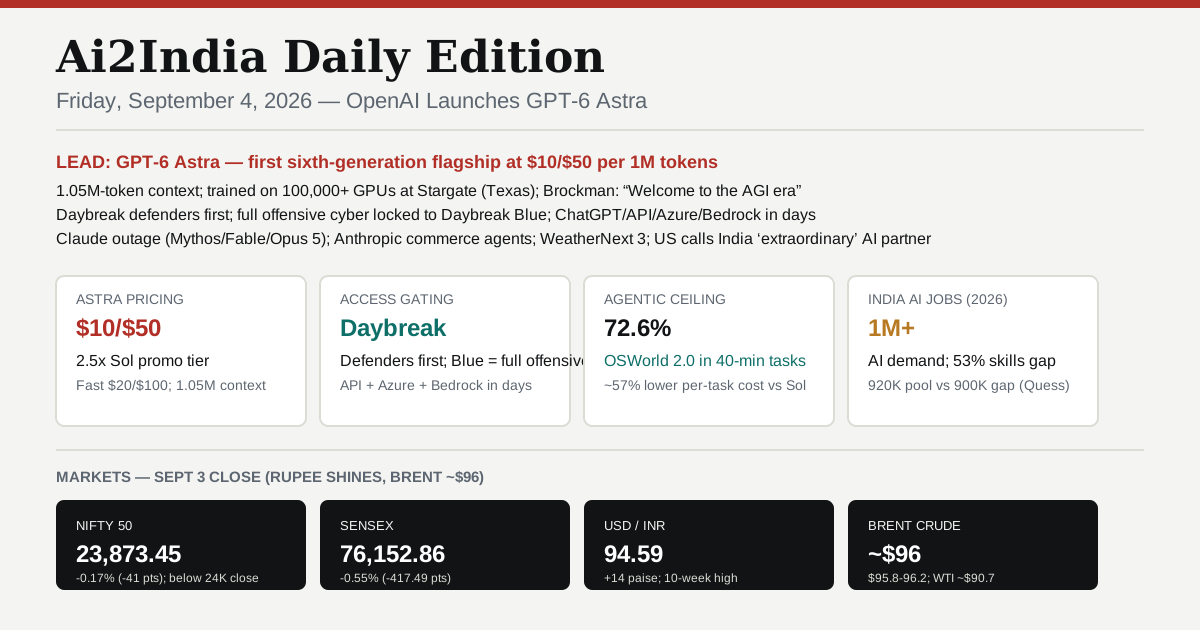
its first sixth-generation model at $10/$50 per 1M tokens standard ($20/$100 Fast), 1.05M-token context, pre-trained on 100,000+ GPUs at Stargate (Texas), released first to Daybreak cyber-defender organizations with full offensive capability locked in Daybreak Blue while ChatGPT Plus/Pro/Business/Enterprise, the API, Amazon Bedrock and Microsoft Azure follow ‘in the coming days’ — Greg Brockman closes the briefing with ‘Welcome to the AGI era’; the same day Claude (Mythos 5.1, Fable 5.1, Opus 5) suffered a multi-hour outage, Anthropic fielded an AI shopping-agent blueprint (Shopify, Priceline live), Google DeepMind rolled out WeatherNext 3; Sensex 76,152.86 (-0.55%), Nifty 23,873.45 (-0.17%), INR at 10-week high 94.59, Brent ~$96
Friday, September 4, 2026: The day’s most significant AI development is OpenAI’s launch of GPT-6 Astra on Thursday Sept 3 — the first model in the sixth generation of OpenAI’s flagship line, and the most consequential release of the year for Indian enterprises building on agentic workflows.
Priced at $10 per million input tokens and $50 per million output tokens (Fast mode $20/$100, per OpenAI’s API page and developer docs), with a 1,050,000-token context window, Astra displaces GPT-5.6 Sol at the top of the lineup and carries OpenAI’s largest-ever training run: more than 100,000 GPUs at the Stargate site in Texas, per Axios (pasqualepillitteri.it; digitalapplied.com; CNBC; Fortune; WIRED, Sept 3).
The rollout is explicitly gated: Daybreak Access organizations (the application-only cyber-defender program opened in August) get it first; ChatGPT Plus, Pro, Business and Enterprise subscribers, the API (model id gpt-6-astra), Amazon Bedrock and Microsoft Azure follow “in the coming days” (developers.openai.com; Axios).
OpenAI describes two circulating versions — the ChatGPT/API version with cyber capabilities shielded by classifiers and monitoring (with extra guardrails for paying ChatGPT users, per Bloomberg), and the full offensive capability — autonomous vulnerability discovery and exploit building — reserved for Daybreak Blue, the defender track (pasqualepillitteri.it).
The benchmark table is aggressive: ARC-AGI-3 at 98.6%, FrontierMath Tier 4 at 97.6%, GPQA Diamond 96%, ExploitBench 100% versus Sol’s 73.5%, and OSWorld 2.0 computer-use at 72.6% completing tasks in 40 minutes versus Sol’s 65.7% in 75 minutes (OpenAI; pasqualepillitteri.it).
Greg Brockman closed the press briefing with four words — “Welcome to the AGI era” — and reframed pricing around cost per completed task rather than per token, an argument VentureBeat quantified at roughly 57% lower per-task cost than Sol. For Indian enterprise the read-through is fourfold.
First, the price signal is the story: after Gemini 3.8 Flash at $0.75/$3.75 intro (Sept 2) and Claude’s -75% cache cut (Sept 1), OpenAI has deliberately NOT deflated — Astra at $10/$50 is 2.5x Sol’s $4/$20 promotional rate, the first premium-tier price increase of the 2026 deflation cycle, justified on per-task economics.
Indian CIOs running agentic coding and computer-use automation must now model two cost regimes: cheap Flash-class pipelines versus premium agentic flagships where the TCO wins only if Astra’s task-completion advantage (40-min vs 75-min OSWorld tasks, -57% per task) holds in their workloads.
Second, gating is now the industry norm at every tier: Google Fairwind, Anthropic Mythos trusted-access, and OpenAI Daybreak each serve defenders first — Indian MSSPs, banks and telecoms that already run CrowdStrike/Palo Alto stacks should register for Daybreak via OpenAI or Azure/Bedrock resellers this week, because early-access windows are the new competitive moat.
Third, compute scale is the new scarcity: a 100,000+ GPU single training run at Stargate resets the bar for India’s AI Mission compute ambitions and the capital intensity of frontier competition — relevant to the Sept 7 MeitY empanelment deadline and Sarvam’s 1T-parameter plan.
Fourth, reliability risk is live: the same day, Claude suffered a multi-hour outage across Mythos 5.1, Fable 5.1 and Opus 5 (resolved 16:16 UTC), reminding every Indian pipeline owner that single-vendor agentic dependence carries operational risk — the case for multi-model routing in Indian production stacks.
Markets provided context, not leadership: Sensex fell 417.49 points to 76,152.86 (-0.55%) and Nifty 41 points to 23,873.45 (-0.17%) as elevated Brent (~$96) and bond-yield moves stoked inflation concerns, with IT among the drags for a second session (Moneycontrol; Business Standard; The Hindu BusinessLine; TOI, Sept 3).
The rupee was the outlier — it gained 14 paise to close at 94.59, a 10-week high on its fifth straight day of appreciation, as RBI-scheme dollar inflows and stronger FPI supported the balance of payments (The Hindu; New Indian Express, Sept 3).