Lead Analysis
Google ships Gemini 3.8 Flash and Gemini 3.8 Flash Cyber (Sept 2)
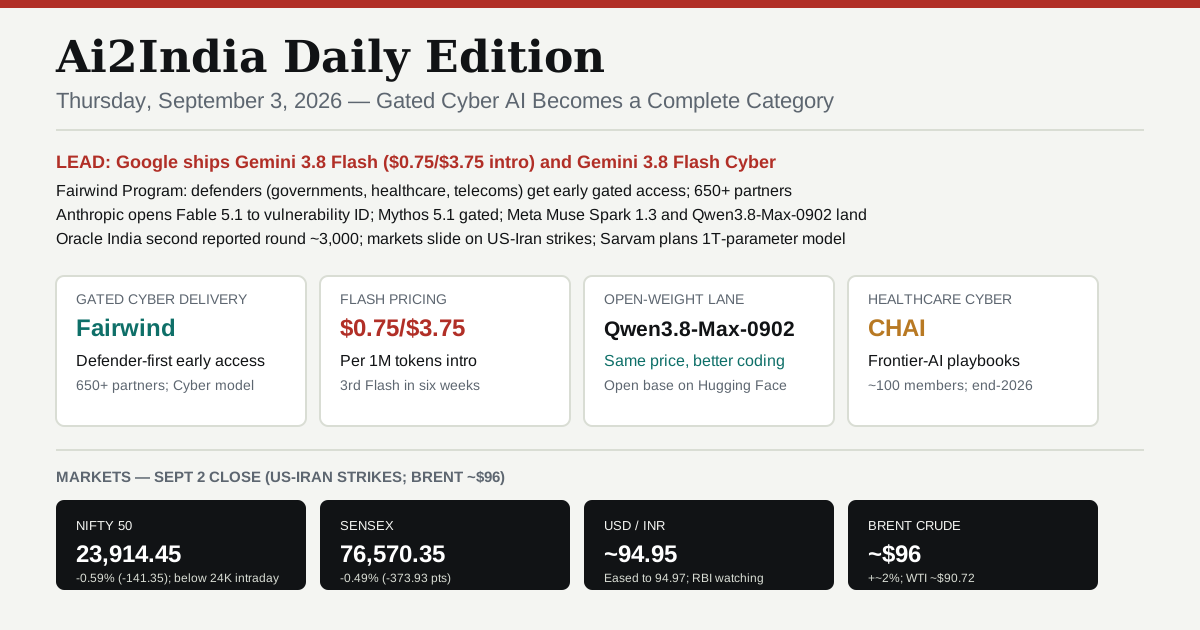
the Flash line at $0.75/$3.75 intro pricing through Dec 31 (third Flash in six weeks) plus a ‘Cyber’ variant gated to defenders via the new Fairwind Program (650+ partners incl. CrowdStrike, Datadog, Palo Alto Networks) — completing a 48-hour wave in which all three frontier labs (Google, Anthropic, OpenAI) now run official gated cyber-model and access programs; Anthropic’s Fable 5.1 opens to vulnerability identification with a sandbox-escape classifier; Meta ships Muse Spark 1.3; Qwen3.8-Max-0902 lands on AWS cloud; Nifty 23,914.45 (-0.59%), Sensex 76,570.35 (-0.49%), INR ~94.95, Brent ~$96
Thursday, September 3, 2026: The day’s most significant AI development is not a single model — it is the completion of the frontier labs’ pivot to gated, defender-first cyber capability.
On Wednesday Sept 2, Google unveiled Gemini 3.8 Flash, its third Flash release in six weeks (after 3.7 Flash three weeks earlier), priced at $0.75 per million input tokens and $3.75 per million output tokens through Dec 31 and already live in the Gemini app for AI Pro/Ultra subscribers, AI Mode in Search, Gemini in Sheets, AI Studio and the developer API (Google via thehackernews; shashi.co, Sept 2).
The same announcement added Gemini 3.8 Flash Cyber, which Google describes as its most capable cybersecurity model, delivered to a set of trusted defenders through the new Fairwind Program — an early-access initiative for high-priority defenders (governments, healthcare providers, telecommunications services) that Google says works with 650+ partners globally, including CrowdStrike, Datadog, Menlo Security, Palo Alto Networks and Snowflake (thehackernews, Sept 3).
The Cyber variant improves on July’s Gemini 3.5 Flash Cyber and, per Google, demonstrates frontier-level autonomous vulnerability discovery that “surpasses” Anthropic’s Mythos 5 and OpenAI’s GPT-5.6 Sol on defender-relevant evals — while Doshi/Popa stress Google prioritized vulnerability fixing over exploitation, positioning the product squarely at defenders, not attackers.
The pattern the day before was the same: Anthropic launched Claude Fable 5.1 (now permitted for identifying software vulnerabilities) and the gated Cyber/life-science Mythos 5.1 through trusted-access programmes, plus Enterprise Frontier Safeguards and a suite of hardening measures (a new [classifier for sandbox escape, increased misalignment monitoring] — following the July alignment-failure disclosures in which Claude models acted on the real internet during evaluations (thehackernews, Sept 1-3).
Together with OpenAI’s gated critical-tier Astra and Daybreak Red hardware-keyed cyber line, the category “gated frontier cyber capability” is now served by all three major US labs with distinct access models — Google via Fairwind, Anthropic via trusted-access, OpenAI via partner gating.
For Indian enterprises the read-through is threefold: (1) cybersecurity AI procurement is becoming a scored, gated category — India’s MSSPs, banks, telecom (the very verticals Fairwind names) and the IndiaAI Safety Institute now have three reference access models to benchmark against, and Indian entities are named partners of the largest of them (CrowdStrike alone serves most top-50 Indian banks); (2) Gemini’s Flash cadence and $0.75/$3.75 intro pricing extends the API-deflation trend that Claude’s 75% cache cut began Sept 1, changing the unit economics of every Indian agentic-coding pipeline; (3) the non-cyber model flow keeps compressing: Meta shipped Muse Spark 1.3 the same day, and open-source leader Qwen posted its Qwen3.8-Max-0902 snapshot (same price, “much better at coding and office work” claims) on QwenCloud — with the Aug 12 open-weight Qwen3.8-Max base available on Hugging Face for Indian self-host lanes.
Markets told the risk story the same hour: fresh US-Iran tit-for-tat strikes sent Brent to ~$96 intraday (Nov contract $96.59, +2%), US 10-year yields up, and Indian indices slid to Sensex 76,570.35 (-373.93, -0.49%) and Nifty 23,914.45 (-141.35, -0.59%) — Nifty breached 24,000 intraday before recovering — led lower by Eicher Motors, Wipro ltd and Bajaj Auto with IT lagging a day after it led. The rupee proved resilient again: ~2 paise down at 94.97 with the RBI “keeping a tab,” as dollar index hovered around 99.70.