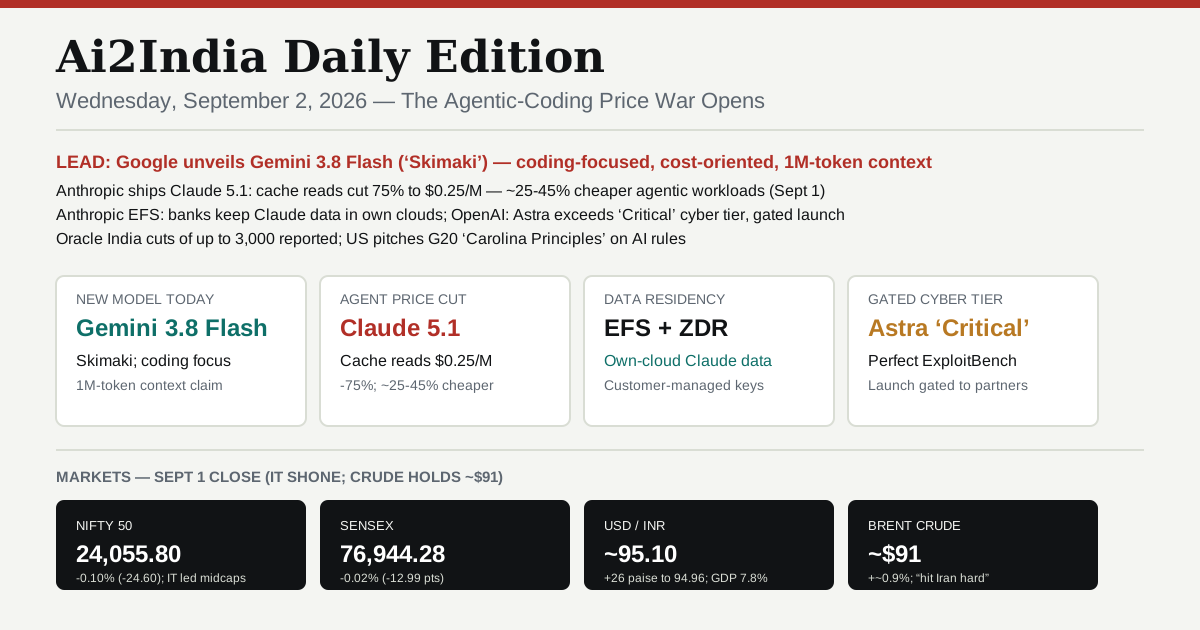
Lead Analysis
Google DeepMind unveils Gemini 3.8 Flash (codenamed ‘Skimaki’) on Sept 2
a cost-focused, coding-tuned model with a 1M-token context claim, tested on its internal Jetski platform through August — as Anthropic ships Claude 5.1 with cache reads cut 75% to $0.25/M (~25-45% cheaper agentic workloads) and Enterprise Frontier Safeguards for bank data residency; OpenAI says Astra is the first model to exceed its ‘Critical’ cyber threshold and gates its launch; Oracle India cuts of up to 3,000 reported; Nifty 24,055.80, INR ~95.1, Brent ~$91
Wednesday, September 2, 2026: The frontier labs are no longer competing on headline benchmarks alone — the battle has moved to the economics and governance of agentic coding, and the day’s biggest development is Google’s.
Google DeepMind is set to publicly unveil Gemini 3.8 Flash (internal codename “Skimaki”) today, a cost-focused workhorse specifically aimed at narrowing the enterprise coding gap, tested through August on Google’s internal Jetski coding platform; the release follows Flash 3.7’s Aug 13 GA and keeps Pichai’s roughly one-model-per-month cadence, with community reporting pointing to a 1M-token context claim and a pitch around cutting verbose outputs (WSJ via Investing.com; cryptobriefing, Sept 1-2).
WSJ separately reports Gemini 4 has impressed on pre-training evals but still needs post-training work — so 3.8 Flash, not Gemini 4, is what Indian teams on Google Cloud can rotate into this month.
The competitive context landed 24 hours earlier and makes the price war explicit: Anthropic shipped the Claude 5.1 line on Sept 1 — Fable 5.1 broadly available, Mythos 5.1 restricted to trusted-access programmes — holding list prices at $10/$50 per 1M tokens but cutting cache reads 75% to $0.25/M, which Anthropic says yields ~25% cheaper workloads and up to 45% savings on highly agentic tasks (benchmarks: 73.4% CursorBench, 77.9% OSWorld partial, 60.9% HLE no-tools); the same day it unveiled Enterprise Frontier Safeguards (EFS), letting regulated customers keep Claude data in their own S3, Azure Blob or GCS buckets with customer-managed keys, with zero data retention in the interim on Fable 5/5.1 — a direct answer to the data-residency objection that has slowed Indian BFSI adoption of foreign frontier models.
The third leg of the day is OpenAI’s Astra: now officially rated as the first model to exceed the Preparedness Framework’s ‘Critical’ cybersecurity threshold — perfect ExploitBench, autonomously finding and exploiting two zero-days in modified tests — with OpenAI saying it will release Astra ‘soon’ but gate the most advanced cyber capabilities to select partners, adding chain-of-thought monitoring, jailbreak detection and containment-escape evaluations.
For Indian enterprises the read-through is threefold: agentic-coding unit economics just improved materially (25-45% cheaper workloads under Claude 5.1; a new Gemini Flash lane within weeks), data residency is becoming a scored procurement variable rather than a bespoke negotiation (EFS vs OpenAI ZDR vs Karnataka data-residency law), and the gated-critical tier Astra now occupies means frontier cyber capability is entering vendor risk matrices as a managed product category, not a lab footnote.
Markets stayed in a holding pattern that fits the story: Nifty 24,055.80 (-0.10%) and Sensex 76,944.28 (-0.02%) closed flat for a second session as elevated crude (~$91 Brent after Washington warned it would “hit Iran hard”) weighed on banks, autos, realty and healthcare — while IT was the bright spot, with MphasiS (+3.32%) and Persistent Systems (+3.03%) the top Nifty Midcap gainers and Naukri (+2.88%) close behind, underlining the market’s rotation toward AI-services exposure.
The rupee gained 26 paise intraday to 94.96 on India’s faster-than-expected Q1 FY27 GDP print of 7.8% and MSCI-related inflows, settling the day’s range around a 95.10-95.20 base — resilient despite Brent above $90. On the jobs front, Oracle’s reported India cuts of up to 3,000 (multiple named sources, no company disclosure) give the layoff radar its first India-specific number in a week.