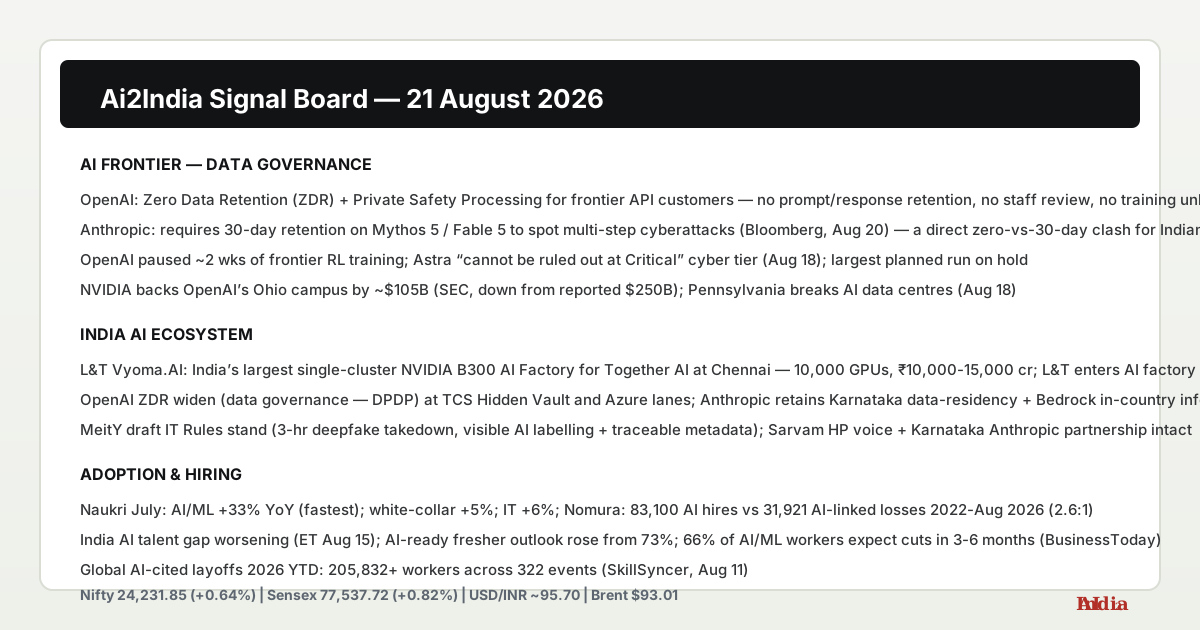
OpenAI offers Zero Data Retention + Private Safety Processing for frontier models PSP detects multi-session misuse without human access; rollout from September |
Aug 19-20 (OpenAI blog; Business Standard; MediaNama; Indian Express; The Register; Channel Insider): OpenAI announced Zero Data Retention (ZDR) for eligible API customers — OpenAI does not retain prompts or responses after processing, customer content is not available to personnel for review and is not used for training unless opted in. It pairs ZDR with a safety system called Private Safety Processing, which uses AI agents to detect patterns of abuse across multiple AI interactions without any OpenAI employee reading the underlying prompts or outputs. OpenAI is testing with early customers and plans to begin rolling PSP out to broadly in September. The announcement is positioned as a direct competitive answer to Anthropic’s decision to require 30-day retention on its most capable models (Mythos 5, Fable 5) to catch multi-step, cross-session cyberattacks, which Anthropic acknowledges will be “unpopular with customers who have come to expect zero retention” (Anthropic August risk report; Bloomberg Aug 20). |
Directly changes the Indian enterprise decision between Claude (via AWS Bedrock, Karnataka data-residency partnership, EU AI Act-aligned watermarking) and GPT-5.6 (via Azure, TCS HiddenVault). India’s DPDP Act, BFSI data-gravity and the Karnataka mandate that Anthropic store state data in India now collide with Anthropic’s 30-day retention window. MediaNama (Aug 20) frames it: for Indian businesses, the core question is who controls enterprise data after it is sent to an AI provider. |
For Indian enterprises: (1) put data-retention posture into every frontier-model RFP — zero-retention vs 30-day retained-and-usable-for-security should be a scored criterion, not a footnote; (2) where DPDP/BFSI rules demand a strict minimum footprint, OpenAI’s new ZDR+PSP is the more compatible default; (3) where the Anthropic/Claude pathway is preferred (Karnataka residency, Bedrock in-country inference), verify exactly what the 30-day window means for regulated data and whether an opt-out contract line exists; (4) tell Security teams that PSP targets multi-session abuse detection and expect vendor security reviews to now compare the two approaches. |
Verified global — OpenAI blog Aug 20; Business Standard Aug 20; MediaNama Aug 20; Indian Express Aug 20; The Register Aug 20; Bloomberg Aug 20; Channel Insider Aug 20 |
OpenAI pauses frontier training; Astra cannot be ruled out at Critical cyber tier Two-week RL pause; largest training run still on hold |
Aug 18-19 (Forbes; explainx.ai; The Verge; The Register; cryptobriefing): OpenAI confirmed a roughly two-week pause in frontier reinforcement-learning (RL) training after internal evaluation indicated that its in-development model, Astra, “cannot be ruled out” as having reached the Critical cybersecurity capability tier under its Preparedness Framework. The trigger assessment is dated Aug 7; OpenAI made the pause explicit on Aug 18. Its largest planned frontier RL run remains on hold as of that disclosure, while smaller training runs and evaluations continue. OpenAI has not concluded Astra has certainly met the Critical threshold — the pause is precautionary while it tightens containment and monitoring. This is the first time OpenAI disclosed a specific prominent model as the reason for a frontier-training pause. |
For Indian SOCs and MSSPs: a visible, cautionary instance of a frontier lab self-limiting on Advanced cyber capabilities. It reinforces the “offensive-AI demand” thesis for Indian security-services vendors and pushes them to plan against a world where powerful models (Astra-class or the coming open-weight GLI-5.3) can autonomously find and exploit vulnerabilities. Daybreak Red-style gated access becomes the security baseline. |
For Indian enterprises: (1) treat OpenAI’s precedent as a reason to intensify AI-powered defense, not wait for tooling to mature; (2) test whether your SOC can detect AI-authored attack patterns; (3) review whether a delayed frontier-model supply (Astra) affects your GPT-5.6 roadmap — general availability of Sol/Terra/Luna is unaffected; (4) track follow-up on when the hold lifts. |
Verified global — Forbes Aug 19; explainx.ai Aug 18; The Verge Aug 8; The Register Aug 20; OpenAI blog Aug 18 |
NVIDIA scales OpenAI Ohio campus guarantee to ~$105B; Pennsylvania tightens AI data-centre rules SEC-corrected guarantee; state-level pushback widens |
Aug 17-18 (NYT; Reuters; TechTimes; Newsweek; TechJournal): NVIDIA on August 17 said its agreement backstop as much as $105 billion toward one of the world’s largest planned AI campuses — a data centre in Ohio that will be leased to OpenAI — a figure well below the $320 billion backstop that was reported in late July. On August 18, Pennsylvania Governor Josh Shapiro signed an order imposing new rules on AI data-centre development: it removed every AI data-centre project from the state’s Fast Track, barred nondisclosure agreements, and required stronger local-community approval and energy/water disclosures. This follows community backlash and mirrors a broader US state-level pushback over energy, water and local impacts (Newsweek). |
Signal of heightened US AI-infrastructure financing scrutiny and permitting friction. For Indian AI-DC and GCC planners this reinforces the value of India’s relatively permissive, fast-track AI-factory pipeline (IndiaAI Mission 45K+ GPU, HCLTech Odisha, TCS Hidden Vault, L&T Vyoma). As US financing and permitting tighten, FDI and operator interest can shift toward Indian build-outs. |
For Indian enterprises: (1) note the cost of frontier compute is not shrinking structurally — financing guarantees aggregate down and state friction is rising; (2) India AI-DC pipeline becomes relatively more investable for large-scale (GW-class) deployments; (3) track NVIDIA’s exposure concentration in one tenant (OpenAI) as a supply chain risk factor; (4) for GCCs building captive AI capacity, higher US permitting friction favors India delivery centres. |
Verified global — NYT Aug 17; Reuters Aug 18; TechTimes Aug 18; Newsweek Aug 19; TechJournal Aug 19 |
L&T Vyoma.AI builds India’s largest NVIDIA B300 AI factory for Together AI 10,000 GPUs; Chennai; ₹10,000-15,000 cr order |
Aug 13-14 (Economic Times; Moneycontrol; Business Standard; ET Datacenters; Rediff/BS): L&T’s AI-infra arm Vyoma.AI, through its subsidiary LTN Compute, secured order to build India’s largest single-cluster AI infrastructure — a NVIDIA B300-based AI Factory at its Chennai data-centre campus to power the AI-native cloud platform of US-based Together AI. Deployment will house 10,000 NVIDIA B300 GPUs for large-scale model training, fine-tuning and inference. Indian media values the order at ₹10,000-15,000 crore. It marks L&T’s entry into the AI factory business. |
Concrete proof of India’s AI-factory build-out at frontier scale: with permissive permitting, fast-tracked pipelines and (now) US friction, Indian DC operators are winning a large single-cluster hyperscale build. It both names India as a credible AWS-scale GPU destination and strengthens the argument that AI-DC demand is re-shoring toward India. |
For Indian enterprises: (1) a 10,000-GPU single cluster in Chennai is a new supply of domestic megascale compute/turnkey for developers on Together AI and future customers; (2) factor it into GCC/IT-services delivery where data residency is mandatory; (3) for buyers using Together AI via this node, expect potentially lower latency for India-bound workloads; (4) track B300 availability as a Sarvam/India sovereign compute partner option. |
Verified India — ET Aug 13; Moneycontrol Aug 13; Business Standard Aug 13; ET Datacenters Aug 13 |
Anthropic revenue run rate crosses $65B; IPO race tightens First profitable quarter; fall 2026 debut target |
Aug 17-18 (Bloomberg; WSJ; Trak.in; Danelfin): Anthropic’s annualized revenue surpassed $65 billion by end-July, up from $47 billion in May and $9 billion at end-2025, with Q2 actual revenue over $11.6 billion and its first quarter of positive adjusted operating income. It confidentially filed for IPO (reportedly June), with sources targeting a listing as early as October 2026 at ~$965 billion valuation. (Carried from Aug 19; reaffirmed by Trak.in Aug 20 and Danelfin Aug 20.) |
Reinforces Anthropic’s India financial stability: its in-country inference (AWS Bedrock, Aug 3), Karnataka partnership (Aug 6) and watermarking lane (Aug 11) all sit on the fastest-growing, profitable vendor. Its new 30-day retention does create one competing with OpenAI’s zero-retention pitch; for Indian buyers the financial-stability picture and the privacy-posture picture are separate decisions. |
For Indian enterprises: keep the dual-vendor weighting between Anthropic (Bedrock, Karnataka, profitability) and OpenAI (Azure, Hidden Vault, ZDR) under review; a Q4 2026 Anthropic IPO could reshape pricing discipline. Policy privacy note: the 30-day retention requirement has commercial consequences and is worth negotiating. |
Verified global — Bloomberg Aug 17-18; Trak.in Aug 18; Danelfin Aug 20; WSJ Aug 18 |