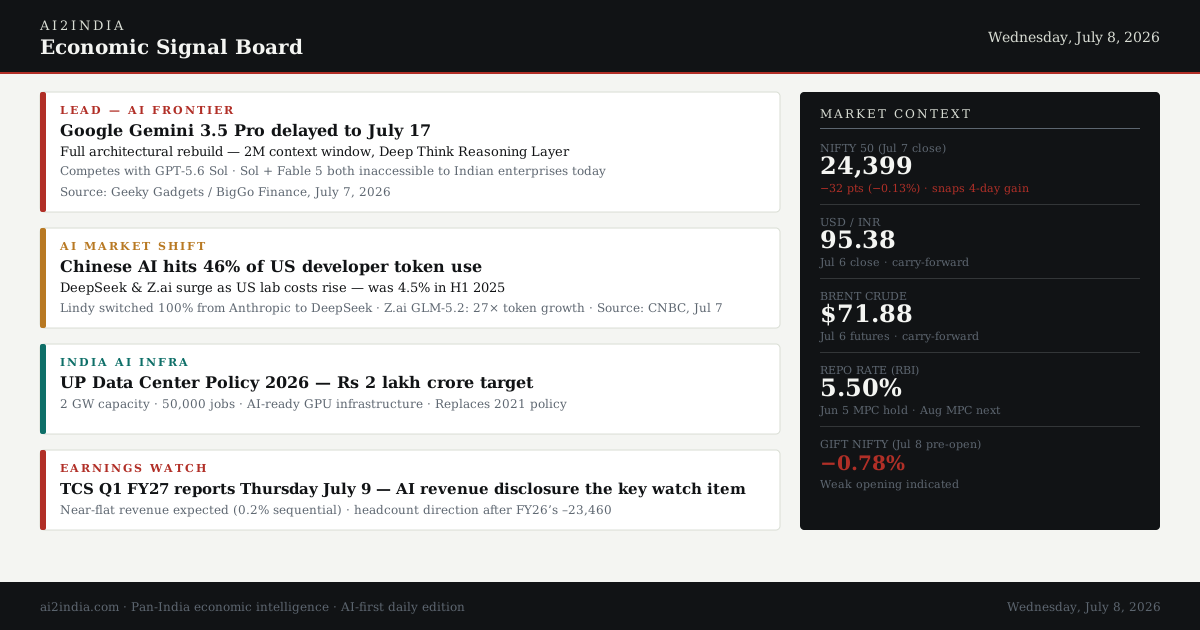
Google DeepMind delays Gemini 3.5 Pro to July 17 after full architectural rebuild — 2-million-token context window, Deep Think Reasoning Layer, improved mathematical reasoning and SVG generation; Nano Banana Pro and Gemini 4 Flash also in pipeline
Google DeepMind announced on July 7, 2026, that the launch of Gemini 3.5 Pro has been delayed to July 17, after the team abandoned the Gemini 2.5 Pro architecture entirely in favour of a complete pre-training rebuild from scratch. The decision reflects internal performance assessment showing the 2.5 Pro base was not competitive with OpenAI’s GPT-5.6 Sol and Anthropic’s Fable 5 on the capability dimensions most valued by enterprise buyers. The rebuilt Gemini 3.5 Pro will feature: a 2-million-token context window (the largest announced by any major frontier lab to date); a Deep Think Reasoning Layer for sustained complex multi-step problem-solving (analogous to GPT-5.6 Sol’s ultra mode but implemented differently); significantly improved mathematical reasoning accuracy; substantially better SVG scene generation (a benchmark Google uses as a proxy for spatial and compositional reasoning); and improved overall image and multimodal output quality. Google is also developing Nano Banana Pro, a specialist image-generation model, and Gemini 4 Flash, a speed-focused high-throughput model — mirroring OpenAI’s three-tier Sol/Terra/Luna structure and confirming that multi-tier model architectures are becoming the industry standard. The architectural rebuild follows a pattern seen in the broader frontier AI race: iterative improvement is being abandoned in favour of fundamental redesign when competitive benchmarks demand it. For Indian enterprise AI planners, the most critical capability is the 2M context window. The current standard for frontier models is 200K–500K tokens (Sonnet 5: 200K; DeepSeek V4-Pro: 128K). A 2M context window eliminates the need for chunking, retrieval-augmented generation overhead, or multi-pass document processing in the following enterprise use cases: full-contract review (typical enterprise contract stack is 50–200K tokens); large regulatory filing analysis; complete codebase comprehension (entire enterprise codebases in context for code review, refactoring, or compliance audit); multilingual document synthesis (entire annual reports, multi-language contract packages); and multi-session conversation memory (eliminating context-window drop-off in long-running AI agents). Each of these is a material productivity improvement for Indian IT services firms, BFSI institutions, and law firms deploying AI. The Deep Think Reasoning Layer is specifically engineered to compete with GPT-5.6 Sol’s ultra multi-agent mode on complex reasoning tasks, targeting: ExploitBench performance (cybersecurity reasoning), mathematical proof verification, and multi-step research synthesis. Both of these capabilities — 2M context and Deep Think — will be available to Indian enterprises from July 17 if general availability is confirmed. |
Geeky Gadgets; BigGo Finance “Google Delays Gemini 3.5 Pro Launch to July 17 for Full Architectural Rebuild” (Jul 7, 2026); Google DeepMind blog (Jul 7) |
Three India dimensions. First, enterprise stack update: Gemini 3.5 Pro on July 17 becomes the first next-generation frontier model accessible to Indian enterprises since the GPT-5.6 Sol access restriction and Fable 5 access closure. It will be the primary upgrade path for Indian enterprises currently using Gemini 2.5 Pro or Gemini Flash in enterprise AI pipelines. The 2M context window is the capability advance that will change the economics of document-heavy AI workflows in Indian IT services, BFSI, and legal sectors. Second, Google Cloud positioning: Indian enterprises running AI on Google Cloud (Vertex AI, Google AI Studio) will get direct access to Gemini 3.5 Pro via their existing Google Cloud agreements — no new procurement required. For IT services firms already on Google Cloud (Infosys, Wipro, Tech Mahindra all have major Google Cloud partnerships), July 17 is a client-delivery capability upgrade, not a procurement event. Third, competitive positioning vs. DeepSeek: Gemini 3.5 Pro’s 2M context window will be its primary competitive advantage over DeepSeek V4-Pro (128K context). For use cases requiring very large context (full-codebase review, large-contract analysis), Gemini 3.5 Pro will be superior. For cost-sensitive volume use cases and self-hosted data-localisation workloads, DeepSeek V4-Flash will remain the preferred option. |
Update enterprise AI roadmaps immediately: Gemini 3.5 Pro available July 17 — plan evaluation sprint for week of July 20. Priority use cases for 2M context: full-contract review, large codebase analysis, regulatory filing synthesis. For Google Cloud customers: no new procurement; capability is available via existing Vertex AI/Google AI Studio agreements. For teams waiting for a GPT-5.6 Sol alternative: Gemini 3.5 Pro is the nearest accessible candidate; benchmark Deep Think Reasoning Layer vs. Sol’s ultra mode on your specific use cases. Note: Sol general availability (OpenAI) remains on unknown timeline — do not wait for it; plan around Gemini 3.5 Pro as the July 17 frontier capability upgrade. |
Verified global — Geeky Gadgets; BigGo Finance; Jul 7, 2026 |
Chinese AI models surge to 30–46% of US developer token usage via OpenRouter — DeepSeek and Z.ai gain ground as OpenAI, Anthropic costs rise; was 4.5% in H1 2025; Lindy switched 100% from Anthropic to DeepSeek; Z.ai GLM-5.2 saw 27× token growth on Vercel; US government considering restrictions
A major analysis published by CNBC on July 7, 2026, drawing on OpenRouter token-level data and interviews with developers and analysts, reveals that Chinese-built AI models now account for 30 to 46% of all developer token usage on OpenRouter — the platform developers use to access multiple AI models — every week since February 8, 2026. The shift is quantitatively dramatic: in the first half of 2025, Chinese AI models averaged 4.5% of OpenRouter token volume. Over the prior 12 months, the average was 11%. Since February 2026, the floor has been above 30%, with peaks at 46%. The models driving this shift are DeepSeek (V4-Pro and V4-Flash) and Z.ai’s GLM-5.2, a model that saw 27-fold daily token volume growth on Vercel (the developer deployment platform) in its first week of availability. AI startup Lindy, which previously ran on Anthropic’s models, moved 100% of its traffic to DeepSeek — a switch it projects will save millions of dollars annually. Brookings Institution fellow Kyle Chan, interviewed by CNBC, framed the driver clearly: “Chinese AI models are particularly attractive to American companies now as AI costs skyrocket. Where previously US companies were prioritising AI adoption regardless of model, now they’re getting more cost-conscious.” The token-level pricing gap is stark: DeepSeek V4-Flash API is approximately $0.14 per million input tokens versus GPT-5.6 Sol at $5 per million (35 times more expensive) and Anthropic Sonnet 5 at $2 per million input (during promotional period, otherwise $3). For tasks that can be handled at DeepSeek-class capability, the economics are overwhelmingly cost-advantaged. The US government’s response is the policy watchpoint: the Trump administration, which requested GPT-5.6 Sol’s staged rollout in June and maintained BIS export controls on Anthropic models until recently, is reportedly considering measures to limit Chinese AI model access in the United States. CNBC notes that this consideration is directly linked to the 30–46% adoption data — regulators view widespread adoption of Chinese AI models as a national-security and data-sovereignty concern. |
CNBC “Chinese AI models are gaining ground with U.S. companies as OpenAI, Anthropic costs surge” (Jul 7, 2026); OpenRouter token data; Brookings Institution (Jul 7); Resultsense “Chinese AI models seize up to 46% of US developer use” (Jul 7) |
Two India dimensions. First, validation of the India enterprise DeepSeek strategy: the CNBC data shows that the cost-driven shift to Chinese open-weight AI is not a fringe developer preference — it is the mainstream enterprise AI procurement pattern in the US. Indian enterprises that adopted DeepSeek V4 for self-hosted regulated-sector workloads or volume API tasks are now in alignment with the production-scale deployment pattern of leading US technology companies. This external validation should accelerate BFSI, healthcare, and government enterprise teams that had been hesitant about DeepSeek adoption due to perceived novelty or supply-chain concern. The supply-chain argument is now harder to sustain: if the model is in production at scale across US enterprises and developer platforms, the operational maturity evidence base is large. Second, US regulatory risk: if the US government introduces access restrictions on Chinese AI models, India will face a decision point — whether to align with US restrictions or maintain independent access. India’s technology relationship with the US (the India–US AI partnership framework) creates pressure to align; India’s cost and sovereignty interests create pressure to maintain access. MeitY will need to take a public position on Chinese AI model access in India if US restrictions materialise. This is a scenario to monitor, not an immediate risk — but enterprise teams in regulated sectors should have contingency plans for a scenario where DeepSeek API access is restricted by policy. |
For enterprise AI architects: the 30–46% US adoption data is the strongest available validation of the DeepSeek cost-efficiency argument. Use this data in internal governance discussions where DeepSeek adoption is being evaluated — it removes the “untested at enterprise scale” objection. For regulated sectors (BFSI, healthcare, government): continue DeepSeek V4-Flash self-hosted evaluation; the self-hosted architecture specifically addresses both cost and data-localisation requirements and is insulated from any future API access restriction. For policy teams: begin scenario planning for a potential US restriction on Chinese AI model API access; a self-hosted deployment architecture is the hedge. Monitor CNBC, Reuters, and MeitY for first-mover policy signals in coming weeks. |
Verified global — CNBC; OpenRouter data; Brookings; Jul 7, 2026 |
Uttar Pradesh Cabinet approves AI-ready Data Center Policy 2026 — Rs 2 lakh crore investment target, 2 GW new capacity, 50,000 jobs; GPU-based, green, AI-ready infrastructure; Rs 21,343 crore already approved under old policy with 644 MW in pipeline
The Uttar Pradesh Cabinet, chaired by Chief Minister Yogi Adityanath, approved the Data Center Policy 2026 on July 7, 2026. The policy replaces the 2021 Data Center Policy, which expired in January 2026, and targets: total investment of more than Rs 2 lakh crore (Rs 2 trillion); additional data centre capacity of 2 gigawatts; creation of 50,000 direct and indirect jobs; and infrastructure standards specifically designed for AI, GPU, and cloud workloads. The policy builds on an already substantial baseline: under the 2021 policy, six data centre parks and two standalone units were approved, with Rs 21,343 crore committed and 644 MW of capacity now under construction across seven live projects. The 2026 policy raises the standard to full AI-readiness: eligibility criteria include GPU cluster integration (rather than CPU-only compute), renewable energy compliance targets (green infrastructure mandate), and high-availability uptime standards consistent with hyperscaler requirements. UP’s geographic advantages for data centre deployment are significant: proximity to Delhi-NCR (the largest enterprise IT consumption market in North India), the existing Delhi–Mumbai Industrial Corridor (DMIC) infrastructure, low land costs relative to Maharashtra and Karnataka, and improving power availability from the UP power sector reform programme. The policy is positioned to compete directly with Maharashtra’s Navi Mumbai data centre cluster, Karnataka’s Bengaluru data centre park, and Telangana’s HITEC City expansion for India’s next generation of AI-workload data centre investment. |
Moneycontrol “UP Cabinet approves AI-ready Data Center Policy 2026 with Rs 2 lakh crore investment target” (Jul 7, 2026); CNBC TV18; Times of India (Lucknow); Organiser “Cabinet approves data center policy 2026” (Jul 7) |
Three India dimensions. First, AI infrastructure competition: UP joining the state-level data centre policy race signals that AI compute infrastructure is now a primary economic development priority for India’s most populous state. The 2 GW target, if achieved, would represent approximately 40% of India’s current total data centre capacity — a transformative addition. For hyperscalers (AWS, Google Cloud, Microsoft Azure) and Indian IT firms considering on-premises or edge AI deployments in North India, UP’s GPU-ready policy framework and competitive land/power costs make it a credible location alternative to existing Bengaluru and Mumbai clusters. Second, sovereign AI relevance: the IndiaAI Mission’s 45,000+ GPU deployment target requires data centre capacity. UP’s AI-ready infrastructure policy directly enables the expansion of compute available to the IndiaAI Mission’s MEITY-managed GPU cluster and to Sarvam AI’s model training infrastructure. Third, GCC implication: Global Capability Centres expanding AI workloads in India (there are now more than 1,700 GCCs in India, per NASSCOM) require AI-grade compute infrastructure. UP’s policy, combined with its existing IT/ITeS ecosystem (Noida, Greater Noida, Lucknow), creates a viable North India GCC AI infrastructure option at scale. |
Monitor UP’s policy for incentive details (land cost, power tariff, GPU subsidy, tax holiday duration) when the detailed operational framework is published — expected within 60–90 days. For IT services firms evaluating North India expansion: UP’s policy creates a new option alongside existing Delhi-NCR location strategies. For hyperscalers: UP’s 2 GW GPU-ready target warrants a formal site evaluation. For the Sarvam AI/IndiaAI Mission team: UP data centre infrastructure is a near-term compute expansion option for thevam105B training and inference at national scale. |
Verified India — Moneycontrol; CNBC TV18; Times of India; Jul 7, 2026 |
Microsoft warns of “more changes” following 4,800 layoffs — AI task automation pattern accelerating at the world’s largest enterprise AI vendor; 267 layoff events in 2026 YTD affecting 185,894 workers (SkillSyncer Jul 7); Intuit 3,000 roles (17% of workforce) cut May 20 to fund AI
The Indian Express reported on July 7 that Microsoft has warned employees of additional restructuring to follow its 4,800-role cut announced July 6 — described as “more changes” in a company-wide communication from senior leadership. The 4,800 cuts (2.1% of global workforce, largest single AI-cited tech layoff of 2026) are now confirmed as a first tranche rather than a one-time event. SkillSyncer’s running tracker shows 267 layoff events in 2026 YTD affecting 185,894 workers globally as of July 7 — a figure that includes both AI-cited and non-AI-cited events. The AI-cited subset (tracked by TechCrunch and Layoffs.fyi) is the more structurally significant: it includes Microsoft (4,800, Jul 6), Oracle (21,000, Jun 22), GitLab (350, Jun 3), and Intuit (3,000, May 20). Intuit’s case is notable: the company cut 17% of its global workforce — including roles in TurboTax, QuickBooks, and Credit Karma product teams — explicitly to reallocate resources toward AI integration. Intuit reported growing revenue and forecast continued gains; the cuts are structural reallocation to AI, not business distress. The pattern across Microsoft, Oracle, GitLab, and Intuit is consistent: record revenues + AI-cited workforce restructuring = AI is generating measurable productivity at scale across software, enterprise technology, and financial software verticals. |
Indian Express “Microsoft warns of more changes after 4,800 layoffs amid broader restructuring” (Jul 7, 2026); SkillSyncer layoff tracker (Jul 7, 2026); TechCrunch running list; News18 “Every Big Tech Layoff in 2026 That Blamed AI” (Jul 7); Intuit press release (May 20, 2026) |
India dimension: Microsoft’s “more changes” warning is the first public indication that the 4,800-role announcement was a tranche, not a total. Microsoft India (headquartered in Hyderabad, with major operations in Bengaluru and Pune) is among Microsoft’s largest non-US engineering and support centres. If subsequent restructuring tranches include India-based roles — which Microsoft has not confirmed — the India impact would be material. India IT services firms that are Microsoft implementation partners (TCS, Infosys, Wipro, HCLTech, Cognizant) should monitor client IT spend signals from Microsoft enterprise customers: if Microsoft’s AI-driven productivity gains reduce its customers’ need for IT services headcount, downstream demand reduction is a secondary risk. The Intuit 3,000-role cut (May 20) is particularly relevant for India’s FinTech sector: Intuit’s products (QuickBooks, TurboTax) are used by Indian SMEs and accounting professionals; the AI integration that drove those cuts will arrive in the India market through Intuit’s India product offerings. |
Monitor Microsoft India communications for any indication of India-specific restructuring in coming weeks. For Microsoft partner firms (TCS, Infosys, HCLTech, Wipro, Cognizant): review Microsoft customer AI adoption rates — if clients are reducing IT services spend because AI is handling tasks previously outsourced to Indian IT firms, that signal will appear in Q2 FY27 client conversations before it appears in revenue data. For FinTech teams: track Intuit India product updates post-AI-integration for productivity benchmark data relevant to Indian financial software workflows. |
Verified global — Indian Express; SkillSyncer; TechCrunch; Jul 7, 2026 |