Pan-India economic intelligenceDaily Edition — 2026-07-07
AI2

Ai2India

Daily Edition

One daily issue tracking AI adoption, markets, hiring, layoffs, real estate, credit and gig-work signals across India.

PublishedJuly 7Daily issue
Nifty 50 (Jul 6 close)24,430.35+159.50 pts (+0.66%) from 24,270.85 (Jul 3 close); 5th consecutive positive week tracking; Sensex 78,285.07 (+521 pts); analysts target 24,450–24,800; TCS reports Jul 9 — first Q1 FY27 result; Rs 17 lakh crore Nifty IT market cap eroded amid AI pricing pressure
USD / INR95.38Jul 6 close; rupee fell 20 paise on the day; DXY firmness; Jul 7 morning range 95.30–95.60 per optionchainindia.com technical; prior close 95.18; carry-forward range
Brent Crude$71.88/bblJul 6 futures; –0.33%; WTI $68.41 (–0.41%); OPEC+ supply balance + US–Iran diplomacy; India import-cost tailwind continues; floor watch at $68; carry-forward
Repo Rate (RBI)5.50%Jun 5 MPC hold; August MPC next live window; Warsh Fed bias remains binding constraint on RBI cut timing; carry-forward

Lead Analysis — Global AI Frontier

OpenAI’s GPT-5.6 Sol, Terra, and Luna — the most capable frontier model series yet — is in limited preview with only ~20 US government-vetted organisations; no general-availability date has been announced, leaving Indian enterprises locked out of the frontier while Microsoft simultaneously cuts 4,800 roles citing AI and India emerges as the world’s second-highest destination for AI-driven tech layoffs, even as AI hiring surges to 16 per cent of all India IT vacancies.

Tuesday, July 7, 2026: OpenAI previewed its GPT-5.6 series — Sol (flagship), Terra (balanced), and Luna (fast/affordable) — on June 25–26. Access is restricted to approximately 20 government-vetted organisations following a White House request for a staged rollout while national-security cybersecurity reviews are completed. No general-availability date has been announced. Indian enterprises and developers cannot access these models today. Simultaneously, Microsoft announced 4,800 layoffs globally (2.1% of its workforce) on July 6, citing AI as the force reshaping how work gets done — the largest AI-cited single-day cut of 2026, bringing the year’s global AI-cited tech layoffs to 120,000. Against this, fresh data from Naukri.com shows India’s AI-specific hiring surging to 16% of all IT vacancies in July 2026, up from 2.9% in January 2023. India is simultaneously the world’s second-highest country for AI-driven tech layoffs (7.16% of global cuts) and one of the fastest-growing markets for AI talent demand. TCS reports Q1 FY27 results on July 9 — the first Indian IT sector earnings disclosure that will include explicit questions about AI’s revenue impact and headcount trajectory. Today (July 7) is also the last day Fable 5 is accessible on select plans before the access window narrows.

GPT-5.6’s architecture and capabilities represent the clearest signal yet that the frontier model race has entered a new phase. OpenAI’s announcement introduces three distinct tiers within a single model generation: Sol (flagship, maximum reasoning, ultra multi-agent mode), Terra (balanced, GPT-5.5 competitive capability at half the price), and Luna (fast, low-cost, high-throughput). The pricing structure is significant: Sol at $5 input / $30 output per 1M tokens; Terra at $2.50 input / $15 output; Luna at $1 input / $6 output. GPT-5.6 also introduces a 90% discount on cached reads (cache writes billed at 1.25× uncached input rate), making repeated enterprise workflows substantially cheaper than earlier pricing regimes. On Cerebras infrastructure, GPT-5.6 Sol will be available at up to 750 tokens per second — a speed figure that redefines real-time AI agent performance — for select customers beginning July 2026.

The capability claims are material. GPT-5.6 Sol sets a new state of the art on Terminal-Bench 2.1 (command-line workflows requiring planning, iteration, and tool coordination). On GeneBench v1 (genomics and quantitative biology), Sol improves on GPT-5.5 while using fewer output tokens. On ExploitBench, Sol is competitive with Anthropic’s Mythos Preview using only one-third of the output tokens. The Ultra mode goes beyond a single-agent architecture, leveraging coordinated subagents to accelerate complex multi-step workflows — a direct capability advance for enterprise agentic deployments in coding, research synthesis, compliance review, and financial modelling.

The access picture for Indian enterprises is a three-tier structure. The most capable models (GPT-5.6 Sol, Terra, Luna) are in a US government-coordinated preview restricted to ~20 vetted partners; OpenAI “has not announced a general-availability date” (OpenAI Help Center, July 3). The second tier is the existing Fable 5 access window, which closes today (July 7) for the select-plan access that was temporarily available — Indian enterprise teams with Fable 5 access on qualifying plans have today as their final evaluation window. After July 7, the practical architecture for Indian enterprises remains: Sonnet 5 (capable agentic tasks), Gemini 3.5 Flash or DeepSeek V4-Flash API (volume tasks), and DeepSeek V4-Flash self-hosted for regulated-sector data-localisation workloads.

The broader geopolitical context is unavoidable: the US government’s request for staged AI model rollouts — first applied to Fable 5 (Anthropic) in June, now GPT-5.6 Sol (OpenAI) in June-July — is establishing a pattern in which the most capable frontier AI tools are released first in a US government-coordinated manner, with non-US enterprise access delayed. For Indian enterprises, this is not an abstract policy debate. It is a concrete constraint on which AI tools are available for deployment today. Enterprise AI planning teams that set strategy based on frontier capability announcements must now separately track capability announcements versus access availability — GPT-5.6 Sol exists and is the most capable model available, but Indian enterprises cannot use it yet.

Microsoft’s 4,800 role cuts, announced July 6, are particularly significant as a signal because Microsoft is simultaneously OpenAI’s largest investor and a primary delivery channel for OpenAI models to enterprise customers. The cuts are described as affecting roles made redundant by AI automation of everyday tasks. Microsoft says the roles “are not being replaced by AI” but simultaneously acknowledges “AI is changing how work gets done.” This is now a standard formulation for AI-cited layoffs — TechCrunch counts roughly 120,000 global tech roles cut in 2026, with AI as the most-cited reason (Challenger, Gray & Christmas, May 2026 data). For Indian enterprises, the Microsoft cuts are a leading indicator: if the company most deeply invested in enterprise AI deployment is reducing roles at this pace, the AI-driven restructuring signal is not a 2027–2028 scenario. It is happening now.

India’s AI jobs data from ETV Bharat (published July 6) synthesises Naukri.com, Stanford AI Index, and government data into a coherent picture: India accounts for 7.16% of global AI-driven tech layoffs in H1 2026 (second only to the US at 71.33%); AI-specific job vacancies have risen from 2.9% of total in January 2023 to 16% in July 2026; AI talent demand (3.5 lakh professionals in India in 2023, 4.2 lakh in 2024) still runs 50% short of the 6 lakh industry demand figure. India is therefore simultaneously the world’s second-largest destination for AI-driven job cuts and one of the world’s fastest-growing markets for AI talent hiring — a structural paradox that reflects the bifurcation of the Indian IT workforce into an AI-skilled cohort (in demand, premium wages) and an AI-displaced cohort (laid off or not being replaced). The Q1 FY27 earnings season opening Thursday with TCS will begin to put hard revenue numbers on this picture.
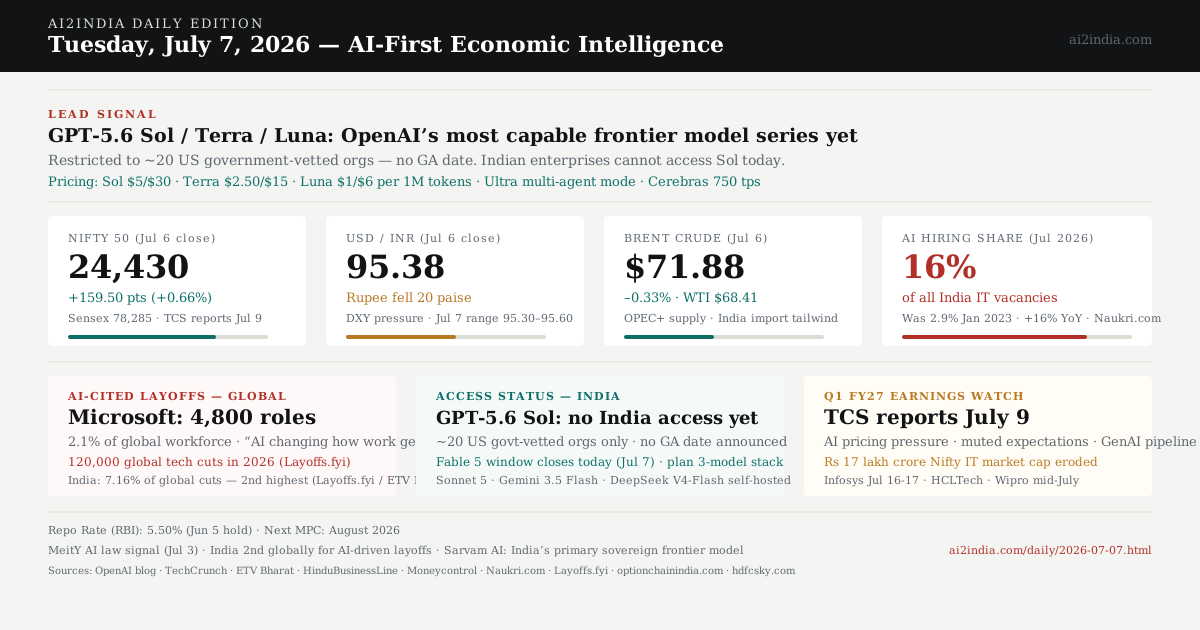
July 7, 2026 signal board: GPT-5.6 Sol/Terra/Luna locked to ~20 US govt orgs; Microsoft 4,800 AI-cited layoffs; India 2nd globally for AI-driven cuts (7.16%); AI hiring 16% of vacancies; Nifty 24,430 (Jul 6 close); USD/INR 95.38; Brent $71.88/bbl; TCS reports Jul 9; Repo 5.50%
Today’s economic signal board. Full analysis in the Daily Edition.

AI Developments Today

Tuesday, July 7, 2026: three verified AI developments that change what Indian enterprise AI planners must track this week. GPT-5.6 Sol/Terra/Luna is the most capable frontier model series available — but not accessible to Indian enterprises today. Microsoft’s 4,800 AI-cited layoffs are the clearest enterprise-level signal yet that AI-driven workforce restructuring is in progress. And the Fable 5 access window closes today.

DevelopmentSource + DateIndia RelevanceWhat this means for Indian enterpriseStatus
OpenAI GPT-5.6 Sol, Terra, and Luna: new frontier model series previewed June 25–26, 2026 — access restricted to ~20 US government-vetted organisations; no general-availability date; Sol at $5/$30 per 1M tokens; Terra at $2.50/$15; Luna at $1/$6; Ultra multi-agent mode introduced; Cerebras 750 tokens/second for select July customers

OpenAI announced a limited preview of its GPT-5.6 series on June 25–26, 2026. The series introduces three model tiers: Sol (flagship, maximum reasoning, new ultra mode leveraging coordinated subagents for complex workflows), Terra (balanced performance competitive with GPT-5.5 at approximately half the price), and Luna (fast, affordable, high-throughput). Benchmarks: Sol sets a new state of the art on Terminal-Bench 2.1 (coding command-line workflows), GeneBench v1 (genomics and quantitative biology), and ExploitBench (cybersecurity, competitive with Anthropic Mythos Preview at one-third the token cost). Access: following a White House request, OpenAI is staging the rollout while national-security cybersecurity capability reviews are completed. Approximately 20 government-vetted organisations have API access through Codex. OpenAI plans to make all three models “generally available in the coming weeks” but has not announced a specific date. The pricing represents the most competitive frontier API pricing OpenAI has offered: Sol is positioned against GPT-5.5 (more capable, similar cost range); Terra is 2× cheaper than GPT-5.5 at competitive capability; Luna is OpenAI’s lowest-cost capable model, positioned against Gemini Flash and DeepSeek V4-Flash for high-volume tasks. Prompt caching: 90% discount on cached reads, with cache writes billed at 1.25× uncached input rate — making repeated enterprise workflows (RAG, multi-turn agents, document analysis) substantially cheaper than earlier pricing regimes. GPT-5.6 Sol on Cerebras infrastructure delivers up to 750 tokens per second — a speed milestone that makes real-time agentic workflows (live coding assistance, real-time document synthesis, interactive customer service AI) significantly more practical than they were with GPT-5.5 API latencies.
OpenAI blog “Previewing GPT-5.6 Sol: a next-generation model” (Jun 25–26, 2026); OpenAI Help Center “A preview of GPT-5.6 Sol, Terra, and Luna” (Jul 3); TechTimes “ChatGPT Pro splitting into three” (Jul 2); TechJack Solutions “GPT-5.6 Pricing” (Jul 3); ExplainX “GPT-5.6 Sol, Terra & Luna: Pricing, Benchmarks & Access” (Jul 3) Three India dimensions. First, access delay: Indian enterprises cannot use GPT-5.6 Sol, Terra, or Luna today. The US government-coordinated access process — now applied to two consecutive frontier model releases (Anthropic Fable 5 in June, OpenAI GPT-5.6 Sol in June–July) — is becoming a structural constraint on India’s access to the most capable AI tools. Until GPT-5.6 reaches general availability (estimated coming weeks), the gap between what frontier AI can do and what Indian enterprises can deploy widens. Second, pricing signal: when GPT-5.6 Sol reaches general availability, it will set a new enterprise pricing benchmark. Terra’s $2.50/$15 pricing at GPT-5.5 capability directly competes with Gemini 1.5 Pro and DeepSeek V4-Pro API pricing — the enterprise model that Indian IT services firms use for volume workloads will likely shift toward Terra as soon as it is accessible. Luna’s $1/$6 pricing competes directly with Gemini 3.5 Flash and DeepSeek V4-Flash for high-volume, lower-stakes tasks. For Indian enterprises building cost-efficient AI pipelines, the GPT-5.6 pricing structure — once accessible — will compress the pricing premium of using GPT models over open-weight alternatives. Third, ultra mode signal: the introduction of coordinated subagent workflows (ultra mode) in Sol is a direct capability advance for the AI agent architectures that Indian IT services firms (TCS, Infosys, HCLTech, Wipro) are building and selling to global clients. When Sol becomes accessible, Indian IT services firms that have invested in multi-agent AI architectures will have a more capable foundation model to deliver on those architectures. Monitor OpenAI’s general-availability announcement for GPT-5.6 Sol — it will arrive within weeks and will require immediate model architecture decisions for enterprise teams. For volume workloads: plan for Terra (GPT-5.5 capability at half price) as the immediate upgrade from GPT-4o/GPT-5 when available. For high-throughput tasks: plan for Luna as a GPT-native alternative to Gemini Flash and DeepSeek V4-Flash. For agentic workflows: Sol’s ultra mode (coordinated subagents) is the capability advance most relevant to Indian IT services firms building AI agent platforms — factor this into Q2 FY27 client capability roadmap discussions. For today: Fable 5 access window closes (see below) — if you have access, use it for final benchmarking before planning your Sol-era architecture. Verified global — OpenAI blog; TechTimes; Jun–Jul 2026
Microsoft eliminates 4,800 roles globally (2.1% of workforce) citing AI transformation — largest single AI-cited tech layoff event of 2026; 120,000 global tech roles cut citing AI this year; India accounts for 7.16% of global AI-driven tech layoffs in H1 2026 — second only to the United States

Microsoft announced on July 6, 2026, that it is eliminating approximately 4,800 roles — representing 2.1% of its global workforce. The company said the roles “are not being replaced by AI,” but simultaneously acknowledged that “AI is changing how work gets done” and is automating many everyday tasks. This is the latest — and the largest single-announcement — in a year of AI-cited tech layoffs tracked by TechCrunch and Layoffs.fyi. According to Layoffs.fyi, roughly 120,000 tech roles have now been cut globally in 2026, with AI as the most-cited reason (confirmed by outplacement firm Challenger, Gray & Christmas for May 2026, the highest single month in years). Other major AI-cited layoffs in 2026: Oracle disclosed 21,000 roles cut over 12 months (13% of workforce) citing AI adoption in a June 22 SEC filing; GitLab cut 350 roles (14% of staff) on June 3 to fund AI infrastructure and handle surging traffic from AI workflows. On the India-specific picture: ETV Bharat (July 6), synthesising Layoffs.fyi and government data, reports that India accounted for 7.16% of the 128,000 global AI-driven tech layoffs in H1 2026, ranking second only to the United States (71.33%). India’s H1 2026 AI-driven layoffs were concentrated in EdTech (21.67% of India’s share) and FinTech (14.73%), with general IT services companies avoiding mass layoff announcements but implementing headcount reductions through hiring freezes and non-replacement (TCS’s net –23,460 headcount in FY26 being the most prominent example).
TechCrunch “Every major tech layoff in 2026 that has name-checked AI” (Jul 6, 2026); Microsoft blog “The latest in our company transformation” (Jul 6); Challenger, Gray & Christmas (May 2026); Layoffs.fyi (Jul 6); Oracle 10-K filing SEC.gov (Jun 22); GitLab press release (Jun 3); ETV Bharat “India’s AI Jobs Paradox” (Jul 6) Two India-specific dimensions. First, the Microsoft signal: Microsoft is India’s largest enterprise technology partner (Azure, Microsoft 365, GitHub Copilot, Bing AI, Azure OpenAI Service) and OpenAI’s largest investor. If Microsoft is restructuring its own workforce at 2.1% globally due to AI automation of everyday tasks, the operational model it is implementing internally is the same operational model it will sell to Indian enterprise clients through Azure AI and GitHub Copilot. Indian enterprise HR leads and workforce planning teams should treat the Microsoft 4,800 cuts as a preview of the AI-driven workforce restructuring model that will arrive in Indian enterprise organisations in 6–18 months. Second, India’s 7.16% share: India is not a passive observer of global AI-driven layoffs — it is the second-highest impacted country. This is a structural signal, not a rounding error. EdTech and FinTech are the most impacted India sectors, but the pattern will spread to general IT services, BFSI back-office operations, and media as AI adoption deepens. The Q1 FY27 earnings season (beginning TCS, July 9) will provide the first quarterly data point on whether the headcount reduction trend is accelerating or stabilising in India IT services. For enterprise workforce planning: use the Microsoft 4,800 cuts as a planning forcing function — identify which roles in your organisation are most susceptible to AI task automation, and build reskilling pathways for those cohorts now rather than after a forced restructuring. For India IT services firms: the 7.16% India share of global AI-cited layoffs will be referenced by clients in enterprise AI transformation discussions — prepare a clear position on your firm’s own AI impact on headcount alongside your AI services revenue story for Q1 FY27 analyst calls. For policy: the combination of Microsoft (4,800), Oracle (21,000), and India’s 7.16% share strengthens the case for the social protection dimension of MeitY’s forthcoming AI law to include provisions for AI-displaced workers alongside AI governance obligations. Verified global — TechCrunch; Microsoft blog; Layoffs.fyi; Jul 6, 2026
India AI hiring surges to 16% of all IT vacancies (July 2026) — up from 2.9% (January 2023); AI talent demand 2.5× global average; 50% talent shortfall; AI hiring +16% YoY while overall IT hiring –3% YoY; AI roles in FMCG, insurance, retail up 25%

Naukri.com data, released July 3 and synthesised in an ETV Bharat analysis published July 6, provides the most comprehensive India AI hiring picture to date. The headline figures: AI-specific roles now constitute 16% of all India IT job vacancies in July 2026, up from 6.5% in March 2025 and 2.9% in January 2023. This 5.5-year trajectory confirms that AI hiring is not a temporary trend but a structural reallocation of India’s IT talent demand. Overall India IT hiring has declined 3% year-on-year, but AI-specific hiring has surged 16% year-on-year. Beyond IT, AI and automation roles in adjacent sectors — FMCG, insurance, retail — grew by up to 25%, reflecting AI’s expanding footprint across India’s broader economy. The talent gap is severe: India had approximately 3.5 lakh AI professionals in 2023; by 2024, that grew to 4.2 lakh; but industry demand already exceeded 6 lakh in 2024, creating a 50% structural talent shortfall. India’s demand for AI talent is 2.5 times the global average, according to both the Stanford AI Index 2026 and Government of India data. New job categories are emerging from the AI displacement: AI auditors, AI compliance specialists, prompt engineers, AI safety specialists, and cybersecurity AI specialists. The ICAI–Sarvam AI MoU (June 2026) and the India–Japan AI pact’s 500-professional pipeline both address dimensions of this talent gap from opposite directions: upskilling existing professionals (ICAI) and creating international pipeline alternatives (Japan).
ETV Bharat “India’s AI Jobs Paradox: Second-Highest Tech Layoffs, But AI Hiring Surges As Skills Gap Widens” (Jul 6, 2026); Naukri.com data (Jul 3, 2026); Stanford AI Index 2026; Government of India data; ICRIER survey of 651 IT companies (2024) The 16% AI hiring share figure is India’s most important labour market data point of the year. It means: for every 100 IT job vacancies advertised in India today, 16 are AI-specific roles. This ratio will be above 25% by 2028 if the acceleration trajectory continues. For Indian enterprise talent teams: AI talent is not a specialty hire — it is entering the mainstream talent market at a pace that changes how you write job descriptions, how you set compensation bands, and how you source candidates. The 50% talent shortfall means that AI talent acquisition is now a competitive advantage question, not just an HR function. Companies that have built reskilling pipelines — like TCS’s internal AI training programme, Infosys Lex, or Wipro AI360’s talent development tracks — will be better positioned to meet demand from internal supply than those relying entirely on external hiring. For India AI startups: the 16% hiring share is also an addressable market signal — AI upskilling platforms, AI talent assessment tools, and AI-native HR products have a structural demand signal that will compound over the next 5 years. Verified India — Naukri.com; ETV Bharat; Jul 3–6, 2026
Fable 5 access window closes today (July 7) — carry-forward from July 6 edition; last evaluation window for Indian enterprise teams on select plans; post-July 7 architecture recommendation remains three-model stack

As flagged in the July 6 edition, Fable 5 was temporarily accessible on certain Anthropic plans until July 7, 2026 — today is the final day of that window. Indian enterprise teams with Fable 5 access on qualifying plans should complete benchmark testing, production use-case validation, and comparative assessments against their current model stack today. After July 7, Fable 5 access will depend on plan type and US government clearance status under the BIS export control regime (June 12 order). The older Anthropic Mythos model remains accessible — US export controls were partially eased (The Guardian, July 1; MeitY Secretary S. Krishnan confirmed July 3). Mythos 5 and Fable 5 next-generation models remain under BIS export control, requiring US government approval for Indian entities seeking broader access. GPT-5.6 Sol (the frontier model that matches or exceeds Fable 5 on key benchmarks) is also not accessible to Indian enterprises today. The practical outcome: the three-model stack remains the recommended architecture for Indian enterprise AI through Q3 2026.
Geeky Gadgets (Jul 5, 2026); The Guardian (Jul 1); MeitY Secretary S. Krishnan CII statement (Jul 3); OpenAI blog (Jun 25–26); OpenAI Help Center (Jul 3) The convergence of Fable 5 access closing (July 7) and GPT-5.6 Sol not yet accessible creates a transitional gap for Indian enterprises that were counting on frontier model capability upgrades in Q3 2026. The gap is temporary — GPT-5.6 Sol general availability is expected in coming weeks per OpenAI — but it reinforces the strategic case for a multi-provider AI architecture that does not depend on any single frontier model’s availability. For regulated sectors (BFSI, healthcare, government): this transitional period is an opportunity to accelerate evaluation of DeepSeek V4-Flash self-hosted as the primary AI for data-localisation-compliant workloads, reducing dependence on both Fable 5 and Sol during the access gap. The MeitY AI law signal further strengthens this argument: a data-localisation provision in India’s forthcoming AI law would make self-hosted AI not just a tactical choice but a regulatory requirement for regulated-sector workloads. Verified global — Geeky Gadgets; The Guardian; MeitY; Jul 1–7, 2026

India AI Ecosystem

Tuesday, July 7, 2026: India’s AI ecosystem enters the week with the Q1 FY27 earnings season opening in two days (TCS, July 9) — the first quarterly data event that will put hard AI services revenue numbers on NASSCOM’s $10–12B projection. Sarvam AI remains India’s primary sovereign frontier model effort following Krutrim’s cloud pivot. The MeitY AI law process is the week’s most important regulatory forward-looking item.

Platform / OrganisationDevelopmentIndia AI SignificanceStatus
TCS — Q1 FY27 results July 9
India’s largest IT exporter
FY26 headcount: –23,460
AI deal pipeline watch
Kotak: preferred large-cap
TCS reports Q1 FY27 on July 9. Expectations are muted across brokerages. Key watch items (BNP Paribas): AI and GenAI deal pipeline size and composition; international business revenue direction; FY27 revenue growth guidance; data centre business update; GenAI partnership investments (including the HCLTech $1.14B AI deal competitive context). FY26 context: TCS posted a net headcount reduction of 23,460 employees — the reversal or continuation of this trend in Q1 FY27 headcount data is the single most-watched India AI workforce signal. AI services revenue disclosure: NASSCOM projects $10–12B in India IT AI services revenue — any explicit AI revenue percentage disclosed by TCS will be the first hard benchmark against this projection. Analyst positioning: Kotak flagged TCS as a preferred large-cap; consensus expects muted revenue growth but potential margin beat. The Rs 17 lakh crore Nifty IT market cap erosion makes a positive surprise in Q1 FY27 a potential catalyst for Nifty IT re-rating — but analyst consensus does not anticipate this. TCS Q1 FY27 results (July 9) are the most important India AI data event of the week. The company’s AI services revenue disclosure — however partial — will be the first empirical data point against NASSCOM’s $10–12B AI services revenue projection. The headcount direction will determine whether the AI-driven workforce bifurcation (AI-skilled hiring up, traditional roles not backfilled) is accelerating or stabilising at India’s largest IT employer. Plan to review TCS’s earnings call transcript for: (1) GenAI deal pipeline size; (2) AI revenue as percentage of total; (3) Q1 headcount vs. Q4 FY26 headcount; (4) Q2 FY27 guidance and FY27 full-year guidance revision. Verified signal — BusinessToday; LiveMint; Financial Express; Jul 6, 2026
Sarvam AI — India’s primary sovereign frontier model
thevam30B + thevam105B
$1.5B valuation
HCLTech 10.46%
India govt 1–2% equity
10M API calls/day
No new Sarvam AI announcement today. However, the GPT-5.6 Sol access restriction — added to the Fable 5 access restriction and Krutrim’s frontier model exit — strengthens Sarvam’s structural position in India’s AI ecosystem. With Sol inaccessible to Indian enterprises and Fable 5 closing today, Sarvam’s thevam105B is the most capable India-based, India-hosted frontier model available for regulated-sector workloads with data-localisation requirements. The MeitY AI law signal (S. Krishnan, Jul 3) creates a forward regulatory environment in which India-domiciled AI models may receive preferential treatment for regulated-sector use — a scenario that structurally benefits Sarvam. The India–Japan AI pact (Jul 3) also creates a non-US AI research partnership channel that Sarvam could leverage for model development support. The IndiaAI Mission’s 45,000+ GPU deployment remains Sarvam’s primary compute resource advantage over open-weight alternatives. Sarvam AI’s position is strengthened by every frontier model access restriction and by every MeitY AI law signal that points toward data-localisation requirements. Monitor Sarvam for: model capability announcements; API pricing; data centre expansion; and any new enterprise partnerships that would validate the $1.5B valuation in the context of a competitive open-weight alternative landscape (DeepSeek V4-Flash self-hosted now provides frontier-class capability at self-hosted cost). The HCLTech Q1 FY27 results (mid-July) will include the first earnings-call commentary on Sarvam’s 10.46% stake value and strategic integration. Verified India (baseline) — strategic analysis from GPT-5.6 access restriction signal
HCLTech — $1.14B AI deal; Sarvam 10.46%; Q1 FY27 watch
Fortune Global 50 EU client
$228M/yr · Jul 2026–Dec 2031
HCL AI Force
+6.3% on deal announcement
Carry-forward from July 3–6 editions. HCLTech’s $1.14B AI deal and Sarvam AI 10.46% stake are unchanged. Q1 FY27 results expected mid-July. Context update for July 7: with Microsoft cutting 4,800 roles citing AI, HCLTech’s $1.14B AI services deal is the counterpoint narrative — the same AI that is cutting 4,800 Microsoft roles is simultaneously enabling a $228M/year AI services contract for India’s IT sector. The AI-driven restructuring and AI services revenue growth are not contradictory signals; they are two faces of the same AI transformation. HCLTech’s Q1 FY27 results will be watched for: HCL AI Force revenue contribution; Sarvam stake integration; GenAI deal pipeline vs. TCS and Infosys; and guidance for the second half of FY27. HCLTech’s positioning — largest India IT AI services contract, Sarvam co-owner, HCL AI Force product, DeepSeek V4 open-weight deployment capability — makes it the best-positioned India IT services firm for the GPT-5.6 Sol general availability event. When Sol becomes accessible, HCLTech’s AI Force platform needs to incorporate Sol quickly to maintain its edge on the $1.14B deal delivery architecture. Verified India — ET; Financial Express; NDTV Profit; Jul 3 (carry-forward)
India IT sector: Rs 17 lakh crore market cap erosion; Wipro –54% from peak; LTIMindtree –53%; AI pricing pressure the structural driver
Nifty IT under-performance
vs. Nifty 50 broad market
Economic Times reported (July 6) that India’s top IT firms have seen a collective market cap erosion of Rs 17 lakh crore. Wipro is down 54% from its peak; LTIMindtree has lost more than 53%. HCLTech, Persistent Systems, Mphasis, and Tech Mahindra have also seen sharp declines. The structural driver: AI-led pricing pressure (clients expect cheaper outcomes from AI-augmented delivery), weak global demand (enterprise spending under pressure from macro uncertainty), and the accelerating commoditisation of traditional IT services (testing, maintenance, basic development) by AI-native tools (GitHub Copilot, Cursor, Devin). Against this, Nifty 50 has attracted global investors seeking stability (Bloomberg, July 5) — the broad market is outperforming the IT sector. This divergence is the market’s pricing of AI disruption risk into India IT specifically while viewing India’s broader economy as relatively stable. The Rs 17 lakh crore erosion is not a valuation problem that Q1 FY27 results will solve in one quarter. It is a structural re-rating of India IT business models that will only reverse when: (1) India IT firms demonstrate AI services revenue growth that offsets traditional services pricing compression; or (2) global enterprise AI spending accelerates enough to expand total IT budgets rather than just shift them from traditional to AI. Q1 FY27 results will indicate which direction Q2 is likely to take. Monitor TCS’s AI pipeline commentary for signal on whether India IT is in a transitional revenue gap (short-term) or a structural pricing decline (long-term). Verified India — Economic Times; Jul 6, 2026
Carry-forward: ICAI + Sarvam MoU; Neysa $1.5B; OpenAI India MD Prabhjeet Singh; NASSCOM AI data; IndiaAI Mission 45K GPUs; Infosys Topaz; TCS AI Cloud; Wipro AI360; Krutrim cloud pivot; MeitY AI law signal All carry-forward items unchanged. Key contextual update for July 7: the Microsoft 4,800 AI-cited layoffs and the India 7.16% AI-driven layoff share together strengthen the case for NASSCOM, MeitY, and India IT firms to invest urgently in AI reskilling programmes — the talent bifurcation (AI-skilled cohort in demand, AI-displaced cohort at risk) is a market failure that requires structured policy response. NASSCOM AI data ($10–12B AI services revenue, 2M+ skilled professionals) will be tested against Q1 FY27 earnings data beginning Thursday. IndiaAI Mission 45,000+ GPU deployment: strategic asset for Sarvam AI’s thevam105B remains a decisive competitive advantage for India’s sovereign model effort vs. open-weight self-hosted alternatives. The Krutrim cloud pivot, MeitY AI law signal, and India–Japan AI pact all carry forward with unchanged strategic significance. The GPT-5.6 Sol access restriction adds a new dimension: India’s AI infrastructure independence is more valuable today than it was last week, because the most capable US frontier model is not accessible. The IndiaAI Mission compute programme and Sarvam AI’s frontier model investment are now explicitly a hedge against US AI access restrictions, not just a sovereign capability aspiration. Verified India — Multiple; Jun–Jul 2026 (carry-forward)

AI Adoption Impact

July 7: India’s AI adoption environment is shaped by three simultaneous forces today. The demand side is pulling AI capability in (16% of IT vacancies are AI roles; AI services revenue growing). The supply side is restricting frontier model access (GPT-5.6 Sol and Fable 5 both inaccessible or closing). And the displacement side is generating the first hard data (7.16% of global AI-driven layoffs, Microsoft 4,800 cuts) that changes how enterprise HR and workforce planning teams must operate.

AI Impact DimensionEvidenceTrajectory
India AI talent bifurcation: AI-skilled cohort (demand accelerating, 16% of vacancies, 50% talent shortfall) vs. AI-displaced cohort (7.16% of global AI-driven layoffs); structural gap widening Naukri.com (Jul 3, 2026); ETV Bharat (Jul 6); Layoffs.fyi H1 2026. AI-specific roles: 16% of India IT vacancies (Jul 2026), up from 2.9% (Jan 2023). AI hiring: +16% YoY. Overall IT hiring: –3% YoY. AI talent demand: 6 lakh (2024); supply: 4.2 lakh — 50% shortfall. India AI-driven layoffs H1 2026: 7.16% of global 128,000 = ~9,165 jobs. EdTech: 21.67% of India share; FinTech: 14.73%. India demand for AI talent: 2.5× global average (Stanford AI Index). New roles emerging: AI auditors, compliance specialists, cybersecurity AI, prompt engineers. TCS FY26: net –23,460 headcount (Q1 FY27 direction is the critical next data point). ↑ Bifurcation deepening; talent shortfall at 50% is structural; Q1 FY27 earnings headcount data will indicate whether the pace is accelerating or stabilising; reskilling investment is the single most effective enterprise response; government AI law design must include worker protection provisions
Enterprise AI adoption: Microsoft 4,800 AI-cited cuts signals AI task automation is crossing from pilot to production at major enterprises; India IT faces both the risk (AI displacing services) and the opportunity (AI services revenue) Microsoft blog (Jul 6); TechCrunch running list (Jul 6); Oracle SEC filing (Jun 22); GitLab press release (Jun 3). Microsoft: 4,800 roles, 2.1% global workforce, July 6. Oracle: 21,000 roles over 12 months (13%), AI adoption cited in SEC filing. GitLab: 350 roles (14%), AI infrastructure investment. Pattern: record revenues + AI-driven restructuring = AI is now generating measurable productivity uplift at scale, not just in pilots. For India IT: the same AI tools that Microsoft is using to restructure its workforce are the tools that TCS, Infosys, Wipro, and HCLTech are selling to clients. The ethical and commercial tension — India IT sells AI that displaces workers, while India workers are being displaced by AI — is the defining strategic tension of Q1 FY27. ↑ AI task automation crossing to production scale globally; India IT firms face dual pressure (being disrupted + selling disruption); Q1 FY27 earnings will reveal which side of this equation is generating more revenue at current pricing
Frontier model access gap: GPT-5.6 Sol locked to ~20 US orgs; Fable 5 window closing today; Indian enterprises effectively operating on Gen-n-1 frontier capability while global peers access Gen-n OpenAI blog (Jun 25–26, 2026); OpenAI Help Center (Jul 3); TechTimes (Jul 2); Geeky Gadgets (Jul 5). GPT-5.6 Sol: locked to ~20 US govt-vetted orgs; no GA date. Fable 5 select-plan access: closes today (Jul 7). Older Mythos: accessible (US controls partially eased). DeepSeek V4-Pro (1.6T param, MIT licence, 85% cheaper than GPT-5.5): self-hostable, India accessible. DeepSeek V4-Flash (284B param): fast, cheap, self-hostable. Sonnet 5 (Anthropic): accessible in India, $2/M input through Aug 31. Gemini 3.5 Flash: accessible. Gap: Sol’s ultra multi-agent mode, Terminal-Bench 2.1 SoTA, ExploitBench performance are not accessible to Indian enterprises today. → Temporary gap (GPT-5.6 Sol general availability expected “in coming weeks” per OpenAI); structural risk if US government-coordinated access patterns become routine for future model releases; builds strategic case for India-domiciled and open-weight AI infrastructure; DeepSeek V4-Pro self-hosted is the current best available substitute for Sol-class capability
Q1 FY27 earnings season: empirical AI revenue test begins Thursday (TCS July 9) — first hard data point against NASSCOM’s $10–12B AI services forecast; Rs 17 lakh crore market cap erosion at stake LiveMint (Jul 6); Financial Express (Jul 6); ET (Jul 6); BusinessToday (Jul 6). TCS Jul 9; Infosys est. Jul 16–17; HCLTech, Wipro, Tech Mahindra mid-July. Expectations: muted underlying growth; AI pricing pressure; cautious client spending; global uncertainty delaying recovery. Infosys likely to cut FY27 guidance. TCS headcount direction: most watched single metric. AI services revenue: any explicit disclosure will be benchmark vs. NASSCOM’s $10–12B industry estimate. HCLTech $1.14B deal: will appear as deal wins in Q1; revenue in Q2 onwards. GPT-5.6 Sol access gap adds a new Q2 planning constraint: IT services firms building GPT-based AI delivery architectures must update client roadmaps once Sol GA is confirmed. → Watch; Q1 FY27 earnings (Jul 9–25) are the most important near-term empirical data events for India AI adoption tracking; TCS (Jul 9) sets the tone; Infosys guidance revision (est. Jul 16–17) is the second key signal

Five Things That Changed

Tuesday, July 7, 2026: three global AI developments (GPT-5.6 Sol locked, Microsoft 4,800 cuts, India 7.16% AI layoff share), one India AI hiring signal (16% of vacancies), one market/earnings catalyst (TCS July 9, Rs 17 lakh crore erosion).

SignalData PointReader ImpactStatus
GPT-5.6 Sol, Terra, Luna: OpenAI’s most capable model series yet, limited to ~20 US govt-vetted organisations; no GA date; Indian enterprises cannot access Sol today OpenAI blog (Jun 25–26, 2026); OpenAI Help Center (Jul 3); TechTimes (Jul 2). Sol ($5/$30/M tokens), Terra ($2.50/$15/M), Luna ($1/$6/M). Ultra mode (coordinated subagents). Cerebras 750 tps for select customers July. Terminal-Bench 2.1 SoTA; GeneBench v1 SoTA; ExploitBench competitive with Mythos at 1/3 token cost. Access: ~20 US govt-vetted partners; White House requested staged rollout pending cybersecurity review. India enterprise status: not accessible. Carry-forward architecture: Sonnet 5 / Gemini 3.5 Flash / DeepSeek V4-Flash stack until Sol GA. Historical context: second consecutive frontier model series (after Fable 5 in June) subject to US government-coordinated access control. Monitor OpenAI GA announcement weekly. Plan model architecture for Sol-era immediately (Terra for volume, Luna for throughput, Sol for complex agents) — so that switching is rapid once accessible. Brief enterprise clients now: any AI agent architecture proposals for Q3 2026 should reference Sol’s capabilities but use Sonnet 5 as the current delivery model, with Sol upgrade path noted. For cost modelling: Terra at $2.50/$15/M is the future primary model for most enterprise use cases — 2× cheaper than GPT-5.5 at equivalent capability — update your AI budget models to reflect this when Sol GA is confirmed. Verified global — OpenAI blog; TechTimes; Jun–Jul 2026
Microsoft 4,800 AI-cited layoffs (2.1% of global workforce) — largest single AI-cited tech cut of 2026; 120,000 global AI-cited tech cuts total; AI task automation is crossing to production scale TechCrunch (Jul 6, 2026); Microsoft blog (Jul 6); Challenger, Gray & Christmas (May 2026); Layoffs.fyi (Jul 2026). Microsoft: 4,800 roles, 2.1% global workforce; “AI is changing how work gets done.” 2026 global AI-cited tech layoffs: 120,000 (Layoffs.fyi). May 2026: highest single month in years; AI most-cited reason (Challenger). Oracle (Jun 22): 21,000 roles, 13% workforce, AI adoption cited in SEC filing. GitLab (Jun 3): 350 roles, 14% staff. Pattern: record revenues + AI-cited restructuring = structural AI productivity realisation at scale. India context: 7.16% of global cuts = ~9,165 estimated India AI-driven layoffs H1 2026 (ETV Bharat). EdTech 21.67%, FinTech 14.73% of India share. The Microsoft 4,800 number is a benchmark for enterprise workforce AI modelling. Develop your own organisation’s AI task automation coverage map — which tasks are fully automatable, which are AI-augmentable, which require irreducible human judgment — and attach a headcount exposure figure to each category. Present this to HR and finance leadership before Q2 FY27 planning begins. For India IT services firms: prepare a clear answer to “how many of your own roles are you replacing with AI?” — it will be asked on the Q1 FY27 analyst call and by enterprise clients reviewing AI services contracts. Verified global — TechCrunch; Microsoft blog; Layoffs.fyi; Jul 6, 2026
India AI hiring: 16% of all IT vacancies are AI-specific (July 2026, Naukri.com) — up from 2.9% (Jan 2023); AI talent demand 2.5× global average; 50% talent shortfall; AI hiring +16% YoY vs. overall IT –3% YoY ETV Bharat (Jul 6, 2026); Naukri.com (Jul 3); Stanford AI Index 2026; Government of India data. AI vacancies: 16% of total IT (Jul 2026) vs. 6.5% (Mar 2025) vs. 2.9% (Jan 2023). AI hiring YoY: +16%; overall IT hiring: –3%. AI roles in FMCG, insurance, retail: +25%. AI talent: 4.2 lakh (2024); demand: 6 lakh; gap: 50%. India demand for AI talent: 2.5× global average (Stanford AI Index). Entry-level hiring worst affected since 2024 ICRIER survey of 651 IT companies. New roles: AI auditors, compliance specialists, prompt engineers, cybersecurity AI. India AI-driven layoffs H1 2026: 7.16% of global — EdTech and FinTech worst hit. The 16% vacancy share is a talent market leading indicator: by 2028, AI-specific roles will likely be 25–30% of India IT vacancies. Update your campus hiring strategy today — AI-competent graduates will be the primary target in the next 2–3 hiring cycles. For mid-career professionals: AI upskilling is no longer optional for career stability in India IT. The ICAI–Sarvam MoU (50,000+ members) and India–Japan pipeline (500 professionals) are structured supply-side responses — but they will take years to close the 50% talent gap. The enterprise that moves first on internal AI reskilling will have a structural talent advantage by FY28. Verified India — Naukri.com; ETV Bharat; Jul 3–6, 2026
Q1 FY27 earnings season: TCS reports Thursday (July 9); Rs 17 lakh crore Nifty IT market cap eroded; AI pricing pressure + weak demand = muted expectations; AI services revenue is the single biggest watch item ET “The Q1 verdict: can TCS, Infosys stop a Rs 17 lakh crore AI-led rout?” (Jul 6, 2026); LiveMint (Jul 6); Financial Express (Jul 6); BusinessToday TCS preview (Jul 6). Nifty IT: Wipro –54%, LTIMindtree –53%, HCLTech, Persistent, Mphasis, Tech Mahindra all down sharply from peaks. TCS Jul 9; Infosys Jul 16–17; HCLTech, Wipro mid-July. Kotak: TCS preferred. Expected guidance cuts: Infosys to 1–2.5% CC revenue FY27; HCLTech to 1–3.5%; Wipro –2 to 0% sequential. Brokerages: “muted underlying growth; AI-led pricing pressure; cautious client spending; global uncertainty.” TCS headcount watch: Q1 FY27 direction after FY26’s –23,460 net reduction. NASSCOM benchmark: $10–12B AI services revenue projection — Q1 results will provide first hard data. TCS earnings (July 9, after market hours): set a research alert and review the earnings call transcript for AI revenue disclosure, headcount direction, and GenAI deal pipeline commentary. This is the week’s most important India AI data event. For enterprise finance teams: use TCS guidance as a leading indicator of enterprise IT spending trends — if TCS signals Q2 improvement, enterprise clients may be beginning to commit AI project budgets that were delayed. For Indian IT investors: the Rs 17 lakh crore erosion has priced in significant AI disruption risk — a positive surprise from TCS could trigger a sharp re-rating of Nifty IT, which has underperformed the broad Nifty 50. Verified signal — ET; LiveMint; BusinessToday; Jul 6, 2026
Fable 5 access window closes today (July 7) and GPT-5.6 Sol not yet accessible — Indian enterprises in a frontier model gap; DeepSeek V4-Pro self-hosted is the current best substitute for Sol-class capability Geeky Gadgets (Jul 5, 2026); OpenAI Help Center (Jul 3); The Guardian (Jul 1); MeitY (Jul 3). Fable 5 select-plan access: closes today. GPT-5.6 Sol: no India access; no GA date. Older Mythos: accessible (controls partially eased). Mythos 5 and Fable 5 next-gen: BIS export control. DeepSeek V4-Pro (1.6T param, MIT licence, 85% cheaper than GPT-5.5): accessible; self-hostable. DeepSeek V4-Flash (284B param): fast, cheap, accessible. Sonnet 5 ($2/M input through Aug 31): accessible. Gemini 3.5 Flash: accessible. Architecture: use DeepSeek V4-Pro self-hosted for Sol-class reasoning tasks; Sonnet 5 for capable agentic tasks; V4-Flash or Gemini Flash for volume; all three are available to Indian enterprises today. If your organisation has Fable 5 access today: complete all evaluations and production tests before midnight IST. After today: do not plan any new Fable 5 dependent workflows. Transition plan: Sonnet 5 is the most capable accessible model for Indian enterprises for complex reasoning; DeepSeek V4-Pro self-hosted for Sol-class multi-step reasoning at data-localisation-compliant workloads. The GPT-5.6 Sol GA event — expected in coming weeks — will supersede this plan; stay ready to switch when accessible. Verified global — Geeky Gadgets; OpenAI; The Guardian; Jul 2026

Data Variables Ledger

Key numbers for Tuesday, July 7, 2026. Market data from July 6 close (latest available at 7:00 AM IST). AI model pricing at published preview rates.

VariableValueSource / DateDirection
GPT-5.6 Sol API pricing (preview)$5.00 input / $30.00 output per 1M tokensOpenAI blog (Jun 25–26, 2026)New pricing tier (Sol is most capable)
GPT-5.6 Terra API pricing (preview)$2.50 input / $15.00 output per 1M tokensOpenAI blog (Jun 25–26, 2026)2× cheaper than GPT-5.5, near-equivalent capability
GPT-5.6 Luna API pricing (preview)$1.00 input / $6.00 output per 1M tokensOpenAI blog (Jun 25–26, 2026)Cheapest capable OpenAI model
GPT-5.6 Sol on CerebrasUp to 750 tokens/second (select customers, July 2026)OpenAI blog (Jun 25–26, 2026)Speed milestone for agentic workflows
Sonnet 5 (current India-accessible frontier)$2.00 input / $10.00 output per 1M tokens (through Aug 31)Anthropic pricing; carry-forwardPrimary accessible capable model for Indian enterprises
DeepSeek V4-Pro (self-hosted, accessible)~85% cheaper than GPT-5.5; MIT licence; 1.6T paramsDeepSeek; Jul 5 carry-forwardBest self-hosted frontier-class alternative to Sol
Nifty 5024,430.35 (Jul 6 close)HinduBusinessLine; TOI; Moneycontrol (Jul 6)+0.66% (+159.50 pts); Sensex 78,285.07 (+0.67%)
USD / INR95.38 (Jul 6 close)HDFCSky; RBI reference (Jul 6)Rupee fell 20 paise on the day; Jul 7 range 95.30–95.60
Brent Crude$71.88/bbl (Jul 6 futures)ET Commodities; Investing.com (Jul 6)–0.33%; WTI $68.41 (–0.41%); India import tailwind
Repo Rate (RBI)5.50%RBI MPC Jun 5, 2026 (hold)Next MPC: August 2026; carry-forward
India AI vacancy share16% of all IT vacancies (July 2026)Naukri.com (Jul 3, 2026); ETV Bharat (Jul 6)Up from 2.9% (Jan 2023); +16% YoY AI hiring; –3% overall IT
India AI talent shortfall~50% (demand 6 lakh; supply 4.2 lakh)ICRIER; Stanford AI Index 2026 (Jul 2026)2.5× global average demand; shortfall widening
Global AI-cited tech layoffs (2026 YTD)~120,000 rolesLayoffs.fyi; TechCrunch (Jul 6, 2026)May was highest single month; AI most-cited reason
India share of AI-driven tech layoffs H1 20267.16% of global (~9,165 estimated)Layoffs.fyi; ETV Bharat (Jul 6, 2026)2nd highest globally after US (71.33%)
Nifty IT market cap erosion (from peak)Rs 17 lakh croreEconomic Times (Jul 6, 2026)Wipro –54%; LTIMindtree –53% from individual peaks
TCS Q1 FY27 results dateJuly 9, 2026BusinessToday; LiveMint (Jul 6, 2026)First India IT Q1 FY27 earnings; AI revenue watch

Verified Layoff Radar

India-confirmed layoffs listed separately from global-only. AI-driven restructuring flagged explicitly. New this edition: Microsoft 4,800 global (no India-specific number disclosed). No new India-specific layoff events verified today beyond carry-forward items.

CompanyAnnouncedIndia ImpactGlobal ImpactAI-Driven?SourceStatus
Microsoft Jul 6, 2026 Not disclosed (no India-specific number from company) 4,800 roles (2.1% of global workforce) Yes — explicit: “AI is changing how work gets done” (Microsoft blog, Jul 6) Microsoft blog (Jul 6); TechCrunch (Jul 6) Verified global; India watchlist (no India number disclosed)
Oracle Jun 22, 2026 India ~12,000 (estimated; no India number confirmed by Oracle) 21,000 roles over 12 months (13% workforce decline) Yes — explicit: AI adoption cited in SEC annual filing (Jun 22) Oracle 10-K SEC filing (Jun 22); TechCrunch (Jul 6) Verified global; India est. only — not confirmed by Oracle India
GitLab Jun 3, 2026 Exiting 22 countries; India-specific number not disclosed ~350 roles (14% of staff) Yes — explicit: AI infrastructure investment; agentic workload transition TechCrunch (Jun 3; Jul 6 compilation) Verified global; India watchlist (country exit list unconfirmed for India)
Opendoor Jun 2026 ~250 India roles (verified India) Broader global restructuring Partial — general cost restructuring + PropTech AI automation Carry-forward; multiple India sources Jun 2026 Verified India — ~250 India roles
LinkedIn May 2026 300–350 India roles (verified India) Broader platform restructuring Partial — AI-driven product restructuring; recruiting platform changes Carry-forward; multiple India sources May 2026 Verified India — 300–350 India roles
TCS FY2026 (full year) Net –23,460 headcount (India + global; attrition + non-replacement) India-focused headcount (TCS is India-headquartered) Structural — AI productivity + hiring freeze; not declared layoff TCS FY26 annual report; Q4 FY26 earnings call; carry-forward Workforce change — headcount reduction via attrition + non-replacement; not a layoff announcement
Oracle (India campus) May 2026 50+ campus offers revoked (India) Separate from the Jun 22 global filing Partial — hiring slowdown consistent with AI-driven restructuring Multiple India sources May 2026; carry-forward Hiring slowdown — India campus offers revoked

Note: Global layoff totals are never converted to India numbers unless a source explicitly confirms the India split. Microsoft’s 4,800 global cuts have no India-specific number disclosed by the company — this is a watchlist item for India. Oracle’s 21,000 global cuts include an India estimate of ~12,000 that is analyst-derived, not company-confirmed — it is clearly flagged as “India est.”

Hiring Demand Watch

AI and ML/data roles are the primary growth areas in India’s tech hiring market as of July 2026. AI-specific roles at 16% of all IT vacancies (Naukri.com, July 3) is the headline signal. The 50% talent shortfall is creating premium wage conditions for verified AI talent across sectors.

Role CategoryDemand SignalSourceIndia Context
AI / ML / Data roles (all sectors) 16% of all India IT vacancies (Jul 2026); +16% YoY; 50% talent shortfall (4.2 lakh supply vs. 6 lakh demand); 2.5× global average demand Naukri.com (Jul 3, 2026); Stanford AI Index; ETV Bharat (Jul 6) Structural: trajectory from 2.9% (Jan 2023) to 16% (Jul 2026) confirms structural reallocation of India IT talent demand to AI; expect 25–30% by 2028
AI roles in FMCG, insurance, retail (non-IT sectors) +25% YoY; AI adoption accelerating beyond IT into India’s broader economy Naukri.com (Jul 3, 2026); ETV Bharat (Jul 6) Expanding AI demand from IT-adjacent sectors suggests the AI hiring wave is broader than a tech-sector story; enterprise AI transformation is beginning in consumer-facing industries
AI compliance and governance roles (emerging) Early demand; expected to accelerate with MeitY AI law signal (Jul 3, 2026) ETV Bharat (Jul 6); MeitY signal (Jul 3) MeitY AI law will create a new compliance obligation for enterprises deploying AI in regulated sectors; AI compliance specialists, AI auditors, and AI risk managers will be the fastest-growing new job categories in India in 2026–2027
Traditional IT roles (non-AI) Overall IT hiring –3% YoY; entry-level hiring worst affected since 2024; AI-native tools (Copilot, Cursor, Devin) reducing demand for routine software development roles Naukri.com (Jul 3, 2026); ICRIER survey (2024); ETV Bharat (Jul 6) Downward pressure on traditional IT hiring is structural, not cyclical; companies are not backfilling roles vacated by attrition in testing, maintenance, and basic development; reskilling to AI-augmented roles is the primary response available to affected cohorts

Real Estate Pulse

GCC and AI company office demand. No new India real estate data today beyond carry-forward items.

Market SegmentSignalSourceStatus
GCC / AI company Grade A office demand (Bengaluru, Hyderabad, Pune) Carry-forward: resilient demand from GCC expansion; AI-driven GCC headcount growth offsetting traditional IT leasing slowdown; Bengaluru Grade A vacancy below 8% in core submarkets; Hyderabad strong pipeline absorption Multiple India real estate sources Jun–Jul 2026; carry-forward Verified signal — carry-forward; no new data today
AI company new office leases (India) No new verified India AI company office lease announcements today. Microsoft India (post-4,800 global cuts): no India office changes announced; monitor for India-specific headcount impact signal. OpenAI India (MD Prabhjeet Singh, arriving September 2026): office establishment likely H2 2026; watch for Mumbai or Bengaluru Grade A lease announcement Carry-forward; Microsoft blog (Jul 6); OpenAI India (Jun 2026) Watchlist — no new verified data today

Market Signals

Four key indicators as of July 6, 2026 close (latest available at 7:00 AM IST July 7). Nifty IT context: Rs 17 lakh crore market cap erosion ahead of Q1 FY27 earnings season.

Nifty 50 (Jul 6 close)24,430.35+159.50 pts (+0.66%) from 24,270.85 (Jul 3 close); Sensex 78,285.07 (+521 pts, +0.67%); analyst target 24,450–24,800 for week; TCS reports Jul 9
USD / INR (Jul 6 close)95.38Rupee fell 20 paise on Jul 6; Jul 7 morning range est. 95.30–95.60 (optionchainindia.com); prior week close 95.18
Brent Crude (Jul 6 futures)$71.88/bbl–0.33%; WTI $68.41; OPEC+ supply + US–Iran diplomacy; India import tailwind continues; floor watch at $68
Repo Rate (RBI)5.50%Jun 5 MPC hold; next live window August 2026; Warsh Fed constraint on RBI cut timing unchanged

Forecast Tracker Updates

Evidence updates for active predictions where today’s data supports or contradicts them. No new dated forecast added today — data does not yet justify a new prediction beyond those active.

PredictionCurrent StatusJuly 7 EvidenceDirection
AI hiring premium will remain elevated in India IT through Q2 FY27 Active — confidence high Strongly supported: Naukri.com Jul 3 data confirms AI hiring at 16% of vacancies (+16% YoY) while overall IT hiring –3% YoY. The talent shortfall (50%) and India AI demand (2.5× global average) confirm the premium will persist. The Microsoft 4,800 cuts and India’s 7.16% AI layoff share further widen the bifurcation between AI-skilled and traditional IT cohorts, reinforcing the premium ↑ Strengthened
India IT sector (Nifty IT) will underperform Nifty 50 until first clear AI services revenue disclosure Active — confidence high Supported: Rs 17 lakh crore Nifty IT market cap erosion (ET, Jul 6) is the current empirical data point; Wipro –54%, LTIMindtree –53% from peaks. Nifty 50 outperforming IT sector (Bloomberg: attracting global investors). Q1 FY27 earnings (TCS Jul 9) is the first potential inflection — if TCS discloses explicit AI services revenue and positive GenAI pipeline, Nifty IT re-rating is possible; if muted, underperformance continues → Monitoring — TCS Jul 9 is the key inflection test
India-first AI deployment preference will rise to 75% probability if MeitY AI law includes data-localisation provision Active — confidence medium-high (raised Jul 6) Maintained: no new MeitY AI law data today beyond Jul 3 signal. GPT-5.6 Sol access restriction (second consecutive US frontier model subject to government-coordinated access control) adds independent evidence that India cannot rely solely on US AI providers for frontier capability — further strengthening the structural case for India-domiciled AI infrastructure (Sarvam, Krutrim cloud, DeepSeek V4-Flash self-hosted). The prediction’s evidence base is incrementally stronger today ↑ Maintained with incremental support
GPT-5.6 Sol general availability for Indian enterprises within 4 weeks of preview date (by July 23, 2026) New prediction (July 7) — confidence medium OpenAI stated it plans to make GPT-5.6 Sol, Terra, and Luna “generally available in the coming weeks” following the June 25–26 preview. Based on OpenAI’s typical GA timeline (2–4 weeks from limited preview to broad API access for non-restricted models), and given that the restriction is for US government review (not a technical readiness issue), a 4-week window (by approximately July 23, 2026) is a plausible target. Risk: if US government cybersecurity review extends, GA could slip to August. Monitor OpenAI’s official channels weekly → New prediction — target date July 23, 2026; monitor weekly
TCS Q1 FY27 headcount will show first stabilisation after FY26’s –23,460 net reduction New prediction (July 7) — confidence low-medium TCS reports July 9. The base case is continued flat-to-modest headcount decline via non-replacement (not active layoffs). However, the HCLTech $1.14B AI deal and the AI talent demand surge (16% of vacancies) create conditions for India IT to begin selectively hiring AI-skilled cohorts while continuing to not backfill traditional roles. A stabilisation in absolute headcount — not growth, but not further sharp reduction — would be a positive signal for India’s AI workforce transition story. Verify on July 9 after earnings release → New prediction — verify July 9 after TCS earnings release

Source Notes

SourceUsed ForTierDate
OpenAI blog “Previewing GPT-5.6 Sol: a next-generation model”GPT-5.6 capabilities, pricing, access structure, safety1 (primary source / company announcement)Jun 25–26, 2026
OpenAI Help Center “A preview of GPT-5.6 Sol, Terra, and Luna”Access policy, GA timeline, pricing confirmation1 (primary source)Jul 3, 2026
TechTimes “ChatGPT Pro splitting into three: GPT-5.6 Benchmark”Access restriction details (~20 orgs, White House request, Jul 2 status)2 (named business publication)Jul 2, 2026
TechJack Solutions / ExplainX “GPT-5.6 Pricing”Pricing table confirmation; caching details; Cerebras 750 tps2 (named AI analysis publication)Jul 3, 2026
Microsoft blog “The latest in our company transformation”4,800 layoffs, AI transformation rationale1 (primary source / company announcement)Jul 6, 2026
TechCrunch “Every major tech layoff in 2026 that has name-checked AI”120,000 global AI-cited tech cuts; Microsoft, Oracle, GitLab context2 (named business publication)Jul 6, 2026
Layoffs.fyi tracker267 layoff events, 185,894 workers (2026 YTD); AI-cited tracking2 (named layoff tracker)Jul 6, 2026
ETV Bharat “India’s AI Jobs Paradox”India 7.16% of global AI layoffs; AI hiring 16% of vacancies; talent shortfall2 (named publication, cites primary sources)Jul 6, 2026
Naukri.com data (via ETV Bharat)AI vacancy share; AI hiring +16% YoY; overall IT –3% YoY; sector breakdown1 (primary data source, India’s largest job portal)Jul 3, 2026
Stanford AI Index 2026India AI demand 2.5× global average1 (primary research)2026
Oracle 10-K SEC filing21,000 roles over 12 months; AI adoption citation1 (primary regulatory filing)Jun 22, 2026
Economic Times “The Q1 verdict”Rs 17 lakh crore Nifty IT market cap erosion; Wipro –54%2 (named business publication)Jul 6, 2026
LiveMint “Not just June quarter”TCS Jul 9 date; H1FY27 washout expectations; Infosys guidance cut expectation2 (named business publication)Jul 6, 2026
BusinessToday TCS results previewBNP Paribas watch items; TCS Jul 9 date confirmation2 (named business publication)Jul 6, 2026
HinduBusinessLine / TOI / MoneycontrolNifty 50 24,430.35; Sensex 78,285.07 (Jul 6 close)2 (named business publications)Jul 6, 2026
HDFCSky “INR vs USD, July 6, 2026”USD/INR 95.38; rupee fell 20 paise; Brent $71.882 (named financial data source)Jul 6, 2026
optionchainindia.com “Technical Analysis 7 July 2026”Brent $72.08; USD/INR 95.495 Jul 7 morning reference; Nifty technical2 (named technical analysis source)Jul 7, 2026
Geeky Gadgets (Jul 5); The Guardian (Jul 1); MeitY S. Krishnan CII (Jul 3)Fable 5 access window closes July 7; Mythos export controls update2 / 1 (Guardian; MeitY primary)Jul 1–5, 2026