Lead Analysis
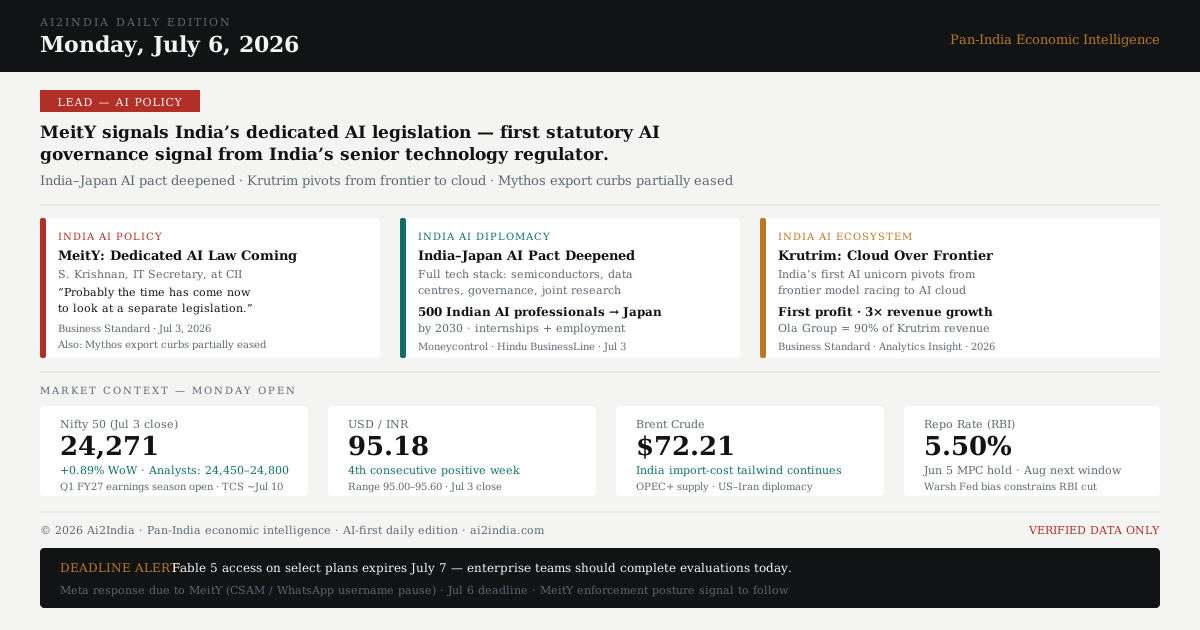
MeitY Secretary S. Krishnan signals India will draft dedicated AI legislation — the most significant India AI policy development of 2026, arriving simultaneously with a deepened India–Japan AI partnership, Krutrim’s pivot from frontier model racing to cloud profits, and a partial easing of US export controls on Anthropic’s older Mythos model; all converging to define India’s AI governance posture as the Q1 FY27 earnings season opens.
Monday, July 6, 2026: At a CII conference on Friday, July 3, IT Secretary S. Krishnan of the Ministry of Electronics and Information Technology (MeitY) said India will begin drafting a standalone AI regulation law — the first time India’s senior-most technology regulator has explicitly placed dedicated AI legislation on the government’s forward agenda. The same week: India and Japan deepened their bilateral AI pact, agreeing on joint cooperation across the full AI technology stack — semiconductors, data centres, AI governance, and a target of 500 highly skilled Indian AI professionals to Japan by 2030. Krutrim (Ola AI), India’s first AI unicorn, confirmed its pivot from frontier model development to AI cloud infrastructure, reporting its first profit and tripling revenue in the process. And MeitY also confirmed that US export restrictions on Anthropic’s older Mythos model have been partially eased, while next-generation models (Mythos 5, Fable 5) remain restricted under the June 12 BIS export control order. For Indian enterprises: a Fable 5 access window on select plans closes tomorrow, July 7 — the last opportunity for enterprise evaluation before the broader access framework settles.
The MeitY AI legislation signal is the lead story on July 6, 2026 for a specific reason: it ends ambiguity. For nearly three years, India’s approach to AI governance has been defined by deliberate regulatory restraint — addressing AI-related concerns (deepfakes, content labelling, platform liability) through existing legal provisions rather than standalone law. The IT Rules under the Information Technology Act 2000, the Digital Personal Data Protection Act 2023, and platform-specific directives served as the de-facto AI regulatory toolkit. Krishnan’s statement on Friday represents a formal departure from that approach. “Probably the time has come now to look at a separate legislation for AI,” he said at the CII conference sidelines, responding to a journalist’s question. “We will start looking at it.” The language is careful — this is a signal, not an announcement — but the signal is significant. Multiple senior sources confirm that MeitY will soon begin work on legislative proposals, though the timeline for Parliamentary introduction remains uncertain (Business Standard, July 3; Deccan Herald, July 4; ET, July 3).
Why does this matter for Indian enterprise AI planners? Because the design choices made in India’s forthcoming AI law will directly determine: (1) which AI models Indian enterprises can use for which tasks; (2) whether regulated sectors (BFSI, healthcare, government) will have data-localisation requirements that preclude US API-based AI deployments; (3) what liability framework applies when AI systems cause harm; and (4) whether India’s AI regulation will converge with the EU AI Act (risk-based, prescriptive), the US approach (sectoral, voluntary), or chart an India-specific path. Enterprise AI planning teams that are not tracking MeitY’s AI legislation process are planning blind.
Three interconnected India AI signals arrived in the same week, each reinforcing the others. The first is the India–Japan AI pact, signed during India-Japan diplomatic exchanges in late June and July. The agreement covers: joint AI research and governance frameworks; cooperation on AI-ready semiconductor infrastructure and data centre buildout; and a specific commitment that Japan will invite 500 highly skilled Indian AI professionals for research, internships, and employment opportunities by 2030 (The Week, July 3; Hindu BusinessLine, July 3; Moneycontrol, July 3; ET, July 6). The 500-professional target may appear modest, but it establishes a formal bilateral pipeline for India’s AI talent base that will compound over time. More substantively, the pact’s semiconductor and data centre cooperation dimensions align directly with India’s IndiaAI Mission compute strategy and create a non-US supply-chain option for India’s AI infrastructure.
The second interconnected signal is Krutrim’s cloud pivot. Analytics Insight reported this week that Krutrim — the AI company founded by Bhavish Aggarwal (Ola) and India’s first AI unicorn — has formally pivoted its primary business strategy from developing frontier AI models to operating AI cloud infrastructure. The strategic rationale is straightforward: building frontier models requires sustained capital, specialised talent, and years of iteration — resources that proved harder to secure than Krutrim’s early momentum suggested. The cloud pivot generated the company’s first profit and tripled revenue (Business Standard, May 2026), validating the commercial logic even as it narrows India’s sovereign frontier model landscape. Notably, Ola Group accounts for approximately 90% of Krutrim’s revenue — meaning the cloud business is currently internal-first. The strategic question for IndiaAI Mission and MeitY: does Krutrim’s retreat from frontier model development create a gap that Sarvam AI must fill alone, or does it free Krutrim’s capital to accelerate India’s AI infrastructure buildout at a lower risk profile?
The third signal is the export control update. The Guardian reported on July 1 that the US lifted export bans on Anthropic’s Fable and Mythos AI models. MeitY Secretary Krishnan confirmed at the CII conference (July 3) that export restrictions on the older Anthropic Mythos model had specifically been eased — while restrictions continue on the next-generation Mythos 5 and Fable 5 models (ET, July 3; anybodycanprompt.com). This means Indian enterprises now have access to the older Mythos model, but the frontier Fable 5 and Mythos 5 systems remain under the BIS export control order. A practical deadline: Geeky Gadgets reports that Fable 5 is temporarily accessible on certain plans until July 7 — making today the last day for Indian enterprise teams to complete Fable 5 evaluations before the access window closes.
Together, these three signals — MeitY’s AI law signal, India-Japan AI pact, and Krutrim’s cloud pivot — define a coherent moment in India’s AI trajectory: India is moving from ad-hoc AI governance to deliberate AI policy design, from frontier model ambition to AI infrastructure pragmatism, and from US-only AI dependency to a multi-partner diplomatic AI strategy. This is not a single-day story; it is the week’s most important India AI policy development, and it should register on the planning horizon of every Indian enterprise with a material AI strategy.