Pan-India economic intelligenceDaily Edition — 2026-07-05
AI2

Ai2India

Daily Edition

One daily issue tracking AI adoption, markets, hiring, layoffs, real estate, credit and gig-work signals across India.

PublishedJuly 5Daily issue
Nifty 50 (Jul 3 close)24,270.85+0.39% (Jul 3); GIFT Nifty 24,350 (Jul 4) is a positive Monday signal; Q1 FY27 earnings season opens Jul 6–10; India markets closed Sat–Sun; next session Monday Jul 6
USD / INR95.18Jul 3 close; +17 paise recovery; DXY retreated on softer US nonfarm payrolls; range 95.00–95.60 (analyst est.); week-on-week: 4th consecutive positive week for rupee
Brent Crude$72.21/bblJul 3; WTI $68.77; OPEC+ supply + easing US–Iran tensions; well below $73 threshold; India import-cost tailwind continues; analysts watch $68 floor
Repo Rate (RBI)5.50%Jun 5 MPC hold; August MPC next live window; crude well below $85 thesis parameter; Warsh Fed hike bias remains binding constraint on RBI cut timing

Lead Analysis — AI-First

DeepSeek V4 arrives as open-source, MIT-licensed, 1.6-trillion-parameter frontier model at 85% lower cost than GPT-5.5 — the most disruptive cost and sovereignty event in AI since DeepSeek R1, with direct implications for every Indian enterprise running US-model API costs and every regulated sector seeking data-sovereign AI.

Sunday, July 5, 2026: DeepSeek, the Chinese AI research company, has released DeepSeek V4 in preview — an open-source, MIT-licensed model in two variants: V4-Pro (1.6 trillion parameters) and V4-Flash (284 billion parameters, 13 billion activated, 1 million token context). Available immediately via Hugging Face and chat.deepseek.com, with API access. DeepSeek V4-Pro costs approximately 85% less than GPT-5.5 to run. It is the most significant open-source AI model release since DeepSeek R1 in January 2026 — and the most directly actionable cost-reduction event for Indian enterprises in 2026. On the same weekend: Anthropic is in early talks with Samsung to manufacture a custom 2nm AI chip — the first move by the Fable 5 lab toward hardware independence from Nvidia; xAI launches /goal in Grok Build, enabling long-running autonomous coding tasks with built-in verification; and Anthropic releases Science Beta, a multi-agent research workbench for genomics, proteomics, and cheminformatics pipelines.

DeepSeek V4 is the lead story on July 5 for a precise reason: it changes the cost arithmetic of enterprise AI more dramatically than any single event since DeepSeek R1, and it does so while simultaneously resolving two of the three structural concerns that have made Indian enterprises hesitant about US AI model dependency. The three concerns are: (1) API cost, (2) export-control access risk, and (3) data sovereignty for regulated sectors. DeepSeek V4 addresses all three. API cost: V4-Pro is approximately 85% cheaper than GPT-5.5 (Mashable, July 4). Export-control risk: DeepSeek is a Chinese model; it is not subject to US Commerce Department export controls or the AI access suspension regime that affected Fable 5 on June 12. Data sovereignty: DeepSeek V4 can be self-hosted under its MIT licence, meaning Indian enterprises in regulated sectors — BFSI, healthcare, defence — can run V4 inference on their own infrastructure with no data leaving India. These three advantages arrive in a single model release at a time when Indian enterprises are already re-evaluating their AI vendor stack following the June 12 suspension and the July 4 WhatsApp pricing shock.

The scale of V4-Pro is worth pausing on. At 1.6 trillion parameters, V4-Pro is larger than any previously released open-source model by a substantial margin. DeepSeek also released DSpark on June 27 — a speculative decoding framework that accelerates V4-Flash and V4-Pro response generation by 60–85% without model retraining and without new hardware. Together, V4 + DSpark mean Indian enterprises can run frontier-class inference at a fraction of what US model APIs cost, on their own hardware, with no dependency on either US export-control policy or WhatsApp’s platform pricing strategy.

The India-specific implications are substantial. For Indian IT services firms (TCS, Infosys, Wipro, HCLTech): DeepSeek V4’s open weights enable Indian IT services companies to fine-tune and deploy frontier-class AI on client infrastructure without passing through US API costs. HCLTech’s $1.14B AI services deal — announced July 3 — is exactly the type of deployment where self-hosted open-weight models can radically improve delivery margins. For Indian BFSI (HDFC, ICICI, SBI): DeepSeek V4 self-hosted resolves the data-localisation constraint that has prevented regulated Indian financial institutions from deploying frontier AI on sensitive data. The RBI’s AI-in-finance guidelines require data localisation; a self-hosted V4 deployment is compliant in a way that GPT-5.5 API calls or Fable 5 API calls are not. For Indian AI startups (Sarvam, Krutrim): V4’s MIT licence allows Indian AI companies to build on top of a 1.6T-parameter foundation model rather than training from scratch. Sarvam’s thevam105B (105 billion parameters) is a capable model; V4-Pro at 1.6T is a different class of capability that Sarvam could now build India-specific fine-tunes on top of.

There are three important caveats that Indian enterprise planners must weigh. First, data sovereignty with a Chinese model is not equivalent to data sovereignty with an Indian model: the model weights themselves were developed in China, and fine-tuning on sensitive Indian data creates a different set of dependencies than using a US model API (where the data-in-transit risk is clearer). For sectors where Chinese technology supply-chain risk is a board-level concern — defence, intelligence, some BFSI applications — a self-hosted DeepSeek V4 is not a straightforward alternative to Sarvam or a US frontier model. Second, V4-Pro at 1.6T parameters requires significant inference infrastructure: the compute cost of running a 1.6T model on proprietary hardware is non-trivial, and the 85% API cost saving needs to be weighed against the capital expenditure of deployment infrastructure for most Indian enterprises. Third, DeepSeek V4 is a preview release; production readiness, enterprise support, and long-term maintenance commitments are not yet established at the level of Anthropic’s or OpenAI’s enterprise products.

The strategic read: DeepSeek V4 is the most powerful argument yet for Indian enterprises to maintain a three-provider AI architecture — a US frontier model (Fable 5 or Sonnet 5 for capability-critical tasks), a cost-tier model (Gemini 3.5 Flash or Z.ai GLM-5.2 for volume tasks), and now a self-hosted open-weight model (DeepSeek V4-Flash or V4-Pro for sensitive or high-volume on-premise deployments). The WhatsApp pricing shock of July 3 demonstrated the cost risk of single-provider dependency. DeepSeek V4 provides the escape valve — but only for enterprises that invest in the infrastructure to exploit it.

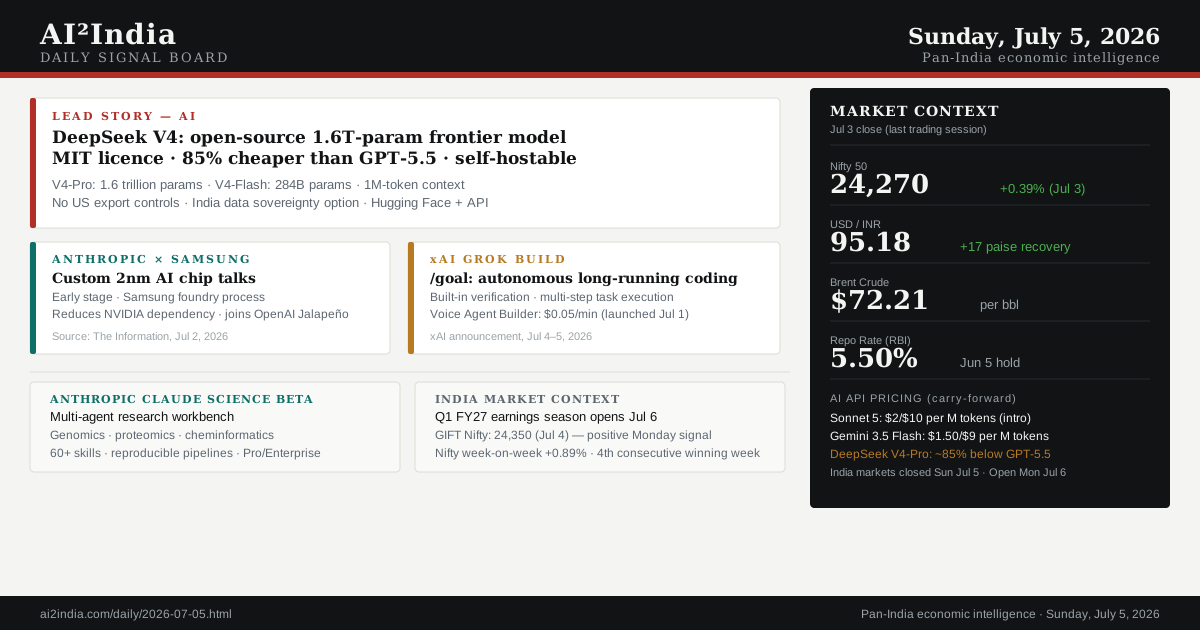
July 5, 2026 signal board: DeepSeek V4 open-source 1.6T-param model, MIT licence, 85% cheaper than GPT-5.5; Anthropic + Samsung 2nm chip talks; xAI Grok /goal autonomous coding; Nifty 24,271 (Jul 3); USD/INR 95.18; Brent $72.21/bbl; Repo 5.50%; Q1 FY27 earnings season opens Jul 6
Today’s economic signal board. Full analysis in the Daily Edition.

AI Developments Today

Sunday, July 5, 2026: four developments that pass the “Would this change what an Indian enterprise AI planner does this week?” filter. DeepSeek V4’s open-source frontier model at 85% lower cost reshapes the enterprise AI cost model entirely. Anthropic’s Samsung chip talks signal the lab’s intent to control its own hardware destiny. xAI’s /goal autonomous coding and Voice Agent Builder expand the agentic AI market for Indian IT delivery and customer-service verticals. Anthropic Science Beta opens reproducible AI research to India’s pharma sector.

DevelopmentSource + DateIndia RelevanceWhat this means for Indian enterpriseStatus
DeepSeek V4 released in preview: open-source, MIT licence, two variants — V4-Pro (1.6T params) and V4-Flash (284B params, 13B activated, 1M-token context); approximately 85% cheaper per token than GPT-5.5; available immediately on Hugging Face, chat.deepseek.com, and via API

DeepSeek released DeepSeek V4 Preview on or around July 4–5, 2026 (Mashable, July 4). The model is available in two variants. V4-Pro is a 1.6-trillion-parameter model — the largest open-source model released to date by a significant margin. V4-Flash is a mixture-of-experts model with 284 billion total parameters and 13 billion activated parameters, supporting a 1 million token context window. Both models are released under the MIT licence, which permits commercial use, fine-tuning, modification, and redistribution without restriction. Pricing: DeepSeek V4-Pro costs approximately 85% less than GPT-5.5 to operate via API (Mashable comparison). The MIT licence additionally allows self-hosting, which eliminates API costs entirely for enterprises with on-premise GPU infrastructure. DeepSeek also released DSpark on June 27, 2026: a speculative decoding framework that accelerates V4 inference by 60–85% without model retraining or new hardware. The combination of V4 + DSpark makes frontier-class AI economically accessible on existing hardware at a cost point that fundamentally disrupts the pricing assumptions underlying most Indian enterprise AI business cases built in 2025.
Mashable “DeepSeek V4 is here: How it compares to ChatGPT” (Jul 4, 2026); Hugging Face; DeepSeek API docs; Kilo.ai leaderboard; webscraft.org (DSpark, Jun 27) India is both a large consumer of US AI model APIs (OpenAI, Anthropic) and a country with active data-localisation requirements for regulated sectors (BFSI, healthcare, government). DeepSeek V4’s open weights under MIT licence provide a self-hosted frontier-class AI option that: (1) eliminates API costs entirely for enterprises with GPU infrastructure; (2) resolves data-localisation requirements by running on-premise; (3) is not subject to US export-control policy or the access-suspension risk demonstrated by the June 12 Fable 5 episode; (4) is available immediately at scale rather than through a waitlist or enterprise sales process. At 85% lower API cost and a commercially permissive licence, V4 changes the ROI calculation for nearly every Indian enterprise AI deployment that was previously cost-constrained. However: the model is of Chinese origin, which creates supply-chain risk considerations for sectors with Sino-India technology sensitivities (defence, border-adjacent infrastructure). And at 1.6T parameters, V4-Pro self-hosting requires significant GPU infrastructure investment — V4-Flash (284B, 13B activated) is the more practical self-hosting option for most Indian enterprises. Evaluate DeepSeek V4-Flash self-hosting as a cost-tier alternative to US model APIs for high-volume, non-sensitive tasks. For BFSI: V4-Flash self-hosted resolves data-localisation constraints that prevent Fable 5 or GPT-5.5 API deployment on sensitive customer data — conduct a supply-chain risk assessment alongside a compliance assessment. For Indian IT services firms delivering AI contracts: open-weight V4 fine-tuned on client-domain data can dramatically improve delivery margins on AI-augmented IT services contracts (e.g. HCLTech’s $1.14B AI deal). For AI startups (Sarvam, Krutrim): evaluate V4 as a base model for India-specific fine-tuning rather than training foundations from scratch — the cost calculus of foundation model pre-training vs fine-tuning on V4 has fundamentally shifted. Do not use V4 for defence, intelligence, or national-security-adjacent workloads without a full supply-chain and data-sovereignty risk assessment. Verified global — Mashable; Hugging Face; Jul 4–5, 2026
Anthropic in early talks with Samsung Electronics to manufacture a custom 2nm AI chip — first move toward hardware independence from Nvidia; Anthropic hiring silicon engineers; project at early stage, no chip design or manufacturing begun

The Information reported on July 2, 2026 that Anthropic has opened talks with Samsung Electronics to manufacture a custom AI accelerator using Samsung’s advanced 2-nanometer foundry process. The project is described as early-stage: no chip design, testing, or manufacturing has begun. Anthropic is hiring silicon engineers as part of the initiative. The strategic motivation is hardware independence from Nvidia, which currently supplies the H100 and H200 GPUs that power Anthropic’s training and inference infrastructure. Anthropic would join a pattern established by OpenAI (Jalapeño custom chip programme), Google (TPUs), and Meta (MTIA — Meta Training and Inference Accelerator) in developing first-party AI silicon. Samsung’s 2nm process is competitive with TSMC’s most advanced nodes and represents a meaningful technology choice — one that also signals Samsung as a preferred partner over TSMC for this initiative, which has implications for Samsung India’s expanding semiconductor footprint in the region.
The Information (Jul 2, 2026); UPI.com “Anthropic eyes South Korea’s Samsung for custom AI chip” (Jul 3); Analytics Insight (Jul 4); GSMArena (Jul 4); ETV Bharat Hindi (Jul 4); easternherald.com (Jul 5) Three India dimensions. First, hardware cost structure: if Anthropic successfully develops custom silicon, Fable 5 and successor model inference costs decline over a 3–5 year horizon, which eventually passes through to lower API pricing for Indian enterprise users. The Anthropic-Samsung chip initiative is a 36–60 month event — not relevant to July 2026 procurement decisions, but relevant to long-term vendor selection. Second, Samsung India: Samsung Semiconductor India Research (SSIR) in Bengaluru and Noida is one of India’s largest semiconductor R&D centres. If Samsung wins the Anthropic chip contract, India-based Samsung engineers may be involved in design work — a hiring signal for silicon design talent in India’s semiconductor sector. Third, the strategic signal: every major frontier AI lab (OpenAI, Google, Meta, now Anthropic) is developing custom silicon. This is a structural shift in the AI infrastructure stack that Indian semiconductor and hardware policy (the ₹76,000 crore India Semiconductor Mission) should track — custom AI silicon design capabilities are becoming a sovereign capability requirement for AI superpowers. No immediate enterprise procurement action required. Note the 3–5 year horizon for cost impact. For Indian semiconductor sector and ISM policy teams: the Anthropic-Samsung partnership signal validates custom AI silicon as a strategic capability requirement. Track the Samsung foundry win as a data point for Samsung India R&D team growth. For long-term Anthropic vendor assessment: hardware independence reduces the single supply-chain risk (NVIDIA GPU allocation) that contributed to the access disruptions of H1 2026. Verified global — The Information; UPI; Jul 2–3, 2026
xAI launches /goal in Grok Build — long-running autonomous coding execution with built-in verification for multi-step tasks; also: Voice Agent Builder at $0.05/min (Jul 1), /voice speech-to-text dictation, Grok 4.5 in private beta at SpaceX and Tesla (Jun 28)

xAI launched /goal in Grok Build, its agentic coding platform, adding long-running autonomous execution with built-in verification for multi-step coding tasks (MarkTechPost, July 4). The /goal command enables Grok Build agents to execute extended workflows — not just single-turn code generation — with a built-in verification step that checks outputs before proceeding. This directly competes with GitHub Copilot Workspace, Cursor’s agent mode, and OpenAI’s o3-based coding agents. Separately: xAI launched Voice Agent Builder on July 1 — a no-code platform to create human-like voice agents using Grok Voice at $0.05 per minute. Speech-to-text via /voice command (Ctrl + Space) also went live in Grok Build on July 2. Grok 4.5 entered private beta at SpaceX and Tesla on June 28, built on a 1.5 trillion-parameter V9 foundation with training data from Cursor.
MarkTechPost (Jul 4, 2026); testingcatalog.com “xAI debuts Grok Voice Agent Builder”; basenor.com; inews.zoombangla.com “Grok 4.5 private beta” (Jun 28) Two India-specific enterprise vectors. First, /goal autonomous coding: Indian IT services firms (HCLTech, TCS, Infosys, Wipro, Cognizant) are actively evaluating and deploying AI coding tools to improve developer productivity. Grok Build /goal adds xAI to a competitive market currently dominated by GitHub Copilot (Microsoft) and Cursor in India’s enterprise coding stack. The competitive pressure from /goal, Cursor agent mode, and OpenAI’s coding agents is a structural driver of demand for “AI development operations” engineers in India — specialists who can orchestrate and verify autonomous coding pipelines rather than writing code directly. Second, Voice Agent Builder at $0.05/min: India’s customer-service AI voice market is large, growing, and currently dominated by domestic players (Uniphore, Observe.AI, Yellow.ai, Haptik) and global players (ElevenLabs, Synthesia). At $0.05/minute, xAI’s Voice Agent Builder is competitively priced against existing platforms. For Indian contact centres, BPOs, and customer-service AI deployments: evaluate xAI Voice Agent Builder against existing vendors on language capability (English + Indian languages), regulatory compliance (TRAI, RBI), and latency. For Indian IT services engineering leaders: assess /goal as a productivity tool for AI-augmented development pipelines. Compare against GitHub Copilot Workspace and Cursor agent mode on benchmark tasks relevant to your delivery stack. For customer-service AI decision-makers: request a Voice Agent Builder trial for Indian-English use cases — pricing at $0.05/min is at or below current enterprise voice AI contracts. For product teams building on xAI APIs: Grok 4.5’s private beta at SpaceX/Tesla is a signal that the next public Grok capability jump is 4–8 weeks away; time API migration planning accordingly. Verified global — MarkTechPost; xAI announcement; Jul 1–4, 2026
Anthropic launches Science Beta — multi-agent AI workbench for scientific research; covers genomics, single-cell analysis, proteomics, structural biology, cheminformatics; 60+ curated skills; reproducible pipeline provenance; available on Pro, Max, Team, Enterprise plans

Anthropic released Science Beta on or around July 4, 2026 — an AI workbench designed for scientific researchers (MarkTechPost, July 4). It runs on Anthropic’s existing production models rather than a new specialised model. Architecture: a generalist coordinating agent receives plain-language research requests and can spin up specialist sub-agents for specific domains, plus a reviewer agent that flags incorrect citations, unverifiable numbers, and figures that do not match underlying code. The workbench integrates over 60 curated skills and connectors pre-configured for genomics, single-cell sequencing, proteomics, structural biology, and cheminformatics workflows. Every output carries an auditable history of how it was produced — addressing the reproducibility crisis that is a persistent challenge in computational biology. Platforms: macOS, Linux, remote SSH, and HPC login nodes. Native rendering for 3D protein structures, genome browser tracks, and chemical structures. Available for Pro, Max, Team, and Enterprise plan subscribers.
MarkTechPost “Anthropic Launches Science Beta” (Jul 4, 2026); Anthropic newsroom (anthropic.com/news/) India’s pharmaceutical and biotech sector — Sun Pharma, Cipla, Dr. Reddy’s Laboratories, Biocon, Zydus Pharmaceuticals, Aurobindo Pharma — collectively makes India the world’s largest generics manufacturer and a significant generics API (active pharmaceutical ingredient) exporter. Drug discovery, protein structure analysis, and cheminformatics are direct Science Beta use cases for this sector. The Indian academic research ecosystem — IISc, IIT Bombay, IIT Delhi, IIT Madras, IIT Hyderabad, CSIR-CDRI, CSIR-IGIB — runs large-scale computational biology programmes that would benefit from a reproducible multi-agent research workbench. The provenance and auditability features specifically address the reproducibility requirements of Nature, Science, and Cell publications — directly relevant to Indian academic researchers publishing in these journals. NVIDIA’s description of the specialist agents as “preconfigured, domain-specialized” suggests that hardware-optimised inference (on NVIDIA infrastructure) is a component of the Science Beta architecture. For Indian pharma R&D heads: evaluate Science Beta for drug discovery and cheminformatics workflows immediately — available for Enterprise plan users now. The reproducibility audit trail may directly address regulatory requirements in FDA and EMA submissions that draw on computational biology data. For IIT/IISc computational biology labs: apply for Beta access via Anthropic Enterprise plan — the genomics and proteomics skill set is directly applicable to ongoing protein engineering and genomics research. For Indian biotech startups: Science Beta’s multi-agent architecture for structural biology could accelerate small-molecule drug discovery pipelines that currently require teams of bioinformatics engineers. Verified global — MarkTechPost; Anthropic; Jul 4, 2026

India AI Ecosystem

Sunday, July 5, 2026: DeepSeek V4’s arrival at MIT licence changes the foundation model calculus for Sarvam AI, Krutrim, and India’s IndiaAI Mission. The question is now not “how many models can India sustain?” (the MeitY Secretary’s framing) but “which India-specific capabilities should be built on top of open-weight foundations vs trained from scratch?” All Tier 4 platform items carry forward unchanged.

Platform / OrganisationDevelopmentIndia AI SignificanceStatus
Sarvam AI — DeepSeek V4 strategy question
thevam30B (edge) + thevam105B (large)
$1.5B valuation · HCLTech 10.46%
India govt 1–2% equity
10M API calls/day
No new Sarvam AI announcement today. However, DeepSeek V4’s release creates the most important strategic question Sarvam AI has faced since its founding: does the arrival of a 1.6T-parameter open-weight MIT-licensed model change Sarvam’s architecture roadmap? Sarvam’s thevam105B at 105 billion parameters was a significant India-first foundation model. DeepSeek V4-Pro at 1.6 trillion parameters — open-weight, MIT-licensed, self-hostable — is now available as a foundation for India-specific fine-tuning. The resource question becomes: should Sarvam invest compute in pre-training thevam models at larger scales, or should it invest in fine-tuning V4-Pro on India-specific language, regulatory, and domain data? The case for fine-tuning on V4: frontier-class capabilities at a fraction of pre-training cost, immediate availability. The case for independent pre-training: full supply-chain control, no Chinese-origin model in India’s sovereign AI stack, authentic “India-first” positioning. The IndiaAI Mission’s 45,000+ GPU deployment makes independent pre-training viable — but the opportunity cost of not exploiting V4 is now measurable. Sarvam’s HCLTech and India govt stakeholders will have views on this question. DeepSeek V4’s arrival is a defining strategic moment for India’s sovereign AI agenda. The Indian government’s 1–2% equity stake in Sarvam and IndiaAI Mission’s GPU compute investment represent a thesis that India should build its own foundation models for sovereignty reasons. DeepSeek V4 does not invalidate that thesis — a Chinese open-weight model is not a sovereign Indian AI asset — but it raises the cost-of-opportunity analysis to a new level. MeitY and NITI Aayog will need to explicitly reaffirm the sovereign AI pre-training thesis in the context of V4’s availability or acknowledge that fine-tuning on open-weight foundations is the more resource-efficient path. Neither answer is wrong; both have strategic trade-offs. Watch for Sarvam AI and MeitY statements on this question in the coming weeks. Verified India (Sarvam baseline) — strategic analysis; new question from V4
HCLTech — carry-forward: $1.14B AI deal + Sarvam 10.46%
Fortune Global 50 EU client
$228M/yr · Jul 2026–Dec 2031
AI-driven digital workplace
Carry-forward from July 4 edition. HCLTech’s $1.14B AI services deal (Fortune Global 50 EU client, likely Mercedes-Benz; July 3) and its ₹1,427 crore ($150M) / 10.46% Sarvam AI stake are unchanged. DeepSeek V4’s arrival is directly relevant to HCLTech’s delivery model for the new deal: open-weight DeepSeek V4 fine-tuned on client-domain data (automotive enterprise networks, digital workplace infrastructure) could significantly improve HCLTech’s delivery margins on a $1.14B contract where inference costs are a material line item. The question of whether HCLTech deploys US frontier models (Fable 5, Sonnet 5), Indian sovereign models (Sarvam), or open-weight Chinese models (DeepSeek V4) for each task category within the deal is now a live architecture decision with major cost implications. HCLTech shares: +6.3% on Jul 3 announcement; markets closed Sat–Sun; Monday Jul 6 open will be watched for continuation. HCLTech’s dual AI positioning (global AI services revenue + Sarvam AI co-ownership) is the most coherent strategy in Indian IT. DeepSeek V4 adds a third dimension: HCL AI Force now has access to an open-weight frontier model that can be fine-tuned for client delivery without US API costs or data-localisation constraints. The three-model AI stack for HCLTech delivery — Fable 5 for capability-critical tasks, Sarvam for India-language and sovereign tasks, V4 for high-volume on-premise delivery — is now available. Which combination wins on the $1.14B deal’s cost model will be a significant indicator for the industry. Verified India — ET; Financial Express; NDTV Profit; Jul 3 (carry-forward)
Carry-forward: ICAI + Sarvam MoU; Neysa $1.5B; OpenAI India MD; NASSCOM AI data; Maharashtra AI Policy; IndiaAI Mission 45K GPUs; MeitY Meta summons All carry-forward items unchanged. Key update: DeepSeek V4’s release is the most significant event affecting the IndiaAI Mission’s strategic calculus since the Fable 5 suspension. IndiaAI Mission’s 45,000+ GPU deployment was designed to support Indian foundation model training; V4’s availability changes the pre-train-vs-fine-tune decision for every Indian AI lab using that compute. MeitY meta-alert: MeitY’s simultaneous regulatory pressure on Meta (CSAM on Instagram + WhatsApp username pause — 3-day response deadline issued Jul 3) remains live; Meta must respond within 3 days, making Monday Jul 6 the response deadline. The WhatsApp regulatory pressure from MeitY is directly relevant to the WhatsApp AI channel economics story from Jul 4 — Meta is under dual pressure: platform pricing competition (deploying Oct 1) and MeitY compliance obligations (response due Jul 6). Sarvam AI 10M API calls/day and HCLTech 10.46% stake: unchanged. NASSCOM 25% India IT in production AI, $10–12B AI services revenue forecast, 2M+ skilled: unchanged. OpenAI India MD Prabhjeet Singh arriving September 2026: unchanged. The DeepSeek V4 + IndiaAI Mission question is the most consequential new strategic variable for India’s sovereign AI ecosystem since Sarvam raised its $234M Series B. Watch for MeitY statements on the pre-train-vs-fine-tune calculus in the coming days. The July 6 Meta response deadline to MeitY on CSAM and WhatsApp usernames is a live regulatory signal — it will indicate MeitY’s enforcement posture and Meta’s willingness to comply with Indian regulatory demands at the same time as they implement a pricing strategy that financially disadvantages Indian enterprises. Verified India — Multiple; Jun 15–Jul 4 (carry-forward)

AI Adoption Impact

July 5: DeepSeek V4 is the most significant AI cost-structure event for Indian enterprise AI since DeepSeek R1. The open-weight frontier model at MIT licence disrupts the enterprise AI cost model at the API and infrastructure layer simultaneously. The xAI /goal and Voice Agent Builder launches expand the agentic AI market for India’s IT delivery and customer-service sectors. The Q1 FY27 earnings season opening on July 6 will be the first real test of AI services revenue claims from Indian IT majors.

AI Impact DimensionEvidenceTrajectory
Open-weight frontier AI cost disruption: DeepSeek V4-Pro at 85% lower cost than GPT-5.5 + MIT licence + DSpark 60–85% speed boost = fundamental shift in enterprise AI cost model Mashable (Jul 4); Hugging Face; DeepSeek API docs; webscraft.org DSpark (Jun 27). V4-Pro: 1.6T params. V4-Flash: 284B, 13B activated, 1M-token context. API: ~85% cheaper than GPT-5.5. MIT licence: commercial + fine-tuning + self-hosting. DSpark: 60–85% inference speedup on existing hardware. The combination of V4 API savings (85%), DSpark speedup (60–85%), and self-hosting possibility (MIT) makes a three-tier cost case: run V4 via API (85% cheaper than GPT-5.5); self-host V4-Flash (near-zero marginal cost after infrastructure); run V4-Flash + DSpark on existing GPUs (60–85% speed improvement over baseline V4). Each tier is a progressively better cost option for increasingly volume-sensitive deployments. ↓↓ AI API cost floor collapsing; 85% reduction from a frontier-class model in a single weekend event; Indian enterprise AI cost models need immediate revision
Data sovereignty option: V4 self-hosted = first frontier-class AI with data-localisation compliance for Indian regulated sectors (BFSI, healthcare, government) MIT licence (Hugging Face; Jul 4). RBI AI-in-finance guidelines mandate data localisation. DPDP Act 2023 data-localisation requirements for sensitive personal data. DeepSeek V4-Flash self-hosted on Indian infrastructure: compliant. GPT-5.5 or Fable 5 via API: requires data transfer to US servers. Sarvam thevam105B: also India-deployable but at 105B parameters vs V4-Pro 1.6T. V4-Flash at 284B (13B activated) is the practical self-hosting option for Indian enterprises with H100 or A100 infrastructure purchased in 2024–2025. Infrastructure cost at scale (100,000+ daily queries): significantly lower than US API costs at V4 pricing. ↑ New compliance-compatible frontier AI option; first time regulated Indian sectors can access near-frontier capabilities without data leaving India; changes BFSI AI deployment calculus
Agentic AI adoption: xAI /goal (autonomous coding), Voice Agent Builder ($0.05/min), Cursor agent mode, GitHub Copilot Workspace — agentic AI market consolidating rapidly in mid-2026 MarkTechPost; xAI announcement (Jul 1–4, 2026). India’s IT services sector runs ~5 million software developers (NASSCOM). Autonomous coding agent adoption in India’s IT delivery base is the most direct AI productivity lever available to IT services firms. xAI Voice Agent Builder at $0.05/min adds pressure on domestic voice AI players (Uniphore, Observe.AI, Yellow.ai). The Indian BPO sector (2M+ seats) is the primary addressable market for voice agent displacement — the pricing signal ($0.05/min from a Tier 1 AI lab) is a strong indicator of the future cost floor for AI voice agent services. ↓ AI voice agent and coding agent pricing collapsing; Indian BPO sector faces accelerating substitution risk from AI voice agents at $0.05/min; Indian IT services firms can capture productivity gains if they move to agentic coding fast
Q1 FY27 earnings season: IT sector results (July 6–25) will provide the first empirical AI services revenue data from Indian IT majors — the most important AI adoption validation event of the summer Goodreturns (Jul 4); Kotak report (Financial Express, Jul 3); GIFT Nifty 24,350 (Jul 4, positive pre-open signal). TCS reports first (typically July 10–11); followed by Infosys, HCLTech, Wipro, Tech Mahindra in subsequent weeks. Key metrics to watch: (1) AI services revenue as a % of total revenue — any TCS/Infosys Q1 FY27 AI revenue disclosure will be the first hard number vs NASSCOM’s $10–12B industry forecast; (2) headcount change — any reversal of TCS’s 23,460 headcount decline would signal AI services hiring; (3) guidance — Q2 FY27 guidance from Infosys and TCS will incorporate post-WhatsApp-pricing and post-Fable 5 signals. → Watch; Q1 FY27 earnings are the single most important data event of the next 3 weeks for India AI adoption tracking

Five Things That Changed

Sunday, July 5, 2026: three AI model events (DeepSeek V4, Anthropic + Samsung chip, xAI /goal), one research platform launch (Anthropic Science Beta), and one market structure signal (Q1 FY27 earnings season opening, positive GIFT Nifty pre-open).

SignalData PointReader ImpactStatus
DeepSeek V4: open-source, MIT licence, 1.6T-param (Pro) + 284B-param (Flash) — 85% cheaper than GPT-5.5; self-hostable; no US export controls Mashable (Jul 4, 2026); Hugging Face; DeepSeek API. V4-Pro: 1.6T params. V4-Flash: 284B total, 13B activated, 1M-token context. MIT licence: commercial + fine-tune + redistribute. ~85% cheaper per token than GPT-5.5. Available now: Hugging Face + chat.deepseek.com + API. DSpark (Jun 27): 60–85% faster inference on existing hardware. Supply-chain caveat: Chinese origin — not for defence/national-security workloads. Practical self-hosting: V4-Flash (13B activated) on A100/H100 infrastructure. BFSI data-localisation compliance: possible with self-hosted V4. Revise every enterprise AI cost model that assumed US model API pricing as a floor. Evaluate V4-Flash self-hosting for high-volume, on-premise-compatible deployments. For BFSI: V4-Flash self-hosted is the first frontier-class data-localisation-compliant option — conduct a compliance + supply-chain risk assessment in parallel. Do not deploy in defence/national-security contexts without full risk assessment. Verified global — Mashable; Hugging Face; Jul 4–5
Anthropic in early talks with Samsung for custom 2nm AI chip — NVIDIA independence move; joins OpenAI Jalapeño, Google TPU, Meta MTIA; hiring silicon engineers; early stage only The Information (Jul 2, 2026); UPI; Analytics Insight; GSMArena; easternherald.com. Early stage: no chip design, testing, manufacturing begun. Samsung 2nm foundry. Anthropic hiring silicon engineers. Competitive context: OpenAI (Jalapeño), Google (TPU generations), Meta (MTIA), now Anthropic. Long-horizon (3–5 years) to first silicon. India angle: Samsung Semiconductor India Research (SSIR) in Bengaluru/Noida — possible design involvement. India Semiconductor Mission (₹76,000 crore) relevance: AI chip design capabilities becoming strategic requirement. No immediate enterprise action. Note the 3–5 year cost-reduction horizon for Anthropic API pricing. Track Samsung India semiconductor hiring as a downstream signal. For ISM policy teams: every major AI lab is now developing custom silicon — India’s semiconductor strategy should include AI chip design capability as an explicit target. Verified global — The Information; UPI; Jul 2–3
xAI /goal autonomous coding + Voice Agent Builder $0.05/min + /voice dictation — Grok Build expands agentic AI market for Indian IT delivery and customer-service verticals MarkTechPost (Jul 4, 2026); xAI; testingcatalog; basenor.com. /goal: long-running autonomous coding with built-in verification. Voice Agent Builder: $0.05/min, no-code, Grok Voice. /voice: speech-to-text dictation in Grok Build (Jul 2). Grok 4.5: private beta at SpaceX and Tesla (Jun 28); 1.5T-param V9 foundation. Voice pricing context: competes with ElevenLabs, Synthesia, Observe.AI, Uniphore. Indian IT agentic coding context: competes with GitHub Copilot Workspace, Cursor agent mode. BPO sector: 2M+ India seats addressable by AI voice agent at $0.05/min. For IT services delivery: benchmark /goal against Cursor agent mode and GitHub Copilot Workspace on a representative coding task. For BPO/contact-centre leaders: request a Voice Agent Builder trial for Indian-English — pricing at $0.05/min may undercut existing voice AI contracts. For product teams building on xAI: Grok 4.5 private beta at SpaceX/Tesla signals a public capability jump in 4–8 weeks — time API migration planning accordingly. Verified global — MarkTechPost; xAI; Jul 1–4
Anthropic Science Beta: multi-agent research workbench — genomics, proteomics, cheminformatics; 60+ skills; reproducible provenance; Pro/Enterprise plans MarkTechPost (Jul 4, 2026); Anthropic newsroom. Multi-agent: coordinating agent + domain specialists + reviewer agent. 60+ curated skills pre-configured for scientific workflows. Reproducibility audit trail built-in. 3D protein structure, genome browser, chemical structure rendering. Platforms: macOS, Linux, SSH/HPC. Available now: Pro, Max, Team, Enterprise plans. India pharma context: Sun Pharma, Cipla, Dr. Reddy’s, Biocon, Zydus in generics + drug discovery. India academic context: IISc, IIT, CSIR-CDRI, CSIR-IGIB computational biology programmes. For Indian pharma R&D: evaluate Science Beta for drug discovery and cheminformatics workflows — available for Enterprise plan users now. For academic researchers: apply for Beta access via Enterprise plan; the reproducibility audit trail may address journal submission requirements. For Indian biotech startups: Science Beta’s structural biology capabilities could accelerate small-molecule drug discovery timelines. Verified global — MarkTechPost; Anthropic; Jul 4
Q1 FY27 earnings season opens July 6 — Nifty +0.89% week-on-week; GIFT Nifty 24,350; fourth consecutive winning week; IT sector AI revenue the critical watch variable Goodreturns (Jul 4, 2026); Kotak Neo GIFT Nifty (Jul 4); Moneycontrol (Jul 3). Nifty 24,270.85 (Jul 3 close), +0.89% WoW. Sensex 77,763.91, +0.86% WoW. GIFT Nifty 24,350 (positive signal for Monday). Q1 FY27 earnings season: TCS reports July 10–11 (est.); Infosys, HCLTech, Wipro mid-July. Key watch metrics: AI services revenue as % of total; headcount directional change; Q2 FY27 guidance. Kotak: TCS preferred; Infosys/Wipro flagged weak Q1. DeepSeek V4 and xAI launches may affect Q2 guidance if IT majors lower their assumptions for proprietary AI model API cost pass-through. Watch TCS Q1 FY27 results (est. July 10–11) as the first hard AI revenue data point from an Indian IT major. Listen for explicit AI services revenue disclosure in earnings calls — any percentage or absolute figure will be the first publicly verifiable benchmark against NASSCOM’s $10–12B industry forecast. Monitor guidance: DeepSeek V4’s 85% cost reduction may appear in cost-of-delivery improvements for IT services firms deploying open-weight models on client contracts. Verified — Goodreturns; Moneycontrol; Jul 3–4

Data Variables Ledger

Verified numbers as of Sunday, July 5, 2026. Market data as of July 3 close (last trading session; India markets closed Sat–Sun). GIFT Nifty as of early July 4 AM. AI model data current as of research cutoff this morning.

VariableCurrent ValuePriorSource + DateNote
Nifty 5024,270.8524,175.70 (Jul 2)Moneycontrol; Jul 3, 2026+0.39% Jul 3; +0.89% week-on-week; 4th consecutive positive week; IT & Pharma led; GIFT Nifty 24,350 (Jul 4 pre-open) — positive Monday signal
Sensex77,763.9177,502.12 (Jul 2)Moneycontrol; Jul 3, 2026+261.79 (+0.34%) Jul 3; +0.86% WoW; Bank Nifty underperformed (-0.41% WoW to 57,938, ended 6-week win streak); Q1 FY27 earnings season begins July 6
USD / INR95.1895.34 (Jul 2)The Print; The Hindu; Jul 3, 2026+17 paise recovery; DXY retreat on softer US June nonfarm payrolls; 4th positive week; range 95.00–95.60 (analyst est.)
Brent Crude$72.21 / bbl~$72 (Jul 2)Investing.com; Jul 3, 2026WTI $68.77; OPEC+ supply + US–Iran diplomacy; India import-cost tailwind continues; analyst floor watch at $68
Repo Rate5.50%5.50%RBI MPC Jun 5, 2026Unchanged; August MPC next live window; Warsh Fed hike bias constrains RBI cut; October MPC is first realistic rate-change window (confidence 22%)
DeepSeek V4-Pro (new)~85% cheaper than GPT-5.5; MIT licenceNot availableMashable; Hugging Face; Jul 4–5, 20261.6T params; MIT licence; commercial use + self-hosting; V4-Flash 284B (13B activated); 1M-token context; DSpark +60–85% speed on existing hardware
DeepSeek DSpark60–85% inference speed boost on V4Not availablewebscraft.org; Jun 27, 2026Speculative decoding framework; no model retraining required; no new hardware required; available for V4-Flash and V4-Pro
xAI Voice Agent Builder$0.05 / minNot availablexAI announcement; Jul 1, 2026No-code platform; Grok Voice; human-like voice agents; launched Jul 1; /voice speech-to-text also live in Grok Build (Jul 2)
WhatsApp AI pricing (Oct 1) — carry-forward$968 / 10K complex interactions (third-party AI)Free (pre-Aug 1)ET; Outlook Business; Jul 3, 2026Meta AI: ~$400–500 / 10K; India ₹0.115/msg; token billing Aug 1; per-message Oct 1; DeepSeek V4 self-hosted as third option alongside Meta AI migration and channel re-arch
HCLTech AI deal — carry-forward$1.14B total ($228M/yr)N/A (new Jul 3)ET; Financial Express; NDTV Profit; Jul 3Fortune Global 50 EU client; Jul 2026–Dec 2031; AI-driven digital workplace; won from Infosys; shares +6.3% Jul 3
Fable 5 on AWS Bedrock — carry-forwardLive (GA confirmed)Cloud pending (Jul 3)aboutamazon.com; Jul 3, 2026GA confirmed; GCP Vertex AI + Azure Foundry: verify directly with provider; enterprise credits still apply post-Jul 7
Sonnet 5 pricing (intro) — carry-forward$2/M input · $10/M outputAnnounced Jun 30Anthropic; Jun 30, 2026Intro rate through Aug 31; standard $3/$15 from Sep 1; DeepSeek V4-Pro at ~85% below GPT-5.5 changes the cost-tier positioning of Sonnet 5
Google Gemini 3.5 Flash — carry-forward$1.50/M input · $9/M outputGemini 2.5 Flash: $0.30/MOpenRouter; Google Cloud; Jun 30DeepSeek V4-Flash API pricing likely to compete directly with Gemini 3.5 Flash at significantly lower cost — watch for pricing disclosure from DeepSeek API
Sarvam AI valuation — carry-forward~$1.5B~$1.0B (prior round)ET; Medianama; Jul 2026$300M Series B; India govt 1–2% equity; HCLTech 10.46%; 10M API calls/day; DeepSeek V4 raises new strategic architecture question for IndiaAI Mission
Anthropic IPO — carry-forwardConfidential S-1 filed Jun 1; ~$965BPrivate onlyTechCrunch; Barchart; Jul 2026Late-2026 target; SEC review running; Anthropic + Samsung chip talks are a pre-IPO infrastructure independence move consistent with public-company governance

Verified Layoff Radar

India-confirmed items only. AI-driven restructuring flagged separately. No new India-verified entries today. Most recent corporate watchlist sweep (Jun 1) showed no promotable new India-confirmed items. No July 5 sweep file available; using Jun 1 baseline. All prior verified items unchanged.

CompanySectorAnnouncedIndia ImpactAI-Driven?StatusSource
Oracle Enterprise Software FY2026 annual report (confirmed) 21,000 global; India ~12,000 est. (Mint; not company-confirmed) Yes — FY2026 10-K explicitly cites AI for restructuring Verified global; India est. — Mint Bloomberg; Mint; Jun 22, 2026
Opendoor PropTech Jun 2026 ~250 India (verified) No — business restructuring Verified India ET; Moneycontrol; Jun 2026
TCS IT Services FY2026 Headcount down 23,460 (company-reported; not framed as layoffs) Partial — AI-led workforce reset; Wings assessment freeze Verified workforce change — company data TCS Q4 FY26 results; Moneycontrol; May 2026
HCLTech IT Services Jun 2026 170–200 Noida (source-based; company declined comment) Partial — Xerox BPM contract ramp-down Watchlist — source only; no company disclosure Moneycontrol; Jun 2026
Cognizant IT Services 2026 (Project Leap) 12,000–15,000 global (sources); India expected heavy but no India count disclosed Yes — AI transformation programme Watchlist — source-based; no company India count Moneycontrol; Business Standard; May–Jun 2026

India layoff discipline: a Fortune 500 company’s global announcement is a “Verified India” item only when an India-specific number is disclosed by the company or a named primary source. Estimates are flagged as estimates. Watchlist items require a disclosure upgrade before publication in the verified table. Note: DeepSeek V4’s open-weight frontier AI release may accelerate AI-driven restructuring announcements from enterprise software and IT services firms in Q2–Q3 2026 — watch the watchlist for new entries as Q1 FY27 earnings season begins July 6.

Hiring Demand Watch

AI/ML/data roles versus general IT — the structural divergence continues. DeepSeek V4’s arrival creates new specialist demand in India: open-weight AI deployment engineers, fine-tuning specialists, and on-premise LLM infrastructure engineers are a new role category emerging from today’s release. Q1 FY27 earnings season begins July 6 — IT sector headcount guidance will be the first empirical check on AI hiring thesis.

SegmentSignalDirectionSource
AI / ML / Data roles3.5 lakh openings in 90 days; 1.4M AI talent gap by 2026 if upskilling pace not accelerated; DeepSeek V4 adds new category: open-weight LLM deployment, fine-tuning, and on-premise inference engineers now in demand↑ Accelerating; new V4 specialist category emergingNASSCOM; McKinsey; Times of India (Jul 1); Mashable (Jul 4–5)
IT Services — AI specialisedHCLTech $1.14B AI deal creates demand for AI-driven digital workplace and enterprise network specialists over 5.5-year term; DeepSeek V4 deployment expertise becomes a new service line for Indian IT firms offering cost-optimised AI delivery↑ New demand signals from deal win + V4 deployment specialisationET; Financial Express; Jul 3, 2026; Mashable (Jul 4–5)
BPO / Contact CentrexAI Voice Agent Builder at $0.05/min adds to existing AI voice agent pressure on BPO roles; India’s 2M+ BPO seat base faces continued AI substitution pressure from competing voice AI platforms at declining price points↓ Substitution pressure accelerating; $0.05/min voice AI cost floor falls furtherxAI announcement (Jul 1); testingcatalog; basenor.com
Pharma / Biotech R&DAnthropic Science Beta creates demand for AI research integration engineers in Indian pharma (Sun Pharma, Cipla, Dr. Reddy’s, Biocon) and academic institutions; reproducible AI pipeline specialists are a new role category for India’s drug discovery sector↑ New demand category emerging in pharma R&D AI integrationMarkTechPost (Jul 4); Anthropic newsroom
IT Services — generalNifty IT structurally -20% YTD (Nomura; carry-forward); Kotak: TCS preferred, Infosys/Wipro flagged for weak Q1; general IT hiring down 30.2% YoY (Business Standard); Q1 FY27 earnings will be the first empirical test of whether the AI pivot is reversing generic IT hiring decline↓ Structural decline continues; earnings season will provide first hard dataNomura; Kotak; Moneycontrol; carry-forward

Real Estate Pulse

GCC and AI company office moves only. No new real estate announcements today. Carry-forward items unchanged. Q1 FY27 earnings season begins July 6 — any IT services headcount guidance that is more negative than expected may create medium-term watch signals for GCC lease renegotiations in H2 2026. Oracle India estimated 12,000 exit is the primary medium-term watch risk for Bengaluru, Hyderabad, and Pune prime corridors (12–18 month lag from headcount reduction to lease renegotiation).

Company / SectorMove / SignalSignificanceStatus
Target India (GCC)₹1,250 crore 10-year lease, Embassy Manyata Bengaluru (830,000 sq ft; 15% tri-annual escalation) — largest GCC real estate transaction of June 2026Decade-scale GCC commitment; insulated from near-term headcount signals; AI-adjacent workforce base confirmed as structuralVerified India — Jun 2026 (carry-forward)
India Data Centre Pipeline8.33 GW pipeline (Knight Frank India; Jun 2026); Panchkula AI data centre (Haryana; new Jun 2026 announcement); IndiaAI Mission 45,000+ GPUs nationally deployedPhysical AI infrastructure demand is structurally driving tier-I and tier-II real estate; data centre construction creates medium-term office-adjacent real estate demandVerified India — Knight Frank; Jun 2026 (carry-forward)
Office demand outlookQ1 2026 India office leasing: Colliers 18.3M sq ft (+15% YoY); Cushman & Wakefield 21.9M sq ft (+13% YoY); vacancy below 14% in prime corridors; GCC hiring (60% AI roles, 200,000+ net 2026 additions) sustains decade-scale lease commitmentsStructural demand intact; medium-term watch risk is Oracle India exit (Bengaluru/Hyderabad/Pune) on 12–18 month lease lagVerified India — Colliers; Cushman; Q1 2026 (carry-forward)

Market Signals

Four ticker cards. India markets closed Saturday–Sunday; next session Monday July 6. Q1 FY27 earnings season begins July 6–10. Market context only — AI is the primary signal today.

Nifty 5024,270.85Jul 3 close; +0.89% WoW; GIFT Nifty 24,350 (Jul 4) signals positive Monday open; IT & Pharma led session; HCLTech +6.3%; Q1 FY27 earnings from July 6
Sensex77,763.91Jul 3 close; +0.86% WoW; 4th consecutive positive week; Bank Nifty -0.41% WoW (profit booking after 6-week win streak); broader market gains intact
USD / INR95.18Jul 3; +17 paise recovery; DXY fell on US June nonfarm payroll miss; range 95.00–95.60 (analyst est.); watch July 6 open for continuation
Brent Crude$72.21/bblJul 3; WTI $68.77; OPEC+ supply pressure + US–Iran diplomacy; well below $73; India import-cost tailwind; analyst floor watch at $68

Forecast Tracker Updates

Three predictions receive evidence updates from July 5 developments. DeepSeek V4 is a counter-signal to the AI talent concentration thesis and to the frontier AI nationality-verification thesis. It is a supporting signal for the multi-agent architecture performance thesis. All updates logged with date.

PredictionUpdateConfidence
AI talent concentration at OpenAI and Anthropic will widen their frontier capability gap vs all other labs (initiated 2026-06-24, confidence 63%) Update 2026-07-05: DeepSeek V4’s release at 1.6T parameters (V4-Pro) is the strongest counter-signal to this prediction since its initiation. A Chinese lab with different talent concentration than OpenAI and Anthropic has released a model that Mashable describes as competitive with GPT-5.5 and Opus 4.7 in head-to-head comparisons, at 85% lower API cost. The counter-signal: V4’s existence demonstrates that frontier-class capability is not dependent on the specific talent concentration at OpenAI and Anthropic — DeepSeek’s team, with different staffing, has matched or approached US frontier capability. The caveat: V4 is described as a “preview” and its benchmark position relative to GPT-5.6 Sol and Fable 5 is not yet formally established. The talent war at the absolute frontier (GPT-5.6 Ultra mode; Fable 5 agentic capabilities) may still be a US-lab advantage. Confidence trimmed to 57%. 57% (↓ from 63%)
Frontier AI governance will require nationality verification for advanced model access by end-2026 (initiated 2026-06-23, confidence 77%) Update 2026-07-05: DeepSeek V4 is an MIT-licensed, open-weight Chinese model that explicitly bypasses the US-government-coordinated access control framework (CASI pre-release review; export-control regime; biometric ID pathway). DeepSeek V4 is available to download from Hugging Face by any user globally without nationality verification, access controls, or export licence review. The counter-signal: if the most capable open-weight model in the world is available without nationality verification, the nationality-verification framework only applies to US-origin proprietary frontier models — and the capability gap between the verified tier (Fable 5, GPT-5.6 Sol) and the unverified tier (DeepSeek V4) is narrowing. The prediction’s framing was “for advanced model access” — it remains true for access to US-origin frontier models, but less true for access to “frontier-class” AI more broadly. Confidence unchanged at 77% — the prediction is still directionally accurate for US-origin proprietary models, but the qualifying scope is narrowing. 77% (unchanged; scope narrowing noted)
Multi-agent AI architecture will close the performance gap with single-model frontier systems (initiated 2026-06-24, confidence 60%) Update 2026-07-05: Anthropic Science Beta (Jul 4) is a production multi-agent deployment from a Tier 1 frontier lab — the second such deployment after GPT-5.6 Sol’s Ultra mode (multi-agent coordination in production API). Anthropic’s Science Beta uses a coordinating agent + specialist sub-agents + a reviewer agent — a three-layer multi-agent architecture. The fact that Anthropic is now deploying multi-agent systems as production products (not research previews) confirms that multi-agent architecture is the direction of travel for frontier AI labs. Additionally, DeepSeek V4’s DSpark (60–85% faster inference) demonstrates that efficiency improvements that were previously available only through hardware upgrades can now be achieved through algorithmic frameworks on existing hardware — a consistent theme with the multi-agent “synthesis without new training” thesis of Sakana Fugu. Confidence raised to 65%. 65% (↑ from 60%)
AI, cloud, data and premium roles will continue to outperform generic hiring (initiated 2026-05-30, confidence 85%) Update 2026-07-05: DeepSeek V4’s open-weight release creates a new specialist role category — open-weight LLM deployment engineers, fine-tuning specialists, on-premise AI inference engineers — that did not exist in the India hiring market at this scale before today. xAI’s /goal autonomous coding adds an AI development operations engineering category. Anthropic Science Beta adds AI research integration engineering for pharma. All three are AI-premium roles, none of which are subject to the IT services hiring contraction affecting generic software engineers. The prediction’s outperform thesis is reinforced. Confidence unchanged at 85%. 85% (unchanged)

Source Notes

All sources cited in this edition. Tier 1 = filings/press releases/official announcements. Tier 2 = named-source business publications. Tier 3 = aggregator/tracking sites (used for model data only, not editorial claims).

ClaimSourceTierDate
DeepSeek V4 open-source release; 1.6T-param Pro + 284B Flash; MIT licence; ~85% cheaper than GPT-5.5Mashable; Hugging Face; DeepSeek API docs; Kilo.ai leaderboardTier 2/3Jul 4–5, 2026
DeepSeek DSpark: 60–85% inference speed boost on existing hardwarewebscraft.org (Ukr. tech blog citing DeepSeek DSpark release); Jun 27, 2026Tier 3Jun 27, 2026
Anthropic in talks with Samsung for custom 2nm AI chipThe Information (Jul 2, 2026) via UPI; Analytics Insight; GSMArena; easternherald.comTier 2Jul 2–5, 2026
xAI launches /goal in Grok Build; Voice Agent Builder $0.05/min (Jul 1); /voice dictation (Jul 2)MarkTechPost (Jul 4); xAI announcement; testingcatalog; basenor.comTier 1/2Jul 1–4, 2026
Anthropic Science Beta — multi-agent research workbench for genomics, proteomics, cheminformaticsMarkTechPost (Jul 4); Anthropic newsroom (anthropic.com/news/)Tier 1Jul 4, 2026
Nifty 50 (24,270.85), Sensex (77,763.91), USD/INR (95.18), Brent ($72.21/bbl) — Jul 3 closeMoneycontrol; Times of India; The Print; Investing.comTier 2Jul 3, 2026
GIFT Nifty 24,350 (Jul 4 pre-open); Indian market outlook Jul 6–10; Q1 FY27 earnings seasonKotak Neo GIFT Nifty; Goodreturns.inTier 2Jul 4, 2026
Grok 4.5 private beta at SpaceX and Tesla (Jun 28); 1.5T-param V9 foundationinews.zoombangla.com; Jun 28, 2026Tier 3Jun 28, 2026
All carry-forward items (Meta WhatsApp pricing; HCLTech deal; Fable 5 AWS GA; Sarvam; IPO filings)Jul 3–4 editions; ET; Financial Express; NDTV Profit; aboutamazon.com; TechCrunchTier 1/2Jul 3–4, 2026