Lead Analysis
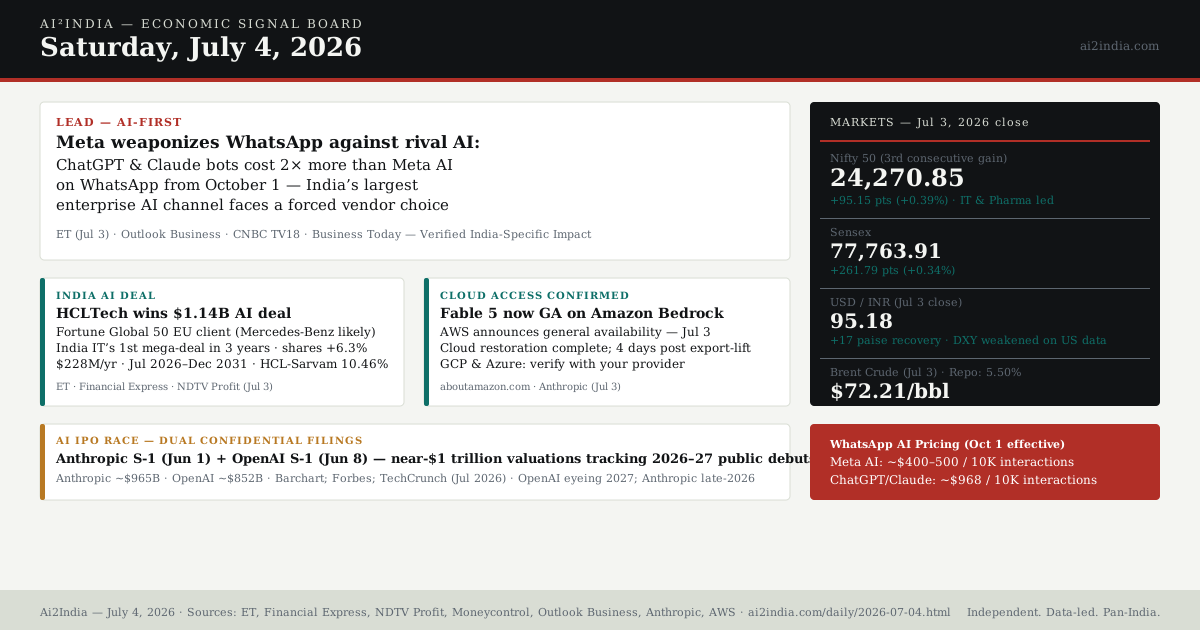
Meta weaponizes WhatsApp against rival AI: new pricing on the Business Agent Platform makes ChatGPT and Claude-powered bots nearly twice as expensive as Meta AI from October 1, forcing a strategic rethink for hundreds of thousands of Indian businesses — while Fable 5 achieves full cloud restoration with general availability on Amazon Bedrock, and HCLTech wins India IT’s largest AI services mega-deal in three years at $1.14 billion.
Saturday, July 4, 2026 opens with the most operationally significant AI platform economics story of the year for Indian enterprises: Meta has restructured pricing on its WhatsApp Business Agent Platform in a way that creates a near-2× cost disadvantage for businesses running ChatGPT, Claude, Qwen, Mistral, or Kimi on WhatsApp versus those using Meta’s own AI. The policy takes effect in stages — token-based billing starts August 1, per-message fees for complex interactions start October 1 — and will affect every Indian company using WhatsApp as a customer AI channel. On the same day: AWS formally confirms Fable 5 is generally available on Amazon Bedrock, resolving the last outstanding cloud-platform uncertainty from the June 12 export-control episode. And HCLTech announces a $1.14 billion AI services deal with a European Fortune Global 50 company (likely Mercedes-Benz), the largest India IT mega-deal in three years, with shares surging 6.3% — and separately, HCLTech had already invested ₹1,427 crore ($150 million) in Sarvam AI for a 10.46% stake, making it simultaneously India’s largest AI services deal-winner and a significant co-owner of India’s sovereign AI platform.
The WhatsApp pricing change is the AI platform economics story that Indian enterprise AI planners have been least prepared for — and it deserves to be the lead on July 4 precisely because it is the development most likely to change what an Indian enterprise does this week. Meta launched the Meta Business Agent Platform on July 1, 2026. As of that date, AI agent conversations on WhatsApp Business are free. Meta has now announced that this free period ends in two phases. Starting August 1, token-based billing begins for messages sent through the Meta Business Agent Platform — the underlying cost of AI inference is now being passed through. Starting October 1, per-message fees apply to “service communications” — the conversations that businesses have with customers through AI agents. The cost differential between Meta AI and third-party AI is the structural story. Running 10,000 complex customer interactions through a third-party AI model (ChatGPT, Claude, Qwen, Mistral, Kimi) will cost approximately $968 from October 1, according to Meta’s published pricing structure (Outlook Business, July 3). Running the same 10,000 interactions through Meta AI is estimated at approximately $400–500 — roughly half the cost. For lower-complexity service interactions at scale, the per-unit fee in India will be ₹0.115 per message at standard rates, with volume discounts for high-traffic deployments (Business Today, July 3).
Why this matters structurally for Indian enterprises: WhatsApp is not a marginal channel in India. It is the primary customer communication channel for a significant share of Indian BFSI, ecommerce, logistics, retail, and D2C businesses. HDFC Bank, Airtel, Flipkart, Zomato, and hundreds of thousands of Indian SMEs conduct customer service, order tracking, payment confirmation, appointment booking, and AI-powered query resolution through WhatsApp Business. Most of these deployments are built on top of OpenAI or Anthropic APIs — not Meta AI — because OpenAI and Anthropic had superior capability profiles and established enterprise integrations when most Indian businesses built their WhatsApp AI stacks in 2024–2025. The Meta pricing structure does not ban third-party AI on WhatsApp; it prices it into a more expensive tier. The effect is equivalent: it creates a powerful financial incentive to migrate from ChatGPT or Claude to Meta AI for WhatsApp-native use cases, or to move WhatsApp AI conversations back toward templated flows that minimise complex-interaction billing. For BFSI specifically: the Reserve Bank of India’s AI-in-finance guidelines specify data governance requirements that may or may not align with Meta AI’s data handling policies; regulated financial services firms cannot simply migrate to Meta AI on a cost signal without a compliance review.
Three decisions Indian enterprises should consider before October 1: (1) Audit which WhatsApp AI deployments use third-party models, and quantify the October 1 cost impact at actual monthly interaction volumes — the $968/10K figure is the reference point, but actual costs depend on interaction complexity, token usage, and Meta’s India-specific pricing. (2) Evaluate whether switching to Meta AI for WhatsApp-native use cases is technically feasible and compliance-compatible — Meta AI’s capability set and data-handling policies need to be assessed against your specific sector’s requirements. (3) Consider whether WhatsApp remains the right channel for AI-heavy customer interactions, or whether browser-based, app-native, or voice-based channels (where Meta’s pricing structure does not apply) are better suited for complex AI interactions. The meta-strategic point: this is the first time a major messaging platform has explicitly priced third-party AI as a more expensive option relative to its own AI — and WhatsApp, with 500 million Indian users and dominant enterprise penetration, has more leverage to execute this strategy in India than any other platform would.
Separately, the MeitY angle adds a regulatory dimension to the Meta India story. IT Minister Ashwini Vaishnaw directed MeitY officials to summon Meta on July 3 over Instagram ads promoting child sexual abuse material (CSAM), according to ET sources. MeitY also issued notices to Telegram, Signal, and WhatsApp over username features, citing impersonation and cybercrime risks; WhatsApp has been asked to pause the username feature rollout and respond within three days. The simultaneous pressure from two directions — platform pricing policy (economic) and CSAM/username enforcement (regulatory) — puts Meta in a complex position in India at precisely the moment it is rolling out a platform pricing model that requires Indian enterprise goodwill.
On Fable 5: AWS confirmed general availability of Claude Fable 5 on Amazon Bedrock on July 3 (aboutamazon.com). This resolves the primary operational uncertainty from the July 3 edition: the cloud-platform restoration from the June 12–July 1 export-control suspension is now confirmed complete for AWS. Indian enterprises running Fable 5 on Amazon Bedrock can restore production workloads. Google Cloud Vertex AI and Microsoft Azure Foundry status should be verified directly with those providers — no equivalent GA announcement has been confirmed as of July 4, 7:00 AM IST, but both were described as “in progress” as of Anthropic’s June 30 post, and the AWS restoration is a positive signal.
On HCLTech: the $1.14 billion contract with a large European Fortune Global 50 company — sources indicate Mercedes-Benz as the likely client, though HCLTech’s filing does not name the company — is significant for three reasons. First, it is “the first mega-deal in three years” for India IT (NDTV Profit), signalling that the AI-driven restructuring of enterprise IT services contracts — which destroyed Nifty IT valuations — is now also generating new large-scale AI services wins. Second, the deal is explicitly structured as an “AI-driven operating model to transform and manage the client’s global digital workplace and enterprise networks” (Financial Express) — not a legacy IT services contract. Third, HCLTech’s dual position — winning AI services revenue ($1.14B deal) while simultaneously investing in India’s sovereign AI platform (₹1,427 crore / $150 million in Sarvam AI for 10.46% stake) — is the most coherent AI-era strategy any major Indian IT firm has executed. HCLTech is positioning to both deliver AI services (Neysa-based infrastructure investment, Sarvam-powered Indian-language AI) and compete for the global enterprise AI services market. Shares surged 6.3% on the deal announcement.