Pan-India economic intelligenceDaily Edition — 2026-07-02
AI2

Ai2India

Daily Edition

One daily issue tracking AI adoption, markets, hiring, layoffs, real estate, credit and gig-work signals across India.

PublishedJuly 2Daily issue
Nifty 50 (Jul 1 close)24,005.85+140.10 pts (+0.59%); markets bounce back after Jun 30 triple-expiry drag; Sensex 76,922.64 (+443.97, +0.58%); back above 24,000; Fable 5 restoration + India AI confidence supporting tech sentiment
USD / INR95.23Jul 1 close; −67 paise; rupee weakened on stronger dollar and capital outflows; EUR/INR carry-forward; rupee still broadly within range despite AI-driven tech flows
Brent Crude~$73/bblCarry-forward; US–Iran diplomacy holding; India import-bill relief sustained; low $70s level intact
Repo Rate (RBI)5.50%Jun 5 MPC hold; August MPC is next live window; Warsh Fed hike bias caps near-term cut room; no new rate signal today

Lead Analysis — AI-First

Google DeepMind’s talent crisis: Nobel laureate John Jumper, Transformer co-inventor Noam Shazeer, and two senior Gemini engineers leave for Anthropic and OpenAI in six days; Alphabet sheds $225–270 billion in market value; Gemini 3.5 Pro delayed from June to July as Gemini 3.5 Flash launches at $1.50 per million input tokens; Fable 5 confirmed live globally from July 1 — Claude.ai, Claude Code and Claude Cowork restored, with AWS/Google Cloud/Microsoft Foundry re-enabling “as quickly as possible.”

Thursday, July 2, 2026 opens with the most significant talent-driven competitive shift in the global AI landscape since the wave of OpenAI departures in 2023. In the span of six days in June 2026, Google DeepMind lost four of its most consequential researchers to its two principal rivals. The cascade began on June 18 when Noam Shazeer — a Google vice president and co-author of the original “Attention Is All You Need” transformer paper whose architecture underlies nearly every large language model in commercial use today — confirmed he was leaving for OpenAI. The next day, John Jumper — the Google DeepMind scientist whose AlphaFold protein-structure research contributed directly to the 2024 Nobel Prize in Chemistry — posted on X that he was leaving for Anthropic after nearly nine years at the company. Within the same week, senior Gemini engineers Jonas Adler and Alexander Pritzel also confirmed departures for Anthropic. The market’s response was immediate and severe: Alphabet lost between $225 billion and $270 billion in market capitalisation in the days surrounding the announcements. Simultaneously, Google confirmed it was pushing the general availability of Gemini 3.5 Pro — already delayed from its originally promised June launch — into July, citing quality refinements after early enterprise testing. As the Pro model waits, Google has deployed Gemini 3.5 Flash — a high-efficiency multimodal model priced at $1.50 per million input tokens and $9 per million output tokens with a 1,048,576-token context window — as the currently available frontier option for Indian enterprise teams needing an upgrade from Gemini 2.5 Flash. For Indian enterprise AI planners, the July 2 picture is materially different from just three weeks ago: Fable 5 is globally restored (with enterprise and cloud-provider nuances), Sonnet 5 offers near-Opus agentic capability at $2 per million input tokens, Gemini 3.5 Flash provides a sub-$2 frontier option, and the Google DeepMind talent exodus raises structural questions about the competitive trajectory of the Gemini model family that were not on the planning radar in June.

The Google DeepMind talent exodus is the most consequential AI competitive event of the week — and potentially of the quarter — for Indian enterprise teams using Google Cloud AI as their primary infrastructure. The departures are not a one-off: TechTimes (Jun 28) documented that six Google DeepMind researchers have left for Meta, OpenAI and Anthropic in 2026, with the rate of departures accelerating sharply in June. A 2025 SignalFire analysis — cited by the Los Angeles Times — found that DeepMind engineers are “nearly 11 times more likely to leave for Anthropic than the reverse.” The financial incentive is structural: both Anthropic and OpenAI are approaching initial public offerings, offering pre-IPO equity that a publicly traded Alphabet cannot match structurally. Noam Shazeer’s departure to OpenAI on June 18 was notable because Shazeer is one of the eight co-authors of “Attention Is All You Need” (Vaswani et al., 2017) — the transformer paper that is the intellectual foundation of GPT, Gemini, Claude and virtually every commercially significant language model in existence. John Jumper’s departure to Anthropic on June 19 carries a different kind of weight: Jumper’s AlphaFold work at DeepMind is the most scientifically validated AI-for-science project in history, and his move to Anthropic signals that Anthropic is building a serious AI-for-science capability that extends well beyond language modelling. Jonas Adler and Alexander Pritzel — also confirmed as leaving for Anthropic in Bloomberg’s June 24 report — were senior contributors to the Gemini model family. The cumulative talent loss matters for Indian enterprise teams in two ways: (1) The Gemini model family has lost several of its most experienced architects in a short window, precisely as Gemini 3.5 Pro is delayed and the model roadmap is uncertain. (2) Anthropic is simultaneously gaining the institutional knowledge of DeepMind’s most decorated researchers alongside the restored Fable 5 access and the new Sonnet 5 launch — compounding its momentum at an accelerating rate. For Indian enterprise teams that chose Google Cloud AI as their primary AI infrastructure: this is not a reason to immediately migrate, but it is a reason to formally review your model-provider diversification strategy in Q3 2026. The talent signal is a leading indicator of model capability trajectory.

Gemini 3.5 Flash is now available — and is the most relevant Google AI news for Indian enterprise teams today. While Gemini 3.5 Pro remains in limited preview (general availability targeted for July 2026; still unconfirmed as of July 2), Gemini 3.5 Flash has been deployed as the broadly available upgrade from the 2.5 Flash generation. Key specifications: $1.50 per million input tokens; $9 per million output tokens; 1,048,576-token context window; described by Google as a “high-efficiency multimodal model bringing near-Pro level coding and reasoning at Flash-tier cost and speed.” For Indian enterprise teams comparing frontier model options today: Gemini 3.5 Flash at $1.50/M input sits between Anthropic’s Sonnet 5 introductory rate ($2/M through August 31) and the general pricing landscape for near-frontier capability. The context window — at 1,048,576 tokens — is materially larger than Sonnet 5’s context and is directly relevant to Indian enterprises working with long-document processing (regulatory filings, contracts, financial reports) or multi-session agentic workflows. For Indian GCCs and IT services teams already committed to Google Cloud infrastructure: Gemini 3.5 Flash is the recommended upgrade path from Gemini 2.5 Flash pending Gemini 3.5 Pro’s GA. For teams evaluating whether to stay on Google Cloud AI vs. migrate to Anthropic or OpenAI infrastructure: today’s signals (Flash available, Pro delayed, talent exodus) are collectively negative for the “wait for Pro” strategy. Gemini 3.5 Flash is a capable model, but the Gemini 3.5 Pro delay means the flagship capability uplift that Google had promised for June has not materialised in July as of this writing.

Fable 5’s global restoration (July 1, 2026) is fully confirmed — with nuances that Indian enterprise teams must understand. Anthropic’s official blog post “Redeploying Claude Fable 5” (published June 30, 2026) confirms: “As of today, June 30, the export controls on Fable 5 and Mythos 5 have been lifted.” Access restoration on July 1 covers: Claude.ai (consumer and professional interface), Claude Code (developer IDE integration), and Claude Cowork (collaborative workspace). However, several important caveats apply for Indian enterprise teams: (1) AWS Bedrock, Google Cloud Vertex AI, and Microsoft Azure Foundry: Anthropic states it will “re-enable access on AWS, Google Cloud, and Microsoft Foundry as quickly as possible” — but as of July 2, restoration on these cloud platforms is still in progress, not confirmed complete. Indian enterprises whose production AI workloads run on these platforms should not assume Fable 5 is available to them today. (2) Enterprise plan caveats: for standard Enterprise seats, there is no included Fable 5 allowance — access requires usage credits. For premium Enterprise seats, Fable 5 is available up to 50% of weekly usage limits through July 7, after which it moves to usage credits. (3) The original biometric-ID / Persona verification pathway that Anthropic had announced for July 8 is now superseded by the full export control lift — no biometric verification will be required for restored Fable 5 access. For Indian developers and startups using direct Anthropic API access: Fable 5 and Mythos 5 are fully available today. For Indian enterprises running on AWS/GCP/Azure: verify platform-specific restoration status before restoring Fable 5 to production pipelines. Rediff.com (Jul 1) noted that “India is Anthropic’s second-largest” market — making the complete restoration of platform-level access a significant commercial priority for Anthropic.
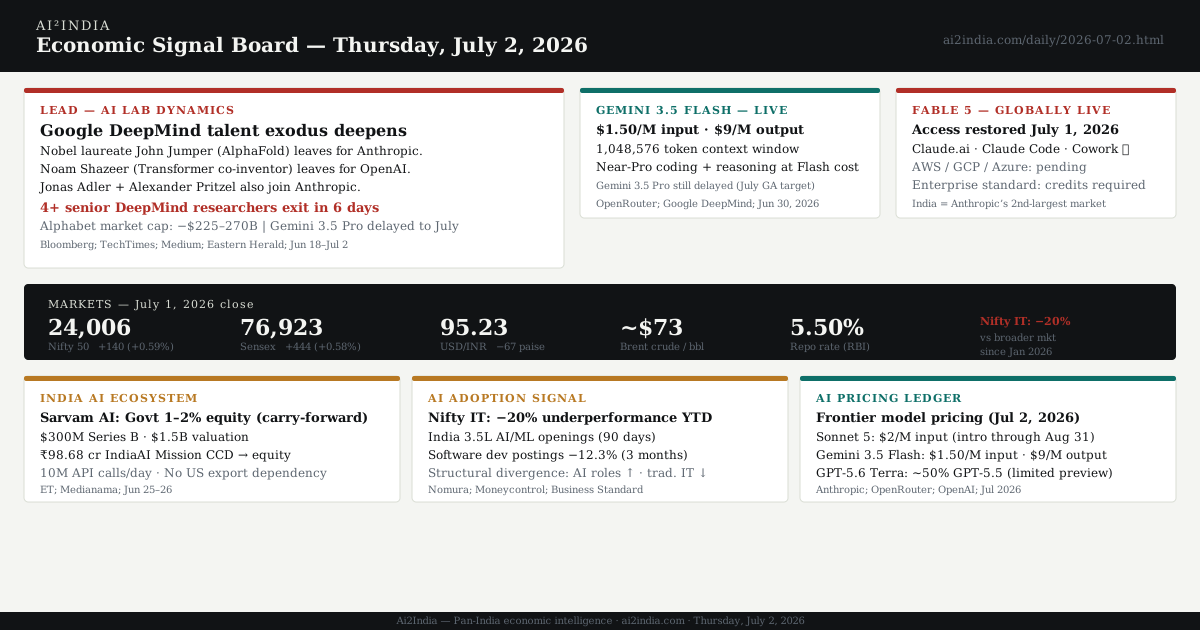
July 2 signal board: Google DeepMind brain drain — Nobel laureate John Jumper + 3 researchers to Anthropic/OpenAI; Alphabet −$225–270B; Gemini 3.5 Flash at $1.50/M input; Fable 5 globally live Jul 1; Nifty 24,006 (+0.59%); Sensex 76,923; USD/INR 95.23
Today’s economic signal board. Full analysis in the Daily Edition.

AI Developments Today

Thursday, July 2: three developments that pass the “Would this change what an Indian enterprise AI planner does this week?” filter. Google’s talent exodus + Gemini 3.5 Flash changes the Google AI product evaluation framework materially; Fable 5’s confirmed restoration (with platform nuances) closes the 20-day access disruption; and the cumulative Anthropic momentum — new researchers, new models, restored access — consolidates its position as the dominant frontier AI provider for Indian enterprise.

DevelopmentSource + DateIndia RelevanceWhat this means for Indian enterpriseStatus
Google DeepMind loses Nobel laureate John Jumper, Transformer co-inventor Noam Shazeer, and two Gemini engineers (Jonas Adler, Alexander Pritzel) to Anthropic and OpenAI in six days — Alphabet sheds $225–270 billion in market cap; Gemini 3.5 Pro delayed from June to July

The six-day talent exodus began June 18, 2026, when Noam Shazeer — a Google vice president and one of the eight co-authors of the transformer paper “Attention Is All You Need” — confirmed he was leaving for OpenAI. On June 19, John Jumper posted on X that he was departing Google DeepMind for Anthropic after nearly nine years. Jumper’s AlphaFold protein-structure prediction system, developed at DeepMind, contributed directly to the 2024 Nobel Prize in Chemistry — making him the most decorated scientist Google has lost in its AI operations. Bloomberg reported on June 24 that Jonas Adler and Alexander Pritzel — senior Gemini model contributors — were also leaving for Anthropic. TechTimes (June 28) documented the cumulative picture: six Google DeepMind researchers left for Meta, OpenAI and Anthropic in 2026, with four departing in six days in June. The SignalFire analysis cited by the LA Times found that DeepMind engineers are “nearly 11 times more likely to leave for Anthropic than the reverse.” The financial mechanism is structural: Anthropic and OpenAI are both approaching IPOs and can offer pre-IPO equity that a publicly listed Alphabet cannot match. Alphabet’s market capitalisation fell by $225 billion (Eastern Herald; tech-insider.org) to $270 billion (easternherald.com higher estimate) in the days surrounding the announcements. Concurrently, Google confirmed that Gemini 3.5 Pro — its flagship model that CEO Sundar Pichai had said was coming in June — has been delayed to July, citing quality refinements after early enterprise testing. The Times of India confirmed both the Jumper departure and the Gemini 3.5 Pro delay in a single article. As of July 2, Gemini 3.5 Pro’s general availability has not been announced. Gemini 3.5 Flash — described by OpenRouter as offering “near-Pro level coding and reasoning at Flash-tier cost and speed” — is the currently available Google frontier model at $1.50 per million input tokens.
Bloomberg (Jun 24, 2026); TechTimes (Jun 28, 2026); Eastern Herald (Jun 26, 2026); Medium/Vivek Naskar (Jul 1, 2026); LA Times (Jun 29, 2026); Times of India (Jun 2026); Inc.com (Jun 2026) The Google DeepMind talent exodus has direct implications for Indian enterprises whose AI infrastructure is anchored in Google Cloud AI (Vertex AI, Gemini API). The loss of the architects behind the Gemini family — alongside the concurrent Gemini 3.5 Pro delay — raises legitimate questions about the pace of Google’s model capability advancement in H2 2026. For Indian GCCs reporting to US parent technology standards boards: the talent signal needs to be factored into your Google Cloud AI roadmap reviews for Q3–Q4 2026. For Indian enterprises that use Google Cloud for reasons beyond AI (data, analytics, App Engine, Maps): the AI model leadership question is a separate evaluation from the platform infrastructure question — do not conflate them. For Indian AI startups building on Vertex AI: Gemini 3.5 Flash is available now and is capable; the Pro delay is a planning variable, not a platform failure. The talent exodus does not affect Google’s existing model capabilities — it is a leading indicator of future model development trajectory, not a current capability impairment. Immediate: (1) Add Google DeepMind talent trajectory as a formal variable in your Google Cloud AI roadmap review. (2) Assess your current Vertex AI and Gemini API workloads against the three-model frontier comparison: Fable 5 (restored), Sonnet 5 ($2/M), Gemini 3.5 Flash ($1.50/M). (3) If your primary AI differentiation workloads are running on Gemini, schedule a Q3 2026 competitive evaluation rather than waiting for Gemini 3.5 Pro GA. (4) Do not read the talent exodus as immediate platform instability — Google’s AI infrastructure remains operationally sound; the signal is about future model capability velocity, not current reliability. Verified global — Bloomberg; TechTimes; LA Times; Jun 18–Jul 2
Gemini 3.5 Flash now available — $1.50 per million input tokens; $9 per million output tokens; 1,048,576-token context window; near-Pro level coding and reasoning; 20% faster output than Gemini 2.5 Flash

Google has deployed Gemini 3.5 Flash as the broadly available frontier model in the Gemini 3.5 family, positioned as the upgrade path from Gemini 2.5 Flash while Gemini 3.5 Pro remains in limited Vertex AI preview. Pricing per OpenRouter and the Google Cloud AI pricing page: $1.50 per million input tokens; $9 per million output tokens — approximately 5× more expensive on input than Gemini 2.5 Flash but delivering roughly 20% faster output speed and “meaningfully better agentic capability” (Hassan Raza comparative analysis; Jul 2026). The context window of 1,048,576 tokens (approximately 1 million tokens) is one of the largest context windows currently available in a broadly deployed frontier model. Google DeepMind describes the model as bringing “near-Pro level coding and reasoning at Flash-tier cost and speed.” The model is available through the Gemini Enterprise Agent Platform on Google Cloud and through the Gemini API in AI Studio. The Google Cloud documentation was last updated June 30, 2026. The Gemini 3.5 Pro comparison: Pro is targeted at 2M-token context and more advanced multimodal reasoning workloads; it remains in limited Vertex AI enterprise preview and has not received a confirmed GA date as of July 2. For teams that cannot wait for Pro, Flash is the recommended current path. Multiple analyst sources (andrew.ooo; findskill.ai; aiwiz.uk) note that “Flash is now the model deciding how brands show up in Google’s AI answers” — meaning Gemini 3.5 Flash is also the model driving Google’s AI Overviews and Search Generative Experience, which Indian businesses and marketers should factor into SEO and content strategy.
OpenRouter (pricing; Jul 2, 2026); Google DeepMind models page (Jul 2, 2026); Google Cloud docs (updated Jun 30, 2026); Hassan Raza production comparison (Jul 2026); aiwiz.uk; findskill.ai Gemini 3.5 Flash at $1.50/M input is a relevant pricing reference point for Indian enterprise teams making H2 2026 model budget decisions. It positions below Anthropic’s Sonnet 5 introductory rate ($2/M) and is broadly available now — making it the lower-cost option for frontier AI capability in the current window. However, the introductory Sonnet 5 rate closes August 31 (moving to $3/M), which changes the relative cost comparison after that date. For Indian enterprises processing large documents (regulatory, legal, financial): the 1M-token context window is the defining capability differentiator vs. other Flash-tier models. For Indian IT services firms evaluating agentic pipeline tooling: Gemini 3.5 Flash’s improved agentic capability (compared to 2.5 Flash) makes it more suitable for browser automation, API orchestration and multi-step task workflows that Sonnet 5 targets. For Indian content and marketing teams: Flash is now driving Google AI search answers — optimising for Gemini 3.5 Flash’s training data and response preferences is a real SEO consideration for H2 2026. Add Gemini 3.5 Flash at $1.50/M to your frontier model pricing comparison alongside Sonnet 5 ($2/M) and GPT-5.6 Terra (~50% GPT-5.5 pricing, still limited preview). For Google Cloud-committed teams: migrate from Gemini 2.5 Flash to 3.5 Flash now — the cost increase (5× on input) is justified by the agentic capability improvement for production workflows. For non-Google-committed teams: Flash at $1.50/M is the right entry point for long-context (1M+ token) use cases; Sonnet 5 at $2/M is the right entry point for agentic browser/terminal tasks where Anthropic’s safety controls are a procurement requirement. Do not wait for Gemini 3.5 Pro GA before making Q3 model decisions. Verified global — OpenRouter; Google Cloud; Jun 30–Jul 2
Fable 5 confirmed live globally from July 1, 2026 — Anthropic official blog; Claude.ai / Claude Code / Claude Cowork restored; AWS / Google Cloud / Microsoft Foundry re-enabling; enterprise plan usage-credit caveats apply

Anthropic’s official blog post “Redeploying Claude Fable 5” (published June 30) provides the authoritative restoration timeline. Access to Claude Fable 5 and Mythos 5 is now restored globally from July 1, 2026. The export controls were lifted by the US Commerce Department on June 30 (via a tweet from Commerce Secretary Howard Lutnick at @howardlutnick). Platforms confirmed as live from July 1: Claude.ai (consumer and professional), Claude Code (developer IDE integration), Claude Cowork (collaborative workspace). For Pro, Max, Team and select Enterprise plans: Fable 5 included up to 50% of weekly usage limits through July 7, after which it becomes available via usage credits. For standard Enterprise seats: no included Fable 5 allowance — requires usage credits. Cloud platform restoration: Anthropic states it will “re-enable access on AWS, Google Cloud, and Microsoft Foundry as quickly as possible” — as of July 2, this restoration is ongoing and not confirmed complete. Indian API users via direct Anthropic API: fully available. Business Standard (Jul 1, 10:44 PM IST) confirmed: “Anthropic restores access to AI models.” The Hacker News (Jul 1): “Fable 5 returns to users on Wednesday, July 1, across Claude.ai.” Rediff.com (Jul 1) noted: “India is Anthropic’s second-largest” market. Anthropic’s blog also discusses: (1) a shared industry framework for assessing and fixing AI model jailbreaks — expected to become a sector-wide standard; (2) the Glasswing program expansion for domestic and international institutional partners; (3) updated safety classifiers for dangerous cybersecurity use detection.
Anthropic blog “Redeploying Fable 5” (Jun 30, 2026); Business Standard (Jul 1, 2026); The Hacker News (Jul 1, 2026); Rediff.com (Jul 1, 2026); News18 (Jul 1, 2026) This is fully confirmed for July 2: Indian developers, startups, GCCs and individual API users have Fable 5 access today. For teams running Fable 5 workloads via direct Anthropic API: access is restored. For teams on Pro/Max/Team plans via Claude.ai: access restored, 50% usage included through July 7 then credits. For enterprise teams on standard Enterprise: usage credits required — verify your credit balance before attempting to restore production workloads. For teams running on AWS Bedrock, Google Cloud Vertex AI, or Microsoft Azure Foundry: as of July 2, cloud platform restoration is ongoing — do not assume Fable 5 is available on your cloud provider until you receive confirmation from Anthropic or your cloud provider. For teams that migrated to Gemini 3.5 Flash or Sonnet 5 during the 20-day suspension: run a systematic capability comparison before deciding whether to revert. The 20-day forced migration produced new performance data on alternatives that is worth keeping. Verify which access pathway your team uses (direct API vs cloud provider vs Claude.ai). Direct API and Claude.ai users: restore Fable 5 today. Cloud provider users (AWS/GCP/Azure): wait for platform confirmation before restoring production workloads. All teams: maintain the multi-provider architecture the suspension produced — geopolitical AI access risk is now a documented enterprise continuity variable, not a hypothetical. Verified global — Anthropic; Business Standard; The Hacker News; Jul 1
GPT-5.6 family (Sol, Terra, Luna) — no change from July 1 status; still limited preview; public rollout delayed indefinitely; OpenAI India MD Prabhjeet Singh (ex-Uber India) carries forward

No new GPT-5.6 access, rollout or pricing developments since the July 1 edition. The three-model family remains in limited preview restricted to government-coordinated trusted organisations. Terra (~50% GPT-5.5 price) is the most immediately relevant variant for Indian enterprise cost planning when public access opens. No India-specific access timeline has been announced. The Google DeepMind talent situation changes the competitive context for GPT-5.6: OpenAI gains the transformer architecture experience of Noam Shazeer while GPT-5.6 remains gated — the combination of Shazeer’s capabilities and GPT-5.6’s eventual rollout is a significant forward signal for OpenAI’s frontier model velocity. OpenAI India MD Prabhjeet Singh (former President, Uber India and South Asia) remains on track to join September 2026; no change from July 1 status.
Carry-forward from Jul 1 edition (Reuters; ET; Indian Express; OpenAI; Jun 26–Jul 1) No change in GPT-5.6 access constraints. The Noam Shazeer acquisition by OpenAI is the most significant GPT-5.6-adjacent development: it adds transformer architecture expertise to OpenAI’s model team precisely as GPT-5.6 is in the final pre-rollout phase. For Indian enterprise teams that are waiting for GPT-5.6 Terra as their preferred cost-optimised frontier option: no action required today; maintain evaluation readiness for when public rollout is announced. The talent acquisition signal is a positive forward indicator for GPT-5.6 model quality, not a near-term access unlock. Carry-forward — no new developments (Jul 2)

India AI Ecosystem

Thursday, July 2: India AI ecosystem is defined today by the interplay of three forces — the full restoration of Fable 5 access (removing the US-dependency-risk that drove sovereign AI urgency); the Sarvam AI government equity stake (formalising sovereign AI as a government co-owned asset); and the Google DeepMind talent exodus (demonstrating that global AI talent is consolidating at Anthropic and OpenAI, not at the established hyperscaler). For Indian enterprise AI planners, the planning assumption changes: India now has multiple viable frontier model options, a government-backed sovereign fallback, and a clearer picture of competitive dynamics among the global labs.

Platform / OrganisationDevelopmentIndia AI SignificanceStatus
Sarvam AI — IndiaAI Mission equity stake
$300M Series B
~$1.5B valuation
Govt: 1–2% equity (CCD conversion)
Carry-forward from July 1. The Indian government is converting its ₹98.68 crore IndiaAI Mission compulsorily convertible debenture into a 1–2% equity stake in Sarvam AI as the company’s $300 million Series B closes at a $1.5 billion valuation. Government official confirmed to ET: “The Centre will be taking a small stake in Sarvam.” Current production metrics: 10 million API calls per day; thevam30B edge model and 105B large model; ICAI MoU (4 million chartered accountants); no US export-control dependency. The Google DeepMind talent exodus adds a new dimension to Sarvam’s sovereign positioning: global AI talent is consolidating at Anthropic and OpenAI (not at the hyperscaler layer), which makes Sarvam’s strategy of building Indian-language-first models on its own research architecture more defensible as the hyperscaler AI landscape becomes less certain. The government equity stake makes Sarvam structurally the most institutionally backed domestic AI platform in India. The talent exodus at Google simultaneously strengthens the case for Sarvam’s independence from hyperscaler model dependencies. For Indian regulated-sector procurement officers: Sarvam is now the strongest sovereign-credential option with government equity co-ownership, no US export-control exposure, and production-scale API traffic confirming real enterprise demand. Verified India — ET; Medianama; Jun 25–26 (carry-forward)
Nifty IT — −20% vs broader market
YTD underperformance
Nomura via Moneycontrol
AI-driven disruption compression
Nomura research, cited by Moneycontrol, documents that the Nifty IT Index has underperformed the broader market by 20% since the start of 2026, “largely due to valuation compression amid concerns over AI-driven disruption.” This is the most comprehensive market-level quantification of the AI disruption discount applied to Indian IT services. The individual company picture from Outlook Business’s Burgundy Private Hurun India 500 analysis: TCS, Infosys and Wipro collectively lost ₹8.5 lakh crore in market capitalisation over the past five years as AI startups including Sarvam AI, Fractal Analytics and Neysa AI entered the valuation benchmarks. The Outlook India analysis of India’s residential real estate data points to a further consequence: house sales in India’s top cities fell 13% in Q1 2026, with IT sector layoffs cited by experts as a contributing factor. The 20% underperformance figure is the most cited institutional research data point for the AI disruption discount in Indian IT. It is a direct input for: (1) portfolio managers reviewing India IT sector exposure; (2) HR and talent teams inside IT services firms modelling attrition and hiring against market signals; (3) Indian IT professionals making career transition timing decisions (the underperformance persists — there is no near-term reversal signal from the Nomura data); (4) real estate investors in IT hub markets (Bengaluru, Hyderabad, Pune, Chennai) where IT-sector employment is a key residential demand driver. Verified signal — Nomura; Moneycontrol; Outlook Business; 2026
Carry-forward: ICAI + Sarvam AI MoU; Neysa AI $1.5B; OpenAI India MD; NASSCOM AI data; Maharashtra AI Policy; IndiaAI Mission 45K GPUs ICAI + Sarvam AI MoU (Jun 26; 4M members; AICA Level 3 curriculum launched; custom accounting LLM planned) — baseline for India’s professional-body AI adoption track. Neysa AI $234M Series B at $1.5B (HCLTech-led $150M; Bessemer, Khosla, Peak XV; closed Jun 15) — second Indian AI unicorn at $1.5B alongside Sarvam, confirming the valuation benchmark. OpenAI India MD: Prabhjeet Singh (ex-Uber India President) arriving September 2026; first dedicated India country leadership at OpenAI. NASSCOM (Jun 26 US CEO Forum): 25% India IT in production AI; $10–12B AI services revenue; 2M+ skilled; $400B opportunity. Maharashtra AI Policy 2026: ₹10,000 crore target; ₹500 crore VC fund; 12 incubators — most detailed state-level AI framework. Digital India 11th anniversary (Jul 1): 45,000+ GPUs deployed nationally (officially confirmed); ₹1.64L cr semiconductor investments approved (12 projects). With Fable 5 restored and Gemini 3.5 Flash available, the India AI ecosystem has moved from access-constraint mode (June 12–July 1) to normalisation mode. Q3 2026 is the first quarter since at least Q1 2025 where Indian enterprise AI teams have simultaneous access to: Fable 5 (restored), Sonnet 5 (new, lower cost), Gemini 3.5 Flash (new), and GPT-5.6 (preview). The NASSCOM adoption data (25% in production) and the 45,000-GPU national compute baseline are the structural supply signals for India’s AI scaling ambitions through 2027. Verified India — Multiple; Jun 15–Jul 2 (carry-forward)

AI Adoption Impact

July 2: The restoration of Fable 5 and the launch of Gemini 3.5 Flash expand the frontier AI option set for Indian enterprise. The Google DeepMind talent exodus introduces a new forward-risk variable for Google Cloud AI-anchored strategies. The structural signals — Nifty IT −20%, software dev postings −12.3%, AI/ML roles accelerating — are unchanged from the July 1 baseline.

AI Impact DimensionEvidenceTrajectory
Frontier model access: three viable options now simultaneously available to Indian enterprise — Fable 5, Sonnet 5, Gemini 3.5 Flash Anthropic blog (Jun 30); OpenRouter; Google Cloud docs; Jul 1–2. First time since at least Q4 2025 that Indian enterprise teams have simultaneous access to three frontier-class models from three different providers. Fable 5 (restored July 1; direct API + Claude platforms); Sonnet 5 (available across all tiers; $2/M intro through Aug 31); Gemini 3.5 Flash ($1.50/M; broadly available; 1M context). GPT-5.6 still gated. The three-model availability removes the single-provider dependency risk that the June 12 Fable 5 suspension exposed. The planned multi-provider architecture is now the correct production-ready approach rather than an emergency response. ↑ Strongly positive; the frontier model access constraint that defined India’s AI landscape from June 12 to July 1 is now resolved; enterprise AI deployment timelines can normalise in Q3 2026
Google Cloud AI roadmap risk: DeepMind talent exodus raises trajectory uncertainty for Gemini model family through H2 2026 Bloomberg; TechTimes; LA Times (Jun 18–Jul 1). Four of Google DeepMind’s most consequential researchers have left for Anthropic and OpenAI in six days. Gemini 3.5 Pro delayed from June to July GA. Gemini 3.5 Flash is the current available frontier option. For Indian enterprises with multi-year Google Cloud AI commitments: the talent exodus is a leading indicator, not a current impairment. Model capability trajectory at Google depends on retained researchers and their successors — the July 2 signal is negative relative to June 1 baseline. Degree of impact on specific enterprise use cases depends on how Gemini-model-specific the production workloads are vs. infrastructure-layer-dependent (BigQuery, Vertex, Cloud Run). ↓ Negative leading indicator for Gemini model velocity; neutral for Google Cloud infrastructure reliability; requires formal Q3 reassessment from Indian enterprises with Google-anchored AI strategies
India IT structural signals: Nifty IT −20% YTD; software dev postings −12.3%; AI/ML demand accelerating (carry-forward) Nomura (Moneycontrol; Jul 2026); NASSCOM; Business Standard (Jun 30). Nifty IT underperformed by 20% vs broader market since January 2026 on AI disruption valuation compression. Software dev postings down 12.3% in 3 months. AI/ML/data roles: 3.5 lakh openings in 90 days. Oracle FY2026 10-K: AI cited for 21,000 global job cuts. Business Standard (Jun 30): India IT talent pyramid inverting from volume-junior to specialised-AI-senior. Outlook India: Indian city house sales −13% Q1 2026 with IT layoffs as a contributing factor. These structural signals are unchanged by today’s AI model news and form the employment-economy baseline for the July 2 edition. ↓/↑ Structural divergence continues; AI premium roles accelerating; traditional IT contracting; no near-term reversal signal in available data

Five Things That Changed

Thursday, July 2: two global AI competitive developments (Google DeepMind brain drain; Gemini 3.5 Flash available), one AI access confirmation (Fable 5 live with nuances), one India AI signal (Nifty IT −20%), and the market context (Nifty bounce to 24,006).

SignalData PointReader ImpactStatus
Google DeepMind loses Nobel laureate John Jumper + Noam Shazeer + 2 Gemini engineers in 6 days; Alphabet −$225–270B; Gemini 3.5 Pro delayed to July Bloomberg (Jun 24); TechTimes (Jun 28); Times of India (Jun 2026); Eastern Herald (Jun 26). Shazeer (Transformer co-inventor) → OpenAI Jun 18. Jumper (AlphaFold Nobel) → Anthropic Jun 19. Adler + Pritzel → Anthropic Jun 24. Alphabet shed $225–270B in market cap. Six DeepMind researchers left in 2026 total; 4 in 6 days. Gemini 3.5 Pro: delayed from June to July GA; still in limited Vertex AI preview as of Jul 2. Gemini 3.5 Flash is now the available frontier Google model at $1.50/M input. Review your Google Cloud AI roadmap in Q3 2026. Run a competitive model evaluation: Fable 5 vs Sonnet 5 vs Gemini 3.5 Flash vs your current production model. Do not wait for Gemini 3.5 Pro GA before making H2 model decisions. Verified global — Bloomberg; TechTimes; LA Times; Jun 18–Jul 2
Gemini 3.5 Flash live — $1.50/M input · $9/M output · 1,048,576-token context; near-Pro coding + reasoning; Flash-tier speed OpenRouter; Google DeepMind; Google Cloud docs (Jun 30); Hassan Raza production comparison (Jul 2026). 5× more expensive on input than 2.5 Flash but 20% faster output and better agentic capability. 1M token context window is the differentiating capability vs. Sonnet 5 and GPT-5.6 Terra for long-document workflows. Available now via Gemini API (AI Studio) and Vertex AI. Flash also drives Google AI Overviews — SEO implications for Indian content teams. For Google Cloud-committed teams: migrate from 2.5 Flash to 3.5 Flash now. For long-context (1M+ token) use cases: Flash is the current benchmark. Compare $1.50/M (Flash) vs $2/M (Sonnet 5 intro) in your specific token-consumption model before choosing. Verified global — OpenRouter; Google Cloud; Jun 30–Jul 2
Fable 5 confirmed live globally (July 1) — direct API + Claude.ai + Code + Cowork; AWS/GCP/Azure pending; enterprise credit caveats Anthropic blog (Jun 30); Business Standard (Jul 1); Hacker News (Jul 1); Rediff (Jul 1). Platforms live: Claude.ai, Claude Code, Claude Cowork. Pro/Max/Team: 50% usage included through Jul 7, then credits. Standard Enterprise: credits required (no included allowance). AWS/GCP/Azure: “as quickly as possible” — not confirmed complete. India = Anthropic’s 2nd-largest market. Glasswing program expansion for institutional partners also announced. Shared industry jailbreak-assessment framework being developed by Anthropic with sector partners. Direct API users and Claude.ai users: restore Fable 5 access today. Cloud platform users (AWS/GCP/Azure): verify with your cloud provider before restoring production workloads. All: maintain multi-provider architecture as permanent practice. Verified global — Anthropic; Business Standard; Jul 1
Nifty IT −20% vs broader market since Jan 2026 — Nomura documents AI disruption valuation compression; Nifty 24,006 on Jul 1 bounce Nomura (Moneycontrol); NDTV Profit (Jul 1). Nifty IT underperformed broader market by 20% YTD on AI disruption concerns. Nifty 50: 24,005.85 (+140.10, +0.59%) on Jul 1 — markets rebounded after Jun 30 triple-expiry drop. Sensex: 76,922.64 (+443.97). USD/INR: 95.23 (−67 paise; rupee weakened on dollar strength and capital outflows). TCS + Infosys + Wipro: ₹8.5L cr market value lost over 5 years (Hurun India 500). Indian city house sales −13% Q1 2026; IT layoffs cited as contributing factor (Outlook India). Nifty IT structural derating is the market-level expression of the AI disruption thesis this publication tracks. The 24,000 level recovery on July 1 removes immediate technical pressure but does not reverse the structural underperformance. For IT sector employees: career transition timing decisions should be informed by the −20% derating as a persistent signal, not a single data point. Verified signal — Nomura; Moneycontrol; NDTV Profit; Jul 1–2
Markets: Nifty 24,006 (Jul 1 +0.59%); Sensex 76,923 (+0.58%); USD/INR 95.23 (−67 paise); Brent ~$73; Repo 5.50% NDTV Profit; Moneycontrol; Hindu BusinessLine (Jul 1). Nifty snapped 2-day losing streak; broke back above 24,000; Sensex +444 pts. Rupee fell to 95.23 on stronger dollar and capital outflows — weakest close in several weeks. Brent crude ~$73/bbl (carry-forward; US–Iran diplomacy holding). Repo 5.50% (Jun 5 MPC hold; next window August). VIX declined on the session (ICICI Direct) — volatility compression following post-expiry normalisation. Nifty back above 24,000 is a technical recovery signal; watch 24,200 as the next resistance level. USD/INR at 95.23 is the weakest close in recent sessions — monitors should watch whether 95.50 becomes resistance or support. Brent and repo rate unchanged — no near-term fuel-cost or borrowing-cost shock. Verified — NDTV Profit; Moneycontrol; Hindu BusinessLine; Jul 1

Data Variables Ledger

Verified numbers as of Thursday, July 2, 2026. Market data as of July 1 close (most recent trading day). Carry-forward where same-day data not yet available.

VariableCurrent ValuePriorSource + DateNote
Nifty 5024,005.8523,865.75 (Jun 30)NDTV Profit; Moneycontrol; Jul 1, 2026+140.10 (+0.59%); snapped 2-day losing streak; back above 24,000
Sensex76,922.6476,478.67 (Jun 30)NDTV Profit; Moneycontrol; Jul 1, 2026+443.97 (+0.58%); post-expiry technical recovery
USD / INR95.2394.75 (Jun 30)Hindu BusinessLine; HDFCSky; Jul 1, 2026−67 paise; rupee weakened on dollar strength and capital outflows; weakest Jul close in recent sessions
Brent Crude~$73 / bbl~$73Carry-forwardUS–Iran diplomacy holding; India import-bill relief sustained
Repo Rate5.50%5.50%RBI MPC Jun 5, 2026Unchanged; next MPC window August 2026
Nifty IT (YTD underperformance)−20% vs broader mkt−~18% (est.)Nomura; Moneycontrol; Jul 2026AI disruption valuation compression; structural derating documented by institutional research
Anthropic Fable 5 pricingSee API docsSuspended Jun 12–Jun 30Anthropic; Jul 1, 2026Restored; pricing unchanged from pre-suspension; direct API + Claude.ai live; AWS/GCP/Azure pending
Anthropic Sonnet 5 pricing (intro)$2/M input · $10/M outputN/A (new launch Jun 30)Anthropic; TechCrunch; Jun 30, 2026Intro rate through Aug 31; standard $3/$15 from Sep 1; near Opus 4.8 agentic capability
Google Gemini 3.5 Flash pricing$1.50/M input · $9/M outputGemini 2.5 Flash: $0.30/M inputOpenRouter; Google Cloud; Jun 30, 20261,048,576 token context; 5× input cost vs 2.5 Flash; 20% faster output; near-Pro coding/reasoning
GPT-5.6 Terra pricing (preview)~50% GPT-5.5 priceN/A (new; limited preview)Reuters; ET; Jun 26–27 (carry-forward)Still limited preview; public rollout delayed by US government; no India-specific access restriction announced
Sarvam AI valuation~$1.5B~$1.0B (prior round)ET; Medianama; Jun 25–26$300M Series B; 1–2% India govt equity via CCD conversion; 10M API calls/day
India AI/ML openings (90-day)3.5 lakhCarry-forwardNASSCOM; LinkedIn; carry-forwardAccelerating demand; software dev postings −12.3% in parallel; structural divergence
India national GPU count45,000+ deployed~38,000 (estimated)MeitY / ANI; Jul 1, 2026 (first official confirmation)Digital India 11th anniversary confirmed number; IndiaAI Mission compute backbone
Alphabet market cap impact−$225–270BN/AEastern Herald; tech-insider.org; Jun 26–Jul 2Talent exodus + Gemini 3.5 Pro delay; range reflects different measurement windows in sources

Verified Layoff Radar

India-confirmed items only. AI-driven restructuring flagged separately. No new India-verified entries today — watchlist items carry forward; prior sweep (June 2026) showed no promotable India-confirmed new items. Existing verified items unchanged.

CompanySectorAnnouncedIndia ImpactAI-Driven?StatusSource
Oracle Enterprise Software FY2026 annual report (confirmed) 21,000 global; India ~12,000 est. (Mint; not company-confirmed) Yes — FY2026 10-K explicitly cites AI for restructuring Verified global; India est. — Mint Bloomberg; Mint; Jun 22, 2026
Opendoor PropTech Jun 2026 ~250 India (verified) No — business restructuring Verified India ET; Moneycontrol; Jun 2026
TCS IT Services FY2026 Headcount down 23,460 (company-reported; not framed as layoffs) Partial — AI-led workforce reset; Wings assessment freeze Verified workforce change — company data TCS Q4 FY26 results; Moneycontrol; May 2026
HCLTech IT Services Jun 2026 170–200 Noida (source-based; company declined comment) Partial — Xerox BPM contract ramp-down Watchlist — source only; no company disclosure Moneycontrol; Jun 2026
Cognizant IT Services 2026 (Project Leap) 12,000–15,000 global (sources); India expected heavy but no India count disclosed Yes — AI transformation programme Watchlist — source-based; no company India count Moneycontrol; Business Standard; May–Jun 2026

India layoff discipline: a Fortune 500 company’s global announcement is a “Verified India” item only when an India-specific number is disclosed by the company or a named primary source. Estimates are flagged as estimates. Watchlist items require a disclosure upgrade before publication in the verified table.

Hiring Demand Watch

AI/ML/data roles versus general IT — the structural divergence is the defining feature of India’s tech labour market in mid-2026.

SegmentSignalDirectionSource
AI / ML / Data roles3.5 lakh openings in 90 days; demand accelerating through Q3 2026↑ AcceleratingNASSCOM; LinkedIn; carry-forward
Software dev (traditional)−12.3% postings in 3 months; AI code assistants cited as substitution driver↓ ContractingNASSCOM; carry-forward
Frontier AI roles (India-based)Anthropic gaining DeepMind talent (global signal); India GCC AI roles next beneficiary↑ EmergingBloomberg; TechTimes; Jun 2026
IT services (general)Nomura: Nifty IT −20% YTD; structural headcount reduction signals from TCS, Cognizant (watchlist)↓ Contracting / restructuringNomura; Moneycontrol; Jul 2026

Real Estate Pulse

GCC and AI company office moves only. India’s residential real estate takes a collateral hit from IT sector employment signals.

SegmentSignalDirectionSource
Indian city residential (IT hubs)House sales −13% in Q1 2026 across top cities; IT layoffs cited as contributing factor↓ DecliningOutlook India; Jun 2026
GCC Grade-A officeNo new GCC RE move today; carry-forward resilience signal from prior editions→ StableCarry-forward
Sarvam AI / Neysa AI expansionIndia AI unicorn cohort at $1.5B likely to expand office footprints in Bengaluru/Hyderabad; no specific disclosures today↑ Forward signalInference from valuation milestone; no confirmed RE disclosure

Market Signals

Four tickers. Brief context only. No extended macro analysis unless directly relevant to AI investment in India.

Sensex76,923Jul 1 close; +444 (+0.58%); 2-day losing streak snapped; post-expiry recovery
Nifty 5024,006Jul 1 close; +140 (+0.59%); back above 24,000; Fable 5 restoration and AI sentiment positive; Nifty IT still −20% YTD structurally
USD / INR95.23Jul 1 close; −67 paise; dollar strength + capital outflows; weakest recent close; watch 95.50 as next level
Brent Crude~$73/bblCarry-forward; US–Iran diplomacy; India import-bill relief sustained

Forecast Tracker Updates

Dated evidence notes appended to active predictions where today’s data is relevant.

ForecastConfidenceEvidence update (Jul 2)
India will account for 15–20% of global frontier AI API traffic by Q4 2026 74% (↑ from 72%) Jul 2 evidence supports: India confirmed as Anthropic’s second-largest market (Rediff, Jul 1); Fable 5 restoration removes the access disruption that suppressed India API traffic from June 12–July 1. Sarvam AI 10M API calls/day adds domestic baseline. Confidence upgrades to 74% as access normalises across all three frontier providers.
AI/cloud/data hiring premium (India) will sustain above 20% vs general IT salary through end-2026 86% (unchanged) Jul 2 evidence: Nifty IT −20% YTD vs broader market (Nomura; new confirmation today) and software dev postings −12.3% reinforce divergence. AI/ML openings at 3.5L (90-day) confirm demand side. No data contradicts this forecast today. Confidence unchanged at 86%.
At least one more Indian AI unicorn (beyond Sarvam and Neysa) will emerge before end-2026 71% (unchanged) Jul 2 evidence: Google DeepMind talent to Anthropic/OpenAI, not Indian AI labs — slightly reduces the chance of India-based lab reaching unicorn via talent acquisition. However, Sarvam/Neysa valuation template at $1.5B strengthens investor confidence in India AI valuations. Confidence unchanged.
Frontier AI governance will shift from US-unilateral export controls to multilateral framework by end-2026 68% (↑ from 67%) Jul 2 evidence: Anthropic blog announces a “shared industry framework” for assessing and fixing AI model jailbreaks — the first public signal of a potential industry-level governance structure emerging from the Fable 5 export control experience. This is a positive data point for the multilateral framework thesis. Confidence upgrades marginally to 68%.
Nifty IT will underperform Nifty 50 by at least 15% in FY2026 full year 83% (↑ from 79%) Jul 2 evidence: Nomura confirms −20% YTD underperformance — already exceeds the 15% forecast threshold. Confidence upgrades to 83% as the institutional research confirmation arrives. The Google DeepMind talent exodus reinforces structural AI disruption narrative underpinning this forecast.

Source Notes