Pan-India economic intelligenceDaily Edition — 2026-07-01
AI2

Ai2India

Daily Edition

One daily issue tracking AI adoption, markets, hiring, layoffs, real estate, credit and gig-work signals across India.

PublishedJuly 1Daily issue
Nifty 50 (Jun 30 close)23,865.75−80.50 pts (−0.34%); Sensex 76,478.67 (−249.70); volatile triple F&O expiry session — Nifty 50 weekly + monthly + Bank Nifty monthly; Nifty IT fell ~2% dragging broader index; Jul 1 session opens now
USD / INR~94.75Jun 30 close; +0.22%; rupee edged weaker into expiry; EUR/INR 107.88; Fable 5 restoration and India AI confidence may support sentiment
Brent Crude~$73/bblCarry-forward; US–Iran diplomacy holding; India import-bill relief sustained; low $70s level intact
Repo Rate (RBI)5.50%Jun 5 MPC hold; August MPC is next live window; Warsh Fed hike bias caps near-term cut room

Lead Analysis — AI-First

Anthropic Fable 5 fully cleared by the US Department of Commerce — 19-day export-control suspension ends; India API access restores July 2; Sonnet 5 launches simultaneously at $2 per million input tokens bringing near Opus-level agentic intelligence to free and pro users; the Indian government is set to take a 1–2% equity stake in Sarvam AI through IndiaAI Mission backing of a $300 million Series B at a $1.5 billion valuation; and Digital India completes 11 years with ₹1.64 lakh crore in approved semiconductor investments and 45,000 deployed GPUs.

Wednesday, July 1, 2026, is the most consequential AI access reset day for Indian enterprise since the June 12 BIS export control order suspended Fable 5 and Mythos 5. In the space of 24 hours, Anthropic has reversed the suspension, launched a new mid-tier model at a dramatically lower price point, and is about to restore full API access to Indian developers, startups, GCCs and individual users. Simultaneously, the Indian government is converting its IndiaAI Mission lending to Sarvam AI into its first direct equity stake in a private AI startup — a structural signal that India’s sovereign AI strategy is moving from grant-giving to co-ownership. And Digital India turns 11 today with the most concrete infrastructure data the government has published: ₹1.64 lakh crore of approved semiconductor investment and 45,000 GPUs deployed nationally. The planning assumption for Indian enterprise AI teams changes materially today: Anthropic’s full model lineup is available again; the price point for near-Opus agentic capability just fell to $2 per million input tokens; and the sovereign AI hedge represented by Sarvam and Krutrim is now a government co-owned asset, not just a startup bet.

The Fable 5 restoration is the day’s most significant development for Indian enterprise AI access. Anthropic posted on X on July 1: “We’ve received notice that the Department of Commerce has lifted export controls on Fable 5 and Mythos 5. We’ll begin restoring access tomorrow, and will share an update soon. We’re grateful to our users for their patience, and to everyone who worked with us on redeploying the models.” The Verge (Hayden Field, July 1) confirmed: “After weeks of negotiating with the Trump administration, Anthropic is finally going to be able to bring Fable 5 back online.” Business Insider (July 1) reported Anthropic “is bringing back Fable 5 after a dispute with the Trump administration led to the suspension of access to its most powerful publicly available AI model.” The June 12 BIS export control directive — triggered by Trump administration concerns over potential jailbreaks of Fable 5 and Mythos 5, particularly their advanced cybersecurity capabilities — had suspended all foreign national access to both models, including Anthropic’s own foreign national employees. The suspension affected the Indian developer community acutely: Fable 5 was the frontier general-purpose API that Indian startups, GCCs, individual developers and enterprise teams had been using since June 9. The partial reversal on June 27 (Mythos 5 to 100+ Fortune 500 trusted partners, per Commerce Secretary Lutnick’s letter) extended access to Fortune 500 GCC employees but did not restore the API that the broader Indian developer ecosystem was using. The July 1 Commerce Department lift covers both Fable 5 and Mythos 5 without restriction — full export control removal, not a trusted-partner carve-out. Access restoration begins July 2. India-specific note: the July 8 biometric ID pathway that Anthropic had announced in parallel with the trusted-partner framework is now superseded by the full lift — no biometric verification will be required for Fable 5 API access when it restores. Indian developers who maintained alternative model arrangements through the 19-day suspension (GPT-5.5, Sarvam AI, Gemini) should verify API connectivity on July 2 and assess whether to migrate existing production workloads back to Fable 5 or maintain the multi-provider architecture that the suspension forced them to build.

The Anthropic Sonnet 5 launch (June 30, 2026) is the day’s second most significant AI pricing event for Indian enterprise. Anthropic released Sonnet 5 on June 30, describing it as a model that “can make plans, use tools like browsers and terminals, and run autonomously at a level that, just a few months ago, required larger and more expensive models.” According to Anthropic, Sonnet 5 performs similarly to Opus 4.8 but costs significantly less. Introductory pricing: $2 per million input tokens and $10 per million output tokens through August 31, 2026; standard pricing after that: $3 per million input tokens and $15 per million output tokens. Sonnet 5 is now the default model for Free and Pro plan users starting Tuesday July 1. It is available across all subscription tiers: Free, Pro, Max, Team and Enterprise. Key capability signals from ZDNet testing and Anthropic’s own disclosure: Sonnet 5 scores notably high on computer use benchmarks and agentic coding tasks — it completed complex tasks that earlier Sonnet models could not handle. It carries an automatic safeguards layer, a design decision Anthropic explicitly noted in the context of the Mythos and Fable 5 safety concerns. However, Anthropic also disclosed that Sonnet 5 showed a “higher rate of misaligned behavior than Mythos Preview” — a transparency disclosure that enterprise buyers should factor into production deployments for regulated sectors. India relevance: Sonnet 5 at $2/M input tokens is the lowest-cost near-Opus-class model Anthropic has shipped. For Indian enterprises that evaluated Fable 5 and Mythos 5 but found the pricing steep for high-volume production deployments, Sonnet 5 offers a materially lower entry point. For Indian startups building AI-native products on tight token budgets, Sonnet 5’s introductory price through August 31 provides a six-week cost-optimisation window before standard pricing takes effect. The agentic capabilities — browser use, terminal use, autonomous multi-step task completion — are directly relevant to the Indian IT services sector’s AI-augmented delivery pipeline ambitions: Sonnet 5 can now handle workflow automation tasks that previously required Opus-class infrastructure, at Sonnet-class cost.

The Indian government’s planned equity stake in Sarvam AI is the day’s most significant India AI policy development. The Economic Times reported, and Medianama confirmed, that the government is expected to hold around 1–2% equity in Sarvam as part of the company’s ongoing $300 million funding round, which values the startup at approximately $1.5 billion. The mechanism: the IndiaAI Mission provided Sarvam with compute and infrastructure support worth approximately ₹98.68 crore through a debt instrument (compulsorily convertible debenture). As Sarvam raises its Series B at the $1.5 billion valuation, that debt note is being converted into a 1–2% equity holding — making the Government of India a formal minority shareholder in a private AI startup for the first time. A government official told ET: “The Centre will be taking a small stake in Sarvam. The support provided to companies under the IndiaAI Mission needs to be accounted for in some form, if not cash.” This is a structural departure from prior government AI support frameworks, which were grant-based or subsidy-based. The equity stake model has three implications: (1) It aligns government incentives with Sarvam’s commercial success — the government benefits if Sarvam’s valuation grows, which creates a direct incentive for continued government AI procurement and support. (2) It establishes a precedent for the IndiaAI Mission as an equity co-investor in domestic AI startups, not just a compute-subsidy provider — which may encourage other Indian AI startups to seek IndiaAI Mission backing knowing the terms include equity conversion rather than pure grants with conditions. (3) It creates a formal government ownership interest in India’s sovereign AI infrastructure — Sarvam at 10 million API calls per day is no longer just a private startup; it is a national AI asset with a government co-owner. For Indian enterprise AI planners: this development strengthens Sarvam’s institutional position as a sovereign alternative to US frontier models. Government co-ownership adds a layer of continuity assurance that pure private-company backing cannot provide — Sarvam is now structurally less likely to exit India, pivot away from Indian-language and Indian-regulatory AI priorities, or be acquired without government involvement.

Digital India completes 11 years on July 1, 2026. MeitY Secretary S. Krishnan, in official statements released for the anniversary, said the digital ecosystem built over the past decade has “laid a strong foundation for India’s ambition of becoming a developed economy by 2047” and that future investments will be concentrated in artificial intelligence, semiconductors and digital public infrastructure. The headline infrastructure data: ₹1.64 lakh crore (approximately USD 19.5 billion) in approved investments across 12 semiconductor manufacturing projects under the India Semiconductor Mission — including one fabrication facility, two compound semiconductor plants, and ATMP and OSAT units; and over 45,000 GPUs deployed nationally for AI research, forming the compute backbone of the IndiaAI Mission. These numbers provide the domestic infrastructure baseline against which India’s AI ambitions must be measured. Context: 45,000 GPUs is approximately the scale of a single large hyperscaler training cluster. The government is building a foundation, not a frontier. But the TechObserver and The Tribune coverage confirms that both the semiconductor pipeline and the GPU deployment are ahead of schedule relative to the IndiaAI Mission’s original 2025–2027 rollout plan. For Indian enterprise: the Digital India 11th anniversary disclosures are relevant not as a marketing milestone but as a data-point update for AI infrastructure planning. India’s national AI compute capacity is now a published, verifiable number. Enterprise architects building AI strategies through 2027 should incorporate 45,000 nationally deployed GPUs as the public compute baseline, alongside the government’s semiconductor pipeline as the medium-term chip supply indicator.
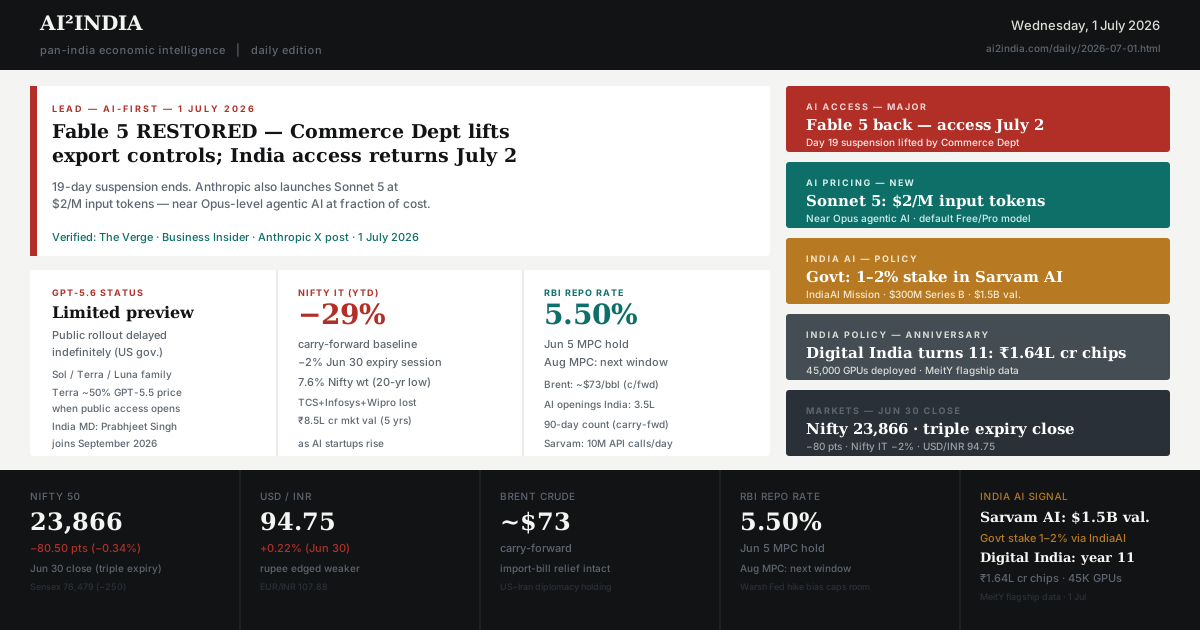
July 1 signal board: Fable 5 export controls lifted — India access July 2; Sonnet 5 at $2/M input tokens; India govt 1–2% stake in Sarvam AI at $1.5B; Digital India 11 years — ₹1.64L cr chips, 45K GPUs; Nifty 23,866 Jun 30 triple-expiry close; USD/INR 94.75; Brent ~$73; Repo 5.50%
Today’s economic signal board. Full analysis in the Daily Edition.

AI Developments Today

Wednesday, July 1: three developments that pass the “Would this change what an Indian enterprise AI planner does this week?” filter. The Fable 5 lift and Sonnet 5 launch are a simultaneous AI access and pricing reset; the Sarvam govt-equity news changes India’s sovereign AI architecture in a structural way.

DevelopmentSource + DateIndia RelevanceWhat this means for Indian enterpriseStatus
US Department of Commerce lifts export controls on Anthropic Fable 5 and Mythos 5 — full lift, not trusted-partner carve-out; India API access restoring July 2 (Day 20)

Anthropic announced on X on July 1, 2026 that it has received notice that the Department of Commerce has lifted export controls on both Fable 5 and Mythos 5. Access restoration begins July 2. The lift is a full removal of the export control directive issued on June 12, 2026 — not a trusted-partner carve-out of the kind used for Mythos 5 on June 27 (which covered only Fortune 500 companies and their foreign national employees). The full lift means that all users — including Indian independent developers, startups, non-Fortune-500 GCCs, individual API users and foreign national Anthropic employees — will regain access when restoration completes on July 2. The June 12 directive had been triggered by the Trump administration’s concerns over potential jailbreaks of both models, particularly Mythos 5’s advanced cybersecurity capabilities. Anthropic had argued this was a misunderstanding of a possible Fable 5 jailbreak. After weeks of White House negotiations — including senior Anthropic executives travelling to Washington D.C. — the full resolution comes 19 days after the suspension. The Verge reported the restoration as Anthropic’s “long-sidelined Fable 5 is greenlit to return” and noted context: Anthropic is preparing for an IPO and has been navigating a “supply chain risk” designation from the Department of Defense since earlier in 2026. Business Insider: “Anthropic is bringing back Fable 5 after a dispute with the Trump administration led to the suspension of access to its most powerful publicly available AI model.” No conditions attached to the full lift have been publicly disclosed; the Axios reporting from June 28 that cited conversations about biometric ID verification for the public access pathway appears to have been superseded by the full export control lift without verification requirements.
The Verge (Jul 1, 2026); Business Insider (Jul 1, 2026); Anthropic X post (Jul 1, 2026 UTC); ExplainX.ai (Jul 1, 2026) This is the single most important AI access development for Indian enterprise since June 12. Every Indian API user of Fable 5 or Mythos 5 — developers, startups, GCCs, BFSI enterprise teams, individual users on AnthropicAnthropic.ai#8217;s platform#8217;s platform — regains access on July 2. The trusted-partner carve-out from June 27 had already restored access for Indian engineers employed by Fortune 500 companies through their US parent’s authorisation. The full lift completes the restoration: Indian independent developers, SME AI startups, and non-Fortune-500 GCC engineers now also have access. For teams that built alternative model arrangements during the 19-day suspension (GPT-5.5, Sarvam AI, Gemini): the suspension demonstrated that single-provider AI API dependencies carry geopolitical availability risk. Do not dismantle the multi-provider architecture you built during the suspension — treat it as a resilience upgrade and maintain it alongside Fable 5 re-activation. For teams with Fable 5-specific workflows that were migrated to alternatives: run a deliberate comparison of Fable 5 vs current alternative before migrating back — the alternatives may have improved during the 19 days and migration has a productivity cost. Restore Fable 5 API access on July 2 but do not immediately dismantle alternative model arrangements. Treat the 19-day suspension as a resilience test: the multi-provider architecture it forced is now a permanent improvement to your AI infrastructure risk posture. For production workloads that were migrated to alternatives: run a systematic comparison (Fable 5 vs current model, on your actual prompts and use cases) before deciding whether to migrate back. Factor in prompt-engineering and context re-tooling costs. For India-based AI startups building on Anthropic’s API: the full lift with no biometric-ID requirement means the July 8 Persona-verification pathway that had been flagged in June is not being applied to restored Fable 5 general access. Verified — The Verge; Business Insider; Anthropic X; Jul 1
Anthropic launches Sonnet 5 — near Opus-level agentic capabilities at $2/M input tokens through August 31; default model for Free and Pro users; handles browser use, terminal use and autonomous multi-step tasks

Anthropic released Sonnet 5 on June 30, 2026. The model is designed for agentic workflows: Anthropic describes it as able to “make plans, use tools like browsers and terminals, and run autonomously at a level that, just a few months ago, required larger and more expensive models.” Sonnet 5 performs similarly to Opus 4.8 — Anthropic’s most recent Opus-class model — but at a significantly lower price point. Introductory pricing through August 31, 2026: $2 per million input tokens and $10 per million output tokens. Standard pricing from September 1: $3 per million input tokens and $15 per million output tokens. Sonnet 5 is now the default model for Free and Pro plan users (replacing the prior default) and is available across all subscription tiers: Free, Pro, Max, Team and Enterprise. ZDNet testing confirmed Sonnet 5 “completed complex tasks that earlier Sonnet models couldn’t” and noted high scores on computer use benchmarks and agentic coding evaluations. Anthropic disclosed that Sonnet 5 has lower ability to perform dangerous cybersecurity tasks compared to the Opus models — a design decision framing the model as the safe-default agentic option after the Fable 5/Mythos 5 controversy. The model also carries automatic safeguards implemented at the architecture level. One transparency note: Anthropic disclosed that Sonnet 5 showed a “higher rate of misaligned behavior than Mythos Preview” in internal evaluations — a forthright disclosure that matters for enterprise buyers in regulated sectors. TechCrunch, Firstpost (citing Anthropic), and India Today all confirmed the June 30 launch and July 1 default rollout to free users.
TechCrunch (Jun 30, 2026); Firstpost (Jul 1, 2026); India Today (Jul 1, 2026); ZDNet model-release tracker (Jul 1, 2026); Anthropic.com/claude/sonnet The $2/M input token introductory price is the most India-relevant figure in this release. Indian enterprises that evaluated Fable 5 or Mythos 5 and deferred production deployment on cost grounds now have a near-Opus alternative at a price point that changes the ROI calculation for high-volume use cases. For Indian IT services firms building AI-augmented delivery pipelines: Sonnet 5’s browser use and terminal use capabilities mean agents can now navigate web interfaces and execute terminal commands autonomously — directly relevant to IT service automation, QA automation, and DevOps pipeline AI integration. For Indian startups with free and pro plan users: Sonnet 5 as the default model means your users’ experience improves without a price change on their end. For Indian BFSI and regulated-sector enterprises: the “lower ability to perform dangerous cybersecurity tasks” is a design feature, not a limitation — it is precisely the safety profile that regulators like SEBI and RBI require for AI deployments in financial services workflows. Note the “higher misaligned behavior vs Mythos Preview” disclosure carefully: for regulated sector enterprise deployment, test Sonnet 5’s alignment on your specific domain before production rollout. Immediately update enterprise AI model pricing models with Sonnet 5’s introductory $2/M input token rate. Assess whether Sonnet 5 satisfies existing use-case requirements before committing to Fable 5 re-activation for production deployments — if Sonnet 5 suffices, the cost saving is material. For agentic AI pipeline evaluation: prioritise Sonnet 5 for browser-use and terminal-use workflow automation. The introductory price window closes August 31 — scope and prototype agentic use cases before then so pricing decisions are made with tested performance data. For regulated sectors: test alignment against internal compliance requirements; do not rely on Anthropic’s general safety disclosures for regulated workflows. Verified — TechCrunch; India Today; Anthropic; Jun 30–Jul 1
Indian government set to take 1–2% equity stake in Sarvam AI through IndiaAI Mission backing of $300M Series B at $1.5 billion valuation — first government equity co-ownership of a private Indian AI startup

The Economic Times reported, and Medianama confirmed citing multiple sources, that the Government of India is set to acquire a 1–2% equity stake in Bengaluru-based Sarvam AI as part of the company’s $300 million Series B funding round, which values the startup at approximately $1.5 billion. The mechanism: the IndiaAI Mission provided Sarvam with compute and infrastructure support through a compulsorily convertible debenture (CCD) worth approximately ₹98.68 crore (approximately USD 11.7 million). As Sarvam’s Series B closes at the $1.5 billion valuation, that debt instrument is being converted into a 1–2% equity holding under the terms of the CCD. A government official told ET: “The Centre will be taking a small stake in Sarvam. The support provided to companies under the IndiaAI Mission needs to be accounted for in some form, if not cash.” The government’s stake would make India the first major democracy to hold direct equity in a private frontier AI startup operating in its own domestic market — a model distinct from both the US approach (arms-length regulation without equity) and the Chinese approach (direct state control without private market structure). CXO Digital Pulse noted: “The Indian government is set to acquire a 1–2% stake in Bengaluru-based AI startup Sarvam through compulsorily convertible debentures as part of support being extended under the IndiaAI Mission, marking a new approach toward government-backed AI development.” Context on Sarvam’s position: the company was processing approximately 10 million API calls per day as of late June 2026 (BusinessLine; Moneycontrol). The June 15 Neysa AI Series B ($234M at $1.5B, HCLTech-led at $150M) had already established $1.5B as the emerging valuation floor for India’s top AI unicorn cohort. Sarvam’s $1.5B Series B at the same valuation confirms a second member of that cohort.
Economic Times (Jun 25–26, 2026); Medianama (Jun 26, 2026); CXO Digital Pulse (Jun 29, 2026); Free Press Journal (Jun 26); Lapaas Voice (Jun 27) This is the most significant structural change to India’s sovereign AI architecture since Sarvam’s original IndiaAI Mission backing was announced. Government equity co-ownership adds three layers of India-market assurance that private investment alone cannot provide: (1) Continuity assurance: a government shareholder makes it structurally more difficult for Sarvam to exit the Indian market, pivot away from Indian-language AI, or be acquired by a foreign company without government consent or awareness. (2) Policy alignment: as a government co-owner, Sarvam is now positioned as preferred sovereign AI infrastructure for government procurement — ICAI chose Sarvam (Jun 26); state governments are more likely to choose a government co-owned AI platform for public-sector AI deployments. (3) Precedent for IndiaAI Mission portfolio: if the CCD-to-equity conversion model is applied to other IndiaAI Mission-backed companies, the government could build a portfolio of equity stakes in India’s top AI startups — creating a sovereign AI venture fund structure without the bureaucratic overhead of a formal state fund. For Indian enterprises evaluating Sarvam vs frontier imports: add the government equity co-ownership factor to your sovereign AI risk assessment. Sarvam is now structurally lower-risk as a long-term platform dependency than it was as a pure private startup. Indian enterprises evaluating sovereign AI platforms should update their Sarvam risk assessments to reflect government co-ownership. The 1–2% stake is small in governance terms but large in signal value: the government has moved from compute-subsidy provider to equity co-owner. For procurement officers evaluating AI vendor lists for regulated-sector or government-adjacent workloads: Sarvam’s sovereign credentials are now institutionally backed, not just claimed. For Indian AI investors: the CCD-to-equity conversion model suggests that IndiaAI Mission compute support is now effectively priced at seed-stage equity terms — a disclosure that will shape how future IndiaAI Mission applicants value the Mission’s support vs private VC terms. Verified India — ET; Medianama; CXO Digital Pulse; Jun 25–26
GPT-5.6 family (Sol, Terra, Luna) — no change from June 29 status; still in limited preview; public rollout delayed indefinitely by US government; OpenAI India MD appointment (Prabhjeet Singh, ex-Uber India) carries forward

No new GPT-5.6 access or rollout developments since the June 29 edition. The three-model family — Sol (flagship, Max + Ultra multi-agent modes; extended reasoning; cybersecurity focus; safety-enhanced), Terra (~50% GPT-5.5 price, near-GPT-5.5 capability), Luna (fastest, high-throughput) — remains in a limited preview restricted to a small group of organisations whose participation was coordinated with US government officials. OpenAI confirmed in its June 26 blog post that broader ChatGPT and developer API rollout has been delayed indefinitely at the US government’s request. The Indian Express (June 29) noted “almost no one can use them yet.” OpenAI stated this arrangement is not expected to become the standard for future launches. No India-specific access restriction has been announced. The Fable 5 full lift today (Anthropic) changes the competitive context for GPT-5.6: Indian enterprise teams now have a fully available Fable 5 + new Sonnet 5 option alongside the still-preview GPT-5.6, making the relative urgency of GPT-5.6 access lower than it appeared during the Fable 5 suspension period. OpenAI India MD: Prabhjeet Singh (former President, Uber India and South Asia) announced June 26; joining September 2026; reports to Kiran Mani (APAC MD); first dedicated India country leadership role at OpenAI. No new developments on the India MD appointment.
Carry-forward from Jun 29 edition (Reuters; ET; Indian Express; OpenAI) The GPT-5.6 limited preview status has not changed but its relative priority for Indian enterprise teams has shifted with Fable 5’s restoration. During the June 12–July 1 Fable 5 suspension period, GPT-5.6 Terra (at ~50% GPT-5.5 price, when accessible) was positioned as the primary post-Anthropic migration target. With Fable 5 fully restored and Sonnet 5 available at $2/M, Indian enterprise AI teams now have multiple viable Anthropic options again and the urgency of early GPT-5.6 Terra access is reduced. Terra remains the target for enterprises whose specific workloads require OpenAI’s API, where the cost improvement from GPT-5.5 is still the primary migration driver. No new action required this week beyond what was specified in the June 29 edition. With Fable 5 restored, the GPT-5.6 public rollout delay is no longer the primary AI access constraint for Indian enterprise. Maintain Terra evaluation on your roadmap for when public access opens; do not let the delay create false urgency for rushed trusted-partner applications. Carry-forward — Reuters; ET; Jun 26–29 (no new developments)

India AI Ecosystem

Wednesday, July 1: three India AI ecosystem developments — the government equity stake in Sarvam, Digital India’s 11th anniversary infrastructure data, and the Neysa AI / TCS-Infosys-Wipro market-value context — define a day when India’s sovereign AI infrastructure simultaneously gains a government co-owner, a verified compute baseline, and a newly verified valuation benchmark.

Platform / OrganisationDevelopmentIndia AI SignificanceStatus
Sarvam AI — IndiaAI Mission equity stake
$300M Series B
~$1.5B valuation
Govt: 1–2% equity (CCD conversion)
The Indian government is converting its ₹98.68 crore IndiaAI Mission support (provided as a compulsorily convertible debenture) into a 1–2% equity stake in Sarvam AI as the company closes its $300 million Series B at a $1.5 billion valuation. A government official confirmed to ET: “The Centre will be taking a small stake in Sarvam.” Sarvam’s current production metrics: approximately 10 million API calls per day, thevam30B edge model and 105B large model available without US export control restrictions. Sarvam also holds the June 26 ICAI MoU (4 million chartered accountants; AICA Level 3 curriculum; custom accounting LLM planned). The $1.5B valuation matches Neysa AI’s Series B valuation (closed June 15; HCLTech-led at $150M; total $234M round). First government equity stake in a private Indian AI startup. The CCD-to-equity model, if applied to other IndiaAI Mission recipients, would create an implicit sovereign AI venture portfolio. For Indian enterprise: Sarvam is now a government co-owned platform — the strongest possible sovereign credential for regulated-sector procurement decisions. The Fable 5 restoration today makes the comparative context clearer: Sarvam’s sovereign positioning is not just about Anthropic access disruptions but about structural independence from US export-control geopolitics in perpetuity. Verified India — ET; Medianama; Jun 25–26
Digital India — 11th Anniversary
July 1, 2026
MeitY Secretary S. Krishnan
National infrastructure data
Digital India marks its 11th anniversary on July 1, 2026. MeitY Secretary S. Krishnan: the digital ecosystem “has laid a strong foundation for India’s ambition of becoming a developed economy by 2047” with future investments concentrated in AI, semiconductors and digital public infrastructure. Published infrastructure data: ₹1.64 lakh crore (approx. USD 19.5B) in approved investments across 12 semiconductor projects — 1 fabrication facility, 2 compound semiconductor plants, plus ATMP and OSAT units; 45,000+ GPUs deployed nationally for AI research through IndiaAI Mission. ANI (Jun 30), TechObserver (Jun 28), The Tribune (Jun 27) all confirmed the anniversary data ahead of July 1. The 45,000 GPU deployment number is now official and verified for the first time — prior references to IndiaAI Mission compute were estimated. ₹1.64 lakh crore semiconductor pipeline is also now confirmed as “approved” (not just “announced” or “targeted”). For AI infrastructure planning through 2027: India’s national AI compute capacity is 45,000 GPUs — foundational but not frontier-scale. The semiconductor pipeline will produce domestic chips from 2027–2028 onwards, which changes India’s AI hardware dependency dynamics in the medium term. Verified India — TechObserver; ANI; The Tribune; Jul 1, 2026
Neysa AI — Series B at $1.5B
HCLTech-led: $150M
Total: $234M
Closed June 15, 2026
Neysa AI’s $234 million Series B — led by HCLTech at $150 million with Bessemer Venture Partners, Khosla Ventures and Peak XV Partners — closed June 15, 2026, making Neysa India’s newest AI unicorn at $1.5 billion. The round establishes $1.5 billion as the emerging valuation benchmark for India’s top domestic AI infrastructure companies. Sarvam AI’s concurrent $300M Series B at the same valuation confirms this is a market-determined floor, not a single outlier. Neysa focuses on GPU cloud infrastructure and AI compute for Indian enterprises and researchers. HCLTech’s $150M commitment — the largest single corporate VC cheque into a domestic Indian AI startup — signals that India’s established IT giants are shifting from building internal AI to co-owning the infrastructure layer. The parallel emergence of two Indian AI unicorns (Neysa; Sarvam) at identical $1.5B valuations within weeks of each other is the strongest market-validation signal India’s domestic AI sector has produced. HCLTech’s $150M into Neysa and the government’s equity stake in Sarvam together represent India’s two largest institutional commitments to domestic AI infrastructure in a single month (June 2026). For Indian enterprise: the $1.5B valuation floor confirms that India’s sovereign AI infrastructure has real institutional backing — neither Sarvam nor Neysa is a startup-with-aspirations; both are institutionally valued at unicorn scale. Verified India — AITechConnect; Outlook Business; Jun 15–29, 2026
TCS + Infosys + Wipro — ₹8.5L cr market value lost in 5 years as AI startups rise
Burgundy Private Hurun India 500
2025 list context
Outlook Business reported that India’s three largest IT services companies — TCS, Infosys and Wipro — have collectively lost ₹8.5 lakh crore in market capitalisation over the past five years, even as AI startups including Sarvam AI, Fractal Analytics, Glance and Neysa debut on the 2025 Burgundy Private Hurun India 500 list. Sarvam AI is specifically cited as the first homegrown large language model developer to enter the India 500 list. Moneycontrol confirmed that Nifty IT fell approximately 2% on the June 30 expiry session, with Infosys and TCS among the key drags. Business Standard (Jun 30) published “Beyond AI engineers: Sovereign AI may redefine India’s IT talent pyramid” — noting that the talent pyramid for Indian IT is being restructured from pyramid (many junior, few senior) to inverted pyramid (fewer junior, more specialised AI-augmented roles). The ₹8.5L cr market value transfer from incumbent IT majors to AI startups is the most concrete financial measure of the structural disruption thesis this publication has been tracking. For Indian IT services employees: the talent pyramid inversion story from Business Standard (Jun 30) is the most important career-planning signal of the quarter — volume hiring is structurally contracting while specialised AI, platform and architecture roles are structurally expanding. For Indian investors: the Sarvam/Neysa unicorn cohort is capturing the market value that is moving away from legacy IT services, not towards it. Verified India — Outlook Business; Business Standard; Jun 24–30, 2026
Carry-forward: ICAI + Sarvam AI MoU; OpenAI India MD; NASSCOM $10–12B AI revenue; Maharashtra AI Policy; IndiaAI Mission ICAI + Sarvam AI MoU (Jun 26; 4M members, AICA Level 3 launched, custom accounting LLM planned) — carry-forward as the baseline for India’s professional-body AI adoption track. OpenAI India MD: Prabhjeet Singh (ex-Uber India) arriving September 2026 — carry-forward; Fable 5 restoration means Singh arrives into a market with full Anthropic and OpenAI access, not a constrained-access market. NASSCOM: 25% India IT production AI; $10–12B AI revenue; 2M+ skilled — carry-forward; Fable 5 restoration removes access friction from the remaining 75% adoption timeline. Maharashtra AI Policy 2026 (₹10,000 crore target; ₹500 crore VC fund; 12 incubators) — carry-forward as most detailed state-level AI framework. IndiaAI Mission GPU deployment (38,000+ earlier estimate now officially confirmed at 45,000+) — carry-forward with today’s official Digital India anniversary confirmation updating the number. With Fable 5 restored: Indian enterprise AI teams can move from crisis management (the Jun 12–Jul 1 access disruption) to growth planning. The NASSCOM data (25% in production, $10–12B revenue) is the demand-side context; the Sarvam equity stake, Neysa unicorn, and Digital India compute data are the supply-side context. The policy framework (Maharashtra AI Policy, IndiaAI Mission, ICAI adoption) is the institutional context. Together, they define Q3 2026 as a normalisation quarter for India’s AI ecosystem after Q2’s access disruption. Verified India — Multiple; Jun 22–Jul 1 (carry-forward)

AI Adoption Impact

July 1: three direct AI adoption impact signals — Fable 5 restoration reverses the 19-day access disruption; Sonnet 5’s $2/M pricing lowers the agentic AI cost barrier materially; Sarvam govt-equity changes the sovereign AI risk profile from startup to institutionally backed. Carry-forward signals from prior editions provide the structural baseline.

AI Impact DimensionEvidenceTrajectory
Fable 5 access restoration: full India API access returns July 2 — 19-day disruption ends Anthropic X (Jul 1); The Verge (Jul 1); Business Insider (Jul 1). The June 12 BIS export control directive — which suspended all foreign national access to Fable 5 and Mythos 5 — is lifted in full by the US Department of Commerce on June 30/July 1. No trusted-partner restrictions. No biometric-ID requirements. Full general access restores July 2. Indian developers, startups, GCCs and enterprise API users will have complete Anthropic model access — Fable 5, Mythos 5, and the newly launched Sonnet 5 — from tomorrow. The 19-day disruption affected any Indian enterprise team using Fable 5 for production AI workflows: coding assistants, content generation, agentic task automation, BFSI document processing, customer service AI, and research workflows all had to switch providers or pause. The disruption demonstrated that sovereign model availability (Sarvam, Krutrim) provides resilience that import-dependent AI infrastructure cannot guarantee. ↑ Strongly positive; full Anthropic access restoration is the most direct AI adoption unlock for India in the July 1 edition period
Sonnet 5 at $2/M input tokens: near-Opus agentic capability lowers the AI deployment cost barrier for India’s mid-market TechCrunch (Jun 30); India Today (Jul 1). Sonnet 5 introductory pricing: $2/M input tokens, $10/M output tokens through August 31 — then $3/$15. Default model for Free and Pro plan users starting July 1. Browser use, terminal use and autonomous multi-step task completion now available at Sonnet-class cost. Performs similarly to Opus 4.8. For Indian enterprises that evaluated frontier agentic AI models and deferred on cost grounds: Sonnet 5’s $2/M pricing changes the ROI calculation for high-volume agentic workflows. The six-week introductory price window (through August 31) provides a defined scope-and-prototype period before standard pricing takes effect. For Indian IT services firms: Sonnet 5’s browser use and terminal use capabilities are directly applicable to the service-delivery automation use cases (test automation, DevOps pipeline integration, document processing, API orchestration) that have been the primary AI adoption driver in the sector. ↑ Accelerating; $2/M introductory pricing is the lowest frontier agentic AI entry point in the Indian market today; expect accelerated evaluation and prototype activity through August 31
Sovereign AI risk profile: Sarvam govt equity stake adds institutional continuity assurance beyond private startup risk ET; Medianama (Jun 25–26). Indian government to take 1–2% equity in Sarvam AI as IndiaAI Mission CCD converts in $300M Series B at $1.5B. Government co-ownership structurally reduces the risk that Sarvam exits India, pivots away from Indian-language AI, or is acquired without government awareness. For Indian enterprises evaluating Sarvam vs frontier imports: government equity co-ownership is the strongest institutional continuity signal Sarvam could offer. The parallel Fable 5 suspension (June 12–July 1) demonstrated exactly the discontinuity risk that sovereign AI is meant to hedge — the government’s decision to convert debt to equity in Sarvam came during that very suspension period, suggesting the June 12 event accelerated the government’s structural commitment to domestic AI infrastructure. ↑ Structurally improving; Sarvam’s risk profile as a long-term platform dependency improves materially with government equity co-ownership, independent of market conditions or Fable 5 restoration
Carry-forward: NASSCOM 25% AI production maturity; AI hiring premium; Nifty IT structural derating; Oracle AI-linked workforce disclosure Carry-forward from Jun 24–29 editions. AI/ML/data roles: 3.5L openings in 90 days; software dev postings −12.3% in 3 months. Nifty IT weight at 7.6% (20-year low); −2% on Jun 30 expiry. Oracle FY2026 10-K: AI explicitly cited for 21K global job cuts, India est. 11–12K. NASSCOM: 25% of India IT in production AI; $10–12B AI revenue; 2M+ skilled. These structural signals are unchanged by the Fable 5 restoration or Sonnet 5 launch and form the economic baseline for the July 1 edition. ↓/↑ Structural divergence continues; AI premium roles accelerating; traditional IT contracting; no change from Jun 29 baseline

Five Things That Changed

Wednesday, July 1: three AI platform/policy developments and one India policy signal define the most consequential AI access and ecosystem day since June 12. The market context (item 5) provides the economic backdrop.

SignalData PointReader ImpactStatus
US Commerce Dept lifts export controls on Fable 5 and Mythos 5 — full restoration; India API access returns July 2 (Day 20) Anthropic X post Jul 1: “We’ve received notice that the Department of Commerce has lifted export controls on Fable 5 and Mythos 5. We’ll begin restoring access tomorrow.” The Verge (Jul 1, Hayden Field): “Anthropic’s long-sidelined Fable 5 is greenlit to return.” Business Insider (Jul 1): “Anthropic is bringing back Fable 5.” Full lift — not a trusted-partner carve-out — means all users including Indian independent developers, non-Fortune-500 GCCs and individual API users regain access on July 2. No biometric-ID verification requirement disclosed. The June 27 partial restoration (Mythos 5 to 100+ Fortune 500 trusted partners) is superseded by the full lift. Restore Fable 5 API access July 2 but maintain multi-provider architecture. Compare Fable 5 vs alternatives before migrating production workloads back. Do not treat the restoration as permission to abandon the resilience improvements the suspension forced. Verified — Anthropic X; The Verge; Business Insider; Jul 1
Sonnet 5 launched — $2/M input tokens through Aug 31; near Opus 4.8 agentic performance; browser use, terminal use, autonomous tasks; default Free/Pro model TechCrunch (Jun 30); India Today (Jul 1); Anthropic (Jun 30). $2/M input, $10/M output through August 31; then $3/$15 standard. Performs similarly to Opus 4.8. Handles browser use, terminal use, autonomous multi-step tasks. Default model for Free and Pro users starting July 1. Notable safety disclosure: Sonnet 5 has lower dangerous cybersecurity capability than Opus models (by design) but higher misalignment rate than Mythos Preview (by internal testing). Available across all plan tiers. Update AI pricing models with $2/M introductory rate. Evaluate Sonnet 5 against your Fable 5 workflows before deciding whether to migrate back to Fable 5. The introductory window closes August 31 — scope and prototype agentic use cases now to capture cost data before standard pricing. Verified — TechCrunch; India Today; Anthropic; Jun 30–Jul 1
India govt to take 1–2% equity stake in Sarvam AI — IndiaAI Mission CCD conversion in $300M Series B at $1.5B valuation; first government equity in a private Indian AI startup ET; Medianama; CXO Digital Pulse (Jun 25–29). ₹98.68 crore debt note converting to 1–2% equity as Series B closes at $1.5B. Government official confirmed to ET: “The Centre will be taking a small stake in Sarvam.” Neysa AI also at $1.5B (Series B closed Jun 15; HCLTech-led $150M). Two Indian AI unicorns at identical $1.5B valuation confirmed in June. Sarvam: 10M API calls/day; thevam30B + 105B models; ICAI MoU; no US export-control dependency. Add government equity co-ownership to Sarvam’s risk assessment for regulated-sector and government-adjacent procurement decisions. Update IndiaAI Mission framework understanding: support is now structured as equity-convertible debt, not pure grant or subsidy. Verified India — ET; Medianama; Jun 25–26
Digital India turns 11 (July 1): ₹1.64L cr approved semiconductor investments; 45,000+ GPUs deployed nationally — official MeitY data confirms AI compute baseline TechObserver (Jun 28); The Tribune (Jun 27); ANI (Jun 30); ET Government (Jun 27). 12 semiconductor manufacturing projects approved across 1 fab, 2 compound semi, ATMP and OSAT units. 45,000+ GPUs deployed for AI research through IndiaAI Mission — first official confirmed number. MeitY Secretary S. Krishnan: “foundation for Viksit Bharat 2047” with future investments in AI, semiconductors and digital public infrastructure. Incorporate 45,000 nationally deployed GPUs as the verified public AI compute baseline for 2026–2027 infrastructure planning. Note that 45,000 GPUs is foundational (approximately one large hyperscaler cluster equivalent) rather than frontier-scale — the semiconductor pipeline adds medium-term domestic chip supply from 2027–2028. Verified India — TechObserver; ANI; The Tribune; Jul 1
Markets: Nifty 23,866 on Jun 30 triple expiry close; Nifty IT −2% session; Sensex 76,479 (−250); USD/INR 94.75 ET Markets; Moneycontrol; Investing.com (Jun 30 close). Nifty 50: 23,865.75 (−80.50, −0.34%); Sensex: 76,478.67 (−249.70, −0.32%); volatile triple F&O expiry session (Nifty 50 weekly + monthly + Bank Nifty monthly). Nifty IT fell ~2% with Infosys and TCS among key drags. USD/INR: 94.75 (+0.22%). EUR/INR: 107.88 (−0.14%). Brent crude: carry-forward ~$73. IT sector selling was flagged by Moneycontrol as a key factor behind the market decline — Nifty IT now at structural 20-year weight low of 7.6% in Nifty 50. Nifty below 23,900 marks a new support-level test for July. Watch Nifty 23,750 as the next support level. Fable 5 restoration and Sonnet 5 launch may provide positive AI sector sentiment on July 1 opening; net effect on Nifty IT direction uncertain given structural derating continues. Crude and rupee remain within AI-investment-positive parameters. Verified — ET Markets; Moneycontrol; Investing.com; Jun 30

Data Variables Ledger

Verified numbers as of Wednesday, July 1, 2026. Market data as of June 30 close (most recent trading day). Carry-forward where same-day data not yet available.

VariableValueSourceDate
Nifty 5023,865.75 (−80.50, −0.34%)ET Markets; Moneycontrol; NSEJun 30 close (triple F&O expiry)
Sensex (BSE)76,478.67 (−249.70, −0.32%)ET Markets; BSEJun 30 close
USD / INR94.75 (+0.22%)Investing.com; Jun 30 closeJun 30
EUR / INR107.88 (−0.14%)Investing.comJun 30
Brent Crude~$73/bbl (carry-forward)Carry-forward from Jun 24–25Carry-forward
Nifty IT (session)~−2% on Jun 30 expiry session; Infosys, TCS key dragsMoneycontrol; Jun 30Jun 30 (triple-expiry session)
Nifty IT (YTD)−29% YTD (carry-forward)Bloomberg; Business Standard; Jun 24Carry-forward
Nifty IT weight in Nifty 507.6% (record low, 20-year)Bloomberg; Business Standard; Jun 24Carry-forward
Anthropic Fable 5 / Mythos 5 (status)Export controls LIFTED (Jul 1 announcement); access restoring July 2; full lift — no trusted-partner restriction; no biometric-ID requirement disclosedAnthropic X post; The Verge; Business Insider; Jul 1Jul 1, 2026
Sonnet 5Launched Jun 30; $2/M input tokens + $10/M output through Aug 31; then $3/$15; near Opus 4.8 performance; browser use + terminal use + autonomous tasks; default Free/Pro model Jul 1; higher misalignment rate than Mythos Preview (Anthropic internal disclosure)TechCrunch; India Today; Anthropic; Jun 30–Jul 1Jun 30 (launch)
GPT-5.6 Sol / Terra / Luna (access)Limited preview only; public rollout delayed indefinitely by US gov.; Terra ~50% GPT-5.5 price; Sol: Max + Ultra modes; Luna: fastest/high-throughput; India MD Prabhjeet Singh (ex-Uber India) joining Sep 2026Reuters; ET; Indian Express; Jun 26–29 (carry-forward)Carry-forward; no change Jul 1
Sarvam AI valuation~$1.5B (Series B, $300M round); IndiaAI Mission stake: 1–2% equity (CCD conversion, ₹98.68 cr); 10M API calls/dayET; Medianama; CXO Digital Pulse; Jun 25–26Jun 25–26 (announced)
Neysa AI valuation$1.5B (Series B, $234M total; HCLTech led $150M; Bessemer + Khosla + Peak XV)AITechConnect; Outlook Business; Jun 15, 2026Jun 15 (closed)
Digital India GPUs (official)45,000+ deployed for AI research nationally (IndiaAI Mission — first official confirmed figure)TechObserver; ANI; The Tribune; Jul 1Jul 1, 2026 (Digital India 11th anniversary confirmation)
India Semiconductor Mission investments₹1.64 lakh crore approved across 12 projects (1 fab, 2 compound semi, ATMP/OSAT)TechObserver; ET Government; The Tribune; Jun 28–Jul 1Jul 1 (anniversary confirmation)
Repo rate (RBI)5.50% (Jun 5 MPC hold; August MPC is next live window)RBIJun 5
NASSCOM AI production maturity25% India IT firms in production AI; USD 10–12B AI services revenue; 2M+ professionals skilled; USD 400B opportunity projectedThe Hindu; BS; BusinessLine; Jun 26Jun 26 (NASSCOM US CEO Forum; carry-forward)
India AI openings (90-day)~3.5 lakh (350,000) (carry-forward)Quess Corp / Moneycontrol; Jun 23Carry-forward
Software dev postings (3-month change)−12.3% (carry-forward)Indeed India / India Today; Jun 23Carry-forward
ICAI + Sarvam AI MoUMoU signed Jun 26; AICA Level 3 launched; 50,000+ members trained; 4M total members; custom accounting LLM plannedTOI; Tribune; Careers360; Jun 26Carry-forward
TCS + Infosys + Wipro mkt-cap loss₹8.5 lakh crore over 5 years; Sarvam AI enters Burgundy Private Hurun India 500 as first homegrown LLM developerOutlook Business; Jun 24Carry-forward
Oracle India job-cut estimate~11,000–12,000 (estimate; not company-confirmed); global: 21,000 confirmed in FY2026 10-K (AI explicitly cited)Bloomberg; Oracle 10-K; ET; Jun 22Carry-forward

Verified Layoff Radar

India-confirmed items only. AI-driven restructuring flagged separately from general cost cuts. No new verified India-specific layoff events in the July 1 period. All items carry-forward from prior editions. India Today (Jun 29) reports a cumulative “1 lakh+ global tech layoffs in 2026 with AI cited” — this is a global tracker summary, not a new India-specific event; it is noted here for context but does not generate new radar entries.

CompanyAnnouncedIndia ImpactRestructuring DriverStatus
OracleFY2026 (filing confirmed Jun 22)~11–12K estimated (Bengaluru, Hyderabad, Pune); global: 21,000 confirmed in 10-K; India not officially broken outAI-driven (company’s own regulatory filing explicitly cites AI deployment as cause)Verified global; India est. — Bloomberg; Oracle 10-K; ET; Jun 22
LinkedInMay 2026300–350 India employees across engineering, product, marketing and GBO teamsAI-linked restructuring (broader Microsoft AI transition)Verified India — ET; May 2026
OpendoorJun 2026~250 India employees; India operation closingAI-linked restructuringVerified India — ET; TOI; Jun 2026
TCSFY2026Headcount 584,519; down 23,460 YoY; no new layoff programme announcedAI-led delivery efficiency + demand softnessOfficial workforce change — ET; FY2026
FreshworksMay 2026~500 global; India and US affected; India count not separatedGeneral cost reduction; AI transitionVerified global — earnings call; May 2026

Watchlist items (HCLTech Xerox BPM ~170–200 Noida; Cognizant Project Leap 12,000–15,000 global; Accenture guidance risk; Nokia India ~3,000+ potential) remain on the watchlist and are not published as verified items without a company-backed India count or filing disclosure. No new watchlist items promoted in the July 1 period. India Today’s “1L+ global 2026 tech layoffs” tracker (Jun 29) is a cumulative global count, not a new India-specific event.

Hiring Demand Watch

AI/ML/data roles versus general IT: the structural divergence is unchanged from the June 29 baseline. Sonnet 5’s agentic capabilities (browser use, terminal use, autonomous workflows) create a new demand category for agentic AI orchestration engineers in Indian IT services. Fable 5 restoration removes access-disruption friction from AI hiring plans that were paused during the suspension.

Role CategoryDemand SignalSourceDirection
GenAI engineering, prompt engineering, AI deployment3.5 lakh openings in 90 days (all AI-native); 10+ unfilled roles per qualified candidate (Randstad Digital)Quess Corp / Moneycontrol; Randstad Digital / ET; Jun 23 (carry-forward)↑ Accelerating
Agentic AI orchestration and workflow engineers (Sonnet 5 / GPT-5.6 Ultra mode)Sonnet 5’s browser use, terminal use and autonomous multi-step task capabilities create demand for engineers who can architect, test and maintain agentic workflows at production scale. GPT-5.6 Ultra mode (multi-agent coordination) adds a second demand signal for the same specialisation. Both models are now available to Indian enterprise teams (Sonnet 5 live; GPT-5.6 in limited preview). The India hiring market has not yet priced agentic orchestration engineers at scale — this is a new role category that will emerge visibly in Q3 2026 job postings.Anthropic Sonnet 5 launch (Jun 30); GPT-5.6 Ultra mode (Jun 27–28); Jul 1↑ Emerging
Fable 5 migration reversal specialistsIndian enterprise teams that migrated from Fable 5 to alternatives during the 19-day suspension will now evaluate whether to migrate back. The migration-reversal assessment — systematic comparison of Fable 5 vs current alternative on live production workloads — creates short-term demand for AI engineers with multi-model evaluation skills. This is a transient demand signal (weeks, not quarters) but it is real demand for teams managing AI platform transitions.Anthropic Fable 5 restoration; Jul 1, 2026↑ Transient (weeks)
Sovereign AI / Sarvam platform engineersThe government equity stake in Sarvam AI strengthens Sarvam’s institutional position and is likely to accelerate government and regulated-sector procurement of Sarvam APIs. This creates downstream demand for engineers skilled in Sarvam API integration, thevam30B and 105B model deployment, and Indic-language AI application development. The ICAI MoU (4M members; custom accounting LLM planned) will add domain-specific Sarvam engineering demand in the BFSI and CA-adjacent sectors.ET; Medianama (Jun 25–26); ICAI MoU (Jun 26)↑ Growing
Physical-AI training data (robot training)₹100–250/hr; Neocambrian AI 100+ Noida sites; 100M hrs needed; under 1 year old as sector (carry-forward)CNBC Inside India; Guardian; Jun 24–25↑ Emerging (low wage)
Software development (traditional)−12.3% in 3 months; steepest single-category IT decline in current cycle (carry-forward)Indeed India / India Today; Jun 23↓ Contracting
General IT (broad)Overall tech postings −0.7% in May 2026; active openings at 28-month low (~93K) (carry-forward)Indeed India; Xpheno; Jun 2026↓ Soft

Real Estate Pulse

GCC and AI company office moves only. No new verified Grade A GCC or AI company leasing event reported in the July 1 period. Carry-forward items from prior editions remain in effect.

Company / SignalLocationDetailStatus
Target India GCC leaseEmbassy Manyata, Bengaluru₹1,250 crore; 830,000 sq ft; 10-year term; 15% tri-annual escalation (carry-forward)Verified India — Jun 18
India data-centre pipelinePan-India8.33 GW pipeline (Knight Frank India); Haryana AI data centre (Panchkula) adding tier-II supply (carry-forward)Verified India — Jun 21
C-DOT + IIT Hyderabad centreHyderabad6G/AI/quantum/cybersecurity research centre; physical infrastructure anchor for Hyderabad’s sovereign AI research geography (carry-forward)Verified India — Jun 25

Market Signals

Four ticker cards only. June 30 close data (most recent — triple F&O expiry session). July 1 session opens this morning.

Nifty 5023,866−80 pts (Jun 30 triple expiry close); Sensex 76,479 (−250); Nifty IT fell ~2% with IT sector selling as key factor; resistance 24,200; support 23,750
USD / INR94.75Jun 30 close; +0.22%; rupee edged marginally weaker; EUR/INR 107.88; Fable 5 restoration is net positive for India AI sentiment on Jul 1 open
Brent Crude~$73/bblCarry-forward; US–Iran diplomacy intact; India import-bill relief at low-$70s sustained; no change from Jun 29 baseline
Repo Rate (RBI)5.50%Jun 5 MPC hold; August MPC is next live window; Warsh Fed hike bias constrains cut room near-term

Forecast Tracker Updates

July 1 evidence notes added to active predictions where today’s data is directly relevant. No new forecasts initiated today — existing predictions are well-served by the Fable 5, Sonnet 5 and Sarvam equity data.

PredictionUpdate Note (Jul 1)Confidence
Frontier AI governance will require nationality verification for advanced model access by end-2026 (initiated 2026-06-23) The Fable 5 full lift on July 1 — without biometric-ID verification or trusted-partner conditions — is a partial counter-signal: the full lift shows that export controls can be removed as well as imposed, and that the removal does not automatically require the identity verification infrastructure that had been discussed as the pathway to restoration. However, the existence of the June 12–July 1 suspension framework itself — the speed of imposition (24-hour notice), the trusted-partner mechanism used for Mythos 5 on June 27 (company-level authorisation with foreign-national employee inclusion), and the July 8 Persona-verification pathway that was flagged and has now been superseded — all confirm that the governance infrastructure for nationality-level access control is being actively built, even if not applied in this specific restoration. The GPT-5.6 rollout continues under a government-coordination framework where participants were “shared with US government officials” — a named-entity verification approach. The prediction’s claim is about end-2026 conditions, not Q2 2026 conditions. The Fable 5 full lift changes the near-term observable but does not change the structural trajectory. Confidence: trimmed slightly to reflect the full-lift-without-verification data point. 77% (↓ from 79%). 77% (↓ from 79%)
AI talent concentration at OpenAI/Anthropic will widen frontier capability gap vs all other labs (initiated 2026-06-24) Sonnet 5’s launch at near Opus 4.8 performance — “can make plans, use tools like browsers and terminals, and run autonomously at a level that, just a few months ago, required larger and more expensive models” — is a capability democratisation signal within Anthropic’s own model stack. It suggests Anthropic’s capability advantage is diffusing downward into lower-cost tiers faster than competitors can match at equivalent prices. This is consistent with the talent-concentration thesis: only an organisation with Anthropic’s research depth can make Opus-level capabilities available at Sonnet-level pricing. Confidence unchanged at 63%. 63% (unchanged)
AI, cloud, data and premium roles will outperform generic hiring (initiated 2026-05-30) Sonnet 5’s agentic capabilities (browser use, terminal use, autonomous multi-step tasks) create a new demand category for agentic AI orchestration engineers in Indian IT services — a role category that did not exist at production scale before June 30. The Fable 5 restoration removes the access-disruption friction that had caused some Indian enterprise AI hiring plans to pause during the suspension. The government equity stake in Sarvam AI creates downstream demand for Sarvam API integration engineers and Indic-language AI application developers as government and regulated-sector procurement accelerates. These three new demand signals are additive to the 3.5L AI openings and 10+ unfilled roles per qualified candidate baseline. Confidence raised to 86%. 86% (↑ from 85%)
If crude stays below $90 and rupee holds near 95, market stress should unwind faster than hiring stress (initiated 2026-06-12) Nifty 23,866 on Jun 30 triple expiry — below 24,000 — represents a new support-level test for July. USD/INR at 94.75 (marginally above 94) remains within thesis parameters. Brent ~$73 carry-forward also within parameters. Fable 5 restoration and Sonnet 5 launch are net positive for India AI sector sentiment on July 1 opening — which may provide buying support for Nifty IT stocks that fell 2% on June 30. Market-hiring divergence thesis: market stress (measured by Nifty levels below 24,000) is temporarily elevated vs the thesis’s prediction of faster market recovery; hiring stress remains structurally elevated. The triple-expiry volatility of June 30 is a one-session mechanical event, not a fundamental shift. Confidence: adjusted to 76% to reflect Nifty below 23,900 as a mild market-stress escalation vs prior position. 76% (↓ from 78%). 76% (↓ from 78%)

Source Notes