Lead Analysis
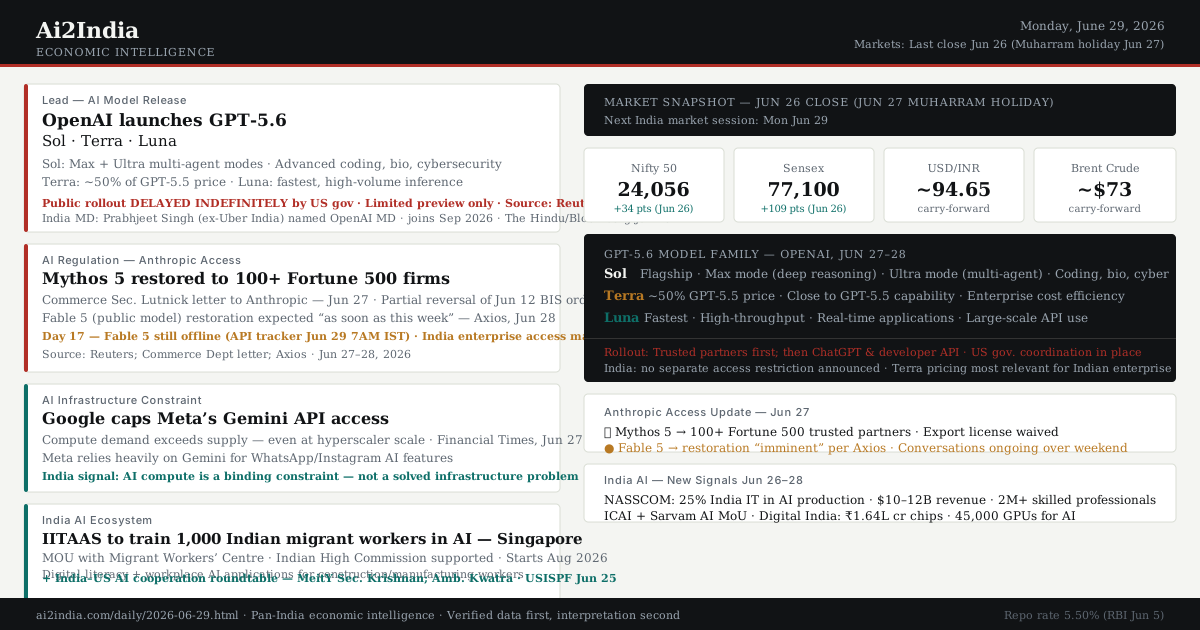
OpenAI launches GPT-5.6 (Sol, Terra, Luna) — the first frontier model family designed with explicit US government coordination and phased access controls; Terra at approximately half the cost of GPT-5.5 is a pricing inflection for Indian enterprise; the US Commerce Department simultaneously grants Anthropic permission to release Mythos 5 to 100-plus Fortune 500 trusted partners, with Fable 5 restoration described as imminent; and Google moves to cap Meta’s Gemini API access, confirming that AI compute supply is a binding constraint even at hyperscaler scale.
The weekend of June 28–29, 2026 delivers the densest simultaneous AI policy and product news since the June 12 BIS order suspended Anthropic’s models globally. Three developments — the GPT-5.6 launch, the Mythos 5 partial restoration and the Google-Meta capacity cap — together define a new phase in frontier AI governance and access economics that Indian enterprise AI planners must absorb before Monday markets open. The signal is not that AI is arriving; it is that AI is being rationed, priced and regulated at scale, and the terms of that rationing are being written by the US government in real time. India sits between two forces: the most capable AI models are now subject to US access controls and trusted-partner restrictions, while compute infrastructure constraints mean that even unrestricted access to second-tier models is not guaranteed. The IITAAS-Singapore training programme is a quiet but concrete example of what “AI inclusion at the base” looks like in practice — and it contrasts sharply with the governance complexity at the frontier.
The GPT-5.6 launch, confirmed by Reuters and reported by Economic Times on June 27–28, is OpenAI’s most significant model release since GPT-5.5. Unlike previous launches, it introduces a family of three models rather than a single flagship. Sol is the flagship: it offers two new access modes beyond standard chat. Max mode allows the model to spend additional compute time reasoning through problems before generating a response — relevant for complex coding, biological analysis and cybersecurity vulnerability identification. Ultra mode coordinates multiple AI agents working in parallel to solve problems that exceed a single model’s capacity — the first commercially available multi-agent architecture from OpenAI that will reach enterprise users through the standard API. OpenAI states Sol outperforms prior models across coding, biology and cybersecurity tasks. The safety architecture is materially different from prior releases: Sol is designed to reject harmful cyber requests, while monitoring systems can review, delay or block risky responses before delivery. This is not a post-hoc safety layer but a design-level constraint — OpenAI explicitly notes that the safeguards may cause the model to refuse more requests or respond more slowly than earlier versions. Terra is the model with the most immediate India relevance from a cost perspective. OpenAI describes Terra as offering capabilities close to GPT-5.5 while costing approximately half as much. For Indian enterprises that have been evaluating GPT-5.5 for production deployment but held back on cost grounds, Terra represents a direct inflection point: the cost-capability frontier just moved significantly. Luna is the smallest and fastest in the family — designed for high-throughput, real-time applications that need to process large numbers of requests efficiently. Luna is the model most relevant for Indian IT services firms building AI-augmented delivery pipelines at scale, where per-token cost and latency are the binding constraints on economics. The rollout is the most explicitly government-coordinated in OpenAI’s history. The company limited the initial preview to a small number of organisations whose participation has been shared with US government officials. OpenAI says it does not expect this process to become the standard for future launches but agreed to the temporary arrangement while broader policies around frontier AI are developed. This is the same framework that the CASI pre-release review executive order (June 2, 2026) established for all frontier model labs — and GPT-5.6 is the first model explicitly deployed under it. For Indian enterprise and developer access: GPT-5.6 is currently in a limited preview restricted to a small group of trusted organisations selected in coordination with the US government. Broader public rollout through ChatGPT and the developer API has been delayed indefinitely at the request of the US government — OpenAI confirmed this in its June 26 blog post and separately in its Help Center guidance for the limited preview. OpenAI stated it does not expect this arrangement to become standard but agreed to the temporary coordination while broader frontier AI policies are developed. The Indian Express reported on June 29 that “almost no one can use them yet.” Separately, OpenAI announced on June 26 the appointment of Prabhjeet Singh — former President of Uber India and South Asia — as Managing Director for India, one of the company’s top-priority markets. Singh will join in September 2026 and report to Kiran Mani, Managing Director for APAC. This is the first dedicated India country leadership position at OpenAI, underscoring India’s significance as a developer and enterprise market. No India-specific access restriction on GPT-5.6 has been announced, but Indian API users should note that the limited-preview phase means GPT-5.6 is not yet available for general developer or enterprise access. When the public rollout opens, Indian API users should also expect the safety filters — which reject harmful cyber requests — to produce higher refusal rates on security-adjacent prompts than GPT-5.5 produced. Teams using GPT-5.5 for penetration testing, vulnerability assessment or red-teaming should evaluate whether GPT-5.6 Sol’s safety architecture is compatible with their use case before migration. Terra is the planned migration target for most Indian enterprise production deployments once the broader rollout launches.
The Anthropic Mythos 5 and Fable 5 developments represent the most significant partial resolution of the June 12 BIS export control order to date. Commerce Secretary Howard Lutnick wrote to Anthropic on June 27, stating: “Since the issuance of my June 12 letter, Anthropic has worked with the U.S. government to address risks associated with the Covered Models. These efforts have yielded significant progress.” The letter grants Anthropic permission to release Mythos 5 to over 100 organisations — reported to include many Fortune 500 companies — without requiring an export licence for those firms or their foreign national employees. This is a materially significant carve-out: it means that Fortune 500 companies with India-based development centres, GCCs and subsidiaries can access Mythos 5 through their US parent’s trusted-partner authorisation, even if the individual engineers accessing the model hold Indian citizenship. The Fable 5 situation is different. Fable 5 is the public-facing model — the version that Indian developers, startups, SMEs and individual users accessed directly through the API and through Anthropic’s chat platform before June 12. The Lutnick letter does not mention Fable 5. However, Axios reported on June 28 — citing a source close to the situation — that the Trump administration is close to allowing Anthropic to restore Fable 5 access as well, potentially “as soon as this week.” A second Axios source said conversations between the parties continued over the weekend, and Anthropic expects to restore Fable access soon. As of Monday June 29 morning (Day 17 of the June 12 BIS order), Fable 5 remains offline — confirmed by real-time API checks and TechTimes reporting from June 28. The isfable5back.com tracker, which polls the Anthropic API every minute, shows no restoration as of 7:00 AM IST June 29. The key technical distinction matters for India planning: Fable 5 and Mythos 5 use the same underlying AI model, but Fable 5 is designed for general public use while some safeguards are lifted for Mythos to serve research and specialised applications. Mythos’s trusted-partner framework is unlikely to directly help the Indian startup ecosystem or the 90%-plus of Indian API users who are not Fortune 500 subsidiaries. Fable 5 restoration — if it happens this week — will be the development that restores direct India access. The planning assumption changes materially: instead of “treat Fable 5 as unavailable through at least Q3 2026” (the June 25 edition’s guidance), Indian enterprise teams should now plan for potential Fable 5 restoration within the next seven to fourteen days, while maintaining current alternative model arrangements until official confirmation from Anthropic.
Google’s decision to cap Meta’s access to its Gemini models — reported by the Financial Times on June 27 and highlighted by The Verge — is a structural signal about the AI industry that Indian enterprise architects should carry into their infrastructure planning. Meta is among Google Cloud’s largest AI customers, using Gemini APIs to power AI features across WhatsApp, Instagram and Facebook. Despite Google spending tens of billions of dollars on chips, data centres and power, it cannot provide the compute capacity that Meta wants. Google has notified Meta and a number of other large clients that it will cap their access to its models. The FT frames this as a “rare glimpse into the infrastructure pressures and bottlenecks building across the AI industry.” For Indian enterprise: the Google-Meta capacity cap demonstrates that AI compute availability is not a solved infrastructure problem — even at the hyperscaler level where Google operates. If Google cannot guarantee capacity to Meta, the implicit assumption that India-based cloud customers have guaranteed access to AI APIs on demand is incorrect. This has direct implications for Indian enterprise architects designing AI-dependent production systems: single-provider AI API dependencies carry availability risk that has not been visible in practice until now. The bottleneck also has a structural cause: demand for AI inference is growing faster than chipmakers and data-centre builders can supply capacity. NVIDIA, AMD and custom chip programmes (Google TPU, AWS Trainium, Microsoft Maia) are all running at near-full capacity. For Indian enterprises evaluating multi-provider AI architectures: the Google-Meta cap is a data point for the business case. India-based enterprises that distribute inference workloads across two or more providers — rather than committing to a single frontier model vendor — now have a concrete, named infrastructure risk to cite in their resilience planning documentation.
The IITAAS-Singapore programme — confirmed by Economic Times on June 28 — is the week’s most important India-originated AI inclusion story. The Indian Institutes of Technology Alumni Association in Singapore signed a Memorandum of Understanding with the Migrant Workers’ Centre on June 28, supported by the Indian High Commission and High Commissioner Dr Shilpak Ambule. The programme will deliver digital literacy and AI training to approximately 1,000 migrant workers — including a large proportion of Indians working in construction, marine and manufacturing sectors — over two years. Training sessions will be held twice a month at the MWC Recreation Club at Soon Lee in the Jurong industrial zone, beginning August 2026. The curriculum covers foundational digital literacy, practical workplace AI applications and emerging technologies including AI, designed to be accessible and immediately useful to the workers’ daily lives. The March 2026 pilot — a full-day AI literacy workshop for over 100 migrant workers who chose to spend their weekly day off learning about AI — provides the proof-of-concept. For Indian enterprise and policy planners, the IITAAS-Singapore programme is notable for what it demonstrates about demand: migrant workers with weekly days off are choosing to spend them learning about AI. This is not a supply-led training initiative imposed on a reluctant workforce; it is a demand-driven response to workers’ own understanding that AI knowledge will affect their employment prospects. For India’s MeitY and NASSCOM: the IITAAS model — IIT alumni network delivering structured AI curriculum to non-technical workers through an existing welfare infrastructure (MWC) — is a template for India’s domestic AI skilling challenge, particularly for the approximately 100-plus million workers in construction, logistics, manufacturing and domestic services sectors who will be affected by AI but are not served by existing corporate AI training programmes.