Pan-India economic intelligenceDaily Edition — 2026-06-25
AI2

Ai2India

Daily Edition

One daily issue tracking AI adoption, markets, hiring, layoffs, real estate, credit and gig-work signals across India.

PublishedJune 25Daily issue
Nifty 50 (Jun 24 close)24,021.65+197.55 pts (+0.83%); 24,000 reclaimed on crude drop and trade optimism; broad-based buying
Sensex (Jun 24 close)76,991.22+790.54 pts (+1.04%); all sectors except auto, metal and energy in green
USD / INR94.65Stronger 11 paise vs 94.78 prev; crude drop provides relief; DXY ~101.63 caps further gains
Brent Crude~$73/bbl−2%; US–Iran diplomacy holds; India import-bill relief; low $70s level not seen since early 2024

Lead Analysis — AI-First

Oracle becomes the first Fortune 500 company to attribute mass job cuts to AI in its own regulatory filing — 21,000 global, India estimated at 11,000–12,000; while a CNBC investigation published Thursday reveals India has quietly built the world’s most active physical-AI training economy, with factory workers earning ₹100–250 per hour to film themselves performing tasks they are teaching robots to replicate; Gemini 3.5 Pro delayed to July; Meta remains the last major AI lab outside the US pre-release review framework; and India’s IT sector weight in the Nifty 50 falls to a 20-year low of 7.6%.

Thursday, June 25, 2026 delivers a single, coherent narrative for Indian enterprise planners: the AI transition is no longer a hypothesis or a forecast — it is a legally documented, regulatory-filed fact (Oracle), a labour-market reality visible at the individual gig-worker level (CNBC/Guardian physical-AI data economy), and a structural market verdict now priced into two decades of index history (Nifty IT at a 20-year Nifty 50 low). The question for June 25 is not whether AI is restructuring the Indian economy; it is how fast, at what wages, and with what institutional support. Today’s edition tracks four signals that together define the answer: the Oracle filing as a corporate-accountability landmark; the physical-AI training economy as the emerging bottom rung of India’s AI-era labour market; the Gemini 3.5 Pro delay as a platform-selection inflection point; and the Meta regulatory standoff as the final chapter in the US government’s first systematic effort to impose safety review on all major frontier AI models. Market context supports the narrative rather than competing with it: the June 24 Nifty rebound to 24,021 (+0.83%), rupee strengthening to 94.65 and Brent crude falling to approximately $73 per barrel are positive macro signals — but the structural story for Indian enterprise is not the markets. It is the labour and AI platform signals described below.

The Oracle annual regulatory filing, confirmed by Bloomberg on June 22, 2026, is a landmark in corporate accountability for the AI era. Oracle explicitly stated in its US Securities and Exchange Commission filing for fiscal year 2026: “the deployment of AI technologies across our operations has resulted in, and may continue to result in, reductions to our workforce.” This is the first time a Fortune 500 company has made this causal claim in a regulatory document — not in an earnings call, not in a press release, not in a CEO letter, but in the legally sworn annual filing that companies are liable for misrepresenting. The global scale: Oracle’s workforce fell from approximately 162,000 to 141,000 employees across fiscal 2026, a net reduction of approximately 21,000 roles (around 13% of the workforce). Restructuring and severance costs reached approximately $1.8 billion — nearly five times the $374 million spent in fiscal 2025. Oracle spent approximately $55.7 billion on AI and data-centre infrastructure in fiscal 2026 — a capital expenditure surge of approximately 162% — while simultaneously cutting one in eight employees. The strategic posture is explicit in the filing: capital in, people out. India estimates: Oracle has not officially disclosed a country-level breakdown. Economic Times, citing sources, puts India cuts at approximately 10,000 roles; Babushahi and Marksmen Daily coverage puts the range at 11,000 to 12,000, concentrated in Bengaluru, Hyderabad and Pune — the three cities where Oracle maintains its largest India development, support and back-office operations. The India estimate is specific, dateable and sourced, but remains an estimate rather than a company-confirmed figure. Oracle’s campus offer-withdrawal record (50+ IIT and NIT offers revoked in India, already in the Layoff Radar) preceded this filing and is consistent with the scale. For Indian enterprise: the Oracle filing is significant not only as a data point about Oracle’s India workforce. It is significant as a regulatory-accountability moment — the first formal corporate admission, under oath, that AI deployment is the direct cause of large-scale workforce reduction. Every enterprise board in India conducting AI adoption programmes should now treat this filing as precedent: the causal chain from AI investment to headcount reduction is legally documented, and it is reasonable to expect more companies to make equivalent disclosures in their FY2026 and FY2027 filings as AI-linked restructuring accelerates.

The physical-AI training data economy story, published Thursday by CNBC’s Inside India newsletter and previewed Wednesday by The Guardian’s global development desk, reveals the structural consequence of Oracle-style AI adoption playing out at the other end of the income distribution. India has become the world’s most active supplier of “egocentric” or “first-person” video data — the footage that robotics companies need to train humanoid and industrial robots to perform physical tasks with human-like dexterity. Workers across India are being hired to attach head-mounted cameras or smart glasses and film themselves performing everyday tasks: cooking, washing dishes, packing items, sorting materials, and executing factory floor movements. The data is then sold to robotics firms in the US and China. The economics: pay ranges from approximately ₹100 to ₹250 per hour (roughly $1.20 to $3.00) — significantly below the global average for equivalent AI data work, but above the minimum wage in most Indian states. A case study from CNBC: Tanisha Reddy, a teacher in southern India, works as a “robot trainer” in her spare time, recording three to four hours of first-person video per day at under $4 per hour. The scale emerging: a Noida-based startup, Neocambrian AI, has opened a “robotics data factory” that simulates industrial environments for structured data collection. It has built a network of more than 100 factories where workers film themselves performing tasks. Its founder estimates achieving human-level dexterity in robots will require approximately 100 million hours of video — creating a sustained multi-year demand for physical-AI data work. Under one year since the category emerged, multiple Indian companies now specialise in egocentric video data collection, quality control and annotation for overseas clients. The Guardian investigation raises ethical concerns that enterprise planners must engage with: workers frequently report not receiving extra pay or clear disclosure about how footage will be used. Many understand they are training robots to do their own jobs. Labour protections are limited because most engagement runs through intermediary platforms rather than direct employment. For Indian policymakers, gig-labour regulators and enterprise AI strategy teams: the physical-AI training economy is the newest and least-understood layer of India’s AI-era labour market. It sits at the intersection of the e-Shram regulatory framework (which was designed for platform gig workers but may not clearly cover robot-training data workers), the Data Protection framework under DPDPA 2023 (footage of workers performing tasks may be biometric in nature), and India’s ambition to compete with China and the US in physical AI and humanoid robotics. The CNBC/Guardian reporting is the first major business-media treatment of this category, and it will reach enterprise AI planners, policymakers and investors through mainstream channels by end of the trading day.

Gemini 3.5 Pro’s delay to July, confirmed by Business Insider on June 24, is the most operationally significant platform update for Indian enterprise AI teams this week. Google is using feedback from early testers on its internal Antigravity platform and from the LMArena AI benchmarking site to tune the model before public release. The focus areas are long-horizon multi-step problem-solving and AI agent capabilities — exactly the enterprise use cases that Indian GCCs, IT services firms and BFSI AI programmes are building toward. Token efficiency concerns flagged from Gemini Flash 3.5 testing are also being addressed before the Pro launch. The delay is the right call strategically, but its timing has compounded the Google platform-continuity uncertainty introduced by the Noam Shazeer departure (June 24). Shazeer was the engineering co-lead of Gemini; Gemini 3.5 Pro is now entering final pre-release testing without its most prominent builder. For Indian enterprise architects: the Gemini 3.5 Pro delay means the current frontier comparison table remains GPT-5.5 (OpenAI), Claude Opus 4.8 (Anthropic), and Gemini 3.1 Pro (enterprise preview) — a table that has not changed in the two weeks since the Fable 5 suspension. Fugu (Sakana AI) remains the only new entry to the practical frontier model set. GPT-5.6 remains unconfirmed by OpenAI in any official communication as of June 25; available reporting suggests a mid-July window at the earliest. Indian enterprise platform selection decisions should plan on a four-to-six week gap before any new major frontier model enters production availability.

Meta’s position as the last major AI lab to not sign the US government’s pre-release review framework for frontier models is a development with direct implications for Indian consumers and enterprises. The framework, created by a June 2, 2026 executive order, gives the Center for AI Standards and Innovation (CASI) up to 30 days to evaluate frontier models before they reach partners or the public. OpenAI, Anthropic, Google DeepMind, Microsoft and xAI have all signed the agreement. Meta has not, despite operating with Muse Spark — its April 2026 frontier model with Instant and Thinking modes — as its current top AI product. The Trump administration is actively urging Meta to sign, with a Meta spokesperson indicating they hope to reach agreement soon. For Indian enterprise: Meta’s consumer AI reach in India is enormous — Muse Spark is embedded across WhatsApp, Instagram and Facebook, which collectively reach hundreds of millions of Indian users. Whether Meta operates inside or outside the pre-release safety review framework determines whether Muse Spark faces the same export-control and access-restriction risks that suspended Anthropic’s Fable 5 and Mythos 5 globally on June 12. If Meta signs, it accepts the same regulatory channel that exposed Anthropic to the June 12 suspension. If Meta refuses, it operates outside the framework but also without the government access and partnerships that signing enables. The regulatory standoff is not yet resolved; both outcomes carry consequences for India’s access to Meta’s frontier AI capabilities.

The Nifty IT weight signal, reported by Bloomberg on June 24 and confirmed by Business Standard, is the market’s collective verdict on the structural AI threat to India’s traditional IT model. The combined weight of five major Indian IT firms in the Nifty 50 has fallen below 7.6% — the lowest level since at least 2002. At the sector’s early-2000s peak, IT commanded over 20% of the Nifty 50. The Nifty IT index itself has fallen approximately 29% year-to-date, versus a roughly 9% decline for the broader Nifty 50. The macro trigger for recent weakness was Accenture’s FY26 revenue guidance cut to 3–4% in June 2026, but the structural cause is the investor thesis that generative and agentic AI will systematically compress the labour-arbitrage margin that powered India’s IT growth from 2000 to 2024. Goldman Sachs and other strategists cited in June 2026 market commentary argue agentic AI could slow IT services industry growth from historical 15–20% to 5–10% annually by approximately 2028. This is a long-term structural repricing, not a tactical correction. The June 24 Nifty rebound to 24,021 reflects improving macro (crude at $73, rupee at 94.65) rather than any reversal of the IT structural thesis. For Indian IT services firms, GCC operators and professional investors: the Nifty IT 7.6% weight is a market signal that the structural AI disruption thesis is now priced into two decades of index history. The question is no longer whether the disruption is real; the question is which IT services firms have a credible AI-native transformation story that justifies a re-rating from current levels.

India’s domestic AI infrastructure continues to expand in parallel with the commercial disruption signals. C-DOT and IIT Hyderabad announced a new joint research centre focused on 6G, AI, quantum computing and cybersecurity — one of the most ambitious state-backed AI and deep-tech research mandates to emerge from an IIT partnership in 2026. The centre positions Hyderabad alongside Bengaluru as a dual-city anchor of India’s sovereign AI research infrastructure. It is also consistent with the IndiaAI Mission’s emphasis on building domestic capability across the full technology stack — from AI model training and deployment to the 6G network infrastructure that next-generation AI applications will run on. The Fable 5/Mythos 5 suspension (now in day 13 as of June 25) continues to inform the urgency of this domestic infrastructure build. Anthropic’s July 8 biometric ID pathway remains the only announced path to US-based restoration; the Legion LegalTech lawsuit (filed June 24) is the first legal challenge to the BIS directive but is unlikely to produce a rapid resolution. The operational planning assumption for India enterprise AI teams should remain: treat Fable 5 as unavailable through at least Q3 2026.
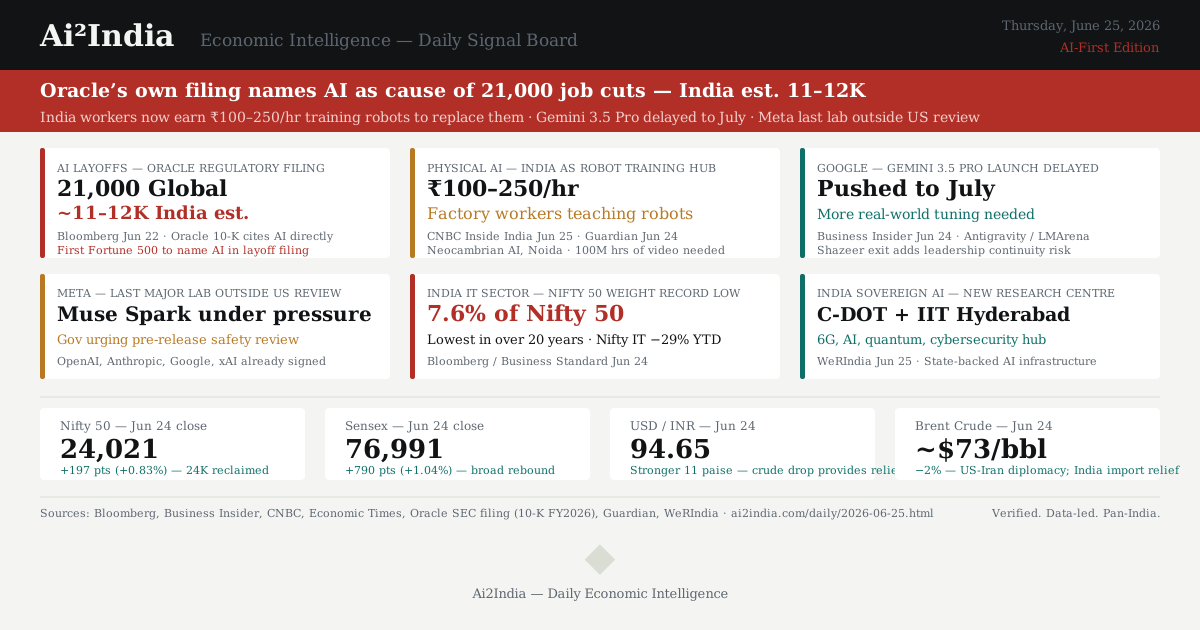
June 25 signal board: Oracle files AI cut 21K global, India est. 11–12K; India workers ₹100–250/hr training robots; Gemini 3.5 Pro delayed July; Meta last lab outside US review; Nifty IT 7.6% Nifty50 weight 20-yr low; Nifty 24,021; USD/INR 94.65; Brent ~$73
Today’s economic signal board. Full analysis in the Daily Edition.

AI Developments Today

Thursday, June 25: four developments that pass the “Would this change what an Indian enterprise AI planner does this week?” filter. Oracle’s regulatory filing and the physical-AI training economy story are the most significant; the Gemini 3.5 Pro delay and Meta regulatory standoff are the most operationally consequential for platform decisions.

DevelopmentSource + DateIndia RelevanceWhat this means for Indian enterpriseStatus
Oracle’s annual regulatory filing explicitly attributes 21,000 global job cuts to AI deployment — the first Fortune 500 company to make this causal claim in a legally sworn SEC filing; India estimates at 11,000–12,000

Oracle’s FY2026 annual report (10-K), confirmed by Bloomberg on June 22, states: “the deployment of AI technologies across our operations has resulted in, and may continue to result in, reductions to our workforce.” Workforce fell from approximately 162,000 to 141,000 employees — a net reduction of approximately 21,000 roles (around 13% of total). Restructuring and severance costs: approximately $1.8 billion, nearly five times FY2025’s $374 million. AI and data-centre capital expenditure in FY2026: approximately $55.7 billion, a reported increase of approximately 162%. The filing covers restructuring across Oracle Health (Cerner) — where 8,000–10,000 roles were reportedly cut globally — as well as legacy on-premise software, support and back-office functions. India impact: Economic Times (citing sources) estimates approximately 10,000 roles cut in India, approximately 20% of a 50,000-strong India workforce. Babushahi, Marksmen Daily and additional coverage puts the India range at 11,000 to 12,000, concentrated in Bengaluru, Hyderabad and Pune. Oracle has not confirmed a country-level breakdown. The legal significance: Oracle’s explicit filing statement transforms the AI-layoff debate from a speculative inference to a documented corporate admission. Every subsequent Fortune 500 AI-adoption programme will now face investor, analyst and regulatory scrutiny about whether AI is “resulting in reductions to workforce” in the same terms Oracle has used.
Bloomberg (Jun 22, 2026); Economic Times; CNBC (Jun 23); Oracle FY2026 10-K (SEC); Babushahi; Marksmen Daily; Gujarat Samachar; Jun 22–25, 2026 For Indian enterprise boards with AI adoption programmes: the Oracle filing is a legal precedent for how AI-linked headcount reduction must be disclosed. Indian companies listed on NSE/BSE or dual-listed globally should assess whether their AI-programme communications are consistent with the disclosure standards now established by Oracle’s filing. For HR, L&D and workforce planning teams at Indian IT, BFSI and manufacturing firms: if Oracle’s AI-adoption decision reduced 13% of its workforce in one year, the “AI will only augment, not replace” narrative requires direct board-level challenge. For Indian workers in Bengaluru, Hyderabad and Pune: the Oracle India estimated 11–12K cut is the largest single AI-attributable India job-reduction event in the current cycle — visible in the local rental, consumer and BFSI demand data for those cities over coming quarters. For campus placement officers at IITs, NITs and engineering colleges with Oracle relationships: the Oracle campus offer-withdrawal pattern (50+ offers revoked, already in the Layoff Radar) is now explained by the same filing that shows the company’s strategic direction. Placement officers should adjust company-mix expectations for the 2027 cohort. Every Indian enterprise board approving AI adoption budgets should now require the CFO and CHRO to jointly model the workforce and disclosure implications under the Oracle framework. Do not wait for a third-party layoff event to trigger this analysis — Oracle’s filing makes it reasonable for investors, employees and regulators to expect such a model from any company pursuing AI-scale investment. For IT firms building AI-augmented service lines: the filing confirms that the market is watching whether AI adoption results in workforce cost reduction. Firms that can demonstrate revenue growth from AI without headcount cuts will command a re-rating premium. Verified — Bloomberg; CNBC; Oracle 10-K (SEC); Economic Times; Jun 22–25
India emerges as global leader in physical-AI training data — factory workers filming themselves to teach robots at ₹100–250/hr; Neocambrian AI Noida opens “robotics data factory” with 100+ sites; 100 million hours of video needed for human-level dexterity

CNBC’s Inside India newsletter (June 25, 2026) and The Guardian’s global development desk (June 24) both independently document the emergence of a new AI-era labour market in India: the physical-AI training data economy. Workers across India are being recruited by intermediary platforms to film themselves performing physical tasks — cooking, cleaning, sorting, packing, assembling — from a first-person perspective using head-mounted cameras or smart glasses. The footage is exported as training data to robotics companies in the US and China building humanoid and industrial robots. Pay: ₹100–250 per hour (approximately $1.20–$3.00), with no clear labour-contract framework in most arrangements. The scale: Neocambrian AI, a Noida-based startup, has built a network of more than 100 factory sites where workers film industrial tasks and dexterity challenges. It estimates achieving human-level robot dexterity requires approximately 100 million hours of egocentric video — implying multi-year sustained demand for the work. Multiple companies have emerged in under a year specialising in egocentric data collection, quality control and annotation. The sector is described by China Daily and other publications as “physical AI” — the data infrastructure layer that makes humanoid robots commercially viable. Concerns: The Guardian documents that workers frequently do not receive extra pay or clear disclosure about data use, and many understand they are training machines to do their own jobs. Data governance is managed by intermediary platforms rather than direct employer relationships, limiting labour protections.
CNBC Inside India newsletter (Jun 25, 2026); The Guardian (Jun 24, 2026); China Daily (Jun 22); Navbharat Times; Esakal Premium; Jun 22–25, 2026 For India’s AI and gig-labour policy teams: the physical-AI training economy sits in an unregulated gap between e-Shram (designed for platform gig workers), DPDPA 2023 (which may classify egocentric video as biometric data requiring explicit consent and data-localization compliance), and NASSCOM’s AI skills frameworks (which do not yet cover physical-AI data work). This gap requires urgent attention. For Indian AI startups and robotics companies: Neocambrian AI’s model — a domestic company aggregating and managing egocentric data collection at factory scale — is a viable standalone business at the intersection of India’s large labour pool and the global physical-AI demand. For humanoid robotics investors: India’s labour pool and Neocambrian AI’s network of 100+ factory sites position India as the lowest-cost high-volume egocentric data supplier in the world — a structural competitive advantage that China cannot easily replicate due to labour cost convergence. For MeitY and NASSCOM: if India is to benefit from the physical-AI data economy rather than merely supply raw data at ₹100–250/hr, the value-added layer (quality control, annotation, proprietary datasets, robotics simulation partnerships) needs to be built and retained in India rather than exported to US and Chinese robotics firms. The physical-AI data economy at ₹100–250/hr is the emerging base of India’s AI labour pyramid — new work created by AI adoption, but at lower wages and with fewer protections than the traditional tech roles being displaced. The Oracle filing (21K cuts, AI cited) and the Neocambrian AI story (new jobs at ₹250/hr) together describe the labour-market transition with a precision that has not been available before: AI is destroying higher-wage structured employment and creating lower-wage, less-protected data-labour alternatives. The policy gap is now visible and actionable. Enterprise AI programme directors should flag this transition as a workforce ethics issue requiring board-level discussion, not just an HR operational matter. Verified — CNBC; The Guardian; Navbharat Times; Jun 24–25
Gemini 3.5 Pro launch delayed from June to July — Google prioritises real-world tuning on Antigravity and LMArena platforms; long-horizon tasks and agent capabilities are the focus; token efficiency concerns from Flash 3.5 being addressed

Business Insider confirmed on June 24, 2026 that Google has delayed the public launch of Gemini 3.5 Pro from late June to July. The model is currently in limited use on Google’s internal Antigravity evaluation platform and on the LMArena public AI benchmarking site, where it is gathering real-world performance feedback before broader release. Focus areas for the tuning phase: performance on long-horizon tasks — multi-step reasoning, extended workflows, complex agent behaviour — and token efficiency, after Gemini Flash 3.5 drew criticism for consuming tokens too quickly. Gemini 3.5 Pro is described as a frontier model intended to power AI agents and more complex autonomous behaviours. Context: the delay arrives in the same week as the confirmed departure of Noam Shazeer, Google’s Gemini engineering co-lead, to OpenAI. Google has not publicly linked the delay to Shazeer’s departure; the delay was described as an internal product quality decision. The broader context: GPT-5.6 also remains unconfirmed by OpenAI in any official communication as of June 25; the frontier model comparison table available to Indian enterprise is unchanged since the Fable 5 suspension on June 12.
Business Insider (Jun 24, 2026); Jun 24, 2026 For Indian enterprise AI architects planning Gemini 3.5 Pro evaluations: revise timelines to July or later. The current practical frontier for enterprise evaluation remains GPT-5.5 (OpenAI), Claude Opus 4.8 (Anthropic), Gemini 3.1 Pro (enterprise preview), and Fugu (Sakana AI, global open access). For Indian GCCs and IT firms with Vertex AI commitments: the delay does not affect current Gemini 3.1 Pro deployments, but it extends the period before enterprise architects can evaluate whether the “long-horizon tasks and agent capabilities” improvements justify architectural migration from GPT-5.5 or Claude Opus 4.8. The LMArena tuning process is positive — it means the public release will incorporate real-world performance feedback — but the Shazeer departure means the model’s builder has moved on before it enters production. Do not defer GPT-5.5 or Claude Opus 4.8 evaluations on the assumption of imminent Gemini 3.5 Pro GA. Treat July as the earliest realistic production evaluation window for Gemini 3.5 Pro, subject to official Google announcement. The delay creates a four-to-six week window where OpenAI and Anthropic have no imminent competitor frontier model to contend with — a strategic timing advantage in their enterprise sales cycles that Indian enterprise procurement teams should factor into pricing and negotiation leverage. Verified — Business Insider; Jun 24
Meta remains last major AI lab outside US pre-release review framework — Trump administration pressing Meta to submit Muse Spark for CASI safety evaluation; Meta signals agreement is close

The US government is actively urging Meta to sign the pre-release frontier model review framework established by the June 2, 2026 executive order, which created the Center for AI Standards and Innovation (CASI) at the National Institute of Standards and Technology. OpenAI, Anthropic, Google DeepMind, Microsoft and xAI have all agreed to give CASI up to 30 days of pre-release access to evaluate unreleased frontier models. Meta has not yet signed, making it the only major AI lab currently operating outside the framework. Meta’s most recent frontier model is Muse Spark (launched April 2026) — explicitly described in the available reporting as “not yet on par with the very top frontier models” from other labs. A Meta spokesperson indicated the company supports the administration’s goals for “robust and secure frontier AI” and hopes to sign an agreement soon, but details are still being worked out. The political context: the Trump administration is characterising Meta’s holdout as inconsistent with national AI security interests.
Engadget / NewsBreak (Jun 25, 2026); RTTNews; Gadget Review; Jun 24–25, 2026 For Indian enterprise and consumer AI users: Meta AI reaches hundreds of millions of Indian users through WhatsApp, Instagram and Facebook — making Muse Spark one of the most widely deployed consumer AI systems in India regardless of its frontier benchmark position. Whether Meta operates inside or outside the CASI pre-release review framework determines its exposure to the same export-control and access-restriction mechanisms that suspended Fable 5 and Mythos 5 globally on June 12. Indian users and enterprises should monitor whether Meta’s signing of the CASI framework triggers any nationality-verification or access-restriction requirements similar to those Anthropic is now implementing for its biometric ID pathway. For Indian AI policy and MeitY teams: the CASI framework is the new default for US frontier AI governance — India should initiate a formal dialogue about whether the pre-release review process will introduce access restrictions for Indian users of Meta AI in WhatsApp and Instagram, given the scale of that deployment. No immediate action required beyond monitoring. If Meta signs the CASI framework, assess whether the agreement introduces any access-restriction terms similar to Anthropic’s biometric ID pathway. The pre-release review process itself may not affect current Muse Spark availability, but any future frontier model launches by Meta — including any model that exceeds Muse Spark’s capabilities — would be subject to CASI review before reaching Indian users. Verified — Engadget; NewsBreak; RTTNews; Jun 24–25

India AI Ecosystem

Thursday, June 25: two domestic India AI signals — the C-DOT and IIT Hyderabad 6G/AI research centre launch, and the Nifty IT weight data that frames the structural market context for India’s tech sector AI transition.

Platform / OrganisationDevelopmentIndia AI SignificanceStatus
C-DOT + IIT Hyderabad
New joint research centre
6G, AI, quantum, cybersecurity
The Centre for Development of Telematics (C-DOT) and IIT Hyderabad announced a new joint research centre targeting 6G, AI, quantum computing and cybersecurity — a full-stack deep-tech mandate covering the infrastructure layer (6G), the application layer (AI), the security layer (quantum-resistant cryptography and cybersecurity) and the foundational science layer (quantum computing). The centre positions Hyderabad alongside Bengaluru as a dual anchor of India’s sovereign AI research infrastructure and is consistent with the IndiaAI Mission’s emphasis on building domestic capability across the full technology stack. C-DOT’s involvement signals national strategic priority — C-DOT is India’s premier telecom R&D body, and its participation in an AI-plus-quantum centre is a departure from its traditional telecom-only focus. IIT Hyderabad brings academic AI research capacity and access to graduate talent pipelines. The 6G + AI combination is the most strategically significant aspect of this centre. Next-generation AI applications — real-time agentic AI, federated learning at scale, low-latency inference for industrial robotics — require network infrastructure that 5G cannot reliably deliver. A C-DOT-led research centre that builds 6G and AI expertise simultaneously is building India’s capacity to deploy AI at the network level, not just the application level. For Indian enterprise: the centre is a talent and partnership pipeline for 6G-native AI deployments. For Hyderabad as a technology city: the C-DOT + IIT Hyderabad announcement strengthens the case for Hyderabad as the second city in India’s sovereign AI research geography, after Bengaluru. For India’s export-control response: a domestic 6G/AI research centre reduces India’s dependence on foreign AI and network technology — directly relevant in the post-Fable-5-suspension environment. Verified India — WeRIndia; Jun 25, 2026
Indian IT sector
Nifty IT weight: 7.6% of Nifty 50
20-year record low
Nifty IT −29% YTD
Bloomberg reported on June 24, 2026 that the combined weight of five major Indian IT companies in the Nifty 50 index has fallen below 7.6% — the lowest level since at least 2002. Business Standard independently confirmed the record-low reading. The Nifty IT index has fallen approximately 29% year-to-date versus approximately 9% for the broader Nifty 50. Peak IT weight in the Nifty 50 exceeded 20% in the early 2000s, reflecting how dramatically the sector’s relative market influence has contracted. Goldman Sachs and other strategists cited in June 2026 market commentary project IT services annual growth could slow from historical 15–20% to 5–10% by approximately 2028 due to agentic AI compressing outsourcing volumes. The most recent sector catalyst was Accenture’s FY26 revenue guidance cut to 3–4%, but the structural weight decline has been building since the generative AI era began. IT sector P/E multiples are contracting as investors price in lower long-term earnings growth, even as near-term earnings remain resilient. The 7.6% Nifty IT weight is a market signal that the structural AI disruption thesis for Indian IT services is no longer a prediction — it is a priced fact. For Indian IT services company leadership: the sector derating from 20% to 7.6% is the market’s two-decade verdict on what AI means for the traditional outsourcing model. Companies that can demonstrate credible AI-native transformation — not AI as an add-on to existing delivery models, but AI-first delivery architectures that produce higher revenue per FTE — will likely re-rate from current depressed levels. Companies that cannot demonstrate this will continue to derate. For portfolio investors and Indian mutual funds: the 7.6% weight is the lowest in two decades, but that does not mechanically mean a reversal is imminent — structural deratings can persist for years. The thesis for a re-rating requires evidence of either (a) AI-led revenue growth that exceeds margin compression, or (b) a new demand cycle that offsets traditional outsourcing volume decline. Verified India — Bloomberg; Business Standard; Jun 24, 2026
Carry-forward: Sarvam AI
10M API calls/day
Fable 5 suspension: day 13
Sarvam AI’s 10 million API calls per day benchmark — reported June 22–23 — remains the most significant domestic AI scale metric in the current cycle. The figure carries forward as a June 25 baseline because the Fable 5 suspension (now day 13) continues to drive Indian developers and enterprises toward domestic alternatives. Sarvam’s thevam30B edge model and its 105B parameter large model remain available globally without export-control restrictions. The IndiaAI Mission’s portfolio consolidation direction (MeitY Secretary’s “how many models can India sustain?” question) will be the next major policy signal to watch. Maharashtra AI Policy 2026 (₹10,000 crore target, ₹500 crore venture fund, 12 incubators) — announced June 23 — provides the most detailed state-level AI ecosystem framework published to date and carries forward as an active investment and startup opportunity signal. Sarvam’s 10M API call/day metric is now a competitive benchmark for the domestic AI market. For enterprise buyers evaluating Sarvam as a primary or backup model provider in the post-Fable-5 environment: the scale metric addresses the production-readiness question that was previously a concern for sovereign AI alternatives. Maharashtra’s ₹500 crore venture fund is the most significant new source of state-level AI startup capital to emerge in India in 2026. Verified India — BusinessLine; Moneycontrol; Jun 22–23 (carry-forward)

AI Adoption Impact

June 25: three AI adoption impact signals — Oracle’s explicit regulatory confirmation that AI caused 21K job cuts, India’s physical-AI training economy (the labour-market response at the base of the AI pyramid), and the Nifty IT structural derating (the capital-markets verdict on the AI transition). Together, they form the most coherent single-day evidence base for AI’s structural economic impact on India published to date.

AI Impact DimensionEvidenceTrajectory
Oracle filing: AI-linked job displacement confirmed in regulatory disclosure — India bear ~11–12K of 21K global estimate Oracle FY2026 10-K (SEC); Bloomberg Jun 22, 2026. Oracle explicitly states AI deployment “has resulted in, and may continue to result in, reductions to our workforce.” Workforce fell from ~162K to ~141K (−21K, −13%). Restructuring costs: $1.8B (5x FY2025). India estimate: 10K–12K (ET, Babushahi, Marksmen Daily; not officially confirmed by Oracle). Bengaluru, Hyderabad, Pune most affected. Oracle capex on AI/data centre: ~$55.7B (+162%). First Fortune 500 SEC filing to explicitly name AI as a workforce-reduction cause. The “may continue to result in” language is forward-looking and signals continued AI-linked headcount discipline in FY2027. ↓ Structural; AI-linked workforce reduction in large tech firms is now a regulatory-disclosure reality, not a speculative risk; India bears a disproportionate share of global tech restructuring due to concentration of support, development and back-office roles
Physical-AI training economy: India as global robot-training hub — ₹100–250/hr, limited protections, 100M hrs of data needed CNBC Inside India (Jun 25, 2026); The Guardian (Jun 24, 2026). India has become the leading egocentric video data supplier for global humanoid and industrial robot training. Neocambrian AI, Noida: 100+ factory sites, ~100M hrs of video needed. Pay: ₹100–250/hr. Workers frequently: film their own work tasks; sell footage through intermediary platforms; receive no additional pay or usage disclosure; understand they are training their replacements. The sector is less than one year old in organised form. Multiple companies now specialise in egocentric data collection, QC and annotation for US and Chinese robotics firms. This is the first confirmed India-based “physical AI” training economy at scale. ↑ Emerging; India’s large, low-cost labour pool creates a structural supply advantage for physical-AI data; the value-add layer (annotation IP, simulation environments, dataset ownership) needs policy and investment support to prevent this becoming a data-export economy with no domestic retention of value
India Nifty IT weight at 7.6% — 20-year low; structural AI disruption thesis now priced at the index level Bloomberg (Jun 24, 2026); Business Standard (Jun 24, 2026). Five major Indian IT firms now represent below 7.6% of Nifty 50 — lowest since 2002. At peak (early 2000s): over 20%. Nifty IT index YTD decline: approximately 29% vs 9% for Nifty 50. Structural drivers: AI-led compression of outsourcing volumes, Accenture FY26 guidance cut (3–4%), Goldman Sachs projection of 5–10% IT services growth by 2028 vs historical 15–20%. Tactical trigger for June: IT correction after Accenture guidance and Google talent exits. June 24 recovery (+0.83% Nifty) was macro-driven (crude, rupee) rather than sector-specific IT buying. ↓ Structural; the 7.6% weight is a two-decade market verdict; near-term recovery requires credible AI-native transformation evidence from IT firms; short-term macro relief (crude, rupee) does not address the structural thesis
Market macro relief: crude at $73, rupee at 94.65, Nifty 24,021 — positive context but not the structural story The Hindu Business Line (Jun 24, 2026); Andhra Jyothy; ETV Bharat; Univest. Nifty 50: 24,021.65 (+197.55, +0.83%). Sensex: 76,991.22 (+790.54, +1.04%). USD/INR: 94.65 (11 paise stronger). Brent: approximately $73/bbl (−2%). All sectors green except auto, metal, energy. Rupee appreciation linked to crude relief and foreign inflows; DXY ~101.63 caps further gains. Market recovery is macro-driven — crude-linked inflation relief and trade-deal optimism — rather than a structural reversal of the IT sector thesis. ↑ Tactical; macro relief supports equity and rupee; does not change AI adoption impact trajectory; USD-denominated AI API costs reduced modestly at 94.65 vs 94.78 prior close

Five Things That Changed

Thursday, June 25: three AI developments of direct India consequence, one India market signal, and one India infrastructure signal. AI stories lead; markets provide context.

SignalData PointReader ImpactStatus
Oracle’s SEC filing legally attributes 21,000 job cuts to AI — India est. 11–12K; first Fortune 500 regulatory disclosure of AI-driven workforce reduction Oracle 10-K FY2026: “deployment of AI technologies... has resulted in, and may continue to result in, reductions to our workforce.” Global: 162K → 141K employees (−21K, −13%). Restructuring cost: $1.8B (5x FY2025). AI capex: ~$55.7B (+162%). India estimate: 11–12K (Babushahi; ET: ~10K), concentrated Bengaluru, Hyderabad, Pune. Oracle has not confirmed an India-specific count. Bloomberg confirmed the filing June 22; CNBC confirmed June 23. Every board considering AI adoption at scale must now model workforce disclosure implications under the Oracle framework. HR and legal teams should assess whether internal AI programme communications are consistent with the disclosure standards this filing establishes. Verified — Oracle SEC 10-K; Bloomberg; CNBC; ET; Jun 22–25
India’s physical-AI economy: factory workers filming their jobs to train robots — ₹100–250/hr, under 1 year old as a sector, 100M hrs of data needed CNBC Inside India (Jun 25); Guardian (Jun 24). Workers: head-mounted cameras, filming daily tasks. Neocambrian AI Noida: 100+ factory sites. Pay: ₹100–250/hr ($1.20–$3.00). Data exported to US/China robotics firms. Workers often not told how footage is used. Labour protections: limited (intermediary platforms). Duration: sector emerged in under 1 year. Scale target: ~100M hrs of egocentric video for human-level dexterity. MeitY and NASSCOM should urgently map the physical-AI training economy under existing labour (e-Shram), data (DPDPA 2023) and AI policy frameworks. Enterprise AI leaders should flag this as a workforce ethics issue for board-level discussion. Investors should evaluate Neocambrian AI and comparable data-factory models as India’s emerging physical-AI infrastructure play. Verified — CNBC; Guardian; Jun 24–25
Nifty IT weight hits 7.6% of Nifty 50 — a 20-year record low; AI disruption thesis now priced into the index Bloomberg Jun 24; Business Standard Jun 24. Five major IT firms: below 7.6% of Nifty 50 (vs 20%+ peak early 2000s). Nifty IT YTD: −29% vs Nifty 50 −9%. Triggers: Accenture guidance cut; Google talent exits; structural AI outsourcing-volume compression thesis. Goldman Sachs: IT growth 5–10% by 2028 vs 15–20% historical. For IT services investors: the 7.6% weight is a structural derating, not a tactical trade. For IT firm leadership: a credible AI-native transformation narrative is now the minimum requirement for a sector re-rating. For talent: the market is pricing in multi-year sector headwinds; professional development in AI-native skills is now an income-protection measure, not an aspiration. Verified — Bloomberg; Business Standard; Jun 24
Gemini 3.5 Pro delayed to July; Meta last major AI lab outside US pre-release review framework Business Insider Jun 24: Gemini 3.5 Pro from June to July. Focus: long-horizon tasks, agent capabilities, token efficiency. Tuning via Antigravity/LMArena. Meta: Engadget/NewsBreak Jun 25; OpenAI/Anthropic/Google/xAI signed CASI pre-release framework; Meta has not. Muse Spark (Apr 2026) not yet at frontier level. Meta signals agreement “close.” Enterprise platform decisions: keep current GPT-5.5/Claude Opus 4.8 evaluation cycles; do not defer for Gemini 3.5 Pro. Meta AI users in India (WhatsApp/Instagram hundreds of millions): monitor whether CASI signing triggers any access restrictions. No immediate action on Meta; monitor regulatory outcomes. Verified — Business Insider; Engadget; Jun 24–25
C-DOT + IIT Hyderabad launch 6G/AI research centre; Nifty rebounds to 24,021 (+0.83%); rupee at 94.65 (stronger 11 paise); Brent at ~$73 C-DOT + IIT Hyderabad: 6G, AI, quantum, cybersecurity research mandate. Nifty 24,021 (+197 pts). Sensex 76,991 (+790 pts). USD/INR 94.65 (11p stronger). Brent ~$73/bbl (−2%). Rupee appreciation: crude-linked relief + foreign inflows. DXY ~101.63 limits further INR gains. All Nifty sectors green except auto, metal, energy. The C-DOT/IIT Hyderabad centre is a Hyderabad AI infrastructure anchor — relevant for enterprise AI teams evaluating India’s sovereign research pipeline. The macro relief (crude, rupee, equity) is positive but does not reverse structural IT sector headwinds. USD-denominated AI API costs drop marginally at 94.65 vs prior 94.78. Verified — WeRIndia; The Hindu BusinessLine; ETV Bharat; Jun 24–25

Data Variables Ledger

Verified numbers as of Thursday, June 25, 2026. Carry forward where same-day data not yet available.

VariableValueSourceDate
Nifty 5024,021.65 (+197.55, +0.83%)The Hindu BusinessLine; NSEJun 24 close
Sensex (BSE)76,991.22 (+790.54, +1.04%)Andhra Jyothy; BSEJun 24 close
USD / INR94.65 (11p stronger)The Hindu (rupee close); Jun 24Jun 24 close
Brent Crude~$73/bbl (−2%)Univest; psuwatch.com; Jun 24Jun 24 session
Nifty IT (YTD)−29% YTDBloomberg; Business Standard; Jun 24Jun 24
Nifty IT weight in Nifty 507.6% (record low, 20-year)Bloomberg; Business Standard; Jun 24Jun 24
Oracle global job cuts (FY2026)~21,000 (confirmed filing)Oracle 10-K; Bloomberg; Jun 22FY2026 confirmed
Oracle India job-cut estimate~11,000–12,000 (estimate, not company-confirmed)Babushahi; Marksmen Daily; ET (~10K)Jun 2026
Physical-AI pay rate (India)₹100–250/hr ($1.20–$3.00)CNBC Inside India; Guardian; Jun 24–25Jun 25
Neocambrian AI factory sites100+ sites (Noida network)CNBC Inside India; Jun 25Jun 25
India AI openings (90-day)~3.5 lakh (350,000)Quess Corp / Moneycontrol; Jun 23 (carry-forward)Jun 23
Software dev postings (3-month change)−12.3%Indeed India / India Today; Jun 23 (carry-forward)Jun 23
Sarvam AI API calls/day~10 millionBusinessLine; Moneycontrol; Jun 22–23 (carry-forward)Jun 22–23
Repo rate (RBI)5.50% (carry-forward; Aug MPC is next live window)RBI; Jun 5 MPC holdJun 5 (no change)
GPT-5.5 (OpenAI)Current flagship; available in India; Cyber variant for verified defendersOpenAI (carry-forward)Jun 2026
Gemini 3.5 Pro (Google)Delayed to July; Antigravity/LMArena tuningBusiness Insider; Jun 24Jun 24
Fable 5 / Mythos 5 (Anthropic)Suspended globally (day 13); US biometric ID pathway July 8; Legion lawsuit filed Jun 24Multiple; Bloomberg; Jun 24Ongoing

Verified Layoff Radar

India-confirmed items only. AI-driven restructuring flagged separately from general cost cuts. The Oracle filing (FY2026 10-K) updates the June 15 Oracle entry: global total is 21,000 confirmed (revised from the earlier ~30,000 estimate). India estimate of ~11–12K is unchanged; Oracle has still not confirmed a country-level breakdown.

CompanyAnnouncedIndia ImpactRestructuring DriverStatus
OracleFY2026 (filing confirmed Jun 22)~11–12K estimated (Bengaluru, Hyderabad, Pune); global: 21,000 confirmed in 10-K; India not officially broken outAI-driven (company’s own regulatory filing explicitly cites AI deployment as cause)Verified global; India est. — Bloomberg; Oracle 10-K; ET; Jun 22
LinkedInMay 2026300–350 India employees across engineering, product, marketing and GBO teamsAI-linked restructuring (broader Microsoft AI transition)Verified India — ET; May 2026
OpendoorJun 2026~250 India employees; India operation closingAI-linked restructuringVerified India — ET; TOI; Jun 2026
TCSFY2026Headcount 584,519; down 23,460 YoY; no new layoff programme announcedAI-led delivery efficiency + demand softnessOfficial workforce change — ET; FY2026
FreshworksMay 2026~500 global; India and US affected; India count not separatedGeneral cost reduction; AI transitionVerified global — earnings call; May 2026

Watchlist items (HCLTech Xerox BPM ~170–200; Cognizant Project Leap; Accenture guidance risk; Nokia India ~3,000+ potential) are tracked in the Layoff Radar and are not published as verified items without a company-backed India count or filing disclosure.

Hiring Demand Watch

AI/ML/data roles versus general IT: the divergence is the sharpest in the current data cycle. The physical-AI training economy (CNBC June 25) adds a new category of demand at the base of the wage pyramid.

Role CategoryDemand SignalSourceDirection
GenAI engineering, prompt engineering, AI deployment3.5 lakh openings in 90 days (all AI-native); 10+ unfilled roles per qualified candidate (Randstad Digital)Quess Corp / Moneycontrol; Randstad Digital / ET; Jun 23 (carry-forward)↑ Accelerating
AI-augmented security (GPT-5.5-Cyber)New demand category created by Daybreak launch; IBM/CrowdStrike/Accenture access channelsOpenAI Daybreak; Jun 22–23 (carry-forward)↑ New category
Physical-AI training data (robot training)₹100–250/hr; Neocambrian AI 100+ Noida sites; 100M hrs needed; under 1 year old as sectorCNBC Inside India; Guardian; Jun 24–25↑ Emerging (low wage)
Software development (traditional)−12.3% in 3 months; steepest single-category IT decline in current cycleIndeed India / India Today; Jun 23 (carry-forward)↓ Contracting
General IT (broad)Overall tech postings −0.7% in May 2026; active openings at 28-month low (~93K in Jun)Indeed India; Xpheno; Jun 2026↓ Soft

Real Estate Pulse

GCC and AI company office moves only. No new verified Grade A GCC or AI company leasing event reported June 25. Carry-forward items remain in effect.

Company / SignalLocationDetailStatus
Target India GCC leaseEmbassy Manyata, Bengaluru₹1,250 crore; 830,000 sq ft; 10-year term; 15% tri-annual escalation (carry-forward)Verified India — Jun 18
India data-centre pipelinePan-India8.33 GW pipeline (Knight Frank India); Haryana AI data centre (Panchkula) adding tier-II supply (carry-forward)Verified India — Jun 21
C-DOT + IIT Hyderabad centreHyderabad6G/AI/quantum research centre; physical infrastructure anchor for Hyderabad’s sovereign AI geographyVerified India — Jun 25

Market Signals

Four ticker cards only. June 24 close data. Market context for June 25 morning outlook.

Nifty 5024,021.65+197.55 (+0.83%); 24K reclaimed; Sensex +790 pts; all sectors green except auto/metal/energy
USD / INR94.6511 paise stronger; crude-relief driven; DXY ~101.63 caps further gains; rupee intraday range 94.59–94.93
Brent Crude~$73/bbl−2%; lowest since early 2024; US–Iran diplomacy holds; India import-bill relief sustained
Nifty IT−29% YTD7.6% Nifty50 weight — 20-year record low; AI disruption thesis priced in; Jun 24 recovery macro-driven, not sector-reversal

Forecast Tracker Updates

Active predictions updated where June 25 data provides evidence. No new forecast added today; existing predictions are adequately covering the AI adoption and market signals in this edition.

Prediction (Initiated)Jun 25 UpdateConfidence
AI, cloud and premium roles will outperform generic hiring (May 30) Physical-AI training data economy (CNBC Jun 25) adds a new base-tier AI labour category at ₹100–250/hr — consistent with the prediction’s core thesis that AI creates new role categories even as it contracts traditional ones. The “outperform” framing holds, but the wage spread within AI roles is now confirmed to be enormous: AI engineering at premium wages (10+ unfilled per candidate) to robot-training data work at ₹100–250/hr. Confidence unchanged at 83%. 83%
Prime office corridors will stay firmer than broad labour sentiment (May 30) No new GCC leasing event reported June 25. C-DOT + IIT Hyderabad centre adds physical infrastructure to Hyderabad’s AI geography. Oracle India estimated 11–12K cuts create a forward supply signal for Bengaluru, Hyderabad and Pune office markets — the 12–18 month lag between headcount reduction and lease renegotiation is the key watch variable. Confidence unchanged at 73%. 73%
If crude stays below $90 and rupee holds near 95, market stress should unwind faster than hiring stress (Jun 12) Nifty 24,021 (+0.83%), USD/INR 94.65, Brent ~$73 — all three variables remain comfortably inside thesis parameters. June 24 recovery confirms market stress unwinding is resuming after the June 23 correction. Nifty IT structural derating (7.6% weight) reinforces that hiring stress is structural and does not unwind with market recovery. The market-hiring divergence is reaffirmed. Confidence raised to 78%. 78% (raised from 76%)
Active India tech hiring will keep contracting YoY through mid-2026 (Jun 13) Physical-AI training data economy at ₹100–250/hr (CNBC Jun 25) adds a new low-wage AI-adjacent labour category that partially absorbs displaced tech workers — but does not reverse the overall hiring contraction thesis. Nifty IT structural derating (Bloomberg Jun 24) is the market-level confirmation of the structural contraction. Confidence unchanged at 73%. 73%
Frontier AI governance will require nationality verification for advanced model access by end-2026 (Jun 23) Meta regulatory standoff (Engadget Jun 25): Meta is the last major AI lab outside the CASI pre-release review framework. The fact that all other major labs (OpenAI, Anthropic, Google, xAI, Microsoft) have signed confirms the framework is becoming the de facto standard rather than an optional supplement. If Meta signs, the nationality-verification infrastructure becomes essentially universal across frontier AI. Confidence raised to 74%. 74% (raised from 72%)
Multi-agent AI architecture will close the performance gap with single-model frontier systems (Jun 24) No new multi-agent benchmark data published June 25. Gemini 3.5 Pro delay to July (Business Insider Jun 24) extends the window in which Sakana Fugu’s multi-agent approach has no new single-model competitor to benchmark against. Confidence unchanged at 55%. 55%

Source Notes

ItemSourceTierDate
Oracle FY2026 10-K; AI attribution; 21K global job cutsBloomberg; Oracle SEC filing; CNBC; Economic Times; Babushahi; Marksmen DailyTier 1 (SEC filing); Tier 2 (Bloomberg, ET, CNBC)Jun 22–25, 2026
India physical-AI training data economy; ₹100–250/hr; Neocambrian AI NoidaCNBC Inside India newsletter (Jun 25); The Guardian global development desk (Jun 24)Tier 2Jun 24–25, 2026
Gemini 3.5 Pro delayed to July; Antigravity/LMArena tuningBusiness InsiderTier 2Jun 24, 2026
Meta frontier model; CASI pre-release review pressure; Muse SparkEngadget; NewsBreak; RTTNews; Gadget ReviewTier 2Jun 24–25, 2026
Nifty IT weight 7.6% of Nifty 50 — 20-year record low; Nifty IT −29% YTDBloomberg; Business StandardTier 2Jun 24, 2026
C-DOT + IIT Hyderabad 6G/AI/quantum research centreWeRIndiaTier 2Jun 25, 2026
Markets: Nifty 24,021; Sensex 76,991; USD/INR 94.65; Brent ~$73The Hindu BusinessLine; Andhra Jyothy; The Hindu; ETV Bharat; Univest; psuwatch.comTier 2Jun 24 close
Carry-forward: Sarvam AI 10M API calls/day; Maharashtra AI Policy 2026; Fable 5 suspension day 13; Legion lawsuitBusinessLine; Moneycontrol; Bloomberg; Gizmodo; Jun 22–24Tier 1–2Jun 22–24 (carry-forward)