Pan-India economic intelligenceDaily Edition — 2026-06-24
AI2

Ai2India

Daily Edition

One daily issue tracking AI adoption, markets, hiring, layoffs, real estate, credit and gig-work signals across India.

PublishedJune 24Daily issue
USD / INR~94.78Jun 23 session — rupee at fresh lows; USD AI API costs rising in INR terms
Sensex (Jun 23 close)76,200.68−893.39 pts (−1.16%); IT stocks fell ~3%; correction after Jun 22 rebound
Nifty 50 (Jun 23 close)23,824.10−278.80 pts (−1.16%); Nifty IT retreated; broad selling after prior-day rally
Brent Crude<$80/bblBelow $80; US–Iran diplomacy holding; India import-bill relief continues

Lead Analysis — AI-First

OpenAI officially launches GPT-5.5-Cyber and the Daybreak security stack with IBM, CrowdStrike, Accenture and Akamai; Japan’s Sakana AI releases Fugu — a multi-agent system matching Fable 5 on key benchmarks — and tells banned countries they can build their own; India logs 3.5 lakh AI openings in 90 days even as software development roles fall 12.3%; Anthropic suffers its first major system-wide outage and simultaneously launches Claude Tag for Slack; Google loses Transformer co-inventor Noam Shazeer to OpenAI and Nobel laureate John Jumper to Anthropic on the same day — Alphabet sheds ~$270 billion in market cap; and Legion LegalTech files the first US lawsuit seeking to restore global Fable 5 access.

Wednesday, June 24, 2026 delivers six converging AI signals that together redefine what Indian enterprise AI planners must prioritise this week. First, OpenAI has officially launched GPT-5.5-Cyber — a security-focused frontier model — as the centrepiece of a formally expanded Daybreak security platform that counts IBM, CrowdStrike, Accenture and Akamai as launch partners. Second, Japan’s Sakana AI has released Fugu, a multi-agent AI system that beats Anthropic’s suspended Fable 5 on the LiveCodeBench coding benchmark and matches it on GPQA-Diamond scientific reasoning — with a pointed public message to countries shut out of Fable 5 that they can build their own. Third, India’s AI hiring bifurcation has reached data-confirmed scale: 3.5 lakh AI-specific openings in the past 90 days co-exist with a 12.3% three-month fall in software development job postings and a Mercer survey finding that 99% of executives globally expect AI-linked workforce cuts within two years. Fourth, Anthropic suffered its first major system-wide outage on June 23 — affecting the API, Console, Code and Claude.ai simultaneously — while also launching Claude Tag, an always-on Slack integration for enterprise and team users. Fifth, and most significantly for long-term competitive dynamics: Google lost both its Gemini engineering co-lead (Noam Shazeer, Transformer co-inventor) to OpenAI and its most celebrated DeepMind scientist (John Jumper, Nobel laureate for AlphaFold) to Anthropic on the same day, triggering a ~$270 billion Alphabet market-cap loss — one of Google’s worst single-day stock events of 2026. Sixth, Legion LegalTech filed the first US lawsuit directly challenging the June 12 Commerce Department directive that suspended Fable 5 globally, seeking a preliminary injunction to restore access — the first formal legal mechanism that could reverse the export control order affecting Indian enterprises. For Indian enterprises, these six signals combine into a single strategic directive: the AI transition is now happening simultaneously at the capability layer (GPT-5.5-Cyber), the sovereignty layer (Sakana Fugu), the workforce layer (3.5 lakh openings, −12.3% traditional roles), the reliability layer (Anthropic outage), the talent layer (Google loses its two most celebrated AI researchers), and the legal layer (Fable 5 export controls under first direct court challenge). A reactive posture is no longer adequate.

OpenAI’s GPT-5.5-Cyber, officially launched June 22–23, 2026, is not a general-access model. It is available exclusively to verified defenders — vetted security vendors, government agencies, academic researchers and enterprise security teams — through OpenAI’s Trusted Access for Cyber programme, which requires phishing-resistant authentication and organisational review. Its benchmark performance is the headline: 85.6% on the CyberGym security benchmark, versus 81.8% for standard GPT-5.5 — a new single-model state of the art. Practically, the model can perform deep analysis across large codebases, trace vulnerability reachability paths, develop and test patches for human review, conduct binary reverse engineering, and produce structured evidence for security triage — all capabilities that until the June 12 Fable 5 suspension had been associated primarily with Anthropic’s suspended Mythos 5 base model. The Codex Security plugin extends these capabilities directly into developer workflows. The Patch the Planet initiative coordinates with open-source maintainers to apply and validate patches at scale. The Daybreak Cyber Partner Programme brings IBM, CrowdStrike, Accenture and Akamai into a formal ecosystem that integrates Daybreak capabilities into third-party security products and services. For Indian enterprises: Accenture and IBM — two of the four named Daybreak launch partners — have major India delivery operations. Indian IT security practices that have already built relationships with Accenture or IBM can now access GPT-5.5-Cyber capabilities through those partner channels before direct enterprise access is available. CERT-In and India’s National Cyber Security Coordinator should treat the GPT-5.5-Cyber launch as the first confirmed major AI upgrade to the global defender toolkit since the Fable 5 suspension — the asymmetric threat has not disappeared, but the defensive response has now arrived in formally deployed form.

The Sakana AI Fugu result is the edition’s most strategically significant data point for India’s sovereign AI programme. Sakana AI, a Tokyo-based research lab, released Fugu on or around June 22–23 — a multi-agent AI system that uses automatic synthesis across multiple constituent models rather than a single newly trained foundation model. The benchmark results are striking: LiveCodeBench 93.2 (Fugu Ultra) versus Fable 5’s 89.8; GPQA-Diamond 95.5 versus Fable 5’s comparable frontier-level scores; SWE-Bench Pro 73.7 for Fugu Ultra. The Times of India covered the story under the specific framing: the company “shares a message for all countries banned from using Anthropic’s most powerful AI models.” That message is unambiguous — Japan built a Fable-5-equivalent in the months after the export control era began, without requiring a single US-government access clearance. For India’s IndiaAI Mission, Sarvam AI, and Krutrim, the Fugu result is both a benchmark to aspire to and a strategic validation: the path to sovereign AI capability that is not subject to US export controls is achievable within a 12–24 month development cycle with the right multi-agent architecture choices. Fugu is available globally with no nationality restrictions. Moneycontrol, NDTV, VentureBeat and Nikkei Asia all covered the Sakana result, which suggests it will reach Indian enterprise AI planners through mainstream channels within the trading day.

India’s AI hiring bifurcation reached data-confirmed scale on June 23. Quess Corp data, reported by Moneycontrol, shows India logged approximately 3.5 lakh (350,000) AI-related job openings in the past 90 days, with strong demand concentrated in GenAI engineering, prompt engineering, deployment engineering and AI governance roles. Simultaneously, Indeed India data cited by India Today shows overall tech job postings slipped 0.7% in May 2026 and software development roles fell 12.3% over three months — the sharpest single-category decline in the current cycle. A Mercer survey published June 23 adds the executive layer: 99% of executives globally expect AI-linked workforce cuts within two years, with workers aged 22 to 27 identified as the cohort facing the greatest disruption. The bifurcation is not directional ambiguity — it is a simultaneous expansion of AI-native demand and contraction of traditional tech supply, with the gap widening at measurable speed. For Indian campuses, professional development institutions and reskilling programmes, this data is a mandate: the 2026–27 graduate cohort facing a 44% YoY decline in campus hiring and a 12.3% fall in software dev postings is entering the market at the precise moment when 3.5 lakh AI-specific openings exist that most traditional CS graduates are not yet qualified to fill.

The Anthropic outage on June 23 is worth noting in two registers. Operationally, the outage affected Claude.ai, the Claude Console, the Claude API and Claude Code simultaneously — a system-wide event of the kind that enterprise SLA architects must plan for. Anthropic confirmed the fix was implemented and was monitoring results. For Indian enterprises that have migrated workloads to Claude Opus 4.8 following the Fable 5 suspension, the June 23 outage is a reminder that model-agnostic architecture is not just a geopolitical hedge but a business-continuity requirement. Separately, Anthropic launched Claude Tag for Slack on June 23 — an always-on integration for Enterprise and Team customers that lets users invoke the model in Slack with @Claude for discussion summaries, task breakdowns and contextual insights. This is Anthropic’s first major enterprise workflow integration since the Fable 5 suspension and signals that the company is continuing its enterprise product roadmap even while fighting on the regulatory front. Market context: Sensex fell 893 points to 76,200.68 on June 23 (−1.16%), reversing the prior day’s rebound, as IT stocks retreated approximately 3% and broad selling resumed. USD/INR reached approximately 94.78 during the session — a fresh low — which directly increases the rupee cost of USD-denominated AI API services from all major frontier providers.

The Google talent exodus reported June 23–24 is the edition’s most consequential long-term competitive signal. Noam Shazeer — who co-invented the Transformer architecture in 2017, co-founded Character.AI, and returned to Google as VP of Engineering and co-lead of the Gemini AI programme — announced he is leaving Google to join OpenAI. John Jumper — vice president at Google DeepMind and the scientist whose AlphaFold protein-structure prediction work earned him and Demis Hassabis the 2024 Nobel Prize in Chemistry — announced simultaneously that he is leaving Google DeepMind to join Anthropic. The combined market reaction was severe: Alphabet’s stock fell approximately $270 billion in market capitalisation, making it one of the company’s worst trading days of 2026. The stock has now declined more than 16% over the five weeks preceding June 23. Multiple publications — Fortune, Business Insider, CNBC, Times of India — framed the story as evidence that Google is losing the “AI talent war” to its two most aggressive direct competitors. For Indian enterprises and GCCs with deep Google Cloud AI commitments: the simultaneous loss of Gemini’s engineering co-lead and DeepMind’s most celebrated scientist is a strategic platform-continuity risk signal. The Gemini 3.5 Pro GA, expected near June 30, now enters the market at the precise moment when its most prominent builder has departed. The departure also has an India sovereignty dimension: both defectors moved to the two US labs directly associated with the Fable 5 export-control saga — reinforcing OpenAI and Anthropic’s frontier capability accumulation on a trajectory that is simultaneously becoming more restricted for non-US users.

The Legion LegalTech lawsuit, filed June 24, 2026, is the first formal legal mechanism that could alter the timeline for Fable 5/Mythos 5 restoration globally. Legion LegalTech Corp, a San Jose-based legal technology company, challenged the Bureau of Industry and Security (BIS) directive that forced Anthropic to disable Fable 5 and Mythos 5 for any foreign national. The company argues the directive immediately blocked its Canada-based development team and disrupted its entire business. Legion has asked the court to vacate the directive and is seeking a preliminary injunction. For Indian enterprises: a successful preliminary injunction would be the fastest possible path to global Fable 5 access restoration — faster than Anthropic’s own July 8 biometric ID pathway, which is US-only. However, regulatory litigation timelines are measured in months; the operational planning assumption for India should remain that Fable 5/Mythos 5 is unavailable for the foreseeable future. The lawsuit is nonetheless strategically significant: it establishes that the June 12 directive is legally contestable, that BIS must justify its scope in court, and that the export-control framework for AI models is not a permanent or unassailable settlement.
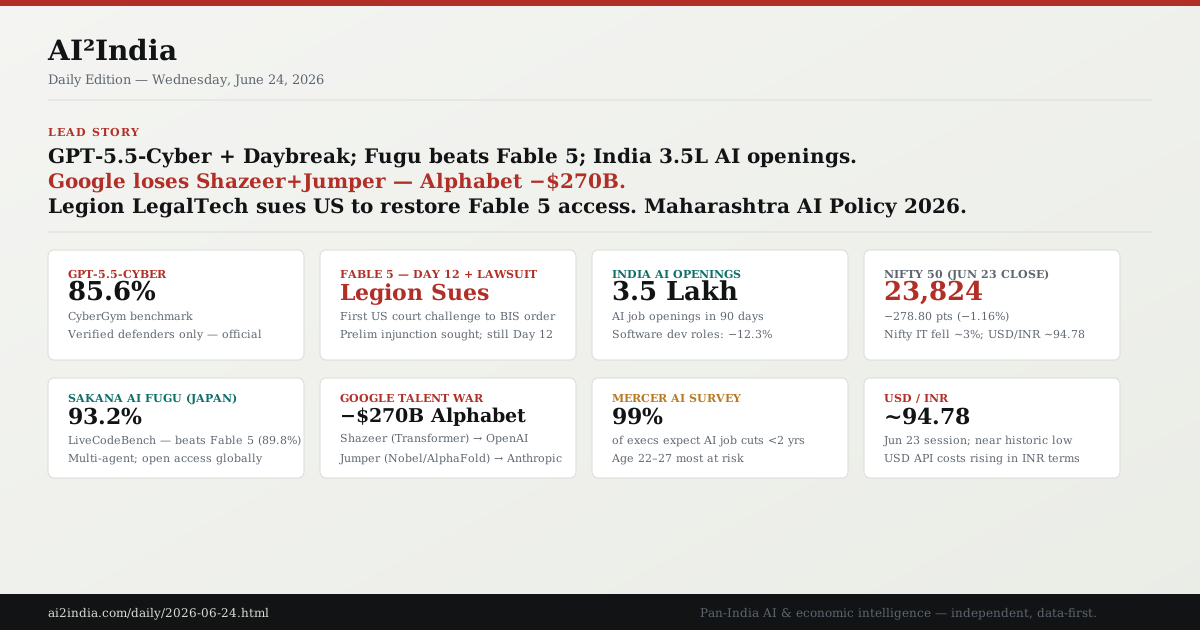
June 24 signal board: GPT-5.5-Cyber 85.6% CyberGym launched; Fugu beats Fable 5 coding 93.2 vs 89.8; Google loses Shazeer+Jumper — Alphabet −$270B; India 3.5 lakh AI openings; software dev −12.3%; Legion sues US over Fable 5; Nifty 23,824; USD/INR ~94.78
Today’s economic signal board. Full analysis in the Daily Edition.

AI Developments Today

Wednesday, June 24: five AI developments that pass the “Would this change what an Indian enterprise AI planner does this week?” filter. GPT-5.5-Cyber’s official launch and Sakana Fugu’s frontier performance are the most significant global events; India’s hiring bifurcation data is the most significant domestic signal.

DevelopmentSource + DateIndia RelevanceWhat this means for Indian enterpriseStatus
OpenAI officially launches GPT-5.5-Cyber + expanded Daybreak security platform with IBM, CrowdStrike, Accenture and Akamai — 85.6% CyberGym; first AI-native defender toolkit at frontier scale

OpenAI formally launched GPT-5.5-Cyber on June 22–23, 2026, as the centrepiece of a significantly expanded Daybreak cybersecurity platform. GPT-5.5-Cyber is a fine-tuned variant of GPT-5.5 purpose-built for authorised defensive security work, available only through the Trusted Access for Cyber programme after organisational review and phishing-resistant authentication approval. Benchmark: 85.6% on CyberGym (vs 81.8% for standard GPT-5.5), a new single-model state of the art for AI-assisted security. Capabilities: deep codebase analysis, vulnerability reachability tracing, exploit path validation, binary reverse engineering, patch development for human review, structured triage evidence. The Codex Security plugin embeds these capabilities into developer workflows. The Patch the Planet initiative targets open-source infrastructure at scale. The Daybreak Cyber Partner Programme formalises IBM, CrowdStrike, Accenture and Akamai as integration partners. Safety posture: automated refusals are reduced for approved defensive tasks (secure code review, malware analysis, red teaming, pen testing) but the model continues to block offensive objectives (credential theft, stealth/persistence, malware deployment). Daybreak was first introduced May 11, 2026; this June launch represents full commercial deployment of the security ecosystem.
Gigazine (Jun 23, 2026); cybersecuritynews.com; aitoolsrecap.com; buildfastwithai.com; OpenAI Daybreak; Jun 22–23, 2026 Accenture and IBM — two of four named Daybreak launch partners — have major delivery operations in India. Indian enterprise security teams with existing Accenture or IBM relationships can access GPT-5.5-Cyber capabilities through those partner channels. For Indian BFSI, telecom, energy and defence-supply-chain enterprises: GPT-5.5-Cyber is now the most capable authorised AI tool for vulnerability discovery and remediation, directly relevant after the Five Eyes warning that AI-enabled infrastructure attacks are months away. For Indian IT security practices: the CyberGym 85.6% benchmark establishes a new baseline for AI-assisted pen testing and VAPT service lines. For CERT-In and India’s national cybersecurity coordinator: the GPT-5.5-Cyber launch is the first confirmed deployment of a dedicated AI defender toolkit at frontier scale since the Fable 5 suspension. Indian government security agencies should evaluate the Daybreak access programme through bilateral technology channel agreements. Indian enterprise CISO and security practices should begin evaluating Daybreak and GPT-5.5-Cyber access pathways through IBM and Accenture India partner channels immediately. For IT firms with security service lines: the Daybreak Partner Programme is a formal alliance-building opportunity that will differentiate security offerings. For product teams building AI-assisted VAPT or SOC-automation tools: GPT-5.5-Cyber is now the benchmark model to test against, even if direct access is not yet available to all. SOC teams should assess whether current security tooling partners (CrowdStrike, Akamai) are integrating Daybreak capabilities and accelerate evaluation cycles. Verified — Gigazine; cybersecuritynews.com; buildfastwithai.com; OpenAI Daybreak; Jun 22–23
Sakana AI (Japan) releases Fugu: multi-agent AI system matches or exceeds Fable 5 on key benchmarks — with a public message to countries banned from Anthropic’s models

Sakana AI, a Tokyo-based AI research lab, released Fugu on June 22–23, 2026 — a multi-agent AI system built from automatic synthesis across multiple constituent models rather than a single newly trained foundation model. Benchmark results: LiveCodeBench 93.2 (Fugu Ultra), 92.9 (Fugu) — versus Fable 5’s 89.8; GPQA-Diamond 95.5 for both Fugu variants — matching Mythos Preview’s 94.6; SWE-Bench Pro 73.7 (Fugu Ultra), ahead of GPT-5.5 (58.6) and Gemini 3.1 Pro (54.2) though below Fable 5’s reported 86.0 on that test. Fugu is not a single new foundation model; its strengths vary by task, which partly explains benchmark spread. Times of India covered the story explicitly as Sakana “sharing a message for all countries banned from using Anthropic’s most powerful AI models” — a pointed editorial framing that positions Fugu as a sovereign-accessible alternative. Moneycontrol, NDTV, VentureBeat and Nikkei Asia also covered the launch. Fugu is available globally with no nationality-based access restrictions, no export-control designation, and no biometric verification requirement.
Sakana AI press release (sakana.ai/fugu-release); Moneycontrol (Jun 23, 2026); VentureBeat; NDTV; Nikkei Asia; Times of India; thedeepdive.ca; Jun 22–23, 2026 For India’s IndiaAI Mission and sovereign AI programme: Fugu is the most visible proof yet that a non-US, non-UK AI lab can produce a system that competes with — and in coding benchmarks surpasses — Anthropic’s flagship suspended model. Sarvam AI’s founders and the IndiaAI Mission team will read the Fugu result as both validation and a benchmark target. The multi-agent architecture approach Sakana used (automatic synthesis across constituent models rather than training a single giant foundation model) is potentially more accessible to resource-constrained sovereign AI programmes — it requires architectural innovation and orchestration engineering more than raw compute. For Indian enterprises currently without access to Fable 5: Fugu is an immediately available alternative with frontier-level coding and reasoning performance, accessible without nationality restrictions. For Indian AI startups and GCCs: the Fugu result significantly lowers the perceived barrier to sovereign AI development, potentially accelerating Indian VC and government investment in domestic foundation model alternatives. Indian enterprise AI teams should add Fugu to their model evaluation matrix immediately alongside GPT-5.5, Claude Opus 4.8 and Gemini 3.1 Pro. The LiveCodeBench 93.2 result makes Fugu particularly relevant for Indian software development, QA automation and code-review AI applications. For India’s AI policy and research community: the Sakana architecture (multi-agent synthesis) should be studied by CDAC, IIT AI labs and Sarvam engineers — it may be more replicable within India’s compute constraints than a brute-force single-model training approach. The Fugu launch is a strategic milestone in the post-Fable-5 global AI landscape: it marks the first confirmed instance of a non-US lab publicly claiming frontier-level equivalence and offering it freely to the countries Anthropic no longer serves. Verified — sakana.ai; Moneycontrol; VentureBeat; NDTV; Nikkei Asia; Times of India; Jun 22–23
Anthropic: major system-wide outage on June 23 affects API, Console, Code and Claude.ai simultaneously — and Claude Tag for Slack launches for Enterprise/Team customers

Anthropic experienced a major system-wide outage on June 23, 2026, affecting Claude.ai, the Claude Console, the Claude API and Claude Code concurrently — the first confirmed system-wide disruption of this scale since the Fable 5 export-control suspension on June 12. Anthropic confirmed elevated error rates across multiple models, published a fix implementation notice and stated it was monitoring results. Recovery was reported by 9to5Google and LiveMint by end of the June 23 working day. Separately, Anthropic launched Claude Tag for Slack on June 23 — described as “always-on Claude” within Slack that users can invoke with @Claude to summarise discussions, break down tasks and provide contextual insights in team chats. Available in research/beta preview for Claude Enterprise and Claude Team customers. TechCrunch covered the Slack launch under the headline “learning your company one Slack message at a time.”
TechCrunch (Jun 23, 2026); Yahoo Finance; 9to5Google; LiveMint; techedt.com; thenextweb.com; njtoday.news; techradar.com; Jun 23, 2026 For Indian enterprises that migrated workloads to Claude Opus 4.8 following the Fable 5 suspension: the June 23 outage demonstrates that reliance on a single provider — even the one chosen as the Fable 5 alternative — creates operational risk. The DPDPA 2023-compliant business-continuity rationale for model-agnostic routing is now backed by a live outage event on June 23. For enterprise Slack users: Claude Tag is a meaningful enterprise workflow integration that reduces context-switching for knowledge workers. Indian enterprises on Slack Enterprise Grid should evaluate the Claude Tag research preview — the @Claude summarisation and task-breakdown features are particularly relevant for distributed teams managing complex product or delivery contexts across multiple time zones. Enterprise architects should treat the June 23 Anthropic outage as a mandatory stress-test trigger: run your AI-dependent workflows through a “primary provider unavailable for 4 hours” scenario and verify fallback routing to GPT-5.5 or Fugu. For Slack Enterprise customers: begin Claude Tag preview evaluation and benchmark it against existing Slack AI and workflow-automation integrations. The combination of a major outage and a major product launch on the same day from Anthropic is itself a signal: the company is building enterprise reach while managing platform stability and regulatory pressure simultaneously. Verified — TechCrunch; 9to5Google; LiveMint; Jun 23
India AI hiring bifurcation confirmed at data scale: 3.5 lakh AI openings in 90 days; software development roles down 12.3% in three months; 99% of executives globally expect AI job cuts within two years

Three data points published June 23 together define the shape of India’s AI labour-market transition. (1) Quess Corp data cited by Moneycontrol: India logged approximately 3.5 lakh (350,000) AI-related job openings in the 90 days ending June 23, with demand concentrated in GenAI engineering, prompt engineering, deployment engineering and AI governance. (2) Indeed India data cited by India Today: overall India tech job postings fell 0.7% in May 2026; software development postings fell 12.3% over three months — the sharpest single-category decline in the current cycle. (3) Mercer global executive survey: 99% of executives globally expect AI-linked workforce cuts within two years, identifying workers aged 22 to 27 as the cohort facing the greatest disruption. Randstad Digital data (Economic Times) notes more than 10 AI solutions and ML engineering roles waiting to be filled per available qualified candidate in India. The simultaneous expansion of AI-native demand and contraction of traditional tech supply is the defining structural feature of India’s 2026 tech labour market.
Moneycontrol (Quess Corp data); India Today (Indeed India data); Mercer global survey; Randstad Digital / Economic Times; Jun 23, 2026 For Indian engineering colleges and professional development institutions: the 3.5 lakh AI openings combined with the software dev -12.3% decline is an unambiguous curriculum mandate. The 2026–27 graduate cohort entering the market needs AI-native skills as a minimum, not a differentiator. For Indian IT services firms: the 12.3% software dev posting decline is consistent with the AI-led productivity narrative — fewer bodies are needed to produce the same software output as AI-augmented development workflows mature. For HR and reskilling teams: the Mercer 99% executive expectation figure — near-universal consensus — should be read as a board-level mandate for workforce transition planning, not a departmental initiative. For Indian AI startups and GCCs hiring: the 3.5 lakh openings signal a tight AI talent market despite the overall tech slowdown — compensation pressure for qualified GenAI engineers is expected to remain elevated through FY27. The Randstad Digital “10 roles waiting per qualified candidate” ratio is the single most actionable data point for enterprise reskilling programmes: if you can certify existing employees in AI engineering before the external hire, you are capturing stranded value. For enterprise AI programme leaders: the Mercer 99% figure is a board-ready data point for workforce transition investment approval. Colleges, bootcamps and corporate L&D teams should be orienting all technical training toward GenAI deployment, AI governance and AI-augmented development tooling as immediate priorities. Verified signal — Moneycontrol (Quess Corp); India Today (Indeed); Mercer; Randstad Digital / ET; Jun 23
Google loses Transformer co-inventor Noam Shazeer to OpenAI and Nobel laureate John Jumper to Anthropic on the same day — Alphabet loses ~$270 billion in market cap in one of its worst trading days of 2026

Two landmark AI talent departures from Google were confirmed June 23–24, 2026. Noam Shazeer — co-inventor of the Transformer architecture (2017) that underpins virtually every large language model in production today, VP of engineering at Google, and co-lead of the Gemini AI programme — announced he is leaving Google to join OpenAI. He had previously co-founded Character.AI and returned to Google via its 2024 Character.AI partnership. John Jumper — senior VP at Google DeepMind and lead scientist of AlphaFold, whose protein-structure prediction work earned him and Demis Hassabis the 2024 Nobel Prize in Chemistry — announced simultaneously that he is leaving Google DeepMind to join Anthropic. Alphabet’s stock fell approximately $270 billion in market capitalisation on the news, Google’s worst single-day market loss of 2026. The stock has declined more than 16% over the five weeks preceding June 23. Fortune, Business Insider, CNBC and Times of India all framed the simultaneous departures as evidence that Google is losing the AI talent war to OpenAI and Anthropic. Shazeer’s move to OpenAI is particularly symbolic: the Transformer architecture he co-invented is the technical foundation of every frontier model that now competes with the Gemini models he was building at Google.
Fortune (Jun 23, 2026); Business Insider; CNBC; Times of India; Taipei Times; Barron’s; pureai.com; Jun 23–24, 2026 For Indian enterprises and GCCs with deep Google Cloud AI relationships — particularly those using Vertex AI, Google Workspace AI and Gemini APIs: the simultaneous loss of Gemini’s engineering co-lead and DeepMind’s most celebrated scientist is a strategic platform-continuity risk signal that should be factored into 2026–27 AI platform selection decisions. The Gemini 3.5 Pro GA, expected near June 30, now enters the market at the precise moment when its most prominent builder has departed for OpenAI. For Indian IT firms evaluating Google Cloud AI vs Azure OpenAI vs AWS Bedrock: leadership continuity is now a vendor assessment criterion. For India’s AI research community: both departures reinforce the concentration of frontier AI research talent at OpenAI and Anthropic — which, through the Fable 5 export-control saga, are also the two labs whose most powerful models are least accessible to Indian users. This is the central tension of the current AI geopolitical moment for India. Indian enterprise AI architects should add “Gemini leadership continuity” as a risk factor in platform selection matrices. Do not accelerate long-term Google Cloud AI lock-in until Gemini 3.5 Pro GA proves the product roadmap is unaffected. For Indian AI researchers and startup founders: the talent mobility signals that frontier AI research capability is increasingly concentrated at OpenAI and Anthropic — which reinforces the strategic rationale for India’s sovereign AI investments (Sarvam, Krutrim, Fugu-style multi-agent approaches) that are not dependent on either lab’s talent pipeline. Verified — Fortune; CNBC; Business Insider; Times of India; Barron’s; Jun 23–24
Legion LegalTech files first US lawsuit against the government over Fable 5/Mythos 5 export control order — seeks preliminary injunction; Fable 5 suspension enters day 12

Legion LegalTech Corp, a San Jose-based legal technology company, filed suit against the US government in Washington, D.C., on June 24, 2026, challenging the June 12 Commerce Department Bureau of Industry and Security (BIS) directive that forced Anthropic to disable Fable 5 and Mythos 5 globally. The directive required Anthropic to disable access for any foreign national; Anthropic shut off both models for all customers globally on June 12. Legion argues the cutoff immediately blocked its Canada-based development team and disrupted its entire workflow. The company has asked the court to vacate and set aside the directive and is seeking a preliminary injunction to halt enforcement pending the outcome of the case. Separately, the NYT reported that the NSA lost access to an Anthropic tool it was using, suggesting US government agencies themselves were affected. Bloomberg, Gizmodo and The Star Malaysia covered the filing June 23–24. The US biometric ID pathway for US-only restoration (Anthropic, July 8 effective date) remains the only announced compliance path; the lawsuit is the first legal mechanism that could alter the global access timeline.
Bloomberg (Jun 23, 2026); The Star Malaysia (Jun 24); Gizmodo; New York Times; Jun 23–24, 2026 For Indian enterprises without access to Fable 5/Mythos 5 since June 12: the Legion LegalTech lawsuit is the first legal mechanism that could accelerate global restoration if the court grants a preliminary injunction. However, regulatory litigation timelines are measured in months to years — the operational planning assumption for India should remain that Fable 5 is unavailable for the foreseeable future. The lawsuit is nonetheless strategically significant because it establishes that the June 12 directive is legally contestable, that BIS must justify the scope of the restriction in court, and that the export-control framework for AI models is not necessarily permanent or unassailable. For Indian enterprise legal and compliance teams: monitor the docket for preliminary injunction developments — if granted, it would be the fastest path to Fable 5 global restoration. Do not modify current AI architecture decisions (model-agnostic routing to Claude Opus 4.8, GPT-5.5, Fugu) on the assumption the lawsuit will succeed quickly. Continue treating Fable 5/Mythos 5 as unavailable for Q3 2026 planning. Assign one legal/compliance team member to monitor the case and flag any preliminary injunction ruling immediately — that event would require a rapid Fable 5 reintegration assessment. Verified — Bloomberg; The Star Malaysia; Gizmodo; NYT; Jun 23–24
GPT-5.6 update: latest signals suggest mid-July delay; no official OpenAI confirmation as of June 24 — treat as unconfirmed

As of June 24, GPT-5.6 remains unconfirmed by OpenAI in any official communication — no blog post, product page or API documentation naming the model and its availability. A Digg technology report citing internal leaks indicates the model has been postponed to mid-July and “will no longer release this week.” A Chinese tech outlet (juejin.cn) reported the model was formally released June 23 including Mini, standard and Pro variants with a 1.5M token context window, but this conflicts with other sources that state the model is not yet public and was only visible as an internal routing entry in OpenAI’s Codex infrastructure. Prediction markets (Consens.io) still give a probability window for late June but explicitly label it unconfirmed. OpenAI’s chief scientist has publicly previewed GPT-5.6 as a “meaningful improvement” over the current model, confirming it is in development. The distinction between GPT-5.5 (the current public top model, available since April 2026) and GPT-5.6 (in-development, status unconfirmed) must be maintained clearly in enterprise planning.
Digg (internal leak report); vpsmac.com; webiano.digital; consens.io; inews.zoombangla.com (chief scientist preview); juejin.cn (conflicting); Jun 22–24, 2026 For Indian enterprise AI teams that were planning GPT-5.6 evaluations imminently: revise your timeline. GPT-5.6 should be treated as a Q3 2026 event (mid-July or later) until OpenAI publishes an official release note. The current frontier options available in India are GPT-5.5 (Pro/standard/Instant), Claude Opus 4.8, Gemini 3.1 Pro (enterprise preview), and now Fugu (open, global access). Planning around an unconfirmed model release date is an operational risk; plan around confirmed availability. Update internal AI model roadmaps: remove GPT-5.6 from any “likely available June 2026” planning documents. Replace with “Q3 2026 earliest, pending official OpenAI announcement.” Do not defer GPT-5.5 or Claude Opus 4.8 evaluations on the basis of a GPT-5.6 timeline that has not been officially confirmed. The GPT-5.5-Cyber security launch is the confirmed OpenAI frontier event of the current week. Unconfirmed — Digg (internal leak); consens.io; no official OpenAI release; Jun 23–24

India AI Ecosystem

Tier 4 India AI platforms, IndiaAI Mission updates, and domestic AI signals for Wednesday June 24. IndiaAI Mission companies are moving to their “next growth stage” per MeitY Secretary S. Krishnan, and Sarvam AI is now processing 10 million API calls per day. Info Edge’s ₹1,268 crore AI portfolio valuation signals private capital conviction in the sector.

Platform / OrganisationDevelopmentIndia AI SignificanceStatus
Sarvam AI
Sovereign AI unicorn
$1.5B valuation; HCLTech 10.5% stake
Sarvam AI is now handling approximately 10 million API calls per day — a figure co-founder Vivek Raghavan cited as evidence that usage has tripled in the last three months since the recent AI summit. Sarvam has released its 105B parameter model (large-scale) and thevam30B (optimised for edge deployment and consumer hardware). The company is also working on hardware applications including smart glasses, indicating a strategy that combines edge-optimised models with consumer and enterprise device integration. HCLTech holds approximately 10.5% of Sarvam at the $1.5 billion valuation (Series B). IndiaAI Mission has committed ₹246.72 crore in financial and compute support. Sarvam co-founders are representing India’s Global South AI sovereignty position at international governance forums. Ten million API calls per day is the first concrete scale metric Sarvam has disclosed that positions it as an operationally active production AI platform rather than a research or pilot project. The tripling of usage in three months — largely attributable to the Fable 5 suspension driving Indian developers to domestic alternatives — validates the commercial case for the $1.5B valuation. The edge model (thevam30B) is significant for Indian enterprises with data-localisation requirements, low-connectivity deployment scenarios (rural India, defence applications) or device-level inference needs. The smart glasses hardware direction signals ambition beyond pure API/cloud services toward a full-stack consumer and enterprise AI platform — a significantly more capital-intensive trajectory that the Series B and IndiaAI Mission support are designed to fund. Verified India — BusinessLine; Moneycontrol; Times of India; Jun 22–23, 2026
IndiaAI Mission / MeitY
“Next growth stage”
Model portfolio strategy
The Hindu BusinessLine reports that IndiaAI Mission companies are advancing to their “next growth stage” — moving from early pilots and initial funding to scaled deployment with measurable outcomes. MeitY Secretary S. Krishnan has stated that a central policy objective is to “ascertain the number of models India can sustain” — signalling a shift from the current “fund everything” early phase to a more strategic portfolio approach that selects which foundation model efforts receive continued government backing. Experts cited by BusinessLine call for milestone-based, measurable incentives tied to usage metrics (API calls, sector deployment, public infrastructure contribution) rather than flat grants. At VivaTech 2026, India served as AI Country Partner under the positioning “For India, AI means All Inclusive” — PM-level messaging emphasising growth, inclusion and sustainability. The MeitY Secretary’s “how many models can India sustain?” framing is the most important domestic AI policy signal of the week. It signals the end of the open-admission phase of India’s foundation model programme and the beginning of a more selective consolidation phase. For Sarvam, Krutrim and other IndiaAI Mission beneficiaries: the next evaluation cycle will ask harder questions about usage scale, commercial viability and sector deployment reach — not just technical capability. Companies that can show API call volume (as Sarvam has done with 10M/day), sector partnerships and measurable deployment outcomes will be better positioned for continued support than those that have only shown benchmark results. The Fugu result from Japan also informs this discussion: if multi-agent synthesis can produce frontier performance more efficiently than brute-force training, India’s model portfolio strategy should evaluate architecture choices as a resource-allocation question, not just a capability question. Verified India — The Hindu BusinessLine; VivaTech; PIB; Jun 22–23, 2026
Info Edge (Naukri)
AI portfolio doubled
28 AI startups; ₹1,268 crore
Info Edge founder Sanjeev Bikhchandani disclosed in a letter to shareholders (Livemint, Jun 23) that the company has invested ₹614 crore in 28 AI startups since 2020, and now values that portfolio at approximately ₹1,268 crore — a doubling of invested capital. The letter was written the week after the Sarvam AI unicorn milestone and explicitly links the Sarvam valuation to the portfolio surge. Info Edge’s 28-startup AI portfolio represents one of the broadest private-capital commitments to Indian AI in the market by a listed Indian company. Info Edge’s portfolio doubling is the clearest listed-company signal that Sarvam’s $1.5B valuation has triggered a measurable re-rating of the Indian AI startup ecosystem by institutional capital. For Indian AI startups seeking Series A and B funding: the Info Edge precedent and the Sarvam benchmark strengthen the fundraising narrative with Indian institutional investors. For NASSCOM and the IndiaAI Mission’s public communication: the private-capital doubling is a market-validation data point that supplements the government’s own programme funding in policy documents and investor briefings. Verified India — Livemint (Sanjeev Bikhchandani shareholder letter); Jun 23, 2026
Maharashtra AI Policy 2026
₹10,000 crore investment target
1.5 lakh jobs by 2031
₹500 crore AI Startup Venture Fund
Maharashtra announced a comprehensive AI Policy 2026 aligned with the India AI Mission, targeting ₹10,000 crore in AI-related investments and 1.5 lakh new jobs by 2031. Key institutional elements: a Maharashtra AI Mission as the anchor body; AI Cities in five designated innovation zones; a State AI Data Exchange; Maharashtra Advanced Centre for AI Training; a ₹500 crore AI Startup Venture Fund; 12 AI incubators across the state. Reskilling target: 2 lakh youth and professionals. MSME support: 20% subsidy on AI implementation costs for 5,000 MSMEs via a central Maha AI Tools Hub. Separately, Maharashtra is deploying a live government AI platform called Maha AI — built by the National Informatics Centre (NIC) — for daily state administration: drafting correspondence and notes, translation, document summarisation, and detecting duplicate beneficiaries in welfare schemes including Mukhyamantri Majhi Ladki Bahin Yojana. CM Devendra Fadnavis personally mandated that all sensitive government data processed through Maha AI remain within state-controlled infrastructure — a data-sovereignty architecture that mirrors the national IndiaAI Mission framework. Sources: Newsonair; Hindustan Times; Jun 23, 2026. Maharashtra’s policy is the most detailed and ambitious state-level AI commitment yet announced in India in 2026. The combination of ₹10,000 crore investment target, ₹500 crore venture fund, 20% MSME subsidy, and 12 AI incubators creates a three-tier AI ecosystem development framework that no other Indian state has matched at this level of policy specificity. For Indian AI startups: the ₹500 crore venture fund and 12 incubators represent the first serious state-level VC and incubation infrastructure for AI in India — a significant fundraising and acceleration opportunity for early-stage AI companies. For MSMEs in Maharashtra: the 20% AI implementation subsidy via the Maha AI Tools Hub is a direct acquisition channel for AI software and services vendors. For NIC and state government AI procurement: the Maha AI welfare-scheme beneficiary deduplication application demonstrates that sovereign AI systems can deliver near-term measurable fiscal impact — a procurement template other state governments will study closely. Verified India — Newsonair (Maharashtra AI Policy); Hindustan Times (Maha AI platform); Jun 23, 2026
IDC – Dell Technologies study
96% of Indian government leaders
advancing sovereign AI strategy
A new IDC study commissioned by Dell Technologies (Times of India, Jun 23, 2026) finds 96% of Indian government leaders are actively advancing sovereign AI strategies — making India one of the most distinctive sovereign AI markets in Asia–Pacific. India’s approach is operationalised through digital public infrastructure: Aadhaar, UPI, ONDC and Bhashini embed governance, data stewardship and trust into the national digital fabric. Government adoption breakdown: 46% evaluating sovereign AI technologies; 46% running proofs of concept; 4% in significant investment. Strategic motivations: 73% see sovereign AI as essential to protect sensitive national data; 70% see it as a geopolitical and supply-chain risk hedge. Priority investment areas: national security and defence (46%), procurement and supply chain (36%). Agentic AI confidence: 97.7% of Indian government leaders believe agentic AI will accelerate adoption, with 44.4% saying it will play a major role — above the Asia–Pacific average of 36.9%. The 96% figure is the most comprehensive single-study confirmation of India’s government-level sovereign AI commitment to date. Combined with the Maharashtra AI Policy 2026 and Sarvam’s 10M API calls/day metric, this creates a three-layer evidence structure for India’s sovereign AI strategy: federal policy (IndiaAI Mission), state policy (Maharashtra AI Policy), and private-sector scale (Sarvam). For AI infrastructure vendors: the 96% government readiness figure — with 46%+46% in evaluation and PoC phases — signals a significant near-term procurement conversion window as strategies move from planning to deployment. The high agentic AI confidence (97.7%) is a signal for vendors building agentic workflows for government use cases — a higher-value and faster-maturing market segment than simple GenAI assistant deployments. Verified India — IDC/Dell study; Times of India (Jun 23, 2026)
AI in Indian public services
Vision Sabarimala; government AI deployment
The Kerala High Court approved “Vision Sabarimala” — an AI-powered crowd management and safety system for the Sabarimala temple complex, one of India’s highest-footfall pilgrimage sites. The system uses computer vision and density mapping to monitor crowd flow, identify dangerous crowd densities and trigger alerts for crowd management authorities. The High Court approval is notable because it is a judicial sign-off on the deployment of operational AI in a safety-critical public context — the first such court-approved AI deployment for crowd safety at a major Indian religious site. Separately, the PFRDA Pension Sahayak AI portal (launched June 22) continues to serve as a carry-forward signal for government AI deployment at scale. The Sabarimala court approval establishes a legal precedent for AI in public-safety contexts in India — a precedent that state governments managing stadium events, railway stations, metro systems and public gatherings can reference in their own AI deployment proposals. For Indian AI companies building computer vision and crowd analytics products (Staqu, Neural Garage, Uncanny Vision, Wobot): the Sabarimala approval is both a reference deployment and a procurement signal. For MeitY’s Digital India programme: court-approved operational AI in safety-critical public contexts is the next phase of the government’s AI deployment narrative. Verified India — indiatv.in; Kerala High Court order; Jun 23, 2026

AI Adoption Impact

India’s AI labour-market bifurcation reached confirmed data scale on June 23. Three simultaneous data releases — 3.5 lakh AI openings, software dev -12.3%, and Mercer’s 99% executive consensus — together constitute the most statistically coherent single-day evidence base for AI-driven structural employment change in India published to date.

AI Impact DimensionEvidenceTrajectory
India AI hiring: 3.5 lakh AI openings in 90 days — labour market bifurcation confirmed Quess Corp data cited by Moneycontrol (Jun 23, 2026): India logged approximately 350,000 AI-related job openings in the 90-day period ending June 23, 2026. Demand is concentrated in GenAI engineering, prompt engineering, deployment engineering and AI governance roles. Randstad Digital data (Economic Times, Jun 23): more than 10 unfilled AI solutions and ML engineering positions exist per available qualified candidate in India. The supply-demand mismatch is structural, not cyclical: the 3.5 lakh openings cannot be filled from current graduate supply alone and will drive reskilling and wage inflation in AI-native roles through FY27. ↑ Accelerating; AI-native demand expanding faster than qualified supply; wage inflation in AI engineering roles expected to persist
Traditional tech hiring contraction: software dev postings -12.3% in three months Indeed India data cited by India Today (Jun 23, 2026): software development job postings fell 12.3% over the prior three months — the steepest single-category decline in the current hiring cycle. Overall India tech postings: -0.7% in May 2026. This contraction is occurring simultaneously with the 3.5 lakh AI opening expansion — a confirmed bifurcation rather than a general tech market decline. The same dynamic is visible in the FAAMNG data: hyperscalers are adding AI and cloud roles while shedding backend and IT ops headcount within the same organisations. ↓ Accelerating; traditional software dev roles contracting as AI-augmented development reduces the headcount needed for the same output
Mercer: 99% of executives globally expect AI-linked job cuts within two years; age 22–27 most at risk Mercer global executive survey cited by India Today (Jun 23, 2026): 99% of executives expect AI-linked workforce cuts within two years. Workers aged 22 to 27 — entry-level and early-career professionals — are identified as the cohort facing the greatest disruption. This near-universal executive consensus is the highest global executive alignment on AI workforce impact yet recorded in a major survey. For India, where the entry-level tech talent pool is disproportionately large (India produces approximately 1.5 million engineering graduates annually), this age-group concentration of risk has outsized structural implications for campus hiring, professional development institutions and government skilling programmes (PMKVY, Skill India Digital). ↑ Structurally significant; near-universal executive consensus creates board-level mandate for workforce transition planning at enterprises of all sizes
GPT-5.5-Cyber: new demand for AI-augmented security professionals GPT-5.5-Cyber’s official launch creates a new AI-security professional category: the “AI-augmented red team analyst” who can deploy GPT-5.5-Cyber for authorised vulnerability discovery, triage and patch development. For Indian IT firms with security service lines, the Daybreak Partner Programme (IBM, CrowdStrike, Accenture, Akamai) creates a new accreditation and training pathway for security professionals who want to work with frontier AI security tools. The Trusted Access for Cyber review process is the gating mechanism — Indian security teams at qualifying organisations should begin the access application process now. ↑ New category; AI-augmented security analysts are an immediately monetisable skill in the VAPT, SOC and red-team services market
Nifty correction: IT stocks fall ~3% on June 23 after June 22 rebound After the June 22 Nifty IT rebound (+1.38%), the index fell approximately 3% on June 23, with Sensex declining 893 points (−1.16%) and Nifty 50 falling 278 points (−1.16%). India Today reported “Sensex ends 893 points lower; Nifty below 24,000; Infosys, IT stocks fall 3%.” The rupee fell to approximately 94.78–94.83 per dollar — a fresh low. The correction reverses the June 22 technical rebound and reaffirms the structural IT sector headwinds established by the Accenture guidance cut. USD/INR at ~94.78 increases the rupee cost of USD-denominated AI API services across all frontier providers. ↓ Structural headwinds unchanged; Jun 22 rebound confirmed as tactical, not structural; USD API cost inflation in INR terms accelerating

Five Things That Changed

Wednesday, June 24: three confirmed AI developments of direct India consequence, one India hiring data signal, and one market correction update. AI stories lead; markets are supporting context.

SignalData PointReader ImpactStatus
OpenAI officially deploys GPT-5.5-Cyber + Daybreak with enterprise security partners — the confirmed frontier AI security event of the current week GPT-5.5-Cyber: 85.6% CyberGym (vs 81.8% GPT-5.5 standard). Trusted Access for Cyber: verified defenders only. Daybreak Partners: IBM, CrowdStrike, Accenture, Akamai. Codex Security plugin: embeds into developer workflows. Patch the Planet: open-source infrastructure at scale. Daybreak first launched May 11; June 22–23 is full commercial deployment. Access via Trusted Access programme or through IBM/Accenture India channels. Not a general-access model — application required. Blocks offensive use; reduces refusals for approved defensive tasks. Indian CISO teams and IT security practices should initiate Daybreak access applications now. IBM India and Accenture India are the fastest access paths for qualified enterprises. For security service line leaders: the 85.6% CyberGym benchmark is the new target for AI-assisted VAPT service differentiation. For CERT-In: evaluate government-channel bilateral access to the Trusted Access for Cyber programme. Do not wait for GPT-5.6; GPT-5.5-Cyber is the confirmed frontier security AI available today. Verified — Gigazine; cybersecuritynews.com; OpenAI Daybreak; Jun 22–23
Sakana AI Fugu: Japan builds Fable-5-equivalent — open access, no export controls, direct message to countries excluded by Anthropic Fugu Ultra LiveCodeBench: 93.2 (Fable 5: 89.8). GPQA-Diamond: 95.5 (matches Mythos Preview 94.6). SWE-Bench Pro: 73.7 Fugu Ultra (Fable 5: 86.0; GPT-5.5: 58.6). Architecture: multi-agent automatic synthesis, not a single trained foundation model. Access: globally available, no nationality restrictions, no biometric verification. Coverage: Moneycontrol, NDTV, Times of India, VentureBeat, Nikkei Asia. Times of India framing: “message for countries banned from using Anthropic’s models.” Add Fugu to enterprise AI model evaluation matrices immediately. For coding automation, code review and scientific reasoning use cases, Fugu Ultra is immediately competitive with the best available alternatives. For India’s IndiaAI Mission: the Sakana multi-agent synthesis architecture is a design template worth studying — it may be more achievable within India’s compute envelope than a brute-force foundation model training approach. This is the most significant sovereignty-relevant AI development since the Fable 5 suspension. Verified — sakana.ai; Moneycontrol; VentureBeat; NDTV; Times of India; Jun 22–23
India AI hiring bifurcation confirmed: 3.5 lakh AI openings vs software dev -12.3%; 99% exec consensus on AI cuts Quess Corp / Moneycontrol: 3.5 lakh AI openings in 90 days. Indeed India / India Today: software dev postings -12.3% in 3 months; overall tech -0.7% in May. Randstad Digital / ET: 10+ unfilled AI roles per qualified candidate. Mercer global survey: 99% of executives expect AI cuts within 2 years; age 22–27 most exposed. Previous data: FAAMNG +13,600 India net hires (Xpheno, H1 2026); AI/cloud +25–30% YoY (TeamLease). Campus hiring -44% YoY (carry-forward, Xpheno). The Randstad 10:1 ratio (roles to candidates) is the single most actionable enterprise reskilling data point available. If you can certify 100 existing employees in GenAI deployment before competitors hire externally, you are filling roles at below-market cost while competitors compete in a 10:1 demand-supply market. Board-level workforce transition plans should cite the Mercer 99% figure. Campus and institutional partners should be briefed on the 3.5L vs −12.3% gap immediately. Verified signal — Moneycontrol (Quess); India Today (Indeed); Mercer; Randstad/ET; Jun 23
Anthropic system-wide outage June 23 — business-continuity risk for single-provider AI strategies June 23 outage affected: Claude.ai, Claude Console, Claude API, Claude Code. Confirmed by Anthropic: elevated error rates; fix implemented; monitoring. Sources: 9to5Google, LiveMint, techedt.com, thenextweb.com, njtoday.news. Same day Anthropic launched Claude Tag for Slack (Enterprise/Team research preview). Context: Fable 5 suspension is now 12 days old; Anthropic is simultaneously managing regulatory compliance and product expansion. This is the first system-wide outage of this scale since the suspension event. If your enterprise AI workloads ran uninterrupted on June 23, your continuity architecture is working. If they failed, you have evidence for an urgent model-agnostic routing investment. The combination of Fable 5 suspension (geopolitical risk), Anthropic outage (operational risk) and Mercer 99% AI-cuts expectation (strategic risk) is a three-signal board mandate for enterprise AI resilience. On the product side: Claude Tag for Slack Enterprise/Team customers is available now — evaluate for knowledge-worker workflow value independently of the business-continuity concern. Verified — 9to5Google; LiveMint; Anthropic status; Jun 23
Markets: Nifty -278 pts to 23,824; Sensex -893 pts to 76,200; Nifty IT −3%; USD/INR fresh low ~94.78 June 23 close: Sensex 76,200.68 (−893.39, −1.16%); Nifty 50 23,824.10 (−278.80, −1.16%); Nifty IT approximately −3% (Infosys −3%+); USD/INR approximately 94.78–94.83; Brent crude below $80. The correction reversed the June 22 technical rebound entirely. RBI repo rate unchanged at 5.25% (Jun 5 MPC). CPI approximately 2.1% (recent). Forex reserves $681.61B (carry-forward). Next MPC: August 5–7. June 24 pre-market: no official gift Nifty data in scope at 3:30 AM IST. The rupee at ~94.78 directly inflates the INR cost of USD-denominated AI API subscriptions. Enterprises billing in INR that consume GPT-5.5 or other USD-API services are paying approximately 6–8% more in rupee terms than at the start of 2026. AI API cost sensitivity analyses should be updated to the 94.78 baseline. The IT sector −3% correction reinforces the structural narrative: markets are pricing in continued headcount and margin pressure from AI productivity adoption, not a cyclical recovery. Verified — Moneycontrol; India Today; NDTV; NSE/BSE; Jun 23

Data Variables Ledger

Numbers first, interpretation second. Updated June 24, 2026. Market figures are June 23 close (last trading day). AI model and ecosystem figures reflect most recent verified disclosures.

VariableLatest ReadingPeriodSource TypeEditorial Read
Nifty 5023,824.10 (−278.80, −1.16%)Jun 23, 2026 closeNSE / Moneycontrol / India TodayCorrection after Jun 22 rebound; IT −3%; broad selling; structural headwinds reasserted
Sensex76,200.68 (−893.39, −1.16%)Jun 23, 2026 closeBSE / Moneycontrol / NDTVErased Jun 22 gains; IT-led selloff; Accenture headwind unchanged
Nifty IT~−3% (approx. 26,975 estimated)Jun 23, 2026 closeIndia Today; NDTVInfosys −3%+; IT correction after technical bounce; structural re-rating narrative ongoing
USD / INR~94.78–94.83 (fresh low)Jun 23, 2026 sessionMoneycontrol; NDTV; Economic TimesRupee at fresh historic low; USD AI API costs rising in INR; capital-account pressure
Brent CrudeBelow $80/bblJun 23, 2026Multiple market sourcesUS–Iran diplomacy + supply stability; India import relief intact; $85+ is watch level
GPT-5.5-CyberOfficially launched (Verified defenders via Trusted Access)Jun 22–23, 2026Gigazine; cybersecuritynews.com; OpenAI Daybreak85.6% CyberGym; IBM/CrowdStrike/Accenture/Akamai partners; India access via IBM/Accenture channels
GPT-5.5 (standard)Generally available (current OpenAI public top model)Apr 24, 2026 (API GA)OpenAICurrent OpenAI GA flagship; GPT-5.2 retired Jun 12; India access: Azure OpenAI + direct API
GPT-5.6 statusUnconfirmed; possible mid-July delay per leaksJun 23–24, 2026Digg (leak); consens.io; no official OpenAI sourceDo not plan around June availability; treat as Q3 2026 at earliest; GPT-5.5-Cyber is the confirmed current week event
Claude Fable 5 / Mythos 5Suspended globally (day 12)Jun 12, 2026 onwardsDoC; Anthropic; GT LawJul 8 biometric ID policy effective date; US-only restoration path forming; India access timeline unknown; plan around unavailability
Claude Opus 4.8Generally available; outage Jun 23 (resolved)May 28, 2026 (GA); outage Jun 23AnthropicCurrent Anthropic GA flagship; outage Jun 23 resolved; model-agnostic fallback to GPT-5.5 recommended
Sakana Fugu (Ultra)Released globally; open accessJun 22–23, 2026Sakana AI press release; Moneycontrol; NDTVLiveCodeBench 93.2 (beats Fable 5 89.8); GPQA-Diamond 95.5; globally accessible; add to evaluation matrix
Gemini 3.5 ProLimited Vertex AI enterprise preview; GA still pendingJun 23, 2026Multiple; Google I/O commitment2M token context; Deep Think mode; GA expected near June 30; still not GA as of Jun 24 morning
India AI openings (90 days)3.5 lakh (350,000)Jun 23, 2026 reportQuess Corp / MoneycontrolGenAI, prompt engineering, deployment, AI governance; Randstad: 10+ unfilled roles per qualified candidate
Software dev postings (India)−12.3% in 3 monthsJun 23, 2026 reportIndeed India / India TodaySteepest single-category decline; bifurcation from AI opening growth confirmed at data scale
Exec AI job-cut expectation99% within 2 years (Mercer survey)Jun 23, 2026Mercer global survey / India TodayAge 22–27 most at risk; near-universal executive consensus; board-level mandate for transition planning
Sarvam AI API calls10 million per dayJun 22–23, 2026Co-founder disclosure; BusinessLine; MoneycontrolTripled in 3 months post-AI summit; thevam30B edge model; smart glasses hardware in development
Alphabet (GOOGL) market capDown ~$270 billion in one session (Jun 23); down >16% over five weeksJun 23, 2026Fortune; CNBC; Times of India; Barron’sShazeer (Gemini co-lead, Transformer co-inventor) → OpenAI; Jumper (Nobel Chemistry, AlphaFold) → Anthropic; India: Google Cloud AI partnership risk flag for GCC and IT firms
Fable 5/Mythos 5 legal statusDay 12 of suspension; Legion LegalTech lawsuit filed; preliminary injunction soughtJun 24, 2026Bloomberg; The Star Malaysia; Gizmodo; NYTFirst legal challenge to BIS/Commerce directive; injunction outcome determines fastest path to global restoration; US-only Jul 8 biometric ID path still the only disclosed compliance route
GIFT Nifty (Jun 24 open indication)~23,892 futures (~+0.3% vs Jun 23 close)Jun 23–24 night sessionNDTV Profit; BusinessLine marketsModestly positive open indicated; support zone 23,800–23,750; deeper fall warned if support breaks; IT sector watch after Alphabet talent story
Maharashtra AI Policy 2026₹10,000 crore investment target; 1.5L jobs by 2031; ₹500 crore venture fund; 12 AI incubatorsJun 23, 2026Newsonair; Hindustan TimesMost ambitious state-level AI policy in India 2026; Maha AI platform (NIC) live for government administration; 20% MSME AI subsidy
IDC/Dell sovereign AI study96% of Indian government leaders advancing sovereign AI strategyJun 23, 2026IDC/Dell; Times of India46% evaluating + 46% PoC; 73% cite data sovereignty; 70% cite geopolitical risk; 97.7% confident in agentic AI
Oracle global headcount cut21,000 (162K → 141K; −13%)FY2026 (filed Jun 22)Oracle FY2026 annual filing (carry-forward)AI explicitly attributed in filing; $1.84B severance; India ~12,000 est. (Mint; unconfirmed by Oracle)
RBI repo rate5.25%Jun 5, 2026 MPCRBICarry-forward; next MPC August 5–7
India CPI~2.1% (recent trough)Recent monthlyIndian Express / RBI (carry-forward)Carry-forward; rupee weakness adds marginal import-inflation pressure
India forex reserves$681.61 billionWeek ended Jun 5 (carry-forward)RBI~11 months import cover; rupee weakness drawing on reserves; next weekly data due

Verified Layoff Radar

No new verified India layoff items today. Carry-forward from June 23 edition. Oracle global restructuring and AI attribution remain the anchoring item. The Mercer 99% executive survey published June 23 is a leading indicator that more restructuring events are likely in H2 2026 — but without company-level disclosures they remain forward risk, not publishable verified events.

CompanyClassificationIndia CountTimelineStatusSource
OracleAI-driven restructuring — annual filing confirmed; AI explicitly attributed~12,000 estimated (global: 21,000 confirmed, −13% headcount; $1.84B severance)FY2026 (ended May 31, 2026); India centres: Bengaluru, Hyderabad, PuneVerified global (Oracle FY2026 filing; Bloomberg; Reuters); India estimate: Mint — not officially confirmed by OracleOracle FY2026 10-K; Bloomberg Jun 22; Reuters; Mint
OpendoorIndia operation shutdown~250Reported Jun 11, 2026Verified IndiaEconomic Times / Times of India
TCSNet workforce change (FY26)Headcount down 23,460 in FY26 to 584,519; no fresh June layoff programmeAGM Jun 9, 2026Official workforce changeTOI / ET
LinkedIn IndiaLayoff300–350May 2026Verified IndiaEconomic Times
Adda247Layoff~200–220May 2026Verified IndiaEconomic Times
OracleCampus-offer withdrawal50+ India offers reportedly revokedMay 2026Verified India hiring slowdownPriority publication reporting

June 24 Watchlist

Mercer 99% survey — forward risk indicator: The near-universal executive consensus published June 23 is a leading indicator of restructuring events in H2 2026, but no specific company-level disclosures have been triggered. Monitor quarterly earnings calls in July–August 2026 for AI-restructuring disclosures from India-facing IT services firms. Watchlist-only pending any company action.

AI startup restructuring risk (Fable 5/Mythos 5 suspension — day 12): No confirmed India AI startup layoffs attributable to the Fable 5 suspension. The suspension is now 12 days old. Anthropic’s June 23 outage briefly compounded the impact for any Anthropic-dependent workflows. Watchlist-only pending company disclosures.

Nokia India (~3,000+ potential roles): No change. Programme runs through end-2026. Stays watchlist-only.

HCLTech (Xerox BPM, Noida): 170–200 employees potentially affected. HCLTech declined to comment. Stays watchlist.

Cognizant (Project Leap): 12,000–15,000 global cuts reported; India expected to be heavily affected per source-based reporting but no company-backed India count. Stays watchlist-only.

Accenture India (forward risk): FY26 guidance at 3–4%; bookings softening. No India workforce action disclosed. Stays watchlist-only.

Hiring Demand Watch

Wednesday June 24: the 3.5 lakh AI openings figure is the most significant single hiring data release of the current quarter. GPT-5.5-Cyber creates a new AI-augmented security professional category. Sakana Fugu adds multi-agent orchestration engineering to the skills demand list.

Sector / CategoryDemand SignalWage / Career ReadConfidence
GenAI and AI deployment roles (India) 3.5 lakh AI openings in 90 days (Quess Corp / Moneycontrol, Jun 23). Randstad Digital: 10+ unfilled AI solutions and ML engineering roles per qualified candidate. AI/cloud/cybersecurity +25–30% YoY (TeamLease, carry-forward). Most in-demand: GenAI engineers, prompt engineers, deployment engineers, AI governance specialists. New additions: AI-augmented security analysts (Daybreak/GPT-5.5-Cyber pathway), multi-agent orchestration engineers (Sakana Fugu architecture signals), EU AI Act compliance engineers (carry-forward). The 10:1 role-to-candidate ratio confirms that compensation for AI-native professionals will remain elevated through FY27. Reskilling existing employees is the most capital-efficient route to filling this demand. New specialisations created this week: AI-augmented security (Daybreak), multi-agent systems engineering (Fugu architecture), and AI business-continuity architecture (Anthropic outage response). High
Software development (India) — contraction underway Software development postings: −12.3% in 3 months (Indeed India / India Today, Jun 23). Overall tech postings: −0.7% in May 2026. This is the sharpest single-category IT hiring decline in the current cycle. Cause: AI-augmented development workflows (GitHub Copilot, Cursor, GPT-5.5 coding, Fugu) reducing the headcount needed per unit of software output. Expected to continue through FY27 as AI coding tools mature and enterprise adoption increases. Software engineers without AI-augmentation skills are facing the fastest relative market deterioration. Developers who can use AI coding tools to produce 3–5x their previous output are still in demand; those who cannot are competing in a contracting pool. The 12.3% decline in postings is the structural floor of a multi-year trend, not a short-term dip. High
AI-augmented security professionals (new category) GPT-5.5-Cyber official launch (Jun 22–23) creates a new professional category: AI-augmented security analysts with access to Daybreak/GPT-5.5-Cyber for authorised VAPT, SOC-automation and patch development. Daybreak Partner Programme (IBM, CrowdStrike, Accenture, Akamai) creates formal certification and accreditation pathways. Access via Trusted Access for Cyber programme — requires organisational review and phishing-resistant authentication. Indian IT security firms that can field teams with GPT-5.5-Cyber access will command significant RFP differentiation in the government, BFSI and critical-infrastructure security services market. Early movers in AI-augmented security will set the benchmark for VAPT and SOC-automation service contracts in H2 2026. IBM India and Accenture India Daybreak partnership status means their security professionals have priority access — creating a near-term competitive gap for competitors. Indian security firms should pursue Trusted Access applications now. High (new category; near-term competitive differentiation value)
Oracle platform talent from restructuring ~12,000 estimated Oracle India professionals (Bengaluru, Hyderabad, Pune) entering the market over FY2026 separation timeline (carry-forward). TCS Oracle AI Data Platform Lab (Kolkata) is one confirmed domestic demand channel. SI partners building Oracle cloud practices are the primary market. Skills: OCI, Oracle Autonomous Database, Oracle Fusion ERP/CRM, Oracle AI Data Platform. Carry-forward. Oracle platform specialists with AI-augmented ERP skills command a premium. SI partners and Oracle cloud-migrating enterprises should be actively recruiting this cohort now, ahead of the talent pool absorption window narrowing in Q3 2026. Medium-High
Entry-level / campus roles Down 44% YoY (Xpheno carry-forward). Mercer: age 22–27 identified as the highest-risk cohort for AI-driven job displacement. Campus hiring budgets suppressed by Accenture guide-cut and overall IT sector headwinds. Oracle restructuring adds experienced talent to the mid-market, compressing entry-level opportunity further. 3.5 lakh AI openings exist but require skills most 2026–27 graduates do not yet have. The worst career entry market for a tech cohort since the 2001 downturn, with the structural difference that roles are being created simultaneously — but in a different skills category than what current graduates are prepared for. The 3.5 lakh vs −12.3% bifurcation is a mandate for educational reform at pace, not a temporary anomaly. High

Real Estate Pulse

No new India commercial real estate or GCC lease transactions to report today. The GCC AI office demand, data-centre pipeline and Oracle office utilisation watchlist carry forward from June 23. Sakana Fugu’s multi-agent architecture approach, which requires less raw compute than single foundation model training, may moderate data-centre build-out demand estimates if adopted widely by Indian AI programmes — a watchlist signal for the 8.33 GW pipeline.

SegmentSignalTrajectoryStatus
GCC AI office demand Carry-forward: 60% of new 2026 GCC roles are in AI/data/platform engineering. India GCC headcount projected +200,000 for 2026. Target India ₹1,250 cr GCC lease (Bengaluru, Jun 17) is the most recent confirmed large-ticket lease. GCC demand for AI-ready Grade A office space (high-density power, digital resilience infrastructure) continues to outpace traditional IT spec. ↑ Continuing; AI-ready GCC space is a premium market segment growing independent of overall office leasing softness Verified signal — carry-forward from Jun 17–23 editions
Oracle India office utilisation Watchlist: Oracle’s confirmed 21,000-person global restructuring, with ~12,000 estimated in India, will reduce Oracle India office density at Bengaluru, Hyderabad and Pune campuses. Oracle India owns/leases significant Grade A office space in all three cities. If confirmed at Mint estimate scale, Oracle becomes one of the largest potential sources of secondary lease market supply in H2 2026. ↓ Watchlist; secondary office supply signal for Bengaluru/Hyderabad/Pune pending Oracle India headcount confirmation Watchlist — India count unconfirmed; monitoring Oracle India real estate signals
India data-centre pipeline Carry-forward: 8.33 GW planned capacity (Knight Frank India). Haryana AI data centre (Panchkula) announced. AI workload demand and data-localisation requirements driving hyperscaler and domestic AI company build-out. New watchlist: Sakana Fugu’s multi-agent synthesis approach could reduce compute-per-capability requirements if adopted broadly, potentially moderating the raw-compute demand projections underpinning current data-centre planning. → Pipeline continues but multi-agent efficiency signal introduces modest uncertainty in long-term compute demand forecasts Verified signal (pipeline) — carry-forward; Fugu efficiency watchlist is new

Market Signals

Four ticker cards. Market data is context for AI investment signals, not the edition’s lead focus.

Sensex76,201Jun 23 close; −893 pts (−1.16%); IT −3%; Jun 22 rebound fully reversed
Nifty 5023,824Jun 23 close; −278.80 pts (−1.16%); Nifty IT ~−3%; GIFT Nifty ~23,892 (+0.3%) signals modest Jun 24 recovery open
USD / INR~94.78Fresh session low; USD AI API costs rising in INR; rupee pressure continues
Brent Crude<$80/bblUS–Iran diplomacy holds; India import relief intact; $85 is the watch level

Forecast Tracker Updates

Active predictions updated with June 24 evidence. One new forecast added based on Sakana Fugu’s multi-agent architecture result.

ForecastDirectionJune 24 EvidenceStatus
AI model-agnostic architecture will become enterprise standard in India by end-2026 (initiated Jun 12) ↑ Accelerating Anthropic’s June 23 system-wide outage is the strongest single operational evidence event since the Fable 5 suspension for this forecast. Enterprises that had model-agnostic routing experienced no disruption during the outage; those that had migrated exclusively to Claude Opus 4.8 from Fable 5 were affected. The combination of a geopolitical suspension (Fable 5, Jun 12) and an operational outage (Anthropic, Jun 23) within 12 days from the same provider creates an unambiguous architectural mandate. GPT-5.5-Cyber and Fugu add two new capable alternatives to the routing pool. Active — strongly supported by Jun 24 evidence; Anthropic outage is the operational proof point
US export-control framework will expand from Anthropic to at least one additional frontier model provider by end-2026 (initiated Jun 21) ↑ Accelerating GPT-5.5-Cyber’s Trusted Access for Cyber programme is OpenAI’s own preemptive compliance architecture: by restricting high-capability security AI to verified defenders only, OpenAI is building the access-control infrastructure that would allow it to comply with a future export-control directive without a Fable-5-style suspension. This is the strongest signal to date that OpenAI anticipates export-control scrutiny on its own security-capable models and is proactively designing around it. The US-only biometric ID path for Fable 5 restoration (Anthropic, Jul 8) and the Trusted Access programme (OpenAI) together represent two major labs independently building nationality-verification infrastructure ahead of regulatory requirements. Active — strongly supported by Jun 24 evidence; GPT-5.5-Cyber Trusted Access programme is preemptive compliance architecture
India domestic AI model ecosystem will capture 15–20% of India government AI procurement by end-FY27 (initiated Jun 21) ↑ Accelerating Sarvam AI’s 10M API calls/day figure is the first concrete scale metric positioning it as a production-ready government AI platform. The Sabarimala court-approved AI deployment demonstrates government and judicial willingness to deploy AI in safety-critical public contexts — creating procurement precedent. MeitY Secretary S. Krishnan’s “how many models can India sustain” framing signals policy consolidation around the strongest performers, which Sarvam’s 10M/day metric positions it to be. The Sakana Fugu result showing a sovereign (non-US, non-UK) multi-agent AI competing at frontier level strengthens the geopolitical and technical case for India continuing to invest in domestic sovereign AI development. Active — supported by Jun 24 evidence; 15–20% target by FY27 end remains plausible
Frontier AI governance will require nationality verification for advanced model access by end-2026 (initiated Jun 23) ↑ Emerging GPT-5.5-Cyber’s Trusted Access for Cyber programme — launched one day after this forecast was initiated — is the most direct confirmation yet. OpenAI is building the access-control, identity-verification and organisational-review infrastructure for its highest-capability model. This is functionally equivalent to a nationality-and-affiliation verification system for advanced AI access, even without an explicit government mandate. Two major US labs (OpenAI: Trusted Access; Anthropic: biometric ID Jul 8) are now independently building access-verification infrastructure. End-2026 for formal regulatory mandate remains the forecast; the voluntary infrastructure is already being built ahead of any mandate. Active — strongly supported by GPT-5.5-Cyber Trusted Access launch; accelerated from “emerging” to “building ahead of mandate”
NEW — Jun 24: AI talent concentration at OpenAI and Anthropic is accelerating the frontier capability gap vs Google and reinforcing India’s sovereign AI imperative ↑ Emerging The simultaneous departure of Noam Shazeer (Transformer co-inventor, Gemini co-lead) to OpenAI and John Jumper (Nobel laureate, AlphaFold) to Anthropic on June 23 — combined with the prior departure of Andrej Karpathy and others referenced in the Business Insider talent-war coverage — represents an accelerating pattern of elite AI researcher movement toward OpenAI and Anthropic and away from Google DeepMind. This is the founding evidence for a forecast that talent concentration will widen the frontier capability gap between OpenAI/Anthropic and all other labs (including Google) within 12 months. For India, the implication is twofold: (1) OpenAI and Anthropic will likely continue to widen their capability lead — making access restrictions to their models (Fable 5/Mythos 5 suspension, Trusted Access for Cyber) more consequential over time; and (2) the talent concentration reinforces the strategic rationale for India to invest in sovereign alternatives that are not dependent on the talent pipelines of either lab. Active — new forecast; Shazeer/Jumper departures are the founding evidence; 12-month capability-gap widening is speculative but directionally supported by talent concentration data
NEW — Jun 24: Multi-agent AI architecture will close the performance gap with single-model frontier systems within 12 months, reshaping India’s sovereign AI development strategy ↑ Emerging Sakana AI’s Fugu result — matching or exceeding Fable 5 on key benchmarks using multi-agent synthesis rather than brute-force foundation model training — is the founding evidence for this forecast. If multi-agent synthesis can achieve frontier performance with significantly less compute investment than training a single large model, then India’s IndiaAI Mission strategy of funding multiple foundation model efforts simultaneously (Sarvam 105B, thevam30B, Krutrim) may be less efficient than concentrating resources on multi-agent orchestration and synthesis research that leverages existing open-weight base models. MeitY Secretary Krishnan’s “how many models can India sustain” question will be significantly informed by whether multi-agent architectures can deliver frontier performance at lower per-model compute cost. Active — new forecast; Fugu is the founding evidence; 12-month performance-gap-closure window is speculative but directionally supported

Source Notes

ItemPrimary SourcesTierConfidence
GPT-5.5-Cyber / Daybreak launchGigazine (Jun 23, 2026); cybersecuritynews.com; aitoolsrecap.com; buildfastwithai.com; OpenAI Daybreak programmeTier 2 (secondary coverage of official launch)High — multiple independent sources confirm; capabilities consistent across all coverage
Sakana AI Fugu benchmarkssakana.ai press release; Moneycontrol; VentureBeat; NDTV; Nikkei Asia; Times of India; thedeepdive.ca; Jun 22–23, 2026Tier 1 (company press release) + Tier 2 (coverage)High — Sakana’s own benchmark disclosure; independent Nikkei/VentureBeat verification; caveats noted (task-specific; multi-agent not single model)
India AI openings (3.5 lakh)Quess Corp data / Moneycontrol; Jun 23, 2026Tier 2 (staffing firm data; methodology not fully disclosed)High — Quess Corp is a listed Indian staffing firm; figure is directionally consistent with other market data
Software dev postings −12.3%Indeed India data / India Today; Jun 23, 2026Tier 2 (platform data; methodology partially disclosed)High — Indeed is a primary job-posting platform; figure is consistent with Xpheno and TeamLease data from prior editions
Mercer 99% exec surveyMercer global executive survey / India Today; Jun 23, 2026Tier 2 (survey; methodology not fully disclosed)Medium-High — Mercer is a major HR consultancy; “99%” is a rounded figure from a survey; directionally consistent with multiple independent surveys
Anthropic outage Jun 239to5Google; LiveMint; techedt.com; thenextweb.com; njtoday.news; techradar.com; Anthropic status page; Jun 23, 2026Tier 1 (Anthropic status page) + Tier 2 (coverage)High — confirmed by Anthropic status updates; multiple independent outlets covered
Claude Tag for SlackTechCrunch (Jun 23, 2026); Yahoo FinanceTier 2 (press coverage of product launch)High — TechCrunch is primary technology press; product feature confirmed
GPT-5.6 delay signalDigg (internal leak report); consens.io; vpsmac.com; Jun 22–24, 2026Tier 3 (internal leak; not confirmed by OpenAI)Medium — treat as directional signal only; do not plan around specific timeline
Nifty / Sensex / Nifty ITNSE; BSE; Moneycontrol; India Today; NDTV; Economic Times; Jun 23, 2026Tier 1High
USD/INRMoneycontrol; NDTV; Economic Times; Jun 23, 2026Tier 1High — intraday range; final settlement rate may differ slightly
Sarvam AI 10M calls/dayBusinessLine; co-founder Vivek Raghavan disclosure; Moneycontrol; Jun 22–23, 2026Tier 1 (co-founder disclosure) + Tier 2 (coverage)High
IndiaAI Mission “next growth stage”The Hindu BusinessLine; Jun 23, 2026; MeitY Secretary S. KrishnanTier 1 (ministry official statement)High
Info Edge AI portfolio valuationLivemint (Sanjeev Bikhchandani shareholder letter); Jun 23, 2026Tier 1 (founder shareholder communication)High
Google talent exodus (Shazeer/Jumper)Fortune (Jun 23, 2026); Business Insider; CNBC; Times of India; Taipei Times; Barron’s; pureai.com; Jun 23–24, 2026Tier 2 (press coverage; multiple independent outlets; stock market data is Tier 1)High — multiple independent Tier 1 business outlets; stock market data confirms Alphabet market-cap reaction; specific departure dates vary slightly by outlet (Shazeer reported Jun 16–17; Jumper Jun 23)
Legion LegalTech lawsuitBloomberg (Jun 23, 2026); The Star Malaysia (Jun 24); Gizmodo; New York Times; Jun 23–24, 2026Tier 2 (press coverage of court filing)High — Bloomberg and NYT are primary legal/financial press; court filing is Tier 1 source; lawsuit details consistent across coverage
Maharashtra AI Policy 2026 + Maha AINewsonair (AIR News; Maharashtra government press release); Hindustan Times; Jun 23, 2026Tier 1 (government announcement) + Tier 2 (coverage)High — Newsonair is the official government news outlet; policy details confirmed by Hindustan Times coverage
IDC/Dell sovereign AI studyIDC study commissioned by Dell Technologies; Times of India (Jun 23, 2026)Tier 2 (commissioned study; methodology not fully disclosed)High — IDC is a primary industry analyst; Dell commissioned study; 96% figure directionally consistent with independent government AI spending surveys
Vision Sabarimala court approvalindiatv.in; Kerala High Court order; Jun 23, 2026Tier 1 (court order) + Tier 2 (coverage)High