Lead Analysis
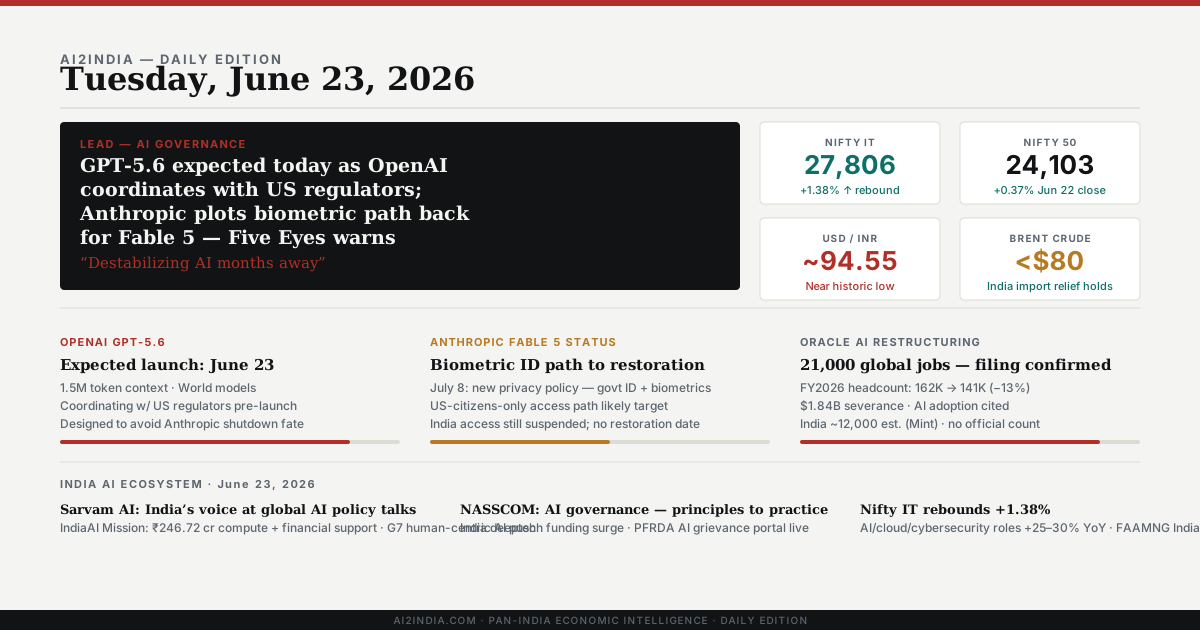
OpenAI’s GPT-5.6 expected today with pre-cleared regulatory pathway; Anthropic plots biometric identity verification route to restore Fable 5 for US users; Five Eyes nations jointly warn AI-enabled destabilisation of governments and businesses is months away; EU finalises high-risk AI classification as governance regime moves from chips to models.
Tuesday, June 23, 2026 is shaping up as the most consequential single day for AI governance since the Claude Fable 5 suspension on June 12. Four simultaneous developments — OpenAI’s expected GPT-5.6 launch, Anthropic’s July 8 privacy policy update signalling a biometric path to US-only Fable 5 restoration, a rare Five Eyes intelligence warning on AI destabilisation risk, and the European Union’s June 23 deadline for stakeholder feedback on high-risk AI classification — together mark the moment that the global frontier AI governance framework visibly began hardening from aspiration into binding architecture. For Indian enterprises, the implications are direct and immediate: the era of unconstrained global access to frontier AI models is ending. The question is no longer whether access will be conditional, but on what terms, on which geopolitical basis, and at what speed.
OpenAI’s GPT-5.6 is expected to reach public release on or around June 23, based on multiple industry sources and a Polymarket prediction-market consensus placing an 83% probability on a release between June 22 and 28. What distinguishes GPT-5.6’s launch from Anthropic’s ill-fated Fable 5 introduction is OpenAI’s visible pre-launch coordination with US regulators. Senior OpenAI leadership met with regulators in Washington on June 22 — a deliberate and public signal that the company is working within the government’s national-security framework rather than presenting completed capabilities as a fait accompli. Technically, GPT-5.6 represents a shift in OpenAI’s upgrade priorities from pure linguistic intelligence toward “spatial intelligence” and world models — more sophisticated internal representations of how the physical and computational world works — alongside a reported increase in the internal reasoning parameter (“Juice Value”) from 768 to 960 that trades modest latency for meaningfully deeper reasoning chains. The context window expands to approximately 1.5 million tokens. Multiple variants are expected: Mini (cost-optimised), standard, and Pro (full capability). GPT-5.5 Cyber, a cybersecurity-oriented variant rolled out in limited preview to selected teams in June 2026, is the model most likely to attract the export-control scrutiny that ended Fable 5 — the fact that OpenAI is not leading with that capability in the GPT-5.6 launch is a deliberate regulatory calculation. For Indian enterprise developers: GPT-5.6 is expected to be accessible through Azure OpenAI and direct API from day one, without the nationality-filtering complications that caused Fable 5’s global suspension. Indian developers who began evaluating alternatives to Fable 5 in June now have a newly released frontier option that has been explicitly designed to survive the regulatory environment that grounded its predecessor.
Anthropic, meanwhile, published an updated privacy policy with an effective date of July 8, 2026, adding explicit support for government-issued ID and biometric verification. Industry analysis — including coverage from promptailearning.com and AI governance monitor asym-intel.info — reads this as groundwork for a US-citizens-only restoration of Fable 5 and Mythos 5: if Anthropic can verify that a user is a US citizen or permanent resident via government ID and biometric match, it can satisfy the letter of the Department of Commerce export-control directive without requiring the directive to be reversed or lifted. Fable 5 and Mythos 5 remain globally suspended as of June 23. The July 8 privacy policy update does not guarantee restoration; it creates the technical and legal infrastructure for a possible restoration that still requires sign-off from the Bureau of Industry and Security. The implication for India is clear and uncomfortable: even if Fable 5 and Mythos 5 are restored in July, the restoration will likely be US-only. Indian users and enterprises — already two weeks into a forced migration to alternative models — should not plan around Fable 5 restoration as a near-term scenario for India access.
The Five Eyes nations — the US, UK, Canada, Australia, and New Zealand — issued a rare joint statement this week warning that AI systems capable of autonomously destabilising governments, critical infrastructure, and major businesses may be only months away. The statement explicitly references the demonstrated capabilities that triggered the Fable 5 suspension (autonomous zero-day vulnerability chaining) as evidence that the threat horizon is shorter than previously believed. This is the broadest allied intelligence consensus on near-term AI risk yet published, and it has direct implications for how India’s government, regulators, and critical-infrastructure operators think about AI deployment risk. Simultaneously, the European Union’s June 23 feedback deadline for high-risk AI system classification guidelines marks a decisive moment in the EU’s AI Act implementation: the outcome will determine which categories of AI deployment — including frontier foundation model APIs — trigger the Act’s most stringent requirements around risk management, human oversight, transparency, and incident reporting. Indian IT firms and GCCs serving EU-regulated clients must now accelerate their EU AI Act compliance programmes to match the classification guidance that will emerge from this process.
Market context: the Nifty IT index rebounded 1.38% on June 22 to approximately 27,806, partly recovering from the Accenture guidance-driven selloff of June 19. Sensex gained 291 points to 77,094.07 and Nifty 50 added 89.8 points to 24,102.90, with broad-based buying (2,100+ advances vs 1,200 declines on NSE). The rupee, however, is trading near historic lows at approximately 94.55 per dollar — a contrast with the equity rally that reflects ongoing capital-account pressures. Brent crude remains below $80, sustaining India’s import-bill relief. Oracle’s annual filing, released June 22, confirmed 21,000 global job cuts in fiscal 2026 (headcount fell from ~162,000 to ~141,000, a 13% reduction) with $1.84 billion in severance costs — and explicitly named AI adoption as a driver of the restructuring. This is the largest single-company AI-attributed global job reduction confirmed to date in 2026, and it formally adds Oracle to the verified AI-driven restructuring register. India-specific count remains Mint’s ~12,000 estimate; Oracle has not published a country breakdown.