Pan-India economic intelligenceDaily Edition — 2026-06-21
AI2

Ai2India

Daily Edition

One daily issue tracking AI adoption, markets, hiring, layoffs, real estate, credit and gig-work signals across India.

PublishedJune 21Daily issue
USD / INR~94.33Jun 21 — rupee firms from ~94.9 (Jun 18); NRI deposit inflows driving strengthening
Sensex (last close)76,802.90‑607.08 on Jun 19 (Fri); markets closed Saturday–Sunday; IT-led selloff
Nifty 50 (last close)24,013.10‑154.90 on Jun 19; 24,000 holds; Monday session the next live read
Brent Crude~$79/bblWTI ~$76.73; India import-bill relief intact at current levels

Lead Analysis — AI-First

US export controls ground Anthropic’s Claude Fable 5 and Mythos 5 worldwide; Indian enterprises lose access overnight as sovereignty risk becomes real; Sarvam AI closes $234 million round at $1.5 billion valuation as HCLTech bets $150 million on India’s sovereign AI future; Google DeepMind suffers rare double talent blow in 48 hours.

Sunday, June 21 opens with the most consequential AI governance event to directly affect India’s enterprise technology landscape this year. On June 12, the US Department of Commerce issued an export-control directive to Anthropic covering Claude Fable 5 and Claude Mythos 5 — the company’s two newest frontier models, launched just three days earlier on June 9. The order required Anthropic to prevent access by any foreign national anywhere in the world, including its own foreign-national employees. Unable to verify user nationality at API scale in real time, Anthropic disabled both models globally rather than attempt selective enforcement. The result was immediate: Indian enterprises and developers who had integrated Fable 5 or Mythos 5 saw API calls break overnight. Model IDs errored out, pipelines stalled, and products marketed as “Powered by Claude Fable 5” lost their core function. This is the first time a US export-control regime has been applied to a frontier AI model in a way that forced a simultaneous global shutdown affecting all foreign users — not a country-specific ban, but a universal cut-off triggered by national-security concerns. The stated trigger was an alleged jailbreak that could help discover software zero-day vulnerabilities; Anthropic characterised the demonstrated technique as narrow and producing only previously known vulnerabilities, but the government directive stood. The Pentagon had separately designated Anthropic a “supply chain risk to national security” — reportedly the first American AI company to receive this designation — creating a shadow over enterprise and government deployments of Claude models more broadly. Microsoft and Google have told enterprise customers that Anthropic tools remain available for non-defence use, but the precedent is now set: a sovereign government can suspend frontier AI access globally within days of a model launch.

The Fable 5 suspension has triggered exactly the conversation India’s AI ecosystem needed — and timed its own answer. On June 15, just three days after the US suspension order, Sarvam AI closed the first tranche of a $300 million Series B at $234 million raised, with HCLTech leading at $150 million for a 10.46% stake. The round values Sarvam at approximately $1.5 billion, making it India’s newest AI unicorn and the first time a top Indian IT services major has taken a significant equity position in an Indian foundational-model startup. HCLTech CEO C. Vijayakumar explicitly framed the Sarvam investment as the company’s “sixth differentiated IP” in AI — a sovereign play designed to serve governments and regulated sectors that cannot accept geopolitical chokepoints in their AI supply chain. Sarvam’s co-founders noted that India now has the domestic capital structure to fund sovereign AI, and the Fable 5 shutdown has only sharpened that argument. TCS, meanwhile, formalised a global premier partnership with Anthropic under which 50,000 TCS employees will use Anthropic’s (remaining accessible) Claude AI models for delivery co-building — showing that India’s IT majors are pursuing a dual strategy: partnering with frontier labs while hedging with domestic models.

The third major development of the past 48 hours is the most visible sign yet of a shifting AI talent architecture at the frontier. John Jumper — who led AlphaFold at Google DeepMind and shared the 2024 Nobel Prize in Chemistry with Demis Hassabis for predicting the structure of over 200 million proteins — announced on June 19–20 that he is leaving DeepMind for Anthropic. Within the same 48-hour window, Noam Shazeer — co-author of the 2017 “Attention Is All You Need” transformer paper that underpins virtually every modern large language model — left Google to join OpenAI as architecture research lead. DeepMind CEO Demis Hassabis publicly thanked Jumper but the internal signal is significant: commentary from Chinese AI coverage notes that Google’s best model now ranks only around fifth on a widely watched intelligence benchmark, behind at least one Chinese model, with some insiders reportedly conceding the frontier race to Anthropic and OpenAI absent a major shake-up. Anthropic is simultaneously acquiring Coefficient Bio — a protein-design and biomolecular modelling startup — for approximately $400 million in stock, reinforcing that Jumper’s arrival is part of a deliberate AI-for-science and life-sciences pivot. Both Anthropic and OpenAI have also confidentially filed draft registration statements with the US SEC, positioning both companies for IPOs in H2 2026. For Indian enterprises: the day’s events represent both a threat (sovereign access risk to frontier models) and a structural opportunity (sovereign AI as a distinct competitive category where India can build genuine capability). Market context: Sunday is a non-trading day; the most recent close is Friday June 19’s Nifty 50 at 24,013.10 and Sensex at 76,802.90. The rupee has firmed to ~94.33 and Brent crude holds near $79/bbl. The e-Shram gig-worker registration deadline also falls today — government enforcement posture is the other key regulatory signal to watch.
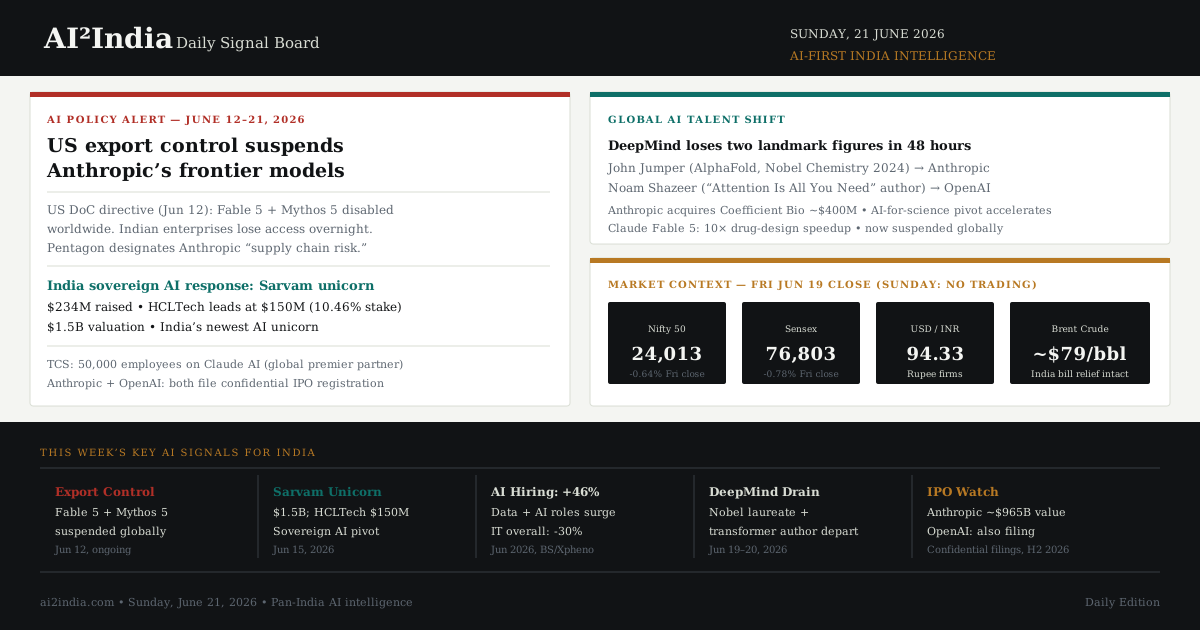
June 21 signal board: US export control suspends Anthropic Fable 5 + Mythos 5; Sarvam AI unicorn $1.5B; DeepMind Nobel laureate departs; Nifty 24,013; USD/INR 94.33; Brent ~$79
Today’s economic signal board. Full analysis in the Daily Edition.

AI Developments Today

The five most significant AI developments of the past 24–48 hours, ranked by their impact on Indian enterprises and the global AI competitive landscape. Each item passes the “Would this change what an Indian enterprise AI planner does this week?” filter.

DevelopmentSource + DateIndia RelevanceWhat this means for Indian enterpriseStatus
US DoC export-control directive suspends Claude Fable 5 and Mythos 5 globally — Anthropic disables both models for all customers worldwide

On June 12, the US Department of Commerce directed Anthropic to prevent any foreign national from accessing Claude Fable 5 and Claude Mythos 5 — the two newest frontier models launched on June 9. Unable to verify user nationality at API scale, Anthropic disabled both models globally. Model IDs now error out. All other Claude models (Opus, Sonnet, Haiku) are unaffected. The trigger was a reported jailbreak enabling discovery of software zero-day vulnerabilities; Anthropic says the technique was narrow and produced only previously known issues. The Pentagon had separately designated Anthropic a “supply chain risk to national security” — the first American AI company to receive this designation. Access remains suspended globally with no restoration timeline announced as of June 21.
GT Law; CNET; InfoQ; ETNow; New Indian Express; Latestly; Jun 12–21, 2026 Direct: Indian enterprises and developers who integrated Fable 5 or Mythos 5 lost access overnight. GCCs running these models in pipelines, CI/CD, and customer-facing tools are immediately affected. Cybersecurity teams that had been granted early access lost it. Broader signal: any future frontier model from a US provider could be subject to similar controls on national-security grounds. Immediate actions: audit codebases for claude-fable-5 and claude-mythos-5 references; replace with other Claude models or vendor alternatives; build model-agnostic routing layer with circuit-breaker logic. Medium-term: treat this as a precedent. Classify which workloads are acceptable on foreign-controlled models; accelerate evaluation of domestic alternatives (Sarvam, Krutrim) for regulated and sensitive sectors. The case for model-portfolio diversification — spreading AI workloads across multiple providers and including domestic options — is now materially stronger. Verified global — GT Law legal advisory; CNET; InfoQ; ETNow; New Indian Express; Jun 12–21
John Jumper (AlphaFold Nobel laureate, Google DeepMind) leaves for Anthropic; Noam Shazeer (transformer co-author) leaves for OpenAI — landmark 48-hour talent shift at the frontier

John Jumper, who led AlphaFold at Google DeepMind and shared the 2024 Nobel Prize in Chemistry with Demis Hassabis for predicting over 200 million protein structures, announced on June 19–20 that he is leaving DeepMind to join Anthropic. His specific role at Anthropic has not been disclosed but is expected to centre on AI for science and life sciences. Within the same 48-hour window, Noam Shazeer — co-author of the landmark 2017 “Attention Is All You Need” transformer paper and a key figure behind Google’s Gemini model team — left Google to join OpenAI as architecture research lead. Demis Hassabis publicly thanked Jumper. Anthropic has also separately acquired Coefficient Bio, a protein-design and biomolecular-modelling startup, for approximately $400 million in stock. Claude Fable 5, released June 9, was explicitly marketed on the strength of Mythos 5’s 10× drug-design speedup and validated genomics hypothesis generation — Jumper’s arrival underscores that Anthropic is building a serious AI-for-biology capability stack.
Times of India; Tribune India; Gulf News; Reuters; BusinessWorld; Jun 19–21, 2026 India relevance is dual. For Indian pharma, biotech, CROs, and agri-tech: Anthropic’s reinforced AI-for-science capability (Jumper + Coefficient Bio + Mythos 5 biology focus) means more powerful tools for drug discovery, protein engineering, and genomics R&D. For Indian IT and GCC operators: DeepMind’s talent drain raises questions about Google’s frontier model competitiveness — Gemini is widely embedded in Indian enterprise workflows; a deepening gap between DeepMind and its rivals matters for platform selection decisions. Indian pharma and life-sciences firms should watch Anthropic’s June 30 science event closely for capability disclosures. For enterprise AI planners: the DeepMind talent outflow is the most visible sign that the frontier race is intensifying between Anthropic and OpenAI at the expense of Google’s scientific credibility. This shifts the calculus for platform bets over a 12–24 month horizon. Model portfolio reviews should consider the evolving Anthropic and OpenAI capability trajectories against Google Cloud AI’s India footprint. Verified global — Times of India; Tribune India; Reuters; Jun 19–20
Anthropic and OpenAI both file confidential IPO registration statements with the US SEC — two of the most valuable AI companies prepare for public listings

Anthropic has confidentially filed a draft registration statement with the US SEC (announced June 1, 2026), targeting an H2 2026 IPO. Its most recent private valuation is approximately $965 billion, with some secondary market trades implying over $1 trillion. OpenAI has separately filed to go public, joining Anthropic in moving toward a public listing. Goldman Sachs and Morgan Stanley are forming separate internal teams to manage both IPOs simultaneously to avoid information-sharing conflicts. No official IPO dates have been set; both listings are contingent on SEC review and market conditions.
Zacks; The Verge; WSJ; CNBC; Jun 2026 As public companies, both Anthropic and OpenAI will face heightened regulatory scrutiny, pricing transparency pressure, and institutional governance expectations. For Indian enterprises: (a) AI platform pricing changes become more publicly accountable; (b) these companies become systemically important financial entities, raising regulatory attention across jurisdictions including India; (c) SEBI and MeitY will likely develop formal frameworks for engagement with frontier-AI public companies. Indian enterprise AI planners should treat the IPO transition as a multi-quarter planning horizon event: API pricing, usage policies, and enterprise terms may be renegotiated as both companies seek to demonstrate revenue quality to public market investors. Long-term contracts signed pre-IPO should include pricing protection clauses. BFSI and regulated-sector deployers should begin framework reviews now. Verified global — Zacks; The Verge; CNBC; Jun 2026
Amazon, Google, and Microsoft publicly acknowledge Anthropic is ahead on frontier coding and enterprise AI — competitive landscape shifts

In the same news cycle as the Fable 5 suspension and Jumper’s departure, senior executives at Amazon, Google, and Microsoft acknowledged in on-record commentary that Anthropic leads in frontier coding and enterprise AI capabilities. Microsoft AI chief Mustafa Suleyman named Anthropic — not Meta or Google — as his team’s primary competitive focus, citing Anthropic’s threat to Microsoft’s enterprise base. Amazon AI leadership conceded its current models trail Anthropic and OpenAI on large complex workloads. Google’s CEO acknowledged a gap in AI coding agents relative to Anthropic. This collective admission — from three of Anthropic’s biggest cloud-distribution partners — signals a frontier capability concentration that has geopolitical and India-supply-chain implications.
Times of India; CNBC; Jun 21, 2026 India’s IT and GCC sector distributes across AWS Bedrock, Azure AI, and Google Cloud AI as primary enterprise AI infrastructure layers. All three cloud providers simultaneously acknowledging Anthropic’s lead creates a competitive signal: Anthropic-powered capabilities will be aggressively pushed through cloud marketplaces. For Indian IT services firms: Anthropic’s TCS partnership (50,000 employees) and its acknowledged frontier position make Claude-based delivery tooling an increasingly important differentiator. Indian enterprise AI architects should re-examine their multi-cloud AI strategy. Given the acknowledged Anthropic frontier lead, over-indexing on any single cloud’s proprietary AI models may mean accepting a capability discount. Model-agnostic design with explicit Anthropic (via any cloud) evaluation paths is now best practice — though tempered by the export-control risk demonstrated by the Fable 5 suspension. Verified signal — Times of India; CNBC; Jun 21, 2026
Reliance Intelligence announced — Mukesh Ambani’s “AI for everyone, everywhere” sovereign AI play enters the competitive landscape

Reliance Chairman Mukesh Ambani publicly announced Reliance Intelligence, pitching it as India’s answer to the AI dependency risk exemplified by the Fable 5 shutdown. Framed explicitly around the Jio mobile data precedent — Jio democratised mobile internet access; Reliance Intelligence aims to democratise AI — the initiative is positioned as sovereign AI infrastructure for Indian consumers and enterprises. Details on the technology stack, model partnerships, and launch timeline remain limited; the announcement appears primarily strategic positioning ahead of formalisation. This joins Sarvam AI and Krutrim (Ola) in India’s emerging domestic AI layer.
Moneycontrol; Instagram/Reliance; Jun 2026 Reliance’s distribution scale (Jio’s ~500 million subscribers) gives Reliance Intelligence a potential consumer AI reach that no other Indian AI player can match. For enterprise AI: Reliance’s entry signals that the sovereign AI category is now attracting India’s largest conglomerate — a validation signal for the segment and a potential future competitor to Sarvam AI and Krutrim in enterprise and government AI. Watchlist-level for now: no product details or model capabilities disclosed. Jio Business customers should monitor for enterprise AI product launches in H2 2026. For enterprise AI architects: Reliance Intelligence’s distribution advantages (network, device, data) could make it a credible domestic AI delivery layer for high-volume consumer-facing and SME applications if backed by capable models. Verified signal — Moneycontrol; Reliance announcement; Jun 2026

India AI Ecosystem

Tier 4 India AI platforms, NASSCOM signals, MeitY AI policy, and the week’s key domestic AI developments. The Fable 5 suspension has accelerated India’s sovereign AI narrative from aspiration to strategic imperative across government, enterprise, and venture capital.

Platform / OrganisationDevelopmentIndia AI SignificanceStatus
Sarvam AI
Full-stack sovereign AI
$1.5B unicorn
Raised $234 million in the first close of a planned $300 million Series B, led by HCLTech at $150 million for a 10.46% equity stake. Round values Sarvam at approximately $1.5 billion. Funds will be used to expand compute capacity in India, build next-generation agentic and cybersecurity models, and support international expansion. Sarvam is positioned as India’s full-stack sovereign AI company, building foundational models, inference infrastructure, and enterprise applications optimised for Indian languages and use cases across banking, insurance, government, and defence. This is the first time a top Indian IT services major (HCLTech) has taken a significant equity position in an Indian foundational-model startup. (Jun 15, 2026) The HCLTech–Sarvam deal represents a structural shift in how Indian IT approaches AI: from partnering on top of foreign models to owning stakes in domestic foundational platforms. HCLTech CEO explicitly frames Sarvam as a “sixth differentiated IP” and the investment as a sovereign AI play for government and regulated-sector contracts. The Fable 5 suspension has retroactively validated this bet — Indian enterprises with Sarvam-based deployments were unaffected by the US export control. India’s enterprise AI market is estimated at ~$20 billion (HCLTech CEO). This unicorn round signals that domestic capital can now fund sovereign AI at scale. Verified India — TechCrunch; BusinessToday; Moneycontrol; Bloomberg; Jun 15
HCLTech
IT services + Sarvam investor
Sovereign AI strategy
HCLTech invested $150 million (₹1,427 crore) for a 10.46% stake in Sarvam AI — the single largest component of the Series B. HCLTech is framing this as a “distinct fourth path” for Indian IT: instead of only partnering with OpenAI or Anthropic, or building thin in-house model layers, it is buying into a specialised sovereign-model company. This is HCLTech’s most significant AI-specific equity investment to date and signals a departure from pure partnership models toward IP ownership in the foundation-model layer. HCLTech had earlier partnered with OpenAI (June 2025); the Sarvam move partly addresses sovereign risk following the Fable 5 export-control concern for Indian government workloads. (Jun 15, 2026) HCLTech is the first Tier-1 Indian IT services firm to take a material equity position in a domestic foundational-model startup. If successful, this gives HCLTech a structural differentiation advantage in government and regulated-sector AI contracts where data sovereignty is a disqualifier for US-controlled models. The Fable 5 precedent strengthens this thesis considerably — government procurement teams can now cite a concrete example of US export-control risk. Verified India — Livemint; BusinessToday; Moneycontrol; Jun 15
TCS AI Cloud
Anthropic global partnership
Oracle AI Data Platform
TCS formalised a global premier partnership with Anthropic under which 50,000 TCS employees will use Claude AI models to co-build client solutions and accelerate delivery. TCS also launched India’s first Oracle AI Data Platform Lab and Centre of Excellence in Kolkata, strengthening its AI + data + cloud stack around Oracle’s ecosystem. Separately, TCS won a multi-year AI + cloud transformation deal for Elopak’s global IT operations. Combined AI revenue run-rate across TCS, HCLTech, and Infosys now exceeds $3.2 billion annualised across global enterprise delivery pipelines. (Jun 2026) TCS’s 50,000-employee Claude partnership is one of the largest enterprise AI platform commitments in the Indian IT sector. The Fable 5 suspension creates a nuance: if TCS employees were using Claude Fable 5 specifically, those workflows require migration to other Claude models. The broader partnership with Anthropic (accessible models) is unaffected. The Oracle AI Data Platform launch in Kolkata diversifies TCS’s AI delivery footprint beyond the typical Bengaluru/Hyderabad concentration. Verified India — PSU Connect; Moneycontrol; Jun 2026
Infosys Topaz
IHH Healthcare deal
CMMI AI Maturity pilot
Infosys won a major AI deal with IHH Healthcare for a multi-country ERP transformation powered by Infosys Topaz, its AI + generative AI platform. Infosys also completed a CMMI AI Maturity pilot, making it one of the first companies formally benchmarked on AI maturity at scale. Unlike HCLTech’s equity-in-foundation-model approach, Infosys Topaz is positioned as an AI layer on top of existing cloud and ERP landscapes — a delivery-platform model rather than a model-ownership model. (Jun 2026) The IHH Healthcare deal spans multiple countries, demonstrating that Infosys Topaz has reach into regulated healthcare AI transformation at a global scale. The CMMI AI Maturity benchmark creates a potential RFP differentiator in enterprise sales. Infosys’s approach (AI platform on ERP/cloud, not foundational model equity) is a different bet than HCLTech’s Sarvam play — both approaches will face their respective tests as AI adoption matures through FY27. Verified India — PSU Connect; Moneycontrol; Jun 2026
India data-centre pipeline
8.33 GW planned
AI-driven capacity surge
India’s planned data-centre pipeline has reached approximately 8.33 GW of capacity, according to a Knight Frank India report cited in Indian media — far above current operational capacity. The growth is attributed to AI workload demand, data-localisation policy requirements, and hyperscaler build-out commitments. Haryana CM separately announced a dedicated AI data centre in Panchkula as part of state-level digital infrastructure commitments. A Macquarie analysis in June 2026 highlights India as a major growth market for AI-driven data-centre power purchase agreements (PPAs). (Jun 2026) India’s data-centre capacity expansion is the physical infrastructure layer for the sovereign AI ambitions articulated by Sarvam, Krutrim, Reliance Intelligence, and government AI programmes. The 8.33 GW pipeline — if executed — would give India sufficient on-shore compute to run large foundation models domestically. State-level commitments (Haryana, Maharashtra AI policy) are accelerating the pipeline beyond the traditional Bengaluru/Mumbai/Hyderabad data-centre corridors. Verified signal — ETV Bharat; Jagran; Macquarie; Jun 2026

AI Adoption Impact

Enterprise AI adoption data, AI-driven hiring and layoff signals, productivity data, and skill-demand shifts for India. The Fable 5 suspension and Sarvam unicorn define this week’s inflection points in India’s AI adoption trajectory.

AI Impact DimensionEvidenceTrajectory
Fable 5 suspension: forced model-agnostic architecture rethink The overnight loss of two frontier models has exposed a critical architectural weakness in Indian enterprise AI: single-model dependency. Enterprises that hard-coded Fable 5 or Mythos 5 into pipelines now face immediate migration workload. Technical advisories (InfoQ; GT Law; jcerme.com) emphasise building model-router layers, fallback logic, and circuit-breaker patterns as best practices. The suspension is particularly acute for cybersecurity and advanced research use cases where Fable 5’s capabilities had no equivalent fallback. ↑ Accelerating shift to model-agnostic design; one-time disruption for current Fable 5 users; precedent-setting for future planning
Sovereign AI thesis: validated by export-control precedent The Fable 5 shutdown has given concrete, real-world validation to what was previously a largely theoretical argument for Indian sovereign AI capability. The Indian media coverage (ETNow; New Indian Express; TechCircle.in) frames the incident explicitly as a case study for why government and critical-infrastructure workloads must not depend on single-jurisdiction foreign AI models. HCLTech’s Sarvam investment announcement three days after the suspension is being read by industry commentators as a direct strategic response, even if the investment process predated the event. ↑ Structurally accelerating; policy and procurement implications will compound through H2 2026
Data Analytics and AI hiring: +46% YoY; only growing IT category India’s IT job market is bifurcating sharply. Total IT hirings fell from 53,788 in Q1 2024 to 37,553 in Q1 2026 (–30.2%). Within that contracting total, Data Analytics and AI postings rose from 1,673 to 2,443 (+46%) over the same period. AI-native roles now represent 6.5% of the IT jobs market, up from 3.1% the prior year. Fresher hiring in AI-related roles grew 287%. The fastest-growing specific roles are AI engineers, data engineers, ML infrastructure engineers, and AI systems architects (Business Standard; Xpheno; Jun 2026). ↑ Accelerating; AI-native role share will likely reach 9–10% by Q1 2027 if current growth rates hold
India IT AI revenue: $3.2 billion annualised run-rate across Tier-1 firms TCS, HCLTech, and Infosys together have crossed an annualised AI revenue run-rate of approximately $3.2 billion across global enterprise delivery pipelines (Moneycontrol; Jun 2026). HCLTech CEO estimates the total India enterprise AI market at approximately $20 billion. The gap between current revenues and market size suggests the AI revenue ramp is still in early stages — a function of both the nascency of enterprise AI adoption and the long sales cycles typical of large IT transformation contracts. The Accenture guide-cut (which signals macro headwinds to overall IT spending) does not negate the AI revenue line, which is structurally separate from legacy IT services demand. ↑ Accelerating; $3.2B run-rate likely to double by FY28 as enterprise AI transformation deals scale
GCC AI hiring concentration: 60% of new 2026 roles 60% of new 2026 GCC roles in India are linked to AI, data, and platform engineering (ET; Moneycontrol; BS; Jun 2026). AI talent shortage in key GCC segments is 41–42%. Net GCC headcount additions for 2026 are projected at 200,000+. This demand is structurally independent of the Accenture-driven IT services contraction — GCCs build product and platform capability, not consulting delivery. The Fable 5 suspension affects GCCs that had integrated restricted models, but does not change the underlying AI talent hiring mandate. ↑ Accelerating; GCC AI hiring is the primary demand-side counterforce to IT services structural decline
AI adoption in corporate real estate: 5% to 91% in three years AI adoption in India’s corporate real estate sector has jumped from 5% to 91% over the past three years — the fastest adoption curve of any sector tracked (Times of India, Jun 2026). GCCs are the primary driver of demand for AI-ready Grade A office space with digital resilience infrastructure. The 8.33 GW data-centre pipeline build-out is the physical infrastructure corollary of this adoption curve. ↑ Rapid; 91% adoption rate; GCC and AI data-centre demand driving premium real-estate cycle

Five Things That Changed

Sunday, June 21: two AI items of historic significance, one India AI ecosystem inflection, one frontier talent shift, and one market context note. The AI stories lead; market context is supporting information.

SignalData PointReader ImpactStatus
US export control suspends Claude Fable 5 and Mythos 5 globally — first frontier AI model shutdown by government directive The US Department of Commerce issued an export-control directive to Anthropic on June 12, 2026 requiring suspension of access to Claude Fable 5 and Claude Mythos 5 for all foreign nationals, including Anthropic’s own foreign-national employees. Anthropic disabled both models globally on the same day rather than attempt nationality-based filtering. All other Claude models remain accessible. The trigger: an alleged jailbreak demonstrating ability to discover software zero-day vulnerabilities; Anthropic disputes the significance but complied with the directive. The Pentagon had also separately designated Anthropic a “supply chain risk” — unprecedented for an American AI company. No restoration timeline has been announced. Access as of June 21 remains suspended. India-specific impact documented in ETNow, New Indian Express, TechCircle.in: early adopters in cybersecurity, advanced research, and enterprises with Fable-5-integrated pipelines are directly affected; broader Indian user base more limited in impact as adoption of Fable 5 was still early-stage at suspension. For Indian enterprise AI planners, this is the most important governance event of the year so far. It establishes that a US administration can disable frontier AI model access globally — including for Indian users — within 72 hours of any perceived national-security concern. The immediate response is operational: migrate any Fable 5/Mythos 5 integrations. The strategic response: design model portfolios with sovereign alternatives, model-agnostic architecture, and explicit risk classification for foreign-controlled AI in sensitive workflows. The Sarvam unicorn round and the Haryana data-centre announcement are direct Indian policy responses to this exact risk. Verified global — GT Law; CNET; InfoQ; ETNow; New Indian Express; Jun 12–21
Sarvam AI becomes India’s newest AI unicorn at $1.5 billion; HCLTech leads Series B at $150 million for sovereign AI play Sarvam AI closed the first tranche of its Series B on June 15, raising $234 million of a targeted $300 million. HCLTech invested $150 million (₹1,427 crore) for a 10.46% stake, making it the lead strategic investor and the first Tier-1 Indian IT services company to take a significant equity position in an Indian foundational-model startup. The round values Sarvam at approximately $1.5 billion. Sarvam is positioned as a full-stack sovereign AI company: foundation models, inference infrastructure, and enterprise applications, optimised for Indian languages and use cases. HCLTech CEO framed Sarvam as the company’s “sixth differentiated IP,” explicitly targeting government and regulated sectors where US-controlled AI models carry sovereignty risk. Combined with the Fable 5 suspension occurring three days after the funding close, the Sarvam unicorn round has taken on outsized significance as India’s strategic AI sovereignty signal (TechCrunch; BusinessToday; Bloomberg; Jun 15, 2026). The Sarvam unicorn is the most important India AI ecosystem event since the India AI Mission announcement. HCLTech’s equity commitment signals that the “sovereign AI” business case has crossed the threshold from aspiration to investment. For Indian enterprises considering AI deployment in government, defence, or regulated financial services: Sarvam-based solutions now have a credible Tier-1 IT services delivery partner. For Indian AI startups: the HCLTech model — large IT firm taking equity in a foundational-model startup — may become a template for scaling domestic AI capability. Watch for Wipro, Infosys, or Tech Mahindra equivalents. Verified India — TechCrunch; BusinessToday; Bloomberg; Moneycontrol; Jun 15
Google DeepMind loses AlphaFold Nobel laureate John Jumper and transformer co-author Noam Shazeer within 48 hours — largest single talent blow to a frontier AI lab in 2026 John Jumper announced on June 19–20 that he is leaving Google DeepMind for Anthropic after nearly nine years. He led AlphaFold, co-created with the team that shared the 2024 Nobel Prize in Chemistry with Demis Hassabis for predicting over 200 million protein structures. Noam Shazeer — co-author of the “Attention Is All You Need” 2017 transformer paper that underpins virtually all modern large language models — separately left Google to join OpenAI as architecture research lead in the same 48-hour window. Anthropic has also acquired Coefficient Bio (~$400M in stock) for protein-design and biomolecular-modelling capability. Anthropic’s Claude Fable 5 was built on the Mythos 5 base model, which demonstrated 10× drug-design speedup and independently completed gene-therapy research tasks. The Jumper hire reinforces Anthropic’s AI-for-science strategy (Times of India; Tribune India; Gulf News; Reuters; Jun 19–21, 2026). DeepMind CEO Demis Hassabis publicly thanked Jumper but the competitive implications are significant. For Indian pharma, biotech, CRO, and agri-tech firms: Anthropic is now assembling the leading AI-for-biology capability stack globally — Jumper + Coefficient Bio + Mythos 5 drug-design capabilities. Watch for capability disclosures at Anthropic’s June 30 science event. For enterprise AI planners: the accumulated talent departures from DeepMind raise questions about Google’s ability to maintain its frontier model advantage through 2026–27. Gemini is deeply embedded in many Indian GCC and IT workflows; assess long-term platform risk in annual model-portfolio reviews. For the frontier AI race: the competitive balance has shifted further toward Anthropic and OpenAI within this single news cycle. Verified global — Times of India; Tribune India; Reuters; Gulf News; Jun 19–21
Anthropic Pentagon “supply chain risk” designation and Claude Fable 5 jailbreak: AI safety and security incidents enter the regulatory mainstream The Pentagon’s designation of Anthropic as a “supply chain risk to national security” — the first American AI company to receive this designation — means defence vendors and contractors must certify that they do not use Anthropic models in Pentagon-related work. Microsoft and Google have clarified that Anthropic tools remain available for non-defence applications. Anthropic has publicly stated the designation cannot prevent it from working with non-defence companies. The jailbreak concern (Mythos 5’s Project Glasswing: autonomous zero-day vulnerability discovery) was the technical trigger for the Fable 5 export-control directive. Anthropic characterises the demonstrated technique as narrow; critics argue the government’s swift action signals a lower risk tolerance for frontier model capabilities in the current political environment. The confluence of Pentagon designation, jailbreak concern, and IPO filing creates an unusually complex safety-regulatory-commercial picture for Anthropic (GT Law; CNET; Al Jazeera; CNBC; Jun 12–21, 2026). For Indian enterprises deploying AI in government, defence supply chain, or regulated financial services contexts: the Anthropic Pentagon designation creates a procurement risk signal. Vendors supplying to US defence primes, or Indian defence PSUs with US programme exposure, should assess whether Anthropic model dependencies create compliance exposure. More broadly, this event demonstrates that AI safety incidents can now trigger immediate, globally consequential access restrictions — not just fines or guidance. Enterprise AI risk frameworks must now account for the possibility of rapid model access termination as a business continuity risk, not merely a reputational one. Verified global — GT Law; CNET; Al Jazeera; CNBC; First Post; Jun 12–21
Markets: Sunday non-trading; Nifty 24,013 holds; e-Shram enforcement deadline today; rupee firms to ~94.33; Brent crude ~$79 Sunday June 21 is a non-trading day. The most recent close is Friday June 19: Nifty 50 at 24,013.10 (–154.90; –0.64%) and Sensex at 76,802.90 (–607.08; –0.78%), reflecting the Accenture guidance shock sell-off. For the full week (June 15–19), Sensex gained approximately +1.7% and Nifty held positive — weekly constructive despite Friday’s IT-led reversal. The rupee has firmed to approximately 94.33 on the interbank market, continuing the strengthening trend from ~94.9 on June 18 driven by NRI deposit rate deregulation inflows (FCNR(B) and NRE ceilings lifted June 17). Brent crude is approximately $79/bbl (WTI ~$76.73); India’s import-bill relief from the US–Iran peace deal period remains largely intact at these levels. Today’s most significant market-adjacent event: the e-Shram gig-worker registration deadline. No extension had been announced as of Saturday evening. Sunday’s enforcement posture by the Ministry of Labour will be the most consequential gig-economy regulatory signal since the original compliance order was issued. The Nifty above 24,000 and the weekly positive close are constructive market signals. IT sector weakness from Accenture’s guide-cut is the primary near-term overhang; Monday’s trading session opens without new market catalysts from the weekend (market-relevant AI events are primarily enterprise risk signals, not immediate price drivers). The rupee at ~94.33 is positive for the RBI’s capital-account management story. For the gig-economy: the e-Shram outcome today — enforce or extend — will define the regulatory credibility of India’s Social Security Code enforcement architecture for the remainder of 2026. Monday morning will bring both market open and a government regulatory posture signal. Verified — ET; The Hindu; dollarrupee.in; TradingEconomics; Jun 19–21

Data Variables Ledger

Numbers first, interpretation second. Updated June 21, 2026. Market figures are Friday June 19 close (last trading day; Sunday markets closed). AI model and ecosystem figures reflect most recent verified disclosures.

VariableLatest ReadingPeriodSource TypeEditorial Read
Nifty 5024,013.10 (–154.90, –0.64%)Jun 19, 2026 close (last trading day)ET / The Hindu / HDFC SkyFive-session rally snapped on Accenture shock; IT-led; 24,000 holds; Monday is next live read
Sensex76,802.90 (–607.08, –0.78%)Jun 19, 2026 closeET / The Hindu / HDFC Sky / BSWeekly still +~1.7%; domestic themes resilient; IT drag concentrated, not broad-based
USD / INR~94.33 (Jun 21 interbank)Jun 21, 2026dollarrupee.in; XflowPay; MTFXRupee firms from Jun 18’s ~94.9; NRI deposit rate deregulation driving inflows; positive RBI capital-account signal
WTI Crude~$76.73 per barrelJun 19, 2026TradingEconomics; Investing.com IndiaSteady in $76–77 range; India import-bill relief intact; next support $74–75
Brent Crude~$79/bblJun 19, 2026TradingEconomics; Business InsiderSlight softening from $80 level; India import comfort maintained; $85 sustained would narrow RBI cut room
Claude Fable 5 / Mythos 5 statusSuspended globally (all users, all regions)Jun 12, 2026 onwardsGT Law; Anthropic; DoC directiveNo restoration timeline; all other Claude models unaffected; Indian enterprise impact: moderate for early adopters, low for mainstream users who had not yet migrated
Sarvam AI valuation$1.5 billion (Series B first close)Jun 15, 2026TechCrunch; Bloomberg; BusinessTodayIndia’s newest AI unicorn; $234M raised of $300M target; HCLTech $150M lead
HCLTech Sarvam stake10.46% for $150M (₹1,427 crore)Jun 15, 2026BusinessToday; Moneycontrol; LivemintFirst Tier-1 Indian IT equity stake in a domestic foundational-model company
India IT AI revenue run-rate~$3.2 billion annualised (TCS + HCLTech + Infosys combined)Jun 2026Moneycontrol; LivemintAI revenue accelerating; macro IT services headwinds do not negate this structural trend
TCS Claude partnership scale50,000 TCS employees on Claude AIJun 2026PSU Connect; MoneycontrolOne of the largest enterprise AI platform commitments in Indian IT; accessible Claude models unaffected by Fable 5 suspension
Anthropic valuation (pre-IPO)~$965 billion (private; some secondary at $1T+)Jun 2026Zacks; CNBCConfidential IPO filing submitted; H2 2026 listing expected; OpenAI also filing
India data-centre pipeline8.33 GW planned capacityJun 2026Knight Frank India; ETV BharatFar exceeds current operational capacity; AI workloads and data-localisation driving build-out
AI/Data Analytics hiring (India)+46% YoY (1,673 to 2,443 postings)Q1 2024 to Q1 2026Business Standard / XphenoOnly growing IT category; AI-native roles now 6.5% of market (from 3.1%); freshers in AI hiring +287%
Overall IT hiring (India)37,553 in Q1 2026 vs. 53,788 in Q1 2024 (–30.2%)Q1 2024 vs Q1 2026Business Standard28-month low in active openings; Accenture signal adds global demand headwind; not cyclical, structural
Active tech job openings~93,000 (28-month low)Jun 2026Xpheno (carry-forward)Active jobseekers: 56,000+ from 20 companies; supply surplus widening
GCC new-role AI share (2026)60% of new GCC roles tied to AI, data, platform engineering2026ET / Moneycontrol / BS41–42% AI talent shortage; GCC AI demand is structural counterforce to IT services decline
Oracle India layoff estimate~12,000 roles (global ~30,000)Jun 2026 (carry-forward)Mint / LiveMintLargest single India tech layoff this cycle; official India-specific confirmation pending
Accenture FY26 guidance3–4% revenue growth (narrowed from 3–5%); Q4 guide $17.75–18.4bnReported Jun 18, 2026TOI; ET; Livemint; BloombergNegative read-across for India IT Tier-1; July Q1 FY27 earnings commentary is next watch
RBI repo rate5.25%Jun 5, 2026 MPCRBIOn hold; next MPC August 5–7 (likely hold); October MPC is first realistic rate-change window
India CPI~2.1% (77-month low) / Apr 2026: 3.48%Recent monthlyIndian Express / RBI (carry-forward)At trough; RBI FY27 forecast 5.1%; crude at ~$79 adds modest upward pressure but within tolerance
India forex reserves$681.61 billion (week ended Jun 5)RBI weekly (carry-forward)RBI / KNN India~11 months import cover; adequate buffer for moderate currency defence; next weekly data due

Verified Layoff Radar

No new verified India layoff items today. Carry-forward from prior editions. The Fable 5 suspension creates a new forward risk category: Indian AI startups and GCCs that built products or services specifically on now-suspended models may face rapid restructuring if product-market fit cannot be achieved through alternative models. Monitoring watchlist-only at this stage.

CompanyClassificationIndia CountTimelineStatusSource
OracleLarge-scale restructuring — India hubs affected~12,000 estimated (global: ~30,000, ~18% of workforce)Separation dates Jun 1–15, 2026; Bengaluru, Hyderabad, PuneVerified India (Mint estimate; Oracle has not officially confirmed country breakdown)Mint / LiveMint
OpendoorIndia operation shutdownAbout 250Reported Jun 11, 2026Verified IndiaEconomic Times / Times of India
TCSNet workforce change (FY26)Headcount down 23,460 in FY26 to 584,519; no fresh June layoff programme disclosedAGM Jun 9, 2026Official workforce changeTOI / ET
LinkedIn IndiaLayoff300–350 reported in IndiaMay 2026Verified IndiaEconomic Times
Adda247LayoffAbout 200–220May 2026Verified IndiaEconomic Times
OracleCampus-offer withdrawal50+ India offers reportedly revokedMay 2026Verified India hiring slowdownPriority publication reporting

June 21 Watchlist

AI startup restructuring risk (new watch category — Fable 5/Mythos 5 suspension): Indian AI startups that built product features specifically on Claude Fable 5 or Mythos 5 face an acute operational challenge. If those features cannot be replicated on alternative models with equivalent performance — particularly in cybersecurity, advanced reasoning, and life-sciences domains where Fable 5 had differentiating capabilities — investor patience and product viability may be tested. No confirmed India AI startup layoffs attributable to this event as of June 21. Watchlist-only pending any company disclosures.

Nokia India (~3,000+ potential roles): No change from prior editions. Nokia has not disclosed any India-specific count. Programme runs through end-2026. Stays watchlist-only.

HCLTech (Xerox BPM, Noida): 170–200 employees at Noida potentially affected by Xerox BPM contract ramp-down. HCLTech declined to comment. Stays watchlist.

Cognizant (Project Leap): 12,000–15,000 global cuts reported; India expected to be heavily affected in source-based reporting but no company-backed India count disclosed. Stays watchlist-only.

Accenture India (forward risk): Guidance cut (3–4% FY26 revenue growth; bookings down 2–3%) raises forward risk of efficiency-driven restructuring at Accenture’s India delivery centres across Bengaluru, Hyderabad, Chennai and Pune. No India-specific workforce action disclosed. Stays watchlist-only.

Hiring Demand Watch

AI/ML/data roles vs. general IT: the split has never been sharper. Data Analytics and AI postings are the only IT category growing; everything else contracts. The sovereign AI push (Sarvam, Reliance Intelligence, government programmes) adds a new domestic hiring demand layer that did not exist 12 months ago.

Sector / CategoryDemand SignalWage / Career ReadConfidence
AI-native and Data Analytics roles +46% YoY; 6.5% of IT jobs market (from 3.1% a year ago); freshers in AI hiring +287%. AI engineer, data engineer, ML infrastructure engineer, and AI systems architect are the fastest-growing specific titles. Active openings in AI/data: 2,443 vs. 1,673 a year prior (Business Standard; Xpheno; Jun 2026). AI-native roles command the highest salary premiums in India’s IT market; shortage conditions (41–42% talent gap in GCC AI segments) mean strong negotiating leverage for specialist profiles. Upskilling from general software engineering to AI/ML roles is the highest-return career investment for Indian tech workers in 2026–27. High
Overall IT services hiring Total IT hirings: 37,553 in Q1 2026 vs. 53,788 in Q1 2024 (–30.2%). Active openings: ~93,000 (28-month low). Active jobseekers: 56,000+ from 20 major companies (Xpheno). Accenture guide-cut adds global demand headwind to a market already under structural pressure from AI-led productivity improvements. No reversal expected in near term. Supply surplus widens; downward pressure on generic IT roles and salaries; mid-level SDE roles down ~11% in 12 months. Accenture signal suggests hiring budgets at large IT services firms will remain constrained into Q3 2026. The IT services contraction is structural, not cyclical — AI productivity tools are enabling the same or greater output with fewer headcount additions. High
Sovereign AI and domestic model development roles Sarvam AI unicorn funding ($234M) explicitly targets compute expansion, next-gen model development, and international expansion — creating a new class of India-based foundational AI engineering roles. Reliance Intelligence (announced) and Krutrim AI similarly create domestic AI R&D demand. These roles require foundational ML research, LLM fine-tuning, multilingual NLP, and sovereign infrastructure engineering skills. No verified headcount numbers published yet from Sarvam’s new funding round. Emerging high-value category; India-sovereign AI companies will pay Google DeepMind–equivalent compensation packages to attract foundational ML researchers. The Fable 5 suspension has strengthened the policy and commercial case for domestic model development, which will flow into talent demand signals over the next two to four quarters. Medium (nascent but directionally clear)
GCC AI and platform engineering hiring 60% of new 2026 GCC roles tied to AI, data, and platform engineering. Net GCC headcount: 200,000+ projected for 2026. Mid-sized GCCs: ~40,000. India GCC AI talent shortage: 41–42%. Target India’s 830,000 sq ft Bengaluru lease (Jun 17) anchors the physical-space demand signal. Fable 5 suspension does not change GCC AI hiring mandate. GCC AI hiring is the structurally resilient counterpoint to IT services contraction. Companies unable to find talent at market rates are accepting 20–30% salary premiums for AI/ML engineering profiles. Cloud-native and platform architecture skills are the premium-commanding complement to AI/ML domain knowledge. High
Entry-level / campus roles Entry-level hiring: down 44% YoY (Xpheno). Oracle campus-offer withdrawals in May 2026. Accenture guide-cut will likely suppress campus-hiring budgets at consulting and IT services firms further into 2026–27 recruitment cycles. 2026–27 graduates face the tightest entry-level market in three years. AI-native skills (prompt engineering, model fine-tuning, AI integration) are the minimum differentiation threshold; without them, generic CS graduates compete in an oversupplied general pool. Sovereign AI programmes (Sarvam, government AI missions) offer a new but numerically limited route for top-tier AI research graduates. High

Real Estate Pulse

No new leasing transactions today. GCC AI office demand and data-centre pipeline remain the primary signals. The Fable 5 suspension does not directly affect GCC real estate commitments, which are driven by multi-year captive investment mandates independent of specific model availability.

SegmentLatest ReadingTrendNotes
Target India GCC — Bengaluru (Manyata)830,000 sq ft leased; ₹1,250 crore over 10 years; 15% escalation every 3 years↑ Verified Jun 17Business Standard / Livemint. Embassy Manyata Business Park. Single largest GCC transaction of June 2026. Unaffected by Fable 5 suspension — this is a capital-deployment and workforce decision driven by multi-year strategy, not model availability.
India data-centre pipeline8.33 GW planned capacity; AI and data-localisation driving build-out↑ AcceleratingKnight Frank India; ETV Bharat; Jun 2026. Haryana CM announced Panchkula AI data centre. The Fable 5 suspension strengthens the investment case for on-shore AI compute — domestic capacity reduces dependency on foreign-controlled model access.
Office leasing across top 9 cities — Q1 202621.5 million sq ft (record Q1, +13% YoY); GCCs: 45.5% of demand↑ Record (carry-forward)Zee News / CBRE Q1 2026. AI adoption in corporate real estate: from 5% to 91% in three years (TOI, Jun 2026).
Full-year 2026 GCC office outlookColliers projects 60–65 msf additional GCC leasing in 2026–27; 2,100+ GCCs active; $64.6bn annual revenue↑ Bullish (forecast)Multi-year structural demand. State incentive policies accelerating pipeline into tier-II cities. GCC demand runs independently of frontier model availability shocks.

Market Signals

Sunday June 21: no trading. Four indicators — all carry-forward from Friday June 19’s last close. Markets reopen Monday with Accenture guidance shock already absorbed; AI governance developments (Fable 5 suspension, Sarvam unicorn) are enterprise risk signals, not immediate price catalysts.

IndicatorValueChangeStatus
Sensex76,802.90 (Fri Jun 19 close)–607.08 on Jun 19; weekly +~1.7%IT-led selloff; domestic themes resilient; 24,000 holds on Nifty; Monday opens neutral
Nifty 5024,013.10 (Fri Jun 19 close)–154.90 on Jun 19; above 24,000Five-day streak ended; Accenture shock absorbed; next catalyst: Q1 FY27 earnings (July)
USD / INR~94.33 (Jun 21 interbank)Firmed ~50–60 paise from ~94.9 on Jun 18NRI deposit deregulation driving inflows; rupee firmness positive for import bill; mild EPS headwind for IT exporters
Brent Crude~$79/bbl (Jun 19 close; WTI ~$76.73)Slightly softer from ~$80 peakIndia import-bill relief intact; Indian Basket tracking ~$78–80; RBI has comfortable current-account room at these levels

Forecast Tracker Updates

The Fable 5 suspension and Sarvam unicorn are the two most significant new evidence inputs for active predictions. They validate the sovereign AI thesis decisively and add a new risk dimension to the “AI and specialist roles will outperform” prediction.

PredictionCurrent ReadUpdate on Jun 21Status
AI and specialist roles will continue to outperform generic hiring Strongly supported Data Analytics and AI postings at +46% YoY vs. overall IT hiring at –30.2% is the sharpest divergence data point to date. Sovereign AI (Sarvam, Reliance Intelligence, government programmes) adds a new domestic demand layer for foundational ML engineering roles that did not exist in prior prediction cycles. The Fable 5 suspension has immediately created demand for model-migration engineering expertise — another AI-specialist skill with genuine urgency. Active — Strongly supported; data and AI roles now 6.5% of market; AI-native hiring +46% YoY
Sovereign AI will become a structural market category in India, not just a policy narrative Confirmed — new prediction validated The Fable 5 suspension has converted this from a forward prediction to a present reality. HCLTech’s $150M equity stake in Sarvam at a $1.5B unicorn valuation, Reliance Intelligence’s announcement, Maharashtra’s dedicated AI department, and the 8.33 GW data-centre pipeline all constitute structural market formation, not just policy signalling. India’s sovereign AI market is now attracting Tier-1 IT services capital and the country’s largest conglomerate. This prediction is now tracking for completion within 12–18 months rather than 24–36 months as originally forecast. Active — Materialising faster than forecast; HCLTech–Sarvam + Fable 5 precedent are key evidence
Prime office corridors will stay firmer than broad labour sentiment Strongly supported Target India’s 830,000 sq ft ₹1,250 crore 10-year lease holds as the week’s anchor. The 8.33 GW data-centre pipeline adds a new physical-infrastructure demand layer that is directly correlated with sovereign AI investment. Fable 5 suspension does not affect already-committed GCC real estate decisions. Active — data-centre pipeline (8.33 GW) added as new supporting evidence
More restructuring stories will arrive with ambiguous India impact Supported The Fable 5 suspension adds a new restructuring risk category: Indian AI startups with single-model dependencies on now-suspended frontier models. This is distinct from IT services restructuring but follows the same “ambiguous India impact” pattern — the global event (model suspension) creates cascading risk whose India-specific footprint will only be visible over the next two to four quarters. Nokia, Cognizant, Accenture India watchlist unchanged. Active — new risk category (Fable 5 AI startup impact) added to watchlist
Active India tech hiring will keep contracting on a year-on-year basis through mid-2026 Confirmed — mid-2026 contraction is now a completed fact Q1 2026 at 37,553 hirings vs. Q1 2024 at 53,788 (–30.2%) and active openings at a 28-month low confirms the prediction. The Accenture guide-cut and Fable 5 suspension add forward headwinds that suggest Q3 2026 will not show a reversal. Watch Q3 2026 hiring data (July–September readings) for first reversal signal. Active — mid-2026 contraction confirmed; Q3 2026 bottom is next watch

Source Notes

Public links for the main inputs used in this edition.

Greenberg Traurig — Anthropic suspends Claude Fable 5 / Mythos 5 following US export-control directive

CNET — Anthropic Claude Fable / Mythos and US export controls

InfoQ — Claude 5 release and suspension timeline

ET Now — Fable 5 and Mythos 5 shutdown: India sovereign AI debate; industry leaders

New Indian Express — US curbs Fable 5 and Mythos 5 access: how it impacts India

TechCircle.in — Explained: US clampdown on Anthropic models and why it matters to India

Al Jazeera — US asks Anthropic to block global access to top AI models

Times of India — Nobel Prize-winning AI researcher John Jumper leaves Google DeepMind for Anthropic; Demis Hassabis thanks note

Tribune India — AlphaFold pioneer John Jumper joins Anthropic after DeepMind exit

Gulf News — Nobel-winning AI scientist quits Google DeepMind for Anthropic; major talent shake-up

TechCrunch — Sarvam becomes India’s newest AI unicorn with $234M funding led by HCLTech

BusinessToday — Sarvam AI becomes unicorn: $234M funding; HCLTech leads with $150M

Bloomberg — Sarvam becomes India’s latest AI unicorn

Livemint — HCLTech Sarvam stake signals new phase; India IT crosses $3.2B in AI revenues

Times of India — Amazon, Google, Microsoft agree Anthropic is ahead; why they are not bothered

Zacks — Anthropic IPO: confidential filing, valuation, timeline

Business Standard — How AI is reshaping India’s IT jobs: 30% fewer hirings, vanishing mid-level roles

Moneycontrol — HCLTech Sarvam deal signals new phase as India IT crosses $3.2B in AI revenues

ETV Bharat — AI drives India data-centre pipeline to 8.33 GW

dollarrupee.in — USD/INR spot rate; June 21, 2026: ~94.33

TradingEconomics — WTI crude ~$76.73; Jun 19 close

TradingEconomics — Brent crude ~$79/bbl; Jun 19 close