Pan-India economic intelligenceDaily Edition - 2026-06-20
AI2

Ai2India

Daily Edition

One daily issue tracking markets, hiring, layoffs, AI adoption, real estate, credit and gig-work signals across India.

PublishedJune 20Daily issue
USD / INRLoading...Jun 20 ~94.3–94.4 (rupee firms from Jun 18’s ~94.9; dollar softens modestly)
Sensex (Fri close)76,802.90‑607.08 on Jun 19; IT-led selloff ends five-day rally
Nifty 50 (Fri close)24,013.10‑154.90 on Jun 19; Accenture guidance cut drags IT stocks
WTI / Brent Crude~$76.73 / ~$80/bblBrent rebounds to ~$80 from $77.91; WTI steady near $76–77

Lead Analysis

Indian markets’ five-session rally snaps at Nifty 24,013 as Accenture’s guidance cut triggers a sharp IT-sector selloff; the e-Shram platform registration deadline arrives Sunday with no extension granted; Brent crude rebounds to ~$80 and the rupee firms slightly to ~94.4.

Saturday, June 20 opens with a decisive end to five days of steady equity gains: the Nifty 50 closed Friday at 24,013.10 (‑154.90, ‑0.64%) and the Sensex at 76,802.90 (‑607.08, ‑0.78%), breaking the streak that had run from June 13 through Thursday June 18. The trigger was unambiguous — Accenture reported Q3 FY26 results on June 18 and simultaneously cut its full-year revenue growth guidance from 3–5% to 3–4%, with Q4 FY26 guidance of $17.75–18.4 billion coming in below the Street’s ~$18.47 billion estimate. Accenture shares fell 17–19% intraday, and the damage spread immediately to Indian IT ADRs: Infosys and Wipro ADRs each fell roughly 5–7%, triggering a sell-off in the domestic IT index on Friday. The Accenture signal is the most authoritative bellwether reading for global IT services demand since Q4 2025 — and it confirms that discretionary tech spending remains muted, that macro headwinds are outweighing AI investment tailwinds for large-cap IT services firms, and that the recovery many had anticipated for H2 FY26 is arriving slower and shallower than hoped. For Indian IT majors — Infosys, TCS, Wipro, HCLTech, Tech Mahindra — this sets a cautionary tone ahead of Q1 FY27 results announcements in July. On the macro side, two developments are notable on Saturday morning: first, the rupee has actually firmed to ~94.3–94.4 on the interbank market (from ~94.9 on June 18), a mild reversal of the post-FOMC dollar softening trend — credit to the RBI’s NRI deposit rate deregulation and capital-account measures; second, Brent crude has rebounded to approximately $79–80/bbl from the $77.91 settlement on June 18, while WTI holds near $76.73 — the Brent re-rating is a modest negative for India’s import bill but does not materially change the disinflation narrative at these levels. The most operationally significant event for Sunday June 21 is the e-Shram gig-worker registration deadline. As of Saturday morning, the Ministry of Labour has issued no extension notice — despite major platform aggregators (Swiggy, Zomato, Uber, Ola, Rapido, Blinkit, Zepto and others) having formally requested one, citing API integration and operational complexity. Amazon India had already confirmed compliance readiness, creating a visible split in platform preparedness. Sunday’s government posture — enforce or extend — will be the defining regulatory signal for India’s gig-worker formalisation agenda.
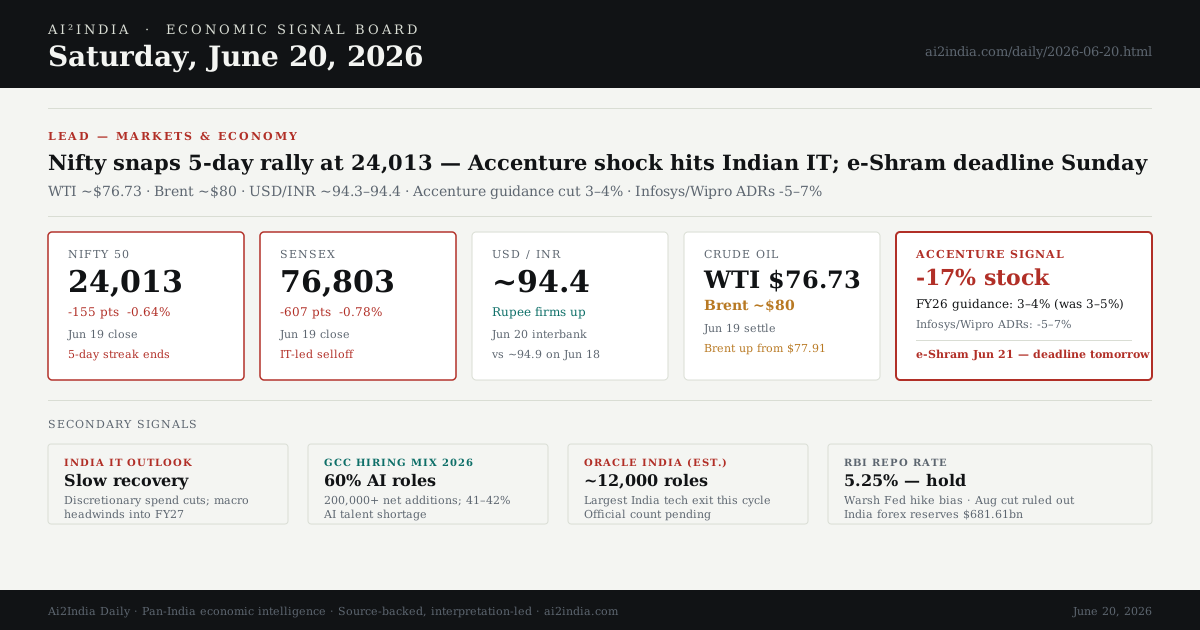
June 20 signal board: Nifty 24,013 five-day streak ends; Accenture cuts guidance to 3–4%; e-Shram deadline Sunday; Brent ~$80; USD/INR ~94.4
Today’s economic signal board. Full analysis in the Daily Edition.

Five Things That Changed

Friday’s session and Saturday morning produced a decisive end to the five-day rally, a major global IT signal from Accenture, a rupee firming, a Brent crude rebound, and an e-Shram enforcement test arriving with no extension in sight.

SignalData PointReader ImpactStatus
Five-session equity rally snaps: Nifty 24,013, Sensex 76,803 — IT selloff breaks the streakThe Nifty 50 closed Friday June 19 at 24,013.10 (‑154.90, ‑0.64%) and the Sensex at 76,802.90 (‑607.08, ‑0.78%), snapping the five-day winning run that had taken the Nifty from below 23,900 on June 13 to a Thursday high of 24,168. The Friday decline was led by IT stocks after Accenture’s guidance cut spooked global IT services investors (Economic Times; The Hindu; HDFC Sky; Business Standard, June 19). Broader market breadth was mixed — advancing stocks outnumbered decliners in some sources, suggesting the damage was concentrated in the IT index rather than broad-based. For the full week (June 15–19), the Sensex was still up approximately 1.7% and the Nifty held positive territory, so the weekly close remains constructive despite Friday’s reversal.A single-session correction after five straight gains is normal and expected, particularly when triggered by a clear external catalyst (Accenture guidance). The question is whether Friday’s Accenture-induced de-rating of IT multiples is a one-session event or a sustained re-pricing of Indian IT services earnings expectations. If Indian IT management commentary in July earnings echoes Accenture’s “slow recovery” language, the multiple compression will persist. For equity investors: the broader market tone remains constructive (Nifty above 24,000; weekly gains intact); the IT-specific risk is the watch item. Domestic themes — financials, industrials, consumption — remain better insulated from the Accenture read-across.Verified (ET; The Hindu; HDFC Sky; BS; Jun 19 close)
Accenture cuts FY26 revenue guidance to 3–4% — bellwether negative for India ITAccenture reported Q3 FY26 results on June 18 and narrowed its full-year revenue growth guidance from 3–5% to 3–4% in local currency. Q4 FY26 revenue guidance of $17.75–18.4 billion came in below the Street’s consensus estimate of approximately $18.47 billion. Accenture shares fell 17–19% intraday — among the steepest single-day declines in recent quarters. Bookings were soft: new bookings down 2% in USD terms and 3% in local currency. Management attributed the weakness to cautious discretionary tech spending and macro uncertainty (Times of India; Economic Times; Livemint; Bloomberg, June 18–19). European peer Capgemini fell approximately 8.4% in sympathy. Infosys ADR fell 5–7%; Wipro ADR similarly. CLSA noted the weakness reflects macro demand softness rather than AI model disruption — implying Indian IT faces the same cyclical headwinds. Ambit Institutional Equities described it as a “negative read-across” for Indian Tier-1 IT demand prospects into FY27 (ET, June 19).Accenture is historically one of the most reliable early indicators for the global IT services demand cycle. A guide-cut here — particularly in bookings — typically presages softer revenue growth commentary from TCS, Infosys, Wipro and HCLTech in their July Q1 FY27 results. The magnitude of Accenture’s stock reaction (‑17–19%) reflects how much the market had priced in a faster demand recovery. For Indian IT sector investors: expect elevated volatility and potential earnings-estimate cuts across Tier-1 names ahead of July results. For IT jobseekers: the Accenture signal adds to structural hiring pressure in legacy IT services; the GCC AI-role wave remains the counterpoint but requires different skill-sets. The story is that macro/geopolitical headwinds are outweighing AI investment tailwinds for large-cap IT services.Verified (TOI; ET; Livemint; Bloomberg; Jun 18–19)
e-Shram June 21 deadline holds — no extension announced as of Saturday morningAs of Saturday June 20 morning, the Ministry of Labour and Employment has issued no notification extending the June 21 e-Shram gig-worker registration deadline. Major platforms (Swiggy, Zomato, Uber, Ola, Rapido, Blinkit, Zepto and others) had formally requested an extension citing API integration and operational complexity (Business Standard, June 18). Amazon India is the notable exception, having confirmed compliance readiness (June 18). The absence of an extension notification as of Saturday means the deadline technically stands for Sunday. Worker unions (IFAT and others) have publicly called for strict enforcement. Section 133 of the Code on Social Security, 2020 provides for penalties on non-compliant aggregators. A government enforcement action or formal extension notice on Sunday will be the key regulatory signal for the week.Sunday is now the pivot point for India’s gig-worker regulatory architecture. If the government initiates penalty proceedings against non-compliant platforms on or after June 21, it will be the first real enforcement test of the Code on Social Security gig-worker provisions — and will dramatically raise the regulatory credibility of the entire framework. If the government grants an extension — even quietly — it signals administrative flexibility over enforcement rigour. For the 12–15 million gig workers on Indian platforms: no direct action required; the registration obligation rests with aggregators. For platforms: the compliance window has effectively closed without an extension; legal teams will be active. Watch for MoLE notification on Sunday morning.Verified — Business Standard June 18; TOI; SCC Online; June 20 no extension
USD/INR firms to ~94.3–94.4 — rupee strengthens from June 18’s ~94.9The rupee firmed to approximately 94.3–94.4 on the interbank market on Saturday June 20, according to multiple rate trackers including dollarrupee.in (94.31), XflowPay (94.33), and Investing.com (94.42), with MTFX showing ~94.5. This represents a meaningful reversal from the June 18 intraday level of ~94.9, which had reflected post-FOMC dollar firmness. The firming is consistent with: (a) the RBI’s NRI deposit rate deregulation (FCNR(B) and NRE ceilings lifted from June 17), which has begun to attract inflows as banks offer 6–7%+ rates; (b) a mild softening in the DXY as global risk appetite adjusted post-Accenture; and (c) WTI crude remaining in the $76–77 range, which keeps India’s current-account position supportive.A rupee at 94.3–94.4 versus the June 18 level of 94.9 is a 50–60 paise strengthening move — meaningful and a positive signal for the RBI’s capital-account strategy. If this level holds into the coming week, it suggests the NRI deposit deregulation is doing its job of attracting inflows. For importers: a sub-94.5 rupee is comfortable; the 95–95.5 risk scenario (from post-FOMC dollar strength) is slightly less likely given the current firming trend. For IT exporters: a stronger rupee is a mild earnings headwind for IT companies reporting in INR, adding to the Accenture-triggered demand concern.Verified (dollarrupee.in; XflowPay; Investing.com; MTFX; Jun 20)
Brent crude rebounds to ~$79–80/bbl — significant upward move from June 18’s $77.91Brent crude settled around $79.46 per barrel on June 19 per TradingEconomics, with Business Insider quoting $80.57 intraday. WTI was approximately $76.73/bbl (TradingEconomics; Investing.com India). This represents a notable Brent rebound from the June 18 settlement of $77.91 — a move of roughly $1.50–2.50/bbl in one session. The Brent–WTI spread has widened somewhat, suggesting supply-logistics and regional factors (potentially Middle East premium repricing). WTI remains in the $76–77 range — still $3–4 below last week’s pre-Iran-deal levels — so India’s import-bill relief is largely intact. The Indian Basket (Oman–Dubai–Brent average) is likely tracking in the $78–80 range, which is comfortable for the current-account outlook but worth monitoring if Brent sustains above $80.India’s June 2026 crude advantage is still intact: the Indian Basket at $78–80 vs the ~$83–85 prevailing before the US–Iran peace deal represents significant import-bill savings. However, the Brent rebound from $77.91 to ~$80 narrows the relief margin and may modestly push up the June WPI Fuel & Power reading (due mid-July). If Brent sustains above $80 and approaches $85, the RBI’s comfortable room for a future rate cut would narrow — but this is not the base case at current levels. Watch for the Indian Basket official price (PPAC) for the most accurate India-specific crude read.Verified (TradingEconomics; Business Insider; Investing.com India; Jun 19)

Data Variables Ledger

Numbers first, interpretation second. Updated on June 20, 2026; market figures are Friday June 19 close (latest available at publication).

VariableLatest ReadingPeriodSource TypeEditorial Read
Nifty 5024,013.10 (‑154.90, ‑0.64%)Jun 19, 2026 closeET / The Hindu / HDFC Sky / Business StandardFive-session rally snapped; IT-led selloff on Accenture guidance; 24,000 holds; 24,500 remains next target
Sensex76,802.90 (‑607.08, ‑0.78%)Jun 19, 2026 closeET / The Hindu / HDFC SkySharp IT drag; weekly still positive (~+1.7%); domestic-theme stocks more resilient
USD / INR~94.3–94.4 (Jun 20 interbank)Jun 20, 2026dollarrupee.in; XflowPay; Investing.com; MTFXRupee firms from Jun 18’s ~94.9; NRI deposit inflows + mild DXY softening; positive RBI capital-account signal
WTI Crude~$76.73 per barrelJun 19, 2026TradingEconomics; Investing.com IndiaSteady in $76–77 range; India import-bill relief intact; next support $74–75
Brent Crude~$79.46–$80.57 per barrelJun 19, 2026TradingEconomics; Business InsiderMeaningful rebound from $77.91 on Jun 18; Brent–WTI spread widening; monitor if Brent sustains above $80
Accenture FY26 guidance3–4% revenue growth (narrowed from 3–5%); Q4 guide $17.75–18.4bnReported Jun 18, 2026Times of India; ET; Livemint; BloombergBearish read-across for India IT Tier-1; bookings down 2–3%; July Q1 FY27 commentary is the next key watch
Accenture stock reaction‑17–19% intraday; Capgemini ‑8.4%; Infosys ADR ‑5–7%; Wipro ADR ‑5–7%Jun 19, 2026Livemint; ET; TOISector-wide repricing; CLSA: macro demand, not AI disruption; Ambit: negative read-across for FY27 demand
FOMC target range3.50–3.75% (hold; dot plot: ~3.8% end-2026)Jun 17, 2026 FOMCCNBC / WSJ (carry-forward)Unanimously held; hike bias intact; August RBI cut effectively ruled out; October MPC is first live rate-change window
India CPI (recent)~2.1% (77-month low) / Apr 2026: 3.48%Recent monthlyIndian Express / RBI (carry-forward)At trough; RBI FY27 forecast 5.1%; Brent rebound adds modest upward pressure on June WPI Fuel & Power
India WPI (May 2026)9.68% YoYMay 2026 (provisional)Ministry of Commerce (carry-forward)Fuel & Power 30.33% under new 2022–23 base; Brent rebound to $80 modestly narrows June easing expectation
RBI repo rate5.25%Jun 5, 2026 MPCRBIOn hold; neutral stance; Accenture signal adds global demand caution; next live window is October MPC
RBI FY27 GDP forecast6.6% (cut from 6.9%)Jun 5, 2026 MPCRBI (carry-forward)Solid growth; Accenture signal does not directly alter domestic demand trajectory
Bank credit growth (YoY)9.6% YoY as of June 13, 2026 (RBI fortnightly)Jun 13, 2026Financial Express; India Infoline / RBIUptick from a three-year low in late May; FY26 full-year: ~15.9% YoY growth to ₹213 lakh crore; MSE credit up 19%
Personal loan growth12.9% as of end-March 2026End-March 2026RBI (carry-forward)Consumer credit moderating; consistent with hiring stress and tech-sector caution
Active India tech job openings~93,000 (-14% MoM, -17% YoY)June 2026Xpheno (carry-forward)28-month low; Accenture signal adds global demand headwind; no reversal in sight for legacy IT roles
GCC new-role AI share (2026)60% of new GCC roles tied to AI, data, platform engineeringJune 2026ET / Moneycontrol / Business Standard41–42% AI talent shortage; the GCC AI surge is the structural counterpoint to legacy IT demand softness
GCC net headcount additions (2026 projection)200,000+ net; mid-sized GCCs: ~40,0002026 calendar yearTOI / ET / Colliers (carry-forward)GCC boom continues independently of Accenture’s IT services demand signal — different client and function profiles
Oracle India layoff estimate~12,000 roles (within global ~30,000)Jun 2026 (carry-forward)Mint / LiveMintLargest single India tech layoff this cycle; official confirmation pending
Nokia India potential impact~3,000+ roles (~20% of ~17,000) — watchlist2026 phased programSightsInPlus / Moneycontrol (carry-forward)Watchlist only; Nokia has not disclosed India count; program runs through end-2026
Active India tech jobseekersOver 56,000 from 20 major companiesJune 2026Xpheno (carry-forward)Fourfold increase from ~12,000 a month ago; Accenture signal adds macro demand caution on top of structural displacement
e-Shram gig registration deadlineJune 21, 2026 — tomorrow (no extension as of Jun 20)ActiveMoLE directive; Business Standard; TOI; SCC OnlineGovernment has not announced extension; Amazon compliant; other platforms reportedly not ready; enforcement test Sunday
India forex reserves$681.61 billion (week ended Jun 5)Most recent RBI releaseKNN India / Business Standard / RBISlight dip from prior week; ~11 months import cover; RBI has adequate buffer for moderate currency defence
RBI NRI deposit rate cap removalFCNR(B) 3–5 yr; NRE 3-yr-plus ceilings liftedEffective Jun 17–Sep 30, 2026ET / RBI notification (carry-forward)Banks offering 6–7%+; driving June 20 rupee firming; NRI inflow pipeline building; $40–50bn potential FY27 (MUFG)

Verified Layoff Radar

No new verified India layoff items today. Accenture’s global guidance cut is a watchlist-level signal — not a disclosed India layoff — but raises the risk of H2 2026 restructuring at India-heavy IT services operations. Nokia India and HCLTech (Xerox BPM) remain watchlist-only.

CompanyClassificationIndia CountTimelineStatusSource
OracleLarge-scale restructuring — India hubs affected~12,000 estimated (global: ~30,000, ~18% of workforce)Separation dates Jun 1–15, 2026; Bengaluru, Hyderabad, PuneVerified India (Mint estimate; Oracle has not officially confirmed country breakdown)Mint / LiveMint
OpendoorIndia operation shutdownAbout 250Reported Jun 11, 2026Verified IndiaEconomic Times / Times of India
TCSNet workforce changeHeadcount down 23,460 in FY26 to 584,519; no fresh June layoff programme disclosedAGM Jun 9, 2026Official workforce changeTOI / ET
TCSHiring slowdown signalMass-scale hiring model being reset; no layoff plan statedAGM Jun 9, 2026Verified signalTOI / ET
LinkedIn IndiaLayoff300–350 reported in IndiaMay 2026Verified IndiaEconomic Times
Adda247LayoffAbout 200–220May 2026Verified IndiaEconomic Times
OracleCampus-offer withdrawal / hiring slowdown50+ India offers reportedly revokedMay 2026Verified India hiring slowdownPriority publication reporting

June 20 Watchlist

Accenture India (new watchlist entry — forward risk): Accenture’s guidance cut (3–4% FY26 revenue growth; bookings down 2–3%) raises the forward risk of efficiency-driven restructuring at Accenture’s India delivery centres. Accenture has a substantial India footprint across Bengaluru, Hyderabad, Chennai and Pune. No India-specific workforce action has been disclosed. Stays watchlist-only pending any company announcement or corroborated India-specific report.

Nokia India (~3,000+ potential roles): No change from June 19. Nokia has not disclosed any India-specific count. Program runs through end-2026. Stays watchlist-only.

HCLTech (Xerox BPM): 170–200 employees at Noida potentially affected by Xerox BPM contract ramp-down. HCLTech declined to comment. Stays watchlist.

Cognizant: Most recent quarterly filing shows sequential headcount growth. No company-backed India layoff number. Stays watchlist.

Macro note: Accenture’s guide-cut signals that discretionary tech spending is not recovering as fast as hoped. Combined with the Warsh Fed’s hike bias (H2 2026), this creates an environment where MNCs with large India IT services and BPO operations will face continued cost discipline pressure through Q3–Q4 FY27. India-heavy functions in consulting, BPO and application management are most exposed. Watch July Q1 FY27 results announcements from TCS, Infosys, Wipro, HCLTech and Tech Mahindra for guidance signals.

Hiring Demand Watch

Accenture’s guidance cut is the most significant new negative for India IT services hiring this week. It reinforces the structural divergence: legacy IT services hiring contracts while GCC AI-specialist demand remains firm. The two trends are now moving in sharper opposition.

Sector / CategoryDemand SignalWage / Career ReadConfidence
Overall active tech job openings~93,000 in June 2026, down 14% MoM and 17% YoY (Xpheno) — a 28-month low. Accenture’s signal adds global demand headwind; no reversal expected in near term.Supply surplus widens; downward pressure on generic IT roles; Accenture adds bellwether caution for July–September hiring budgets at large IT services firmsHigh
GCC and MNC captive hiring — AI mix60% of new 2026 GCC roles linked to AI, data and platform engineering (ET/Moneycontrol/BS, June 2026). 41–42% AI talent shortage cited. This demand is independent of Accenture’s IT services signal — GCCs build product and platform capability, not consulting delivery.AI/ML, data engineering, cloud-native and platform architecture roles command the highest market premiums; shortage means negotiating leverage for strong specialist profiles. GCCs are the primary counterpoint to the Accenture-driven IT services contraction narrative.High
GCC net headcount 2026200,000+ net additions projected; mid-sized GCCs ~40,000. Target India lease (Jun 17): 830,000 sq ft, ₹1,250 crore — decade-scale GCC investment confirmed.The GCC boom is structural and AI-led; Accenture’s IT services guidance does not affect GCC expansion decisions, which are driven by global enterprise AI strategy, not consulting-project pipelinesHigh
IT services structural hiringIT hiring down 30.2% from Q1 2024 to Q1 2026; TCS net headcount down 23,460 in FY26; Wipro net down ~6,180; Accenture’s FY26 guide-cut signals H2 demand weaknessStructural multi-year decline; mid-level SDE roles down 11% in 12 months; Accenture signal suggests the demand floor is lower than previously hoped; not cyclicalHigh
India IT FY27 earnings riskAccenture bookings down 2–3% (new proxy for near-term demand); Capgemini ‑8.4% sympathy move; CLSA: macro/geopolitical demand softness, not AI structural collapse. Ambit: negative read-across for Tier-1 India IT FY27 revenue estimates.Expect Street to cut FY27 revenue growth estimates for Infosys, TCS, Wipro, HCLTech; margin assumptions under pressure; July results conference calls will be closely watched for deal pipeline and ramp commentaryHigh
Active India tech jobseekersOver 56,000 from 20 major companies actively seeking roles (Xpheno); fourfold increase from ~12,000 a month earlierAccenture signal adds macro demand caution on top of structural displacement; the demand-supply gap is likely to widen further into Q3 2026High
Entry-level / campus rolesDown 44% YoY (Xpheno); Oracle campus-offer withdrawals in May2026–27 graduates face the tightest entry-level market; Accenture signal will likely suppress campus hiring at consulting and IT services firms further into 2026High

AI Adoption Impact

Accenture’s guide-cut carries an important nuance: analysts (CLSA) confirm the weakness is macro demand softness, not AI structural disruption of IT services. This means AI is not yet fully cannibalising IT services revenue — but the AI investment tailwind is also not yet large enough to offset macro headwinds for large-cap IT.

AI Impact DimensionEvidenceTrajectory
Accenture signal: AI tailwind vs. macro headwindCLSA: Accenture’s weakness reflects macro and geopolitical demand softness, not AI model disruption. Accenture is still growing (3–4%) — AI is not replacing IT services revenue yet, but it is also not large enough to lift growth back to 3–5%+ (Livemint; TOI; ET, Jun 19). The AI investment thesis for IT services remains intact as a medium-term driver, but the near-term print is macro-constrained.↔ Neutral near-term; ↑ medium-term
GCC AI hiring concentration60% of new 2026 GCC roles in India tied to AI, data and platform engineering (ET/Moneycontrol/BS, June 2026). AI talent shortage 41–42% in key segments. This demand runs independently of IT services demand. GCCs buy AI capability, not IT services consulting delivery.↑ Accelerating
Enterprise AI strategy adoptionSAP study: 71% of Indian businesses have a defined AI strategy; AI handles ~33% of tasks today, projected 51% in two years; 55% of Indian organisations have dedicated AI leaders — highest share globally (carry-forward)↑ Accelerating
IT services delivery pivotTCS–Anthropic partnership formalises AI-first enterprise delivery; GCC leasing at all-time Q1 high (9.1 msf, 44% of total) confirms structural investment wave (carry-forward). Accenture’s guide-cut does not reverse these structural pivots.↑ Structural shift
Global firms building India AI capacityTarget India 830,000 sq ft GCC lease at Bengaluru Manyata (signed Jun 17): tech, analytics and retail supply-chain AI functions. T-Mobile India GCC (Jun 4): ~1,000 AI/cloud/network hires by 2027. Jabil–Adani AI/data-centre partnership: $50bn+ ecosystem (carry-forward)↑ Multi-year investment
AI adoption in corporate real estateTimes of India (Jun 2026): AI adoption in India’s corporate real estate has jumped from 5% to 91% in three years — the fastest adoption curve of any sector tracked. GCCs are driving demand for AI-ready Grade A office space with digital resilience infrastructure.↑ Rapid; 91% adoption rate
White-collar coordination roles at riskLivemint: experienced professionals and middle managers increasingly redundant as AI handles coordination tasks; TOI silent-layoffs warning: up to 50,000 India IT job losses by year-end; Accenture signal reinforces that macro headwinds are accelerating cost-discipline decisions↑ Widening gap

Real Estate Pulse

No new leasing transactions today. The GCC AI-adoption data and Target India’s ₹1,250 crore lease remain the standout signals of the week. Accenture’s guidance cut does not directly affect GCC leasing decisions (GCCs are captive investment vehicles, not consulting delivery centres), but could weigh on new GCC-entry decisions by US tech firms evaluating H2 2026 India investments.

SegmentLatest ReadingTrendNotes
Target India GCC — Bengaluru (Manyata)830,000 sq ft leased; ₹1,250 crore over 10 years; 15% escalation every 3 years↑ Verified June 17Business Standard / Livemint. Embassy Manyata Business Park. Single largest GCC transaction of June 2026. Accenture guidance cut does not affect this 10-year committed lease.
Office leasing across top 9 cities — Q1 202621.5 million sq ft (record Q1, +13% YoY); GCCs: 45.5% of demand (~10 msf)↑ Record (carry-forward)Zee News / CBRE Q1 2026. AI adoption in corporate real estate jumped from 5% to 91% in 3 years (TOI, June 2026).
GCC rents (Q1 2026)Delhi-NCR: ₹105/sqft/mo (+15% YoY); Bengaluru: ₹100.6 (+7%); Pune: ₹80.9 (+5%)↑ Rising (carry-forward)83% of Q1 2026 GCC leasing into green-certified tech parks.
Full-year 2026 GCC office outlookColliers projects 60–65 msf additional GCC leasing in 2026–27; 2,100+ GCCs active; $64.6bn annual revenue↑ Bullish (forecast)Multi-year structural demand. State incentive policies accelerating pipeline into tier-II cities.
Forward watchAccenture signal: US-headquartered tech firms that use India for IT services delivery (not captive GCCs) may pause discretionary India office expansion in H2 2026. New GCC-entry decisions (vs. existing GCC expansions) most at risk. Target India’s 10-year lease is insulated.↓ Medium-term risk for new entrantsNot yet in leasing data. Watch Q3 2026 GCC leasing for first signs of Accenture-signal ripple.

Credit and Banking Watch

Bank credit growth has picked up to 9.6% YoY in the June 13 RBI fortnightly data, rebounding from a three-year low in late May. The Accenture signal is not a direct credit catalyst but adds to the cautious corporate-spending environment that has been moderating personal loan and retail-credit growth.

Credit MetricLatest ReadingTrendRisk Assessment
Bank credit growth (YoY)9.6% YoY as of June 13, 2026 (RBI fortnightly data)↑ Uptick from three-year low (carry-forward from Jun 19 data)Improvement from sub-8% in late May; MSE credit up 19% YoY; full-year FY26 credit growth: ~15.9% YoY to ₹213 lakh crore. Credit growth is recovering but remain moderate; the June 5 rate cut transmission is working.
FOMC federal funds rate3.50–3.75% (hold); dot plot: ~3.8% end-2026↑ Hike bias (carry-forward)Warsh Fed’s hawkish posture is the primary external constraint on RBI rate policy. August MPC cut ruled out. Next re-assessment: October MPC, conditional on FOMC tone by September. Accenture signal is a mild additional constraint — slower IT services growth means less corporate credit demand from IT sector.
India CPI (recent)~2.1% (77-month low); Apr: 3.48%↓ At trough (carry-forward)CPI at a multi-year low provides domestic room for future easing, but Brent rebound to ~$80 adds modest upside risk to June WPI Fuel & Power. RBI FY27 forecast 5.1% — normalisation expected.
WTI crude / BrentWTI ~$76.73; Brent ~$79–80 (Jun 19)↑ Brent reboundingIndia import-bill relief intact; Brent above $80 sustained would narrow the current-account advantage and add modest CPI upside risk
RBI repo rate5.25%→ On holdUnchanged; next MPC: August 5–7 (likely hold). October MPC is first realistic rate-change window.
Personal loan growth12.9% as of end-March 2026↓ Moderating (carry-forward)Consumer credit slowing; consistent with caution in a tightening employment environment amplified by Accenture signal
RBI NRI deposit rate cap removalFCNR(B) 3–5 yr and NRE 3-yr-plus ceilings lifted; Jun 17–Sep 30, 2026↑ ActiveDriving June 20 rupee firming; banks offering 6–7%+; NRI inflow pipeline building; combined FY27 inflow potential ~$40–50bn (MUFG Research)
India forex reserves$681.61 billion (week ended Jun 5)→ Stable~11 months import cover; adequate buffer for moderate rupee defence; next RBI weekly data release will be the first post-FOMC read

Gig Economy Meter

The e-Shram June 21 deadline is now hours away. As of Saturday June 20 morning, the Ministry of Labour has issued no extension. Sunday’s government posture will be the most important gig-economy regulatory data point since the original compliance order was issued in May.

Gig DimensionCurrent StatusTrendReading
e-Shram deadline — June 21, 2026 (tomorrow)No extension announced as of Saturday June 20 morning. June 21 deadline formally stands. Major platforms (Swiggy, Zomato, Uber, Ola, Rapido, Blinkit, Zepto) had formally sought an extension citing API and operational complexity (Business Standard, June 18). Amazon India confirmed compliance readiness. IFAT and worker unions calling for strict enforcement. Penalties possible under Section 133, Code on Social Security, 2020.↑ Critical enforcement test — hours awayThe absence of an extension notice as of Saturday is itself a signal: the government has not publicly blinked. Two scenarios: (1) Ministry holds the line and initiates penalty proceedings against non-compliant platforms on Sunday — first real enforcement test of SS Code gig provisions, high regulatory credibility signal; (2) A quiet extension is issued Sunday — signals administrative flexibility, risks credibility and draws union opposition. Either way, Sunday is a regulatory milestone. Monitor MoLE notifications and platform official statements on June 21.
Registration scope and criteriaActive 90+ days on one platform or 120+ days across multiple; real-time or daily portal update required by aggregators→ DefinedAPI integration remains the primary technical challenge. An extension of 2–4 weeks would likely resolve this without substantive policy change. The benchmark question is whether the government is treating June 21 as a process milestone or a regulatory red line.
Social security benefit clarityIFAT and NITES unions pressing for disclosure: which specific benefits (ESIC, EPFO, PM Shram Yogi Maan-dhan) will flow to registered gig workers and on what timeline?↑ UnresolvedRegistration creates a database, not automatic benefit delivery. Unions are right to focus on benefit-delivery architecture — without funded operational schemes, registration is a compliance exercise rather than a welfare improvement for 12–15 million gig workers.
Gig-to-tech supply pressure56,000+ displaced tech workers actively seeking jobs; Accenture signal could accelerate IT-to-gig migration in H2 2026 if hiring remains contracted↑ Forward riskNot yet visible in gig wage data; 3–6 month lag from layoff to platform-worker supply increase is typical. Watch Q3 gig platform supply data.
Nokia / tech layoff spilloverNokia India (~3,000+, watchlist), Oracle India (~12,000), TCS headcount reset — cumulative exposure for Bengaluru, Hyderabad, Pune gig markets. Accenture adds to the forward risk pool.↑ Forward riskWatch for Q3 gig platform supply data; Accenture India workforce is a new medium-term watch item

Market Signals

Saturday June 20: five-day rally has ended. Markets absorb Accenture shock. e-Shram deadline is Sunday. Brent crude edges up. Rupee has firmed. The week’s final balance sheet: positive weekly close, negative Friday, and a new global IT-demand signal that will define Q1 FY27 earnings expectations.

IndicatorValuevs. Previous ReadingStatus / Trend
Sensex76,802.90 (Fri Jun 19 close)‑607.08 (Jun 19); was 77,409.98 (Jun 18)IT-led selloff; weekly still +~1.7%; domestic themes resilient
Nifty 5024,013.10 (Fri Jun 19 close)‑154.90 (Jun 19); was 24,168.00 (Jun 18)Five-day streak ends; above 24,000; 24,500 remains next target
USD / INR~94.3–94.4 (Jun 20 interbank)Down ~50–60 paise; was ~94.9 on Jun 18Rupee firmed; NRI deposit flows + mild DXY softening; positive RBI capital-account signal
WTI Crude~$76.73 per barrelApprox. flat; was $76.60 (Jun 18)Steady in $76–77 range; India import-bill relief preserved
Brent Crude~$79–80 per barrelUp from $77.91 (Jun 18) — ~+$1.5–2.5/bblNotable rebound; Brent–WTI spread widening; monitor if sustained above $80
Accenture FY26 guidance3–4% revenue growth (was 3–5%); Q4 guide $17.75–18.4bnNew signal (reported Jun 18)Negative read-across for India IT Tier-1; bookings down 2–3%; July earnings season is the next watch
FOMC rate (dot plot)3.50–3.75% hold; end-2026 median ~3.8%Hike bias (June 17 FOMC)August RBI cut ruled out; October MPC is first live rate-change window
India CPI~2.1% (recent low) / Apr: 3.48%77-month low recentlyAt trough; RBI FY27 forecast 5.1%; Brent rebound adds modest upside pressure
Active tech job openings~93,000‑14% MoM, ‑17% YoY28-month low; Accenture signal amplifies structural demand weakness in IT services
RBI repo rate5.25%Unchanged (Jun 5 MPC)On hold; next live window is October MPC
e-Shram deadlineJune 21, 2026 (tomorrow)No extension announced as of Jun 20Enforcement test Sunday; Amazon compliant; others reportedly not ready

Forecast Tracker Updates

Accenture’s guidance cut is the most significant new evidence for several active predictions. The IT services demand forecast is now materially more cautious. The market–hiring divergence prediction gets its clearest confirmation yet — the market corrected on Friday while hiring stress is unchanged.

PredictionCurrent ReadUpdate on Jun 20Status
AI and specialist roles will continue to outperform generic hiringStrongly supportedThe Accenture guide-cut sharpens the divergence: IT services generic demand is weakening further (Accenture bookings down 2–3%), while GCC AI-specialist demand (60% of new roles, 41–42% talent shortage) is untouched. The split between AI-specialist and generic IT demand is now backed by the most authoritative global IT services bellwether in the world.Active — Accenture signal strengthens thesis
Prime office corridors will stay firmer than broad labour sentimentStrongly supportedTarget India’s ₹1,250 crore 10-year lease holds as the anchor. Accenture’s signal introduces a medium-term risk for new GCC-entry decisions by US tech firms, but does not change the trajectory for already-committed GCC expansions. AI adoption in corporate real estate at 91% (TOI, June 2026) reinforces the long-run demand case.Active — medium-term risk flag added; anchor data unchanged
More restructuring stories will arrive with ambiguous India impactSupportedAccenture is now on the watchlist as a forward risk for India restructuring. Nokia watchlist holds. The Accenture signal is not a disclosed layoff, but a guidance cut of this magnitude historically precedes workforce efficiency actions within 1–3 quarters. E-Shram enforcement actions (if initiated Sunday) could add regulatory non-compliance proceedings to the ambiguity category.Active — Accenture added to watchlist
Gig-work income quality will become a bigger issue than total platform growthStrongly supportedThe e-Shram deadline test on Sunday is the most live version of this prediction. If the government enforces, the quality question (what benefits do registered workers actually receive?) immediately becomes the next news cycle. If the government extends, the quality question is deferred but not resolved. Worker union calls for benefit clarity (ESIC, EPFO, PM-SYM) are the on-the-ground signal that the income-quality issue is operational.Active — enforcement test Sunday
If crude stays below $90 and rupee holds near 95, market stress should unwind faster than hiring stressMixedWTI at $76.73, Brent at ~$80, rupee at 94.3–94.4 — all inside thesis parameters. But Friday’s market correction (-607 Sensex, -155 Nifty) on Accenture signal shows that hiring stress and market stress can temporarily converge on a common external trigger. The weekly close is still positive; the hiring stress (56,000+ jobseekers, 28-month low openings) is entirely unchanged. Market-hiring divergence is the baseline; Friday’s Accenture correction is a disruption, not a reversal.Active — Friday correction noted; thesis parameters intact
Active India tech hiring will keep contracting on a year-on-year basis through mid-2026Strongly supportedJune 2026 at 28-month low; mid-2026 contraction is now a completed fact. Accenture guide-cut suggests the bottom may extend further into Q3 2026 before any recovery signal. Watch Q3 2026 hiring data (July readings) for first reversal signal.Active — mid-2026 contraction confirmed; Accenture signal suggests Q3 bottom may follow
Sustained crude relief below $85 will give the RBI room to consider a rate cut at the August MPCEffectively closedBrent at ~$80 (up from $77.91) modestly narrows crude-side room. Warsh Fed dot plot (~3.8% end-2026) continues to close the August window. Confidence: 18% (down from 22%). October MPC remains the first realistic window. Prediction may partially reopen if Brent pulls back below $77 AND FOMC softens September tone.Active — confidence 18%; August cut effectively ruled out; October MPC is first window

Source Notes

Public links for the main inputs used in this edition.