Lead Analysis
OpenAI unlocks agentic commerce with ChatGPT Wallet
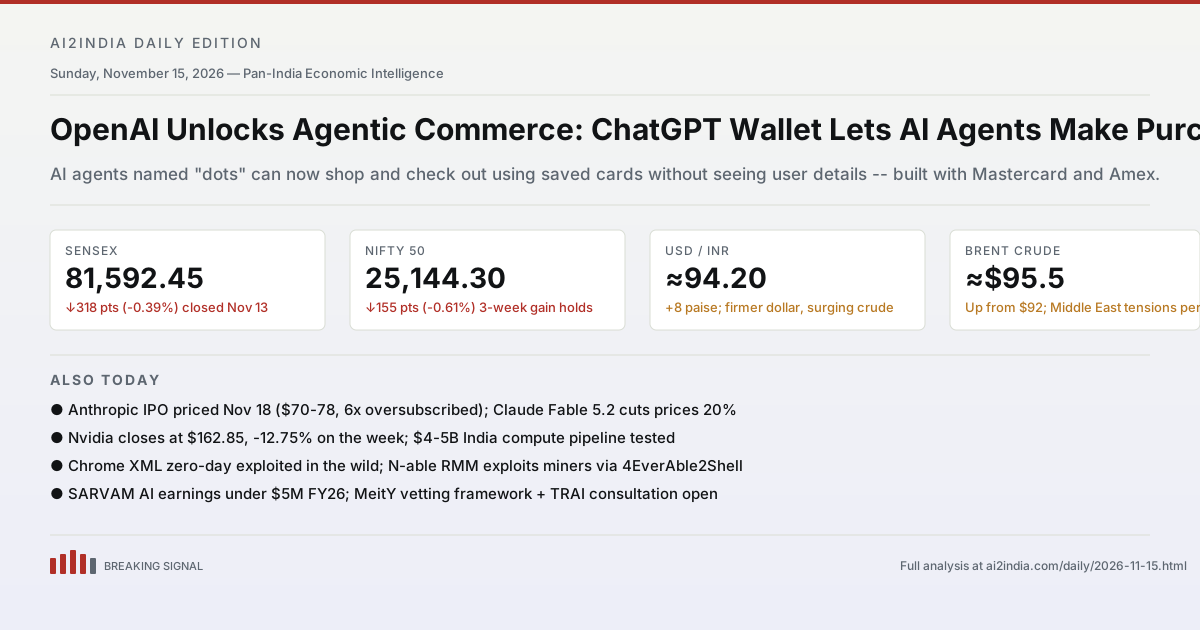
Sunday, November 15, 2026: OpenAI launched ChatGPT Wallet Thursday, letting its "dots" AI agents make purchases on behalf of users with saved payment cards, without seeing card details.
Built with Mastercard and American Express. Agents submit tokens through merchant checkout, preserving customer rewards and dispute protections. Rollout limited to US Pro subscribers 18+. A new product category: autonomous agent payments.
OpenAI announced ChatGPT Wallet on November 13, introducing a payment rail that enables its "dots" AI agents to transact autonomously -- finding items, submitting payment tokens through existing merchant checkout flows, and completing purchases without ever exposing the user's card details to the agent or the merchant. The feature was built in partnership with Mastercard and American Express, and preserves the cardholder's standard rewards and dispute protections so "an agent making a purchase should strengthen, not bypass the trust built into payments," as Mastercard's Sherri Haymond put it. The initial rollout targets ChatGPT Pro subscribers aged 18 and older in the United States with eligible U.S.-issued cards.
The implications for Indian enterprise are broader than a consumer convenience tool. Agentic commerce -- autonomous AI agents acting as shopping proxies or procurement bots -- represents a genuinely new category of AI application that touches the core infrastructure of fintech, e-commerce, and BFSI. Indian payment gateways, UPI-based checkout systems, and digital marketplaces will eventually need to interface with agent-to-agent and agent-to-human payment protocols. For Indian fintech firms and e-commerce platforms, the question is not whether to adopt agent-native payment rails but how quickly their systems can parse and process requests coming from non-human entities that operate outside traditional authentication models.
For enterprise procurement teams, the longer-term angle is equally significant: if an AI agent can negotiate, compare prices, authenticate merchants and execute transactions -- all without human intervention -- then automated procurement becomes feasible for routine spend categories. Indian IT services firms processing vendor management, GCC finance departments managing recurring software licenses, and even individual consumers purchasing cloud compute or API subscriptions could become early adopters once the feature expands beyond the U.S. market.
The current limitations matter too. The rollout is US-only, Pro-subscriber-gated, and focused on B2C-style purchases rather than enterprise-grade transaction workflows. There is no indication yet that agents can handle multi-party escrow, regulatory KYC checks, or cross-border currency conversions -- capabilities any serious enterprise deployment would require. But the path from "agent buys a book" to "agent manages corporate procurement" is shorter than most people assume, and OpenAI has demonstrated repeatedly that what launches as a consumer novelty often evolves into an enterprise capability within months.
In parallel, Anthropic priced its IPO for November 18 at $70-78 per share (up to $64.4B raise within a $90.4B total including secondary), with a 6x covered book debuting November 19 as ANT on Nasdaq -- the largest IPO in history by some measures. Anthropic's flagship model Fable 5.2 and companion model Mythos 5.2 shipped simultaneously at a 20% price cut to $8/$40 per million input/output tokens, while Google Gemini 4 Hydrogen extends the pricing floor. Meanwhile, Nvidia closed the week at $162.85, down 12.75%, reflecting ongoing uncertainty from Jensen Huang's resignation and the Megaspeed export-control scandal impacting India's AI-compute pipeline.