Lead Analysis
Nvidia's leadership reset tests India's AI compute pipeline
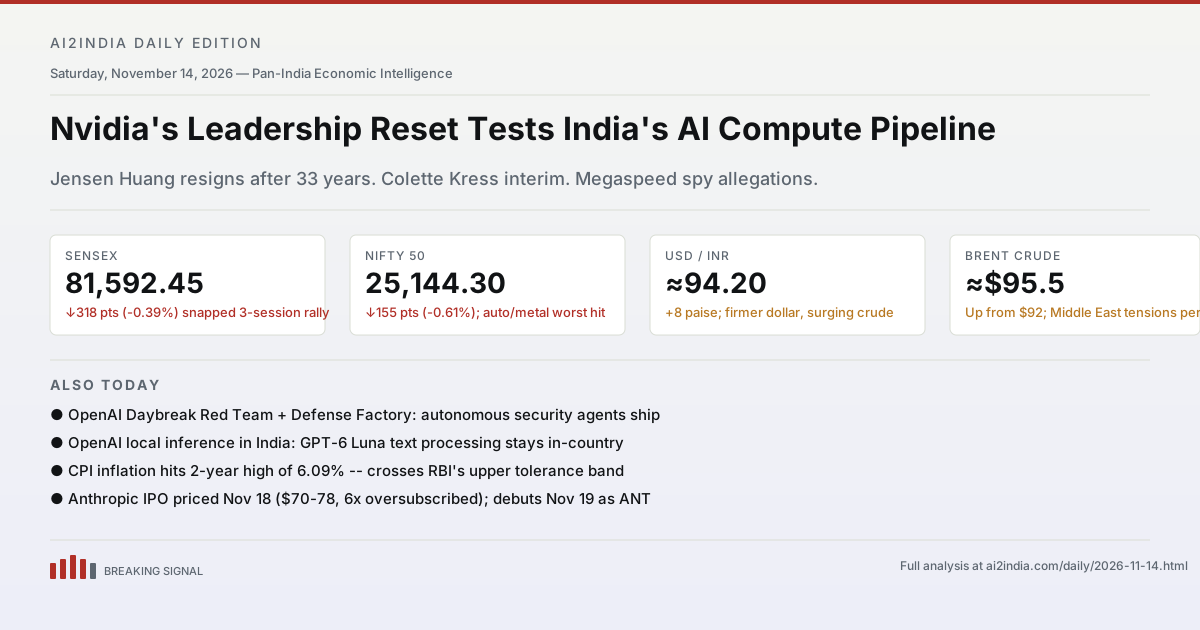
Saturday, November 14, 2026: Jensen Huang stepped down as president, CEO and board member after 33 years. CFO Colette Kress takes interim charge. India's AI compute build-out faces its first leadership test.
Megaspeed allegations put $7.5B in chip shipments in question. Yotta's 20,736-chip project timeline now uncertain. Huang summoned to testify before Congress.
Jensen Huang resigned as president, chief executive officer and board member of Nvidia on November 11, effective immediately, ending a 33-year tenure that transformed a graphics-card startup into the most consequential company in artificial intelligence. CFO Colette Kress has been named interim CEO while the board searches for a permanent replacement. The resignation follows escalating allegations about Huang's personal relationship with a woman linked to Megaspeed, a Singapore-based data-center firm accused of smuggling roughly $7.5 billion worth of Nvidia chips into China through export-control loopholes. Huang has been summoned to testify before Congress. Nvidia's stock was down approximately 4 percent when the news broke.
The implications for India are direct and material. Nvidia supplies the GPUs at the core of every major India AI infrastructure project: the IndiaAI Mission's 25,000-GPU compute clusters, TCS' Hyderabad data-centre project (Rs 70,000 crore), Yotta Infrastructure's 20,736-chip deployment, HCLTech's $1.48B Bhubaneswar AI DC with Sarvam, Microsoft's Hyderabad region and the dozens of regional DC builds feeding the neocloud ecosystem. The leadership vacuum introduces a period of schedule uncertainty -- Nvidia's announcement gave no revised delivery dates for any India project, and the Megaspeed controversy intensifies scrutiny on US export controls applied to India-facing supply chains.
Megaspeed bought more than $4 billion worth of chips from Nvidia according to CNN reporting, and The Guardian cited roughly $7.5B in chips allegedly smuggled into China. The scandal raises questions about how deeply US export-control compliance runs through the channel partners that service Indian data-center builders -- if a Singapore entity used the same procurement pipelines, Indian projects face both compliance audits and potential GPU allocation delays during the interim period.
Congressional testimony adds a further variable: any findings on export-control evasion would reshape the regulatory landscape under which Indian hyperscalers, GCCs and AI factories procure hardware. If the US tightens enforcement on intermediaries, Indian data-center builders relying on channel-partner GPU sourcing could see lead times extend beyond current forecasts. The interim leadership period means no new major deals are likely to be signed for several weeks, compounding the scheduling risk for projects already underway.
In parallel developments, OpenAI launched Daybreak Red Team and Daybreak Defense Factory (Thursday keynote by President Greg Brockman) -- autonomous AI agents that find web-application vulnerabilities and draft security patches -- opening a new category of automated penetration testing available to Indian enterprise security teams. Separately, OpenAI announced local API inference for Indian businesses (starting with GPT-6 Luna), enabling in-country data processing and moving closer to the AI-sovereignty goal that IndiaAI Mission advocates have long demanded.
Markets: Indian indices snapped their three-session winning streak Friday as CPI inflation hit a two-year high of 6.09% in October (food 8.94%), crossing RBI's upper tolerance band for the first time since October 2024. Sensex fell 318.56 points to 81,592.45 and Nifty dropped 155.05 points to 25,144.30; auto, metal and realty were worst hit. The rupee fell 8 paise to 94.20. Economists from Citi, Morgan Stanley and DBS flagged a further 25-50bp rate hike possible at the December MPC meeting. The Nvidia-led tech-sentiment shock arrived alongside the inflation worry as a double headwind for equities.