Lead Analysis
DeepMind’s AI makes 1024-bit RSA forgery ~1,600x cheaper: a crypto-agility moment
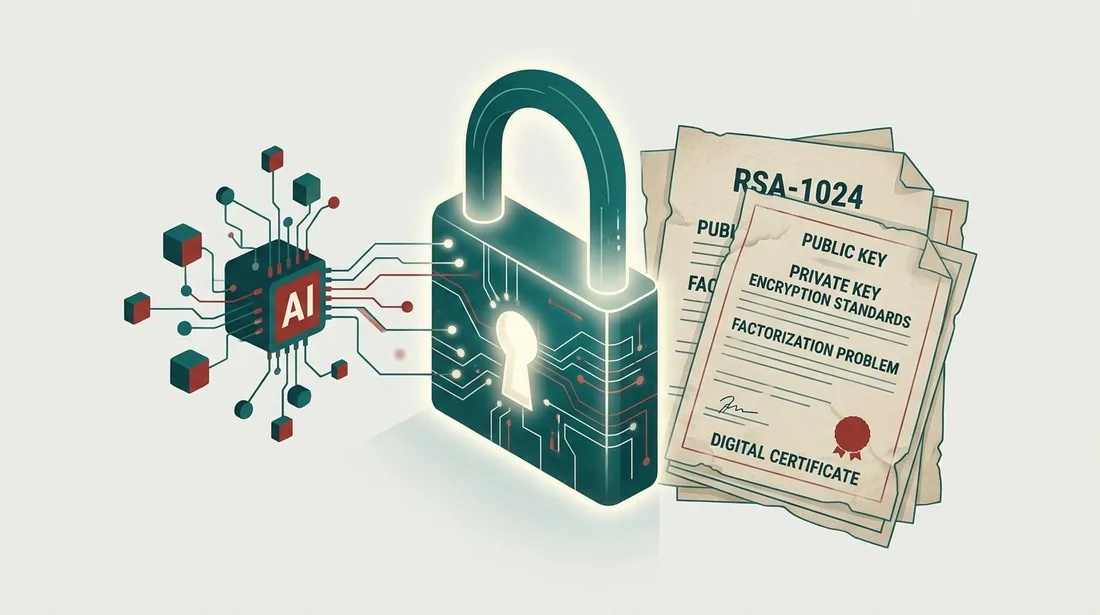
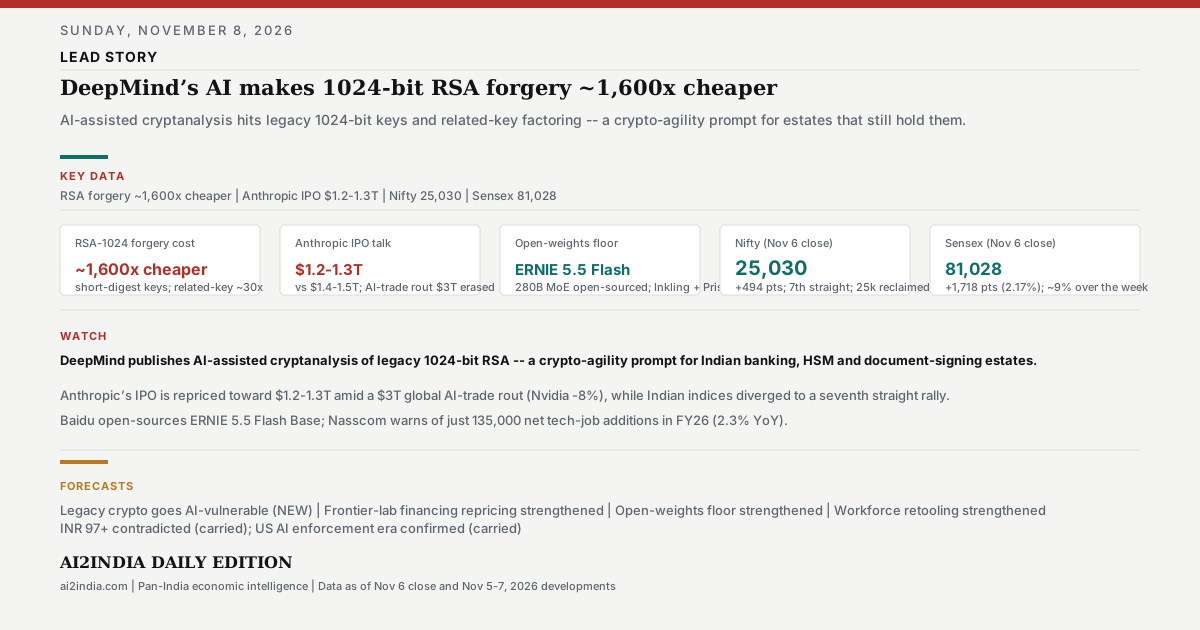
Sunday, November 8, 2026: Google DeepMind has published AI-assisted cryptanalysis that makes signature forgery against legacy 1024-bit RSA roughly 1,600x more efficient and cuts the marginal cost of factoring related keys by about 30x — a security-capability jump that argues Indian estates should retire 1024-bit certificates now.
Announced November 6 by Pushmeet Kohli and led by DeepMind researchers with cryptanalysts Nadia Heninger (UC San Diego/Inria) and Emmanuel Thomé, the work found two weaknesses simultaneously: a signature-forgery technique against short-digest 1024-bit keys and a batch-factoring algorithm for related keys.
This is the second week in a row in which a frontier lab has published AI-driven work aimed at production-grade security assumptions rather than a benchmark. DeepMind validated the approach in a sandboxed simulation against an already-solved RSA-1024 benchmark key, reproducing the result with 3.5x less CPU time. Keys of 2048 bits and above are not affected by this specific result — an important boundary for enterprises that upgraded correctly.
The 1024-bit RSA population is the real question for Indian planners. Although public PKI has largely moved to 2048-bit and SHA-256 signatures, 1024-bit keys persist in legacy banking interfaces, older HSM configurations, embedded payment terminals, document-signing pipelines and long-lived government contracts. The padding weakness reportedly bites hardest when an attacker controls roughly half or more of the signed block, so exposure is context-specific rather than universal.
Anthropic’s GPT-6 Cyber, released three days earlier, already demonstrated the allied direction: an offensive-security model that found 81 novel Firefox vulnerabilities and 948 Linux kernel flaws. DeepMind’s README-ing of the cryptanalysis is the defensive analogue — capability is compounding on both sides of the attack/defence line, and the realistic response for any security estate is faster crypto-agility, not a single patch.
For Indian enterprise the practical reading is a refresh of the legacy-certificate inventory: find every 1024-bit signing key and short-digest signature still in production, and qualify what the marginal cost of factoring-related-key batches now implies for HSM-backed key generation. This is a planning and governance item as much as a cryptography one — the work signals that long-lived asymmetric keys, wherever they sit, are worth an explicit lifecycle review.
The launch lands as the global AI-trade rout of November 5–6 — the S&P 500 fell 4.4% and erased roughly $3 trillion, with Nvidia down 8% in its worst week since April, on data-centre regulation risk after the Democratic midterm sweep — collided with India’s own rally. Indian indices diverged: Sensex +1,718 to 81,028 and Nifty +494 to 25,030 on November 6, a seventh straight advance. Frontier-lab financing is repricing (Anthropic’s IPO being discussed at $1.2-1.3T, down from $1.4-1.5T) even as capability accelerates, and that tension is the backdrop for any Indian buyer pricing multi-year AI commitments.