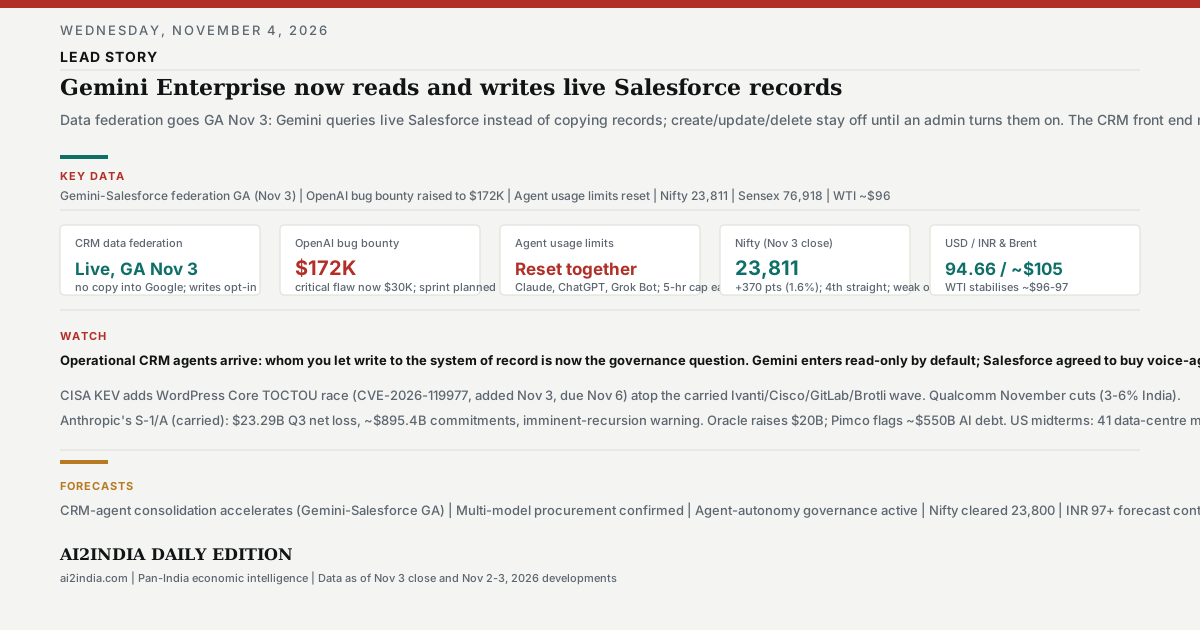
Gemini Enterprise now works on live Salesforce records — data federation goes GA
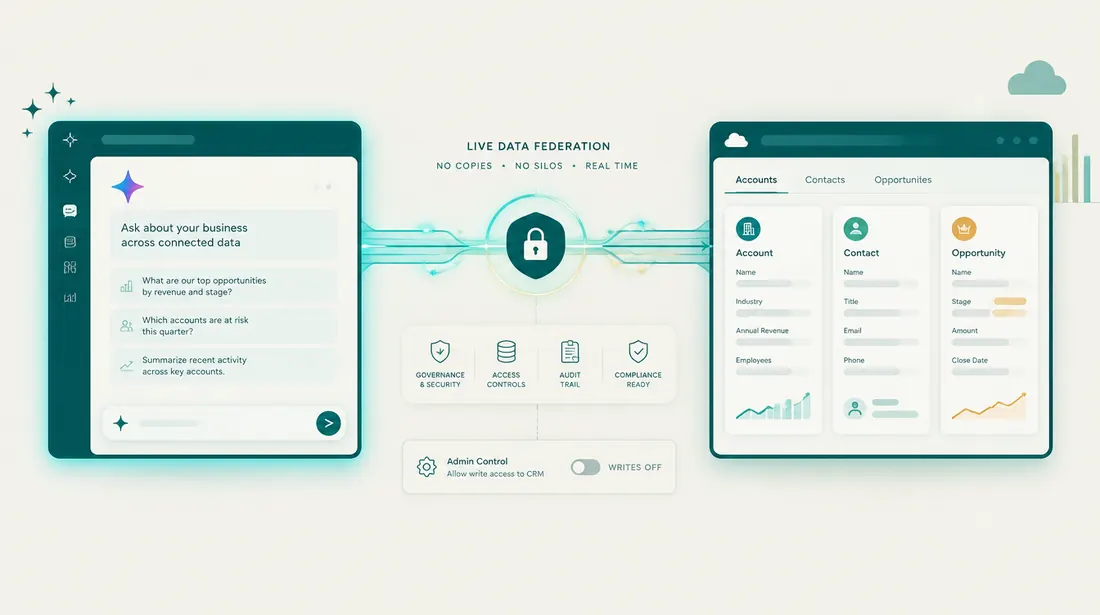
Gemini queries Salesforce live, no record copy to Google; create/update/delete off until admin enables; setup needs SObject All MCP server + Google connector from AppExchange; reads on by default; Microsoft had this first via Copilot for Sales (since 2024) |
Nov 3 (Google Gemini Enterprise release notes; Google Cloud docs; Salesforce blog; TechRepublic; The AIMarketingCollective): General availability of the Salesforce data-store connector for Gemini Enterprise. Data federation means each question hits Salesforce’s API directly; no copies into Google’s training data. Admin controls read/write scope per user. HubSpot version reached GA earlier in the year (June 29). Salesforce integration first appeared in Google’s release notes March 31. Google also made private network connections and fixed IP addresses GA Oct 27 for custom MCP servers. |
Salesforce has one of the largest deployment bases in Indian BFSI, telecom, retail, and GCC sales operations. An AI assistant reading and writing CRM data is a governance-relevant shift: the question of which assistant accesses the system-of-record and whether writes are permitted becomes a procurement and compliance decision alongside standard vendor due diligence. Indian IT services firms that implement CRM integrations will need Gemini-compatible architectures. |
(1) Audit your CRM-to-assistant policy now: define who may read, who may write, and which fields are off-limits before the pilot multiplies. (2) Require read-only rollouts with field history tracking enabled before enabling create/update. (3) Factor Gemini-compatible CRM integration into SI/consulting practice roadmaps. (4) Track Microsoft Copilot’s Salesforce integration (already in production at many Indian orgs) against the Gemini rollout. |
Verified global — Google Cloud docs; Salesforce blog; TechRepublic (Tier 1/2); Nov 3, 2026 |
OpenAI raises bug bounty to $30K/$172K — brings in Cathedral for security sprint
Critical ChatGPT, model-assisted testing tool, and API Platform flaws now pays up to $30,000; exceptional findings up to $172,000 with bonuses; plans next security sprint with security firm Cathedral; previous sprint used 25% of product engineers working on security weaknesses |
Nov 2 (CellCog; FourWeekMBA; YourStory; Unite.AI; shiftdelete.net): OpenAI more than quadrupled its bug-bounty midpoints. Exceptional critical findings in core products still eligible for up to $100,000 plus up to $172,000 when bonuses apply. The company is engaging Cathedral, a specialist security firm, to lead the next security sprint. In the prior sprint, 25% of product engineers worked on security weaknesses; they used its model-assisted coding platform itself to investigate reported issues, reproduce vulnerabilities in isolated test environments and prepare patches for review. |
The move reveals how mature frontier labs treat external vulnerability research as core infrastructure, not optional add-on. Indian enterprises consuming OpenAI APIs should note the engagement of a formal security firm and the company’s internal security-sprint cadence — these are leading indicators of the kind of vulnerability disclosures and service disruptions that affect downstream API availability and pricing stability. |
(1) Monitor OpenAI’S security-sprint schedule as a predictor of API stability windows. (2) Budget contingency for zero-day service impacts on agent workloads dependent on OpenAI endpoints. (3) Treat disclosed criticality categories as part of vendor risk scoring, especially if you rely on ChatGPT API or model-assisted tool integrations. |
Verified global — CellCog; YourStory; FourWeekMBA; Unite.AI (Tier 1/2); Nov 2, 2026 |
Agent usage limits reset across Claude, ChatGPT, Grok Bot
$200 Anthropic plan drops 5-hour cap for verified accounts; OpenAI adjusts ChatGPT Agent Plan and its model-assisted coding platform Platform limits; xAI tightens Grok Bot weekly pool; Musk confirms serving costs —unsustainably high relative to revenue— in Nov 1 concession |
Nov 3-4 (The AIMarketingCollective substack, published Nov 4 IST; Gizmodo; Startup Fortune; Reason Machines tracker): In four days, all three major agent platforms changed how they meter usage. Anthropic’s highest plan ($200/mo) removed the 5-hour temporary limit that applied to unverified accounts; OpenAI shifted ChatGPT Agent Plan and its model-assisted coding platform Platform allocations; xAI flipped Grok Bot’s weekly pool between 77% and 100% while Musk confirmed November 1 that serving costs exceeded revenue. Usage caps and quota-based pricing become the consumer-AI default. |
Indian enterprises pricing consumer-facing AI features must assume tighter usage caps will standardise across platforms within quarters. Consumer apps built on free-tier or generous-provisioned models should model quota ceilings into cost projections. For enterprise agent deployments, the reset clarifies that platform economics are shifting toward constrained, metered usage rather than unlimited consumption. |
(1) Rebaseline cost-per-interaction models for any consumer-facing AI feature. (2) Audit integrations dependent on high-volume free tiers; budget quota-based pricing scenarios. (3) Expect usage caps and rate limiting to be baked into future agent-platform offerings, not bolted on later. |
Verified global — The AIMarketingCollective; Gizmodo; Reason Machines (Tier 2); Nov 3-4, 2026 |
Salesforce signs definitive agreement to acquire Cresta
Voice agents that resolve inbound customer calls end to end; no price disclosed; closing expected Q1 fiscal 2028; live rep coaching also included |
Nov 3 (Seeking Alpha; usecarly): Definitive agreement signed with closing expected Q1 FY2028. Cresta’s platform provides voice agents handling inbound calls end to end plus live rep coaching -- a direct signal that contact-centre AI is consolidating into the CRM layer rather than remaining a standalone BPO tool. |
Contact-centre AI remains one of the largest near-term AI deployment categories in India (BPO/KPO, BFSI support, telco customer care). Salesforce’s acquisition of native voice-agents capacity signals where CRM-platform competition is heading -- and which Indian system integrators and GCC contact-centre practices need voice-agent skillsets fastest. |
(1) Map contact-centre AI roadmaps -- voice agents graduating from pilots to platforms. (2) For Indian SI/BPO practices, budget voice-agent enablement as a fiscal-2028 platform shift. (3) Expect price/feature consolidation as CRM vendors bundle native voice agents. |
Reported global — Seeking Alpha; usecarly (Tier 2); Nov 3, 2026 |
CISA KEV adds WordPress Core TOCTOU race condition (NEW entry)
CVE-2026-119977: TOCTOU race during core upgrade window; attackers can inject files into wp-content/upgrade; patched in WordPress 7.1.4 (Oct 28); added to KEV Nov 3, federal due date Nov 6 |
Nov 3 (CISA KEV catalog; HOL Guard threat campaign; windowsforum.com): WordPress’s brief upgrade window (the few seconds a site spends applying a core update) is exploitable via a timing attack to place malicious files. Patched in WordPress 7.1.4 released October 28. This is the first WordPress Core item added to CISA’s KEV catalog on this watch list -- SMB and media estates running PHP-hosted WordPress sites receive the same KEV-grade risk as enterprise appliances but with no dedicated patch window. |
WordPress powers a significant share of the Indian SMB web, agency-built corporate sites, and managed-hosting tenants. A TOCTOU exploit targeting the upgrade window affects anyone who delays patching 7.1.4. Immediate control short of patching: block HTTP access to wp-content/upgrade until patched. No CERT-In advisory located. |
Patch WordPress 7.1.4 immediately for any site running an earlier branch. If patching cannot happen immediately, block HTTP access to wp-content/upgrade as interim protection. Audit hosts for compromise indicators in the gap between the October 28 fix date and actual patch application. |
Verified exploited — CISA KEV (3 Nov); WordPress 7.1.4 (28 Oct); HOL Guard (Tier 1/2); Nov 3, 2026 |
Anthropic follow-up S-1/A: credit exposure deepens (carried from Nov 3)
Q3 net loss $23.29B (non-cash fair-value); $104B nine-month loss; QoQ growth decelerated to ~47%; compute +77% to $9.9B; adjusted margin 15% (~$895.4B commitments); RSP-imminent-threshold warning; investors push $1.5-2T ask |
Nov 2-3 (usecarly; CNBC; Fortune; SEC S-1/A; AI Weekly): Follow-up filing details unchanged since morning edition. IPO listing window confirmed week of Nov 16, Nasdaq, ANT. Jay Ritter statistic: 14 of 4,110 IPOs priced above $40/revenue-dollar returned below-market. Blackstone double-B junk expectation noted. Vendor-credit risk scorecard update still required for Indian enterprises on Anthropic APIs. |
Vendor-credit risk remains the primary India read-through: $104B nine-month losses (even non-cash), decelerating growth, self-improvement threshold disclosure. Multi-year pricing lock recommended before Nov 16 window. Governance boards approving autonomous agents face scrutiny questions from the recursion-threshold disclosure. |
Update vendor risk scorecards. Lock pricing/portability terms. Brief boards on RSP disclosure. Re-run unit-cost projections with margin-defence scenario. |
Verified global — SEC S-1/A; CNBC; Fortune (Tier 1/2); Nov 2-3, 2026 |
Oracle raises $20B; Pimco flags AI-debt ceiling (carried from Nov 3)
Oracle files to sell $10B stock + $10B senior notes; 2031 note yields 7.276%; shares -8.8% on filing day; five-year CDS 292 (+265% in a year; S&P BBB- July). Pimco CEO: ~$550B AI debt issued in 2026, —at some point it’s going to be too much— |
Nov 2-3 (CNBC: Oracle filing and share reaction; Pimco CEO Emmanuel Roman comments). The two-disclosure bracket around Anthropic’s S-1/A defines the AI-buildout financing model: vendor equity/debt at the hyperscaler level, lab-level commitment stacks, and rising cost of capital passing through to enterprise pricing. |
Every AI-infrastructure vendor’s financing cost is rising. Indian enterprises and GCCs consuming cloud commitments and managed-service pricing should model supplier price risk through FY27 as build-out financing costs increase. Expect more vendor equity/debt announcements of this shape. |
Track AI-vendor credit spreads as procurement inputs. Model supplier price risk. Review pass-through clauses for managed-infrastructure contracts. |
Verified global — CNBC (Tier 1); Nov 2-3, 2026 |
xAI: Grok Bot serving cost —unsustainably high— admitted (carried)
Musk confirms serving costs exceed revenue for flagship consumer bot; paid users burned through weekly pool early; xAI refused reset requests; weekly meter flips between 77% and 100% |
Nov 1-3 (Gizmodo; Startup Fortune; tbreak.com; Christopher Alarcon blog; reasonmachines.com): First public concession by a frontier consumer-bot operator that serving costs exceed revenue. Cursor forum reports indicate weekly meter oscillating unpredictably (77%-100%). Official X Subscription prices and usage multiples unchanged; exact limits unknown. |
Direct signal for Indian enterprises pricing consumer-facing AI: unit economics strain is real at frontier labs. Expect tighter usage caps, quota-based pricing, and higher per-interaction costs across consumer AI in coming quarters. |
Audit consumer-AI cost structures. Model quota-ceiling scenarios. Track whether other labs follow with usage limits. |
Reported global — Gizmodo; Startup Fortune; Musk on X (Tier 2/3); Nov 1-3, 2026 |
CISA KEV carry-forward: runtime/edge-wave (carried from Nov 3)
Ivanti chain (CVE-2026-111357/118527: Nov 2/Nov 13 deadlines), Cisco ASA SSL-VPN DoS CVE-2026-76418 (KEV Oct 29), GitLab RCE CVE-2026-97229 (1,000+ servers exposed), VMware ESX insufficient logging CVE-2026-41709 (Warp Panda China-nexus), Linux kernel CVE-2026-46300 (KEV Oct 28, CVSS 7.8), Brotli CVE-2026-111497 —Node2Shell— (KEV Oct 27, CVSS 9.2, Node.js/.NET/cloud), Adobe Commerce/Magento CVE-2026-48356 (KEV Oct 27, CVSS 9.3) |
Oct 27-Nov 3 (CISA KEV catalog synced Nov 3; Threat Radar mirror; aviatrix.ai CISA alert; CiberLATAM): Eight additions in 7 days. Wave extends from edge appliances into language runtimes (Brotli/Node2Shell hits Node.js, .NET, containerised cloud), Linux kernels, and SMB e-commerce (Magento). No new KEV additions observed beyond the WordPress CVE added today (see Section 2 above). |
Runtime/stack exposure complements the earlier appliance-layer wave: Node.js/.NET stacks, Linux kernels in cloud containers, and PHP via carried PHP2Shell entries. Exactly the substrate of Indian SaaS and e-commerce estates. |
Patch Linux kernels (46300), update Brotli/Node.js/.NET (111497), Adobe Commerce/Magento (48356), and all carried items. Treat KEV addition as patch trigger, not CVSS. Audit for prior compromise. |
Verified exploited — CISA KEV; Threat Radar mirror (synced Nov 3); Tier 1/2; Oct 27-Nov 3, 2026 |