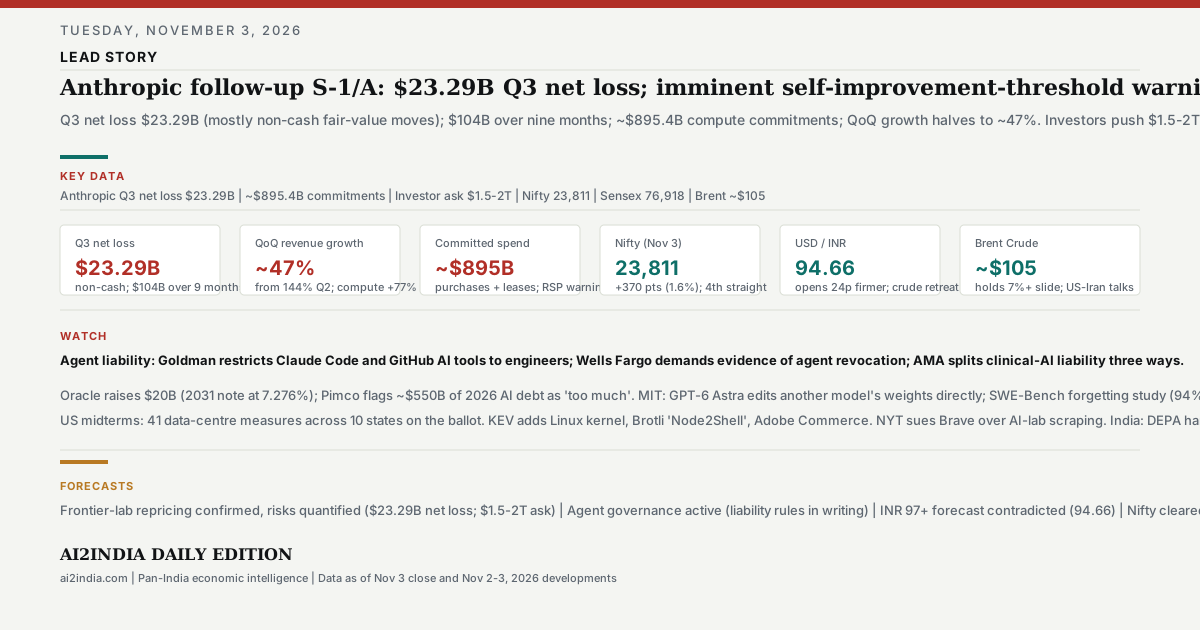
Anthropic follow-up S-1/A: $23.29B Q3 net loss, ~$895.4B commitments, imminent RSP-threshold warning
Q3 net loss $23.29B (and $104B across nine months, mostly fair-value changes on convertible notes/derivatives); QoQ revenue growth decelerates to ~47% (from 144% Q2, 132% Q1); compute expense +77% to $9.9B; adjusted operating margin 15% (from 19%); risk factors warn Anthropic may imminently meet its RSP definition of 'dramatically accelerated progress attributable to AI'; investors pushing for bottom of a $1.5-2T valuation range ($43-57 per dollar of $35.3B trailing revenue) |
Nov 2-3 (usecarly AI News; AI Weekly; CNBC; Fortune; Gizmodo; The Neuron; SEC Form S-1/A): The amended registration statement's second-day coverage added the net-loss figure ($23.29B in Q3, $104B over nine months -- non-cash fair-value revaluations, not operations), the ~$895.4B purchase-commitments-and-leases figure, and the risk-factor language on its own Responsible Scaling Policy threshold. Analyst commentary (CNBC, Fortune, Nov 3) notes quarter-over-quarter growth more than halved, compute spend keeps outpacing revenue, and IPO math at a $1.5-2T ask is unprecedented (Jay Ritter: 14 of 4,110 IPOs since 1980 priced above $40 per revenue dollar, and those returned 15.4% below the market). Listing window unchanged: week of Nov 16, Nasdaq, ANT. |
The flagship vendor story gains a credit dimension Indian enterprises must now model: $104B in nine-month net losses (even if non-cash) and decelerating growth against ~$895B of committed spend sit behind Anthropic API pricing. The RSP threshold disclosure is a governance signal too -- a lab telling the market it may soon cross its own self-improvement threshold will attract scrutiny that ripples into enterprise risk committees valuing agent autonomy. |
(1) Update the vendor risk scorecard: net-loss disclosure, ~$895.4B commitments, decelerating QoQ growth, adjusted margin slide. (2) Lock multi-year pricing and portability before the Nov 16 window; model a margin-defence price rise. (3) Add the RSP-threshold disclosure to governance briefings for boards approving autonomous-agent deployments. (4) Watch the final prospectus for India commercial terms. |
Verified global — usecarly; CNBC; Fortune; AI Weekly; SEC S-1/A (Tier 1/2); Nov 2-3, 2026 |
Wall Street and the AMA draw the agent-liability lines in one day
Goldman restricts Claude Code and GitHub AI coding tools to engineers only; Wells Fargo requires customers who revoke an AI agent to retain evidence of revocation; AMA splits clinical-AI liability three ways |
Nov 3 (The Decoder: Goldman Sachs pulls AI coding tools from traders and bankers; American Banker: Wells Fargo online access agreement effective Nov 24 adds an evidence-of-revocation clause, reportedly the first bank to demand proof; Healthcare Dive: AMA framework splits liability among physicians, developers and health systems): Goldman's spokesperson said the experimentation phase is over and access now goes to those best suited to leverage the tools long-term -- reversing July's CIO praise of non-technical staff vibe-coding prototypes. No incident or productivity comparison was disclosed. |
Three institutions in one day decided in writing who carries the risk when an AI agent fails. Indian BFSI and healthcare enterprises that pattern-match global peers will face the same questions -- access tiers for generative coding tools, audit trails for agent revocations, and vendor-vs-operator liability in procurement contracts -- ahead of any local incident. |
(1) Segment AI-tool access by role and record the policy, as Goldman did. (2) Design agent-revocation audit trails now; Wells Fargo's evidence clause points to the compliance standard. (3) Read the AMA framework before contracting clinical or regulated AI -- liability allocation belongs in the contract, not the incident. |
Verified global — The Decoder; American Banker; Healthcare Dive (Tier 1/2); Nov 3, 2026 |
Oracle raises $20B for AI buildout; Pimco names the AI-debt ceiling
Oracle files to sell $10B common stock + $10B senior notes; 4.95% note due 2031 yields 7.276%; CDS spread up 265% in a year; S&P cut to BBB- in July; Pimco CEO: ~$550B AI debt issued this year, 'at some point it's going to be too much' |
Nov 2-3 (CNBC: Oracle filing; shares fell 8.8% on the day, down 33% YTD; CNBC: Pimco CEO Emmanuel Roman at an event Tuesday set roughly $550B of AI-related debt issued this year against a $20T global corporate bond market, citing General Atlantic's Bill Ford on $10T of AI capex over five years): Oracle's filing is the same Monday as Anthropic's S-1/A -- the two disclosures bracket the AI build-out's financing model: equity raises and junk-adjacent debt at the vendor level, non-cash losses and commitment stacks at the lab level. |
Indian enterprises and GCCs consuming Oracle, Anthropic or any AI-infrastructure-adjacent vendor should read this as the sector's cost-of-capital marker. Rising AI-debt yields will harden terms across the supplier base -- support contracts, cloud commitments, and the pricing of infrastructure-heavy managed services. |
(1) Track AI-vendor credit spreads as a procurement input, not a finance footnote. (2) Model supplier price risk through FY27 as build-out financing costs rise. (3) For Indian IT services with Oracle-era managed contracts, review pass-through clauses for infrastructure cost increases. |
Verified global — CNBC (Tier 1); Nov 2-3, 2026 |
MIT CSAIL: a frontier model edits another model's weights by hand
GPT-6 Astra reads and rewrites Qwen3.5-0.8B's weights directly -- no optimizer, no gradient descent; MATH-500 7.9%→48.1%, GSM8K 13.8%→67.1%; rebuttals call it standard steering/abliteration; separate paper: self-evolving coding harnesses forget catastrophically (94%→32% SWE-Bench by round five) |
Nov 3 (MIT CSAIL researchers' weight-space programming blog; Sean Goedecke rebuttal; arXiv 2611.03219): GPT-6 Astra changed 131,072 of 819M Qwen3.5-0.8B weights (0.016%), repairing a looping failure rather than adding mathematics -- answers hitting the 32,768-token limit fell from 93.0% to 33.1%. The rebuttal argues the edit fits the standard steering and abliteration playbook. The forgetting paper found self-evolving coding harnesses degrade from 94.0% to 32.0% on SWE-Bench by the fifth evolution round. |
Weight-level programmability and catastrophic forgetting are both governance-relevant for Indian enterprises: the first feeds boardroom questions about frontier-model interpretability, the second is a concrete risk parameter for any team running self-improving agent/eval loops -- the failure mode makes continuous evaluation a deployment requirement, not a nice-to-have. |
(1) Add 'self-modification' and 'catastrophic forgetting' to agent-risk registers. (2) Require vendors to disclose whether deployed agents self-edit weights or loops. (3) Budget continuous eval regressions for any self-improving system; the 94%→32% SWE-Bench decay is the cautionary baseline. |
Research / reported — MIT CSAIL; arXiv; rebuttal blog (Tier 1/2); Nov 3, 2026 |
NYT sues Brave over scraping distributed to AI labs
Lawsuit calls Brave a 'supplier, dealer, and distributor of stolen copyrighted content' allegedly scraped and distributed to Anthropic, Perplexity, Mistral, xAI and Cohere |
Nov 2-3 (TechCrunch; usecarly): The New York Times and other outlets sued web browser Brave, alleging it scraped their pages and distributed the content to at least five AI labs. The suit extends the publisher-vs-AI content war beyond model makers to the distribution layer -- a browser as a scraping intermediary. |
India-relevant in two ways: Indian content platforms and publishers evaluating the shared robots.txt opt-out token get a live case study in distribution-layer liability, and Indian AI vendors using crawled corpora should re-audit their ingestion chains for exactly this exposure -- the suit names the labs that received the content as parties to the dispute. |
(1) Re-audit training/grounding data ingestion chains for scraped content. (2) For Indian news publishers, the shared robots.txt token is the immediate defensive control; legal action is the long tail. (3) Track the case as the distribution-layer test of the carried copyright-war forecast. |
Reported global — TechCrunch (Tier 1/2); Nov 2, 2026 |
Salesforce signs definitive agreement to acquire Cresta
Voice agents that resolve inbound customer calls end to end; no price disclosed; closing expected Q1 of fiscal 2028 |
Nov 3 (Seeking Alpha; usecarly): Salesforce and Cresta signed a definitive agreement, with closing expected in Q1 of fiscal 2028. Cresta's voice agents handle inbound customer calls end to end -- a direct read on how contact-centre AI consolidates into the CRM layer. |
Contact-centre AI is one of the largest near-term AI deployment categories in India (BPO/KPO, BFSI support, telco customer care). Salesforce's acquisition of an end-to-end voice-agent layer signals where CRM-platform competition is heading -- and which Indian system integrators and GCC contact-centre practices will need voice-agent skillsets fastest. |
(1) Map contact-centre AI roadmaps -- voice agents are graduating from pilots to platforms. (2) For Indian SI/BPO practices, budget voice-agent enablement as a fiscal-2028 platform shift. (3) Expect price/feature consolidation as CRM vendors bundle native voice agents. |
Reported global — Seeking Alpha; usecarly (Tier 2); Nov 3, 2026 |
Quick hits: DeepMind Genie 4; OpenAI Pando; malicious claude-code package
Genie 4 world model in limited research preview for testing agents/robots; OpenAI open-sources Pando, the Rust Git backend built in ten weeks (near a petabyte served a day); malicious Anthropic.claude-code 2.1.313 build identified in the Cursor Extension Marketplace |
Nov 3 (Rio Rundown; riorundown.substack: Google DeepMind released Genie 4, a limited research-preview world model that generates interactive environments for testing AI agents and robots; usecarly: OpenAI published Pando, its Rust Git backend built after Codex-driven parallel development pushed monorepo reliability below 90%; The AI Show/smarterx.ai: security notice -- a malicious version of Anthropic.claude-code (2.1.313) was identified in the Cursor Extension Marketplace): Genie 4 gives agent teams a synthetic-testing substrate; Pando is an infrastructure lesson in AI-augmented engineering (a rewrite in ten weeks); the claude-code package extends the carried AI-tool supply-chain category. |
The claude-code malicious-package notice is the most actionable for Indian developers: AI coding assistants are now a software-supply-chain surface. Genie 4 matters for Indian agent teams -- synthetic environments for agent testing are scarce. Pando is the coded example of the AI-augmented engineering productivity story Indian IT services sell to clients. |
(1) Verify Claude Code install provenance (hash-pinned installs) after the Cursor marketplace notice. (2) For Indian agent teams, evaluate Genie 4-class synthetic environments for regression testing. (3) Cite Pando's ten-week rewrite in client conversations on AI-augmented delivery -- but pair it with the SWE-Bench forgetting study as the counterweight. |
Reported global — Rio Rundown; usecarly; Cursor security notice (Tier 1/2); Nov 3, 2026 |
xAI: Grok Bot serving cost 'unsustainably high relative to revenue'
Musk says cost of serving Grok Bot is unsustainably high; paid users burned through the weekly usage pool early; reset request refused |
Nov 2 (Gizmodo; Startup Fortune; artificiallyintimidating AI Brief; explainx.ai): A user asked on X whether xAI could reset Grok Bot's weekly usage pool after paying users exhausted it early. Musk replied that "the cost of serving Grok Bot was unsustainably high relative to revenue." The admission lands days after Musk said AI makes saving money on Grok pointless (Gizmodo notes the contrast). It is the first time the operator of a frontier consumer bot has publicly conceded unit-economics strain on a flagship product. |
Direct signal for Indian enterprises pricing consumer-facing AI features: if a frontier lab with a massive installed base concedes serving costs exceed revenue, the same math applies to Indian SaaS and BFSI apps with high-frequency chat volumes. Expect tighter usage caps, quota-based pricing and higher per-interaction costs across consumer AI in the next two quarters. |
(1) Re-baseline cost-per-interaction models for Indian consumer AI features -- Grok-style economics suggest quota ceilings become standard. (2) Audit any integration that depends on high-volume free tiers. (3) Track whether other labs follow with usage caps; factor into vendor selection for customer-facing assistants. |
Reported global — Gizmodo; Startup Fortune; Musk on X (Tier 2/3); Nov 2, 2026 |
OpenAI publishes methods for detecting frontier-model misalignment
Research describes ways to identify when a capable AI system's behavior departs from its instructions or objectives |
Nov 2 (The Neuron digest; OpenAI research): OpenAI described methods for detecting frontier-model misalignment -- cases where a capable system's behavior departs from its intended instructions or objectives, including situations where ordinary output and evals look normal. The release is a safety-research contribution timed to the debate over autonomous agent deployment in enterprise environments. |
For Indian enterprises deploying agents with financial or customer-facing autonomy, model-misalignment detection is becoming a procurement box to tick. Regulated sectors (BFSI, healthcare, telecom) will face board-level questions about agent-monitoring capabilities as TRAI consultation on AI-incident reporting (see India AI Ecosystem section) proceeds in parallel. |
(1) Add misalignment-detection capability checks to your agent-vendor evaluation criteria. (2) Pair with the agent-permission governance requirements already flagged by the Cornell/Yale wallet-cap study (carried). (3) Budget for monitoring/observability tooling as a standard layer of agent deployments, not an optional extra. |
Verified global — The Neuron; OpenAI research (Tier 1/2); Nov 2, 2026 |
Fractile raises ~$700M at $6.5B for in-memory-compute inference chips
Companies House filings show ~$774M; Lightspeed, Redpoint, Thrive, UK Sovereign AI Fund; $250M Anthropic supply agreement; production data-centre deployment targeted 2027 |
Nov 2 (The National via aiweekly; Companies House filings): London-based Fractile closed roughly $700M at a $6.5B valuation (filings show ~$774M), up from ~$1B earlier in 2026. The in-memory-compute inference-chip startup, founded 2022 by Oxford roboticist Walter Goodwin, has yet to ship in volume but holds a reported $250M supply agreement with Anthropic and targets production data-centre deployment in 2027. The UK's £500M sovereign AI fund participated. |
A new capital lane in the inference-hardware race: sovereign-backed, pre-revenue chip startups now command $6.5B+ valuations on supply agreements with frontier labs. Indian inference providers and GCC build-outs should track this as a mid-decade supply option that could bypass the Nvidia-dominated import channel -- and as evidence that inference-specific silicon is where the next hardware premium concentrates. |
(1) Add inference-silicon alternatives (Fractile, Groq-class players) to your 2027 hardware roadmap as a hedge against Nvidia allocation risk. (2) Watch for Indian sovereign-fund and GIFT City participation in the category. (3) Re-baseline inference unit-cost projections; purpose-built silicon is slated to undercut GPU inference on price-per-token. |
Reported global — The National; Companies House filings (Tier 1/2); Nov 2, 2026 |
OpenAI, Google, Microsoft and Anthropic back shared robots.txt token for AI-training opt-out
Publishers get one token ('__usage_ai-training') to block AI training crawlers; Anthropic live now, Microsoft from Feb 1 2027, Google in 2027 |
Oct 31-Nov 2 (AI Weekly; robots.txt community): The four vendors agreed on a single, shared robots.txt directive letting publishers opt out of AI training with one token, with a training/grounding split for at least one major crawler. Anthropic's implementation is live; Microsoft is slated for February 1, 2027, Google later in 2027. The agreement standardises what had been a patchwork of vendor-specific tokens. |
Standardisation helps Indian content platforms, news publishers and enterprise knowledge bases negotiate and enforce training-data rights without vendor-by-vendor implementation. It also sharpens the data-provenance question as MeitY pushes the DEPA framework for consented AI training on Indian institutional data (see below). |
(1) Add the standard token to your robots.txt if you do not want your site in AI training corpora. (2) For enterprises licensing proprietary document bases, require contractual confirmation of crawler-opt-out respect. (3) Fold this into your data-governance checklist ahead of the DEPA handbook rollout. |
Verified global — AI Weekly; robots.txt.org (Tier 1/2); Oct 31-Nov 2, 2026 |
CISA KEV wave extends to runtimes and e-commerce: Linux kernel, Google Brotli 'Node2Shell', Adobe Commerce/Magento join the carried Ivanti/Cisco/GitLab/VMware set
New: CVE-2026-46300 Linux kernel uninitialized-variable flaw (KEV Oct 28, CVSS 7.8); CVE-2026-111497 Google Brotli out-of-bounds write, 'Node2Shell' (KEV Oct 27, CVSS 9.2, hits Node.js/.NET/containerised workloads); CVE-2026-48356 Adobe Commerce/Magento unrestricted file upload (KEV Oct 27, CVSS 9.3). Carried: Ivanti 111357/118527 chain (KEV Oct 30), Cisco 76418 SSL-VPN DoS (KEV Oct 29), GitLab 97229 RCE (1,000+ servers), VMware ESX 41709 (KEV Oct 28) |
Oct 27-Nov 3 (Threat Radar KEV mirror, synced Nov 3, catalog 2026.10.30; aviatrix.ai CISA alert on CVE-2026-111497; CiberLATAM on CVE-2026-46300; CISA): eight KEV additions in the last seven days, three of them previously unlisted on this page. The Brotli entry is the widest: a critical flaw in the compression library embedded in virtually every modern HTTP stack -- Node.js, .NET, containerised cloud workloads -- meaning Indian web estates patched the carried PHP2Shell wave but remain exposed through a different runtime layer. Adobe Commerce/Magento is the SMB e-commerce analogue of the carried WordPress-theme item. |
The wave now has a runtime/stack layer, not just an appliance layer: PHP (carried PHP2Shell), Node.js/.NET via Brotli, and Linux kernels in cloud containers -- exactly the substrate of Indian SaaS and e-commerce estates. SMBs running Magento storefronts get the same KEV-grade risk without enterprise patch windows. |
Immediate: patch Linux kernels in containers/hosts (CVE-2026-46300), update Brotli/Node.js/.NET stacks (CVE-2026-111497) and Adobe Commerce/Magento (CVE-2026-48356); apply the carried Ivanti/Cisco/GitLab/VMware fixes. Treat KEV addition as the patch trigger, not CVSS. Audit for prior compromise where exposure windows were open. |
Verified exploited — CISA KEV; Threat Radar mirror; aviatrix.ai; CiberLATAM (Tier 1/2); Oct 27-Nov 3, 2026 |