Lead Analysis
Anthropic opens its books: S-1 reveals $16.3B revenue and ~$650B compute bill ahead of Nasdaq debut
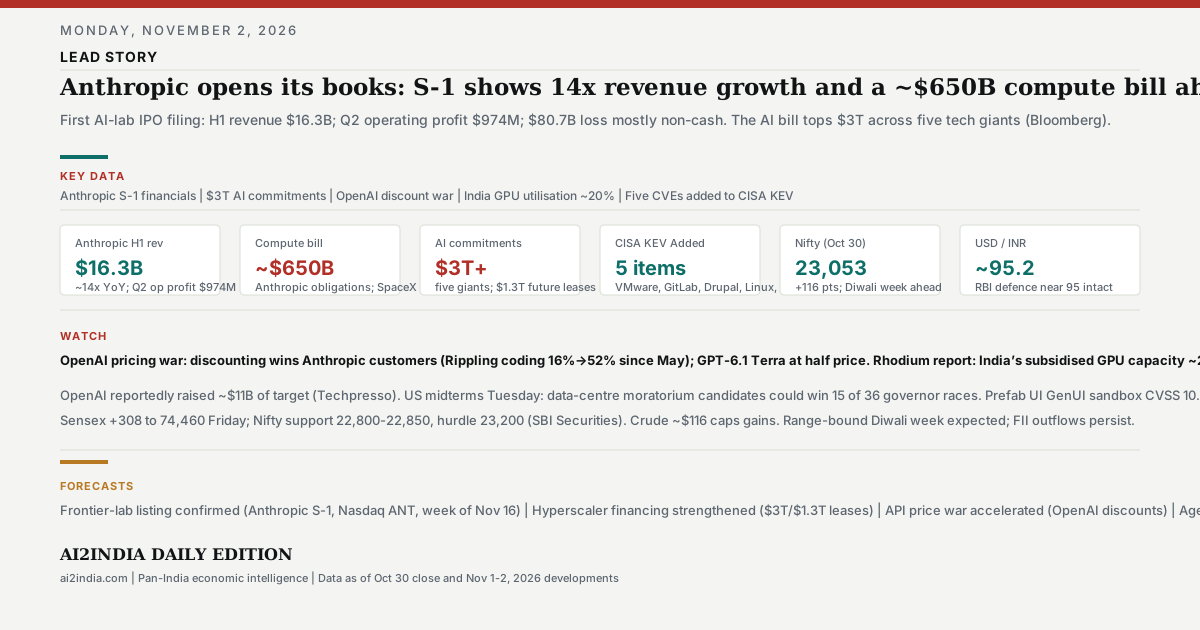
First AI-lab IPO filing shows H1 revenue up 14x, Q2 operating profit of $974M, and an $80.7B net loss dominated by a non-cash charge; listing targeted for the week of November 16.
Monday, November 2, 2026: Anthropic's S-1 -- publicly filed October 26 with Nasdaq ticker ANT and target listing week of November 16 per the Wall Street Journal -- provides the clearest look yet at frontier-lab economics: first-half revenue of $16.3 billion (up roughly 14 times year-on-year), a $974 million quarterly operating profit in Q2, an $80.7 billion net loss that is primarily a $72.4 billion non-cash revaluation, and approximately $650 billion in compute obligations. These disclosures come just one day after OpenAI trimmed its own funding round, making two sides of the same private-lab capital story simultaneously visible.
The compute obligations tell half the story on their own. Axios reported Anthimaly owes almost $650 billion; the publication AI Secret put its contracts between $518 billion and $807 billion. Bloomberg named Anthimaly SpaceX's largest customer, spending $3 billion per month on compute alone. Nvidia has already layered approximately $170 billion in credit support and investments across neocloud customers, effectively becoming a de facto lender to AI-infrastructure builders. The hardware vendor's credit stack now extends across Anthimaly's entire build-out pipeline, including a new 460-megawatt phase in West Virginia under its six-year roughly $45 billion deal.
This lab-level picture sits inside an industry-wide capital reckoning. On Saturday, Bloomberg counted more than $3 trillion in AI commitments across five tech giants -- Alphabet leading at over $1 trillion, Meta at $800 billion, Microsoft, Amazon and Oracle also deeply invested. Approximately $1.3 trillion represents future leases stretching up to 30 years. How they pay: Meta announced a $95 billion stock sale, Microsoft raised $25 billion through bonds (with $115 billion in demand), and Amazon exercised its right to borrow up to $80 billion against AI hardware. These financing structures -- bond sales, stock offerings, asset-backed borrowing -- mark a structural shift: AI buildouts are priced as leveraged debt rather than organic growth.
For Indian enterprise, the implications operate on three layers. First, cost transparency: a public SEC filing gives Indian buyers disclosed, auditable cost structures from a frontier model provider -- something impossible while Anthimaly remained private. Every Indian CFO and technology planner evaluating AI-vendor selection should fold this newly-available financial data into due diligence, and lock exit terms and data-portability clauses before competitors react. Second, valuation benchmarking: if Anthimaly lists at any meaningful fraction of its $1.5 trillion implied valuation, domestic labs -- Sarvam at roughly $389 million cumulative, Krutrim at $75 million -- face both opportunity (cheaper foreign competition) and pressure (lower fundability expectations). Third, the financing pattern itself: every hyperscaler capex wave is funded through leverage, which keeps cloud-services demand strong for Indian system integrators and GCCs while the market prices the debt load.
On the competitive front, the discount war intensifies. According to The Information, OpenAI is actively winning Anthimaly's former customers through aggressive pricing: Rippling's coding workload shifted from 16% to 52% on OpenAI models since May. OpenAI's new GPT-6.1 Terra costs half as much as the model it replaces, and the company merges ChatGPT and Codex usage into a single shared token bucket starting December. Meanwhile Gemini 4 Carbon scores 59 on the new Artificial Analysis index (vs Claude Opus 5.5 at 58 and GPT-6 Astra at 57) but remains behind a locked door accessible only to a subset of cyber defenders, carries an 11% hallucination rate on one fact test versus Argon's 4%, and doubles to $4/$20 post-launch.
Indian markets close out Friday's rebound -- Nifty at 23,053 (+116 points, +0.51%), Sensex at 74,459 (+308 points, +0.42%) -- and open today into Diwali week. Experts expect range-bound trading next week, with crude price volatility and the US midterm elections on Tuesday as key global variables. Support sits at the 22,800–22,850 zone for Nifty; a decisive break below could drag toward 22,650. The 23,200 hurdle, if cleared, targets 23,500 (SBI Securities). FII outflows persist, and the AI-capex repricing narrative from US markets remains the dominant external catalyst for Monday's open.