Lead Analysis
OpenAI and Anthropic confirm AI has disproved a 27-year-old foundational hypothesis in mathematics
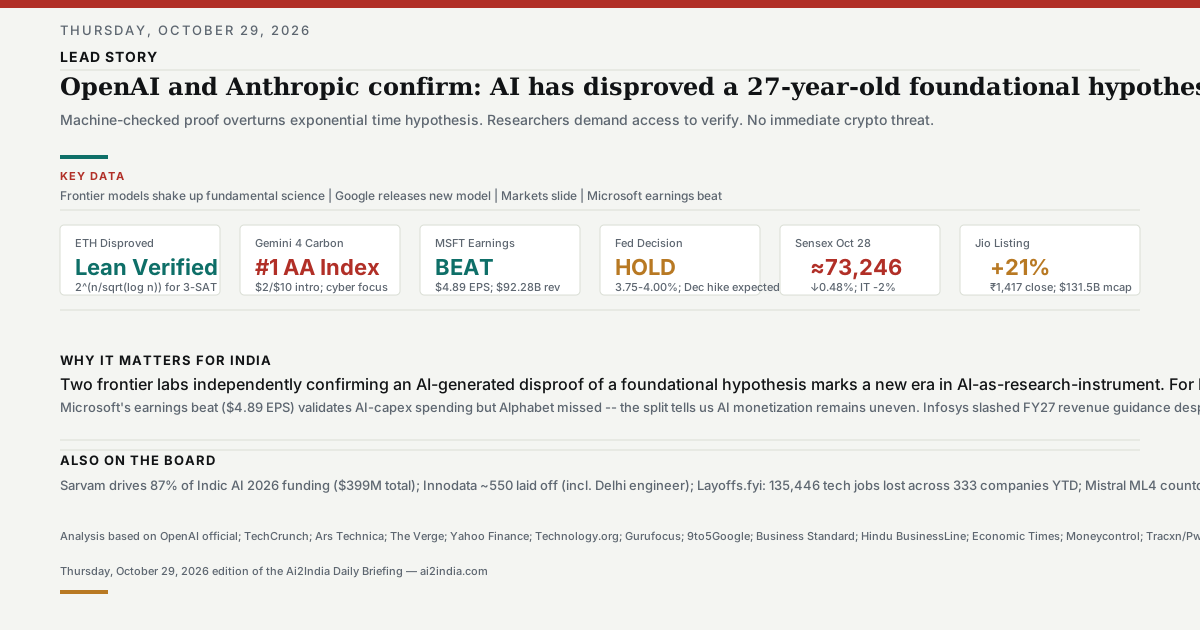
Thursday, October 29, 2026: An OpenAI model produced a disproof of the Exponential Time Hypothesis on October 16, formalized in the Lean proof checker a day later. Anthropic independently confirmed it reached the same conclusion on October 28. Both labs posted papers on GitHub. The ETH proposed in 1999 was treated as a load-bearing wall in cryptography and complexity theory.
On October 26, OpenAI announced three scientific discoveries simultaneously — one each in mathematics (harmonic analysis), computer science (complexity theory via the ETH), and physics (quantum field theory). The ETH disproof centered on 3-SAT, a logic puzzle dating back to the Cook-Levin theorem. Russell Impagliazzo and Ramamohan Paturi, who proposed the hypothesis in 1999, will lead the review alongside MIT’s Ryan Williams. The algorithm handles inputs with n variables in roughly 2^(n/√log n) steps — beating ETH’s exponential floor while remaining far too slow for practical use.
Anthropic announced on October 28 that it had independently reached the same conclusion through its own research pipeline, lending cross-lab credibility to a claim that would upend a foundational assumption trusted by hundreds of researchers across graph theory, computational biology, and database theory. Both OpenAI and Anthropic are claiming no scientific credit — a stance consistent with OpenAI’s earlier dispute over a Navier-Stokes proof. Scott Aaronson of UT Austin reported students flooding his office with the news, underscoring genuine excitement among complexity theorists.
The result does not prove P equals NP — ETH was a stricter claim than P != NP, so disproving it leaves the larger question open. On Bitcoin and Ethereum: Bitcoin signatures rely on elliptic curve cryptography, an unrelated hard math problem this algorithm does not address. Cryptographer Matthew Green warned that AI could weaken the math behind wallets over time, but the immediate risk is negligible. What matters more for enterprises is the methodology: AI generating natural-language proofs that are then machine-checked in formal verification tools represents a shift from pattern-matching assistants to active research instruments.
For Indian enterprises, three implications stand. First, formal-verification talent (Lean, Coq, Isabelle) is becoming scarce and commands premium pricing — companies building safety-critical AI systems should invest in verification pipelines now. Second, BFSI security planners evaluating cryptographic assumptions underlying their infrastructure should note that hardness-based assumptions remain stable in the near term but the trajectory of AI-driven proof generation may accelerate long-term reconsideration of foundational crypto parameters. Third, AI-as-research-instrument is moving from fringe to frontier: if two top-tier labs can independently generate peer-review-level mathematical results, the capability applies equally to code auditing, protocol design, and system architecture reviews where Indian tech firms already compete globally.
Markets entered Thursday under pressure. Sensex closed 73,246 (-0.48%), Nifty 22,699 (-0.22%), with IT dragging (-2%). Microsoft beats overnight ($4.89 EPS, $92.28B revenue) provided some support but did not prevent the sell-off driven by rising crude ($115+ after Saudi refinery attack) and Infosys FY27 guidance cut (four downgrades in a day, stock -4.26%). The Federal Reserve held rates at 3.75-4.00% in a 10-2 decision yesterday (two dissents favored a quarter-point increase); a December hike is now expected. Jio Platforms debuted at ₹1,358 (+21.4%) and closed around ₹1,417.50, becoming India’s second-most valuable listed company (~$131.5B) from its record ₹30,213 crore IPO. FIIs were net buyers today (₹872 cr), a reversal from Monday’s selling. Amazon reports earnings Thursday US-close. The market faces a crowded week ahead.